
Hiring internationally in Portugal offers incredible opportunities, but 70% of contractor hires may be misclassified, leading to fines up to €100,000. Many HR managers assume compliance is straightforward, yet Portugal’s layered requirements around payroll taxes, GDPR, labor codes, and work visas create hidden pitfalls. This article clarifies the compliance landscape, explores practical solutions like Employer of Record services, identifies critical risks, and examines emerging 2026 trends. You’ll gain actionable insights to ensure legal adherence and efficient employment practices when expanding into Portugal.
Table of Contents
- Key takeaways
- Understanding Portugal’s international hiring compliance landscape
- How employer of record (EOR) services help ensure compliant international hiring
- Critical compliance risks and legal obligations in Portugal international hiring
- Emerging 2026 compliance trends affecting international hiring in Portugal
- How Outsourcing Portugal supports compliant international hiring
- FAQ
Key Takeaways
| Point | Details |
|---|---|
| No local entity required | Foreign companies can hire in Portugal by registering as foreign employers with NIPC and Social Security rather than forming a Portuguese subsidiary. |
| EOR enables rapid hiring | An EOR handles contracts payroll GDPR compliance and adherence so you can hire quickly while remaining compliant. |
| Key compliance areas | Payroll taxes GDPR labor code and work permit rules require careful setup and ongoing monitoring. |
| Common risks and fines | Misclassifying workers can trigger fines up to €100,000 and other penalties. |
Understanding Portugal’s international hiring compliance landscape
Foreign companies entering Portugal face a complex compliance framework, but you don’t need a local entity to hire legally. Foreign companies can hire in Portugal without a local entity by registering as foreign employers with NIPC and Social Security numbers, handling payroll, tax withholding (IRS), and contributions. This registration process establishes your legal presence for employment purposes without incorporating a Portuguese subsidiary.
Payroll management represents the backbone of compliance. Employers must contribute 23.75% of gross salary to Social Security, while employees contribute 11%. These rates apply universally across industries and employee types. You’ll also handle IRS tax withholding based on progressive income tax brackets, remitting payments monthly to Portuguese tax authorities. Understanding the employment cost calculator portugal 2026 helps you budget accurately for total employment expenses beyond base salary.
| Obligation Type | Employer Responsibility | Employee Responsibility |
|---|---|---|
| Social Security | 23.75% of gross salary | 11% of gross salary |
| Income Tax (IRS) | Withhold and remit monthly | Taxed on progressive brackets |
| Registration | NIPC number, Social Security registration | Provide tax identification (NIF) |
| Reporting | Monthly payroll declarations | Annual tax return filing |
Critical registration and compliance steps include:
- Obtain NIPC (business identification number) from Portuguese tax authority
- Register with Social Security as a foreign employer within 24 hours of first hire
- Secure tax representative if no permanent establishment exists
- Submit monthly payroll declarations (Declaração de Remunerações)
- Maintain compliant employment contracts under Portuguese labor code
- Process work permits for non-EU nationals before employment start
Pro Tip: Designate a local tax representative early in your hiring process. This person becomes your official contact with Portuguese authorities and ensures timely compliance with reporting deadlines, preventing penalties that can reach thousands of euros for late submissions.
How employer of record (EOR) services help ensure compliant international hiring
Employer of Record services transform compliance complexity into simplicity. An EOR manages contracts, payroll, GDPR background checks, and labor code adherence, enabling rapid compliant hiring without entity setup. The EOR becomes the legal employer on paper while you maintain full operational control over daily work activities and performance management.
Typical EOR services cover employment contracts drafted under Portuguese law, monthly payroll processing with tax withholding, Social Security contributions and reporting, benefits administration including mandatory vacation accrual, and ongoing labor law compliance monitoring. Setup timelines average 1-2 weeks from engagement to first payroll, dramatically faster than the 3-6 months required for entity incorporation.
Cost considerations matter for budget planning. Most employer of record portugal providers charge around £599 per employee monthly, plus the actual employment costs. This fee structure makes EOR economically viable for teams under 8-10 employees. Beyond that threshold, entity setup often becomes more cost effective for long-term operations.
EOR services excel in specific scenarios:
- Testing the Portuguese market with 1-5 initial hires before committing to entity setup
- Hiring specialized contractors or consultants for project-based work under 18 months
- Expanding rapidly into Portugal when speed matters more than long-term cost optimization
- Managing compliance for remote employees while your company lacks Portuguese HR expertise
- Avoiding the administrative burden of Portuguese payroll and labor law navigation
The eor portugal model handles GDPR compliance for background checks, a critical requirement often overlooked. Portuguese data protection law requires explicit employee consent before processing personal data for employment screening. EOR providers maintain compliant consent workflows and secure data handling procedures that meet CNPD (Portuguese Data Protection Authority) standards.
Pro Tip: Choose EOR over entity setup when you’re hiring fewer than 8 employees or testing market viability for under 3 years. Beyond these thresholds, calculate total cost of ownership. Entity setup involves higher upfront investment but lower per-employee ongoing costs, making it more economical for larger, permanent teams.
Critical compliance risks and legal obligations in Portugal international hiring
Worker misclassification dominates compliance risk discussions. 70% of contractor hires may be misclassified leading to reclassification, back pay, and fines up to €100,000. Portuguese labor law presumes employment relationships when workers demonstrate subordination, integration into company structure, or economic dependence. Courts examine the reality of working conditions, not just contract labels.

Misclassification triggers cascading consequences. You’ll owe retroactive Social Security contributions for both employer and employee portions, unpaid vacation and holiday entitlements calculated from the start date, severance payments if the relationship ends, and administrative fines from labor inspectors. The financial exposure compounds quickly, especially for multi-year contractor relationships.
Visa requirements for non-EU nationals create another major risk area. Non-EU hires require work visas with contracts stating visa details; illegal hiring fines up to €10,000. Employment contracts must explicitly reference visa type, validity period, and renewal obligations. Starting work before visa approval constitutes illegal employment, exposing both employer and employee to penalties.
Mandatory compliance obligations extend across multiple domains:
- Obtain explicit GDPR consent before processing employee personal data for background checks or HR systems
- Submit to labor inspections by ACT (Autoridade para as Condições do Trabalho) with 24-hour notice
- Conduct annual equal pay audits comparing compensation across gender for similar roles
- Maintain employment contracts in Portuguese or bilingual format with Portuguese version controlling
- Provide mandatory health and safety training within first 30 days of employment
- Register work accidents with insurance carrier within 24 hours of occurrence
- Respect maximum working hours (8 daily, 40 weekly) with documented overtime authorization
Labor inspection consequences vary by violation severity. Minor infractions like incomplete employee records generate warnings and 30-day correction periods. Serious violations including unpaid overtime or missing safety training result in fines from €2,000 to €10,000 per affected employee. Very serious violations like systematic discrimination or illegal hiring trigger fines up to €100,000 plus potential criminal liability for company directors.
“Portuguese labor authorities take worker protection seriously. What seems like a minor paperwork issue in other jurisdictions can escalate to significant penalties here. Documentation standards are high, and inspectors expect immediate access to compliant records.”
The faq hiring in portugal with eor services and payroll resources help you understand common pitfalls. Prevention beats remediation every time. Invest in proper classification analysis upfront, secure work permits before employment starts, and maintain meticulous documentation of all employment decisions and policy communications.
Emerging 2026 compliance trends affecting international hiring in Portugal
Portugal’s digital labor landscape is evolving rapidly. AI HR tools are now high-risk, requiring bias audits under new 2026 regulations. Companies using AI for resume screening, interview assessments, or performance evaluation must conduct annual audits documenting algorithmic fairness. These audits examine whether AI systems produce discriminatory outcomes based on protected characteristics like gender, age, or nationality. Non-compliance triggers CNPD investigations and potential fines under GDPR frameworks.
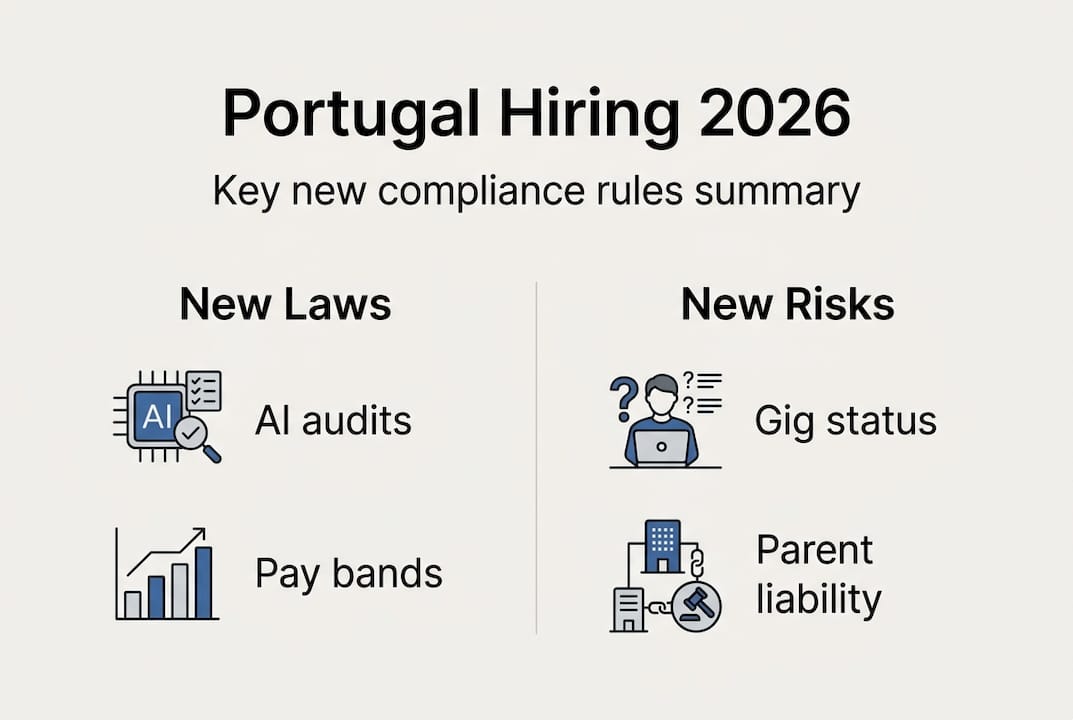
Pay transparency mandates reshape compensation practices. New laws require salary band disclosures in job postings and annual pay gap reporting for companies with 50+ employees. You must publish minimum and maximum salary ranges for each role advertised, preventing the negotiation disadvantages that perpetuate pay inequity. Annual reports must detail median compensation differences across gender, with explanations required when gaps exceed 5%. This transparency pressure encourages proactive pay equity analysis.
Platform worker classification receives statutory presumption of employment status. Gig economy companies face automatic employee classification unless they prove workers maintain genuine independence. This presumption reverses the burden of proof, requiring platforms to demonstrate that workers control their schedules, set their rates, and work for multiple clients simultaneously. The change aims to extend labor protections to Portugal’s growing platform workforce.
Joint liability rules create unexpected parent company exposure. Foreign parent companies are liable for Portuguese subsidiary labor debts per Constitutional Court ruling. This doctrine pierces corporate veils when subsidiaries fail to pay wages, Social Security contributions, or severance. Parent companies can’t shield themselves through separate legal entities if they exercise operational control over Portuguese hiring and employment decisions.
| Compliance Area | Pre-2026 Requirement | 2026 Requirement |
|---|---|---|
| AI HR Tools | No specific regulation | Annual bias audits mandatory |
| Salary Transparency | Optional disclosure | Mandatory salary bands in job posts |
| Pay Gap Reporting | Voluntary for most companies | Required for 50+ employees |
| Platform Workers | Case-by-case classification | Presumption of employment status |
| Parent Liability | Limited to subsidiary debts | Joint liability for labor obligations |
These trends demand proactive HR system updates. Review your working in portugal processes against 2026 standards now rather than scrambling for compliance later. Audit existing AI tools for bias, prepare salary band methodologies, and assess parent company exposure if you operate through Portuguese subsidiaries.
Pro Tip: Conduct a pre-emptive ai compliance assessment if you use any automated HR tools. Document your AI systems’ decision logic, test for discriminatory patterns across protected groups, and establish governance procedures for ongoing monitoring. This preparation positions you ahead of enforcement actions and demonstrates good faith compliance efforts.
How Outsourcing Portugal supports compliant international hiring
Navigating Portugal’s compliance landscape becomes straightforward with expert support. Outsourcing Portugal’s EOR and payroll services enable compliant hiring without entity setup, handling the full spectrum of employment obligations from registration through ongoing administration. We manage NIPC registration, Social Security enrollment, monthly payroll processing, tax withholding and remittance, and labor law compliance monitoring.
Our country overview of eor portugal services demonstrates comprehensive support across tax compliance, social security contributions, GDPR data handling, labor code adherence, and work visa sponsorship coordination. We provide fast onboarding timelines averaging 7-10 days from engagement to first payroll, avoiding the costly compliance pitfalls that trap companies attempting DIY Portuguese employment.
Key service benefits include:
- Legal compliance across all Portuguese employment regulations and reporting requirements
- Cost efficiency through expert management avoiding penalties and misclassification risks
- Local expertise with native Portuguese HR professionals who understand cultural and legal nuances
- Scalable solutions supporting everything from single hires to teams of 50+ employees
Our employer of record portugal and payroll services let you focus on business growth while we handle compliance complexity. Whether you’re testing the Portuguese market or building a permanent team, we provide the infrastructure and expertise for confident international hiring.
FAQ
What are the top compliance challenges in international hiring in Portugal?
Registration as a foreign employer, tax and social security compliance, GDPR background checks, and visa requirements for non-EU nationals represent the primary challenges. Misclassification risks between contractors and employees create significant exposure, with 70% of contractor relationships potentially triggering reclassification. Labor inspections by ACT demand immediate access to compliant documentation, catching many foreign employers unprepared.
When should companies prefer an Employer of Record over setting up a local entity?
Employer of Record services suit smaller teams under 8 employees, market testing scenarios, and situations requiring rapid deployment within weeks. Entity setup becomes preferable for long-term operations beyond 3 years or when headcount exceeds 10 employees, as the per-employee cost advantage shifts. Calculate total cost of ownership including setup time, ongoing administration, and compliance risk when making this decision.
What are the penalties for non-compliance in hiring foreign employees in Portugal?
Fines reach €100,000 for worker misclassification, €10,000 for illegal hiring without proper work visas, and variable amounts for GDPR violations depending on severity. Labor inspection penalties range from €2,000 to €10,000 per affected employee for serious violations like unpaid overtime or missing safety training. Beyond financial penalties, you face back pay obligations for unpaid Social Security contributions, vacation entitlements, and potential severance if relationships end, plus significant reputational damage affecting future Portuguese hiring.
How do 2026 digital labor laws affect international companies hiring in Portugal?
New regulations require annual bias audits for AI-powered HR tools used in hiring or performance management. Pay transparency mandates force salary band disclosures in job postings and annual pay gap reporting for companies with 50+ employees. Platform worker presumption automatically classifies gig workers as employees unless you prove genuine independence. These changes demand proactive HR system updates and documentation practices to maintain compliance throughout 2026 and beyond.