
TL;DR:
- Understanding Portugal’s cultural profile is essential for effective remote hiring and team cohesion.
- Portuguese work culture highly values hierarchy, structure, and clear communication, impacting HR practices.
- Proactive cultural assessment and tailored onboarding strategies improve remote team performance and loyalty.
Portugal sits at the intersection of Southern European tradition and modern global work culture, and that combination surprises most HR teams. Many international companies assume that because Portugal is English-friendly and EU-based, cultural integration will be seamless. It rarely is. Cultural distance negatively impacts firm performance and location choice, even for geographically close markets. Understanding Portugal’s specific cultural profile before you hire remotely is not a soft skill exercise. It is a hard business requirement that directly affects compliance, retention, and team output.
Table of Contents
- Understanding cultural compatibility: What it means for remote hiring
- Portugal through Hofstede’s lens: Key cultural dimensions for HR
- Practical challenges and high-impact solutions for international HR
- Evaluating and fostering cultural compatibility in your hiring process
- Why cultural fit in Portugal is more strategic than most HR leaders realize
- Take the next step: Hire and integrate in Portugal with confidence
- Frequently asked questions
Key Takeaways
| Point | Details |
|---|---|
| Portugal is culturally distinct | Assuming Portugal is like other EU countries risks team misalignment and reduced effectiveness. |
| Hofstede dimensions matter | High Power Distance and Uncertainty Avoidance shape remote HR needs and management style. |
| Clarify processes for success | Portuguese teams thrive when HR offers structure, clear roles, and transparent communication. |
| Evaluate compatibility early | Embedding cultural fit into hiring boosts compliance, morale, and long-term retention. |
| Expert partners smooth integration | Leveraging Portugal-specific HR services ensures both compliance and optimal cultural synergy. |
Understanding cultural compatibility: What it means for remote hiring
Cultural compatibility is not about whether your new hire speaks English or lives in a similar time zone. It is about whether their deeply held assumptions about work, authority, and communication align well enough with your organization’s norms to enable effective collaboration. When those assumptions diverge significantly, you get friction, and friction in remote teams is expensive.
For HR managers hiring in Portugal, this matters in concrete ways. A Portuguese employee may interpret a loosely worded job description as a red flag rather than a sign of flexibility. A manager in London or New York who gives vague feedback expecting initiative may instead trigger anxiety and disengagement. These are not personality issues. They are cultural patterns.
The risks are real. Miscommunication leads to missed deadlines. Compliance blind spots emerge when local labor norms are misunderstood. Onboarding fails when cultural expectations go unaddressed. On the flip side, companies that invest in understanding Portuguese work culture see faster integration, stronger loyalty, and lower turnover. Portugal’s infrastructure’s role in supporting remote teams adds another layer of advantage when cultural fit is also managed well.
Here is what cultural compatibility actually affects in remote HR:
- Decision-making speed: Hierarchical cultures expect top-down approval, which can slow agile workflows
- Feedback reception: Indirect communication styles can make performance reviews feel confusing or harsh
- Conflict resolution: Some cultures avoid open disagreement, which masks problems until they escalate
- Compliance behavior: High rule-orientation affects how employees interpret policies and escalate issues
- Team cohesion: Collectivist tendencies affect how remote workers bond and collaborate across borders
| Compatibility factor | Low attention risk | High attention benefit |
|---|---|---|
| Communication style | Misread feedback, disengagement | Clear expectations, trust |
| Authority structure | Bottlenecks, confusion | Smooth escalation paths |
| Rule orientation | Policy gaps, compliance errors | Consistent process adherence |
| Group vs. individual work | Isolation, poor collaboration | Strong team identity |
Pro Tip: Do not wait until onboarding to assess cultural compatibility. Build it into your screening process by including scenario-based questions that reveal how candidates handle ambiguity, authority, and feedback.
For companies exploring nearshore outsourcing in Portugal, cultural fit is one of the most underrated variables in long-term team success.
Portugal through Hofstede’s lens: Key cultural dimensions for HR
Geert Hofstede’s six-dimension model gives HR leaders a structured way to compare national cultures. Portugal’s scores are striking, and understanding them changes how you approach everything from job postings to performance management.
“Portugal exhibits high Power Distance (PDI 63), low Individualism (IDV 27), moderate Masculinity (MAS 31), very high Uncertainty Avoidance (UAI 99), moderate Long Term Orientation (LTO 28), and low Indulgence (IND 33) per Hofstede’s model.”
Those numbers tell a story. Here is what each one means for your HR strategy:
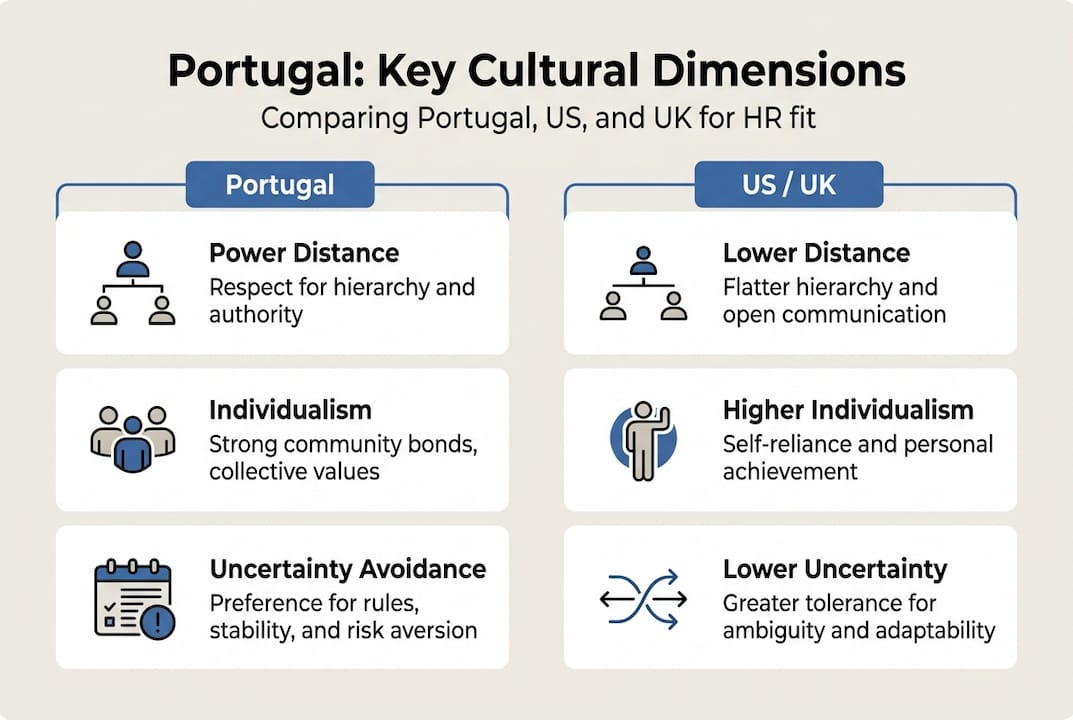
- Power Distance (63): Portuguese employees generally respect hierarchy and expect clear authority structures. Flat org charts or informal leadership can create confusion. Be explicit about who owns decisions.
- Individualism (27): Portugal is a collectivist culture. Employees value group harmony and team loyalty over individual recognition. Reward structures focused solely on personal performance may feel alienating.
- Masculinity (31): Portugal scores low here, meaning work-life balance, cooperation, and quality of life matter more than competition and status. Aggressive sales cultures or high-pressure environments may increase churn.
- Uncertainty Avoidance (99): This is Portugal’s most defining score. Portuguese professionals strongly prefer clear rules, structured processes, and predictable environments. Ambiguity is not a feature. It is a stressor.
- Long Term Orientation (28): Portugal leans toward short-term thinking, meaning immediate results and established norms carry more weight than long-range planning. Change management needs to be gradual and well-justified.
- Indulgence (33): Low indulgence means a restrained approach to personal enjoyment and impulse. Work is taken seriously, and professional obligations are rarely treated casually.
| Dimension | Portugal | United States | United Kingdom |
|---|---|---|---|
| Power Distance | 63 | 40 | 35 |
| Individualism | 27 | 91 | 89 |
| Masculinity | 31 | 62 | 66 |
| Uncertainty Avoidance | 99 | 46 | 35 |
| Long Term Orientation | 28 | 26 | 51 |
| Indulgence | 33 | 68 | 69 |
The gap between Portugal and the US or UK on Individualism and Uncertainty Avoidance is enormous. These two dimensions alone explain most of the friction international teams experience. Understanding the working culture in Portugal through this lens gives HR leaders a real advantage before day one.
Practical challenges and high-impact solutions for international HR
Knowing the scores is one thing. Knowing what to do with them is another. Here is where the cultural dimensions translate into everyday HR challenges and practical fixes.
The ambiguity problem is the biggest one. Portugal’s UAI score of 99 versus the US score of 46 represents one of the largest gaps in the Hofstede database. Portuguese professionals operating under vague mandates, unclear KPIs, or shifting priorities will not thrive. They will disengage or escalate unnecessarily. This is not a weakness. It is a preference for professionalism and clarity.

Decision-making delays are another common friction point. High Power Distance means employees may wait for explicit direction rather than acting autonomously. If your management model assumes proactive self-direction, you need to adjust expectations and build in more structured touchpoints.
Communication misfires happen when directness norms collide. American or British managers who give blunt, rapid-fire feedback may come across as disrespectful to Portuguese colleagues who value relational context before critique.
Here are quick wins for HR teams managing Portuguese remote employees:
- Write detailed job descriptions, process documents, and onboarding guides. Specificity is reassuring, not bureaucratic.
- Schedule regular one-on-one check-ins with clear agendas so employees know what to expect.
- Introduce cultural onboarding sessions that explain your company’s communication norms explicitly.
- Avoid sudden structural changes without explanation. Frame change with context and rationale.
- Recognize team achievements alongside individual ones to honor collectivist values.
- Use written summaries after meetings so nothing feels ambiguous or unresolved.
Pro Tip: Restructure your team meetings for Portuguese remote employees by circulating a clear agenda 24 hours in advance and assigning specific roles. This simple change reduces anxiety, increases participation, and signals that you respect their preference for structure.
For companies running outsourcing sales in Portugal, these adjustments are especially important because sales roles require a blend of autonomy and process that must be carefully calibrated for the Portuguese context.
Evaluating and fostering cultural compatibility in your hiring process
Most hiring processes screen for skills, experience, and language ability. Cultural compatibility gets a brief mention at the end of an interview, if at all. That needs to change.
Firms prefer culturally closer locations like Portugal for EU entry precisely because moderate cultural distance makes integration more manageable. But moderate distance still requires active management. Here is a step-by-step framework:
- Pre-hire cultural assessment: Add scenario-based questions to your interview process. Ask how candidates handle unclear instructions, team disagreements, or feedback from senior managers. Their answers reveal cultural defaults.
- Structured culture interview: Dedicate 20 minutes to exploring values, work style preferences, and expectations around communication and hierarchy. This is not a trick. It is a conversation.
- Reference checks with cultural context: Ask previous employers specifically about how the candidate handled ambiguity, team dynamics, and management relationships.
- Onboarding cultural orientation: In the first two weeks, provide explicit documentation of your company’s norms. Do not assume shared understanding.
- 30-60-90 day integration checkpoints: Schedule structured reviews that assess not just performance but comfort, clarity, and team connection.
Positive signals in candidate interactions include asking detailed clarifying questions, referencing team outcomes over personal wins, and showing strong process orientation. Red flags include discomfort with any structure, dismissiveness toward hierarchy, or inability to articulate how they handle unclear situations.
| Integration checkpoint | Tool or method | Timing |
|---|---|---|
| Cultural fit screening | Scenario questions, values survey | Pre-hire |
| Norm alignment | Written company culture guide | Week 1 |
| Feedback loop | One-on-one with structured agenda | Monthly |
| Team cohesion check | Team survey or peer review | 90 days |
| Long-term integration | Annual culture alignment review | Yearly |
For deeper guidance, the EOR best practices articles on our platform cover compliance and integration frameworks that work specifically for Portugal-based remote teams.
Why cultural fit in Portugal is more strategic than most HR leaders realize
Most articles stop at frameworks and checklists. Here is what they miss. Cultural fit in Portugal is not just about avoiding friction. It is about unlocking a specific type of professional loyalty that is rare in high-individualism markets.
Portuguese employees, when they feel respected, structurally supported, and part of a genuine team, stay. They invest. They become institutional knowledge carriers. The hidden cost of ignoring local values is not just turnover. It is the loss of that deep, relationship-based commitment that collectivist cultures build over time.
We have seen teams struggle for 18 months because their onboarding assumed American norms. We have also seen teams thrive within 60 days because someone took the time to write a clear process document and hold a weekly structured check-in. The difference is not budget. It is intention.
The companies that treat cultural compatibility as a strategic investment rather than a compliance checkbox are the ones building the most resilient remote teams in Portugal right now. If you want to talk to Portugal HR experts about what this looks like in practice, the conversation is worth having before you make your next hire.
Take the next step: Hire and integrate in Portugal with confidence
Understanding Portugal’s cultural dimensions gives you a real edge, but translating that knowledge into compliant, effective hiring requires the right infrastructure and local expertise.
Our Employer of Record services handle the legal, payroll, and compliance side of hiring in Portugal, so you can focus on building teams that actually work together. From contract structuring to onboarding support, we make sure your hires are set up for success from day one. Explore our global employment solutions to see how cultural compatibility and legal compliance can work together as a single, managed process for your organization.
Frequently asked questions
How does Portugal’s high Uncertainty Avoidance impact remote HR management?
Portuguese teams expect clear rules and dislike ambiguity, so HR must provide detailed processes, structured meeting formats, and explicit written guidance to support effective remote collaboration.
Which cultural dimensions are most important for hiring in Portugal?
Power Distance, Uncertainty Avoidance, and Individualism have the biggest impact on integration and team effectiveness, with Portugal scoring PDI 63, IDV 27, and UAI 99 on Hofstede’s model.
Why do international firms prefer Portugal for remote hiring?
Portugal offers moderate cultural distance from US and UK markets, which makes integration more manageable. Firms prefer culturally closer locations for EU market entry because the adjustment curve is shorter and team cohesion builds faster.
What are the risks of ignoring cultural compatibility in Portugal?
Ignoring compatibility leads to compliance gaps, disengaged employees, and higher turnover. Cultural distance negatively impacts firm performance when left unmanaged, particularly in remote team structures where informal cultural cues are harder to read.