
TL;DR:
- Portuguese HR compliance involves complex contracts, CBAs, social security, and mandatory training requirements.
- Using an Employer of Record simplifies legal, payroll, and compliance tasks, reducing risks for international employers.
- Ongoing adherence to training, CBA updates, and accurate documentation is essential to avoid labor disputes.
Managing HR for international hires in Portugal is harder than most companies expect. Between employment contracts, collective bargaining agreements (CBAs), mandatory training hours, and social security registrations, the compliance landscape is layered and unforgiving. Miss one step and you risk fines, disputes, or damaged employee trust. This guide walks you through every stage of a practical HR support workflow, from legal preparation through ongoing compliance, so your team can hire, onboard, and manage Portuguese employees with confidence and far less friction.
Table of Contents
- What you need before starting your HR workflow in Portugal
- Step-by-step HR workflow for hiring in Portugal
- How to ensure ongoing legal compliance
- Troubleshooting and common mistakes in HR support workflows
- A fresh perspective on HR workflows in Portugal
- Streamline your HR workflow with expert help
- Frequently asked questions
Key Takeaways
| Point | Details |
|---|---|
| Preparation is crucial | Gather all necessary documents and understand local law before starting HR workflows in Portugal. |
| Follow step-by-step processes | Structuring your workflow in clear stages reduces the risk of mistakes and compliance gaps. |
| Prioritize compliance maintenance | Continuous attention to training, payroll, and legal filings keeps your team compliant year-round. |
| Cultural understanding matters | Respecting Portuguese work-life balance and CBAs ensures smoother HR operations and employee satisfaction. |
| Outsourcing can simplify workflows | Trusted local partners and EoR services help streamline hiring and reduce administrative burdens for international HR teams. |
What you need before starting your HR workflow in Portugal
Before you post a single job listing, you need to get the legal and administrative foundation right. Portugal has a well-structured labor framework, and international companies that skip the preparation phase almost always pay for it later.
The first thing to sort out is your employment contract. Portuguese law requires written contracts for most employment types, and the contract must specify role, salary, working hours, and notice periods. Beyond the contract, you need to register your employee with the Portuguese social security system (Segurança Social) and obtain their tax identification number (NIF). Identity verification is also mandatory.
One area that catches international teams off guard is CBAs. Portugal has sector-specific collective bargaining agreements that can raise minimum wages, extend notice periods, or add benefit requirements beyond what the base law mandates. Checking whether a CBA applies to your industry before hiring is not optional.
Cultural fit matters too. Portuguese work culture places a strong emphasis on work-life balance and professional development, and employers are legally required to provide at least 40 hours of professional training per employee each year. Building this into your workflow from day one avoids scrambling at year end.
Here is a quick-reference checklist for your pre-hire preparation:
- Written employment contract (compliant with Portuguese labor code)
- Social security registration for the employee
- NIF (tax identification number) obtained
- Identity document verification completed
- CBA applicability check for your sector
- Annual training plan drafted (minimum 40 hours)
- Work schedule and overtime rules documented
| Document or step | Why it matters | Who handles it |
|---|---|---|
| Employment contract | Legal requirement; defines terms | HR or legal counsel |
| Social security registration | Mandatory for all employees | Employer |
| NIF registration | Tax compliance | Employee with employer support |
| CBA review | May increase minimum obligations | HR or local expert |
| Training plan | 40h/year legal requirement | HR manager |
Pro Tip: CBAs in Portugal are sector-specific and frequently updated. Working with a local HR expert or using an onboarding guide for Portugal ensures you catch CBA requirements before they become compliance gaps.
Step-by-step HR workflow for hiring in Portugal
With the groundwork in place, you can move through the hiring process in a structured way. A clear workflow reduces errors, speeds up onboarding, and keeps your team legally protected at every stage.
Here is the core hiring workflow:
- Define the role and check CBA obligations for your sector before writing the job description.
- Post the job on relevant Portuguese and international platforms, noting legal requirements for language and contract type.
- Screen candidates against both skills criteria and right-to-work requirements.
- Prepare the employment contract with all mandatory clauses, including salary, working hours, probation period, and notice terms.
- Register the employee with Segurança Social and confirm NIF status before the start date.
- Run compliance checks on the contract against current labor law and any applicable CBA.
- Onboard the employee, including system access, role briefing, and the mandatory training schedule.
- Document everything in a centralized HR system for audit readiness.
Where international teams lose time is between steps 4 and 6. Contract preparation without a CBA review is one of the most common sources of disputes. As CBAs may enhance minima for pay and benefits, a contract that looks compliant on paper can still fall short of sector-specific obligations.
Here is how different HR models compare for executing this workflow:
| Workflow step | In-house HR | Outsourced HR | Employer of Record (EoR) |
|---|---|---|---|
| Contract preparation | Slow; high legal risk | Faster with local expertise | Handled fully by EoR |
| CBA compliance | Often missed | Checked by specialists | Built into the service |
| Social security registration | Manual; time-consuming | Supported | Fully managed |
| Ongoing payroll | Internal resource drain | Partially managed | Fully managed |
| Audit readiness | Variable | Improved | Consistently high |
For teams managing compliance in Portugal hiring from abroad, the EoR model consistently outperforms in-house approaches on speed and risk reduction. You can also explore the employer of record compliance guide for a deeper breakdown of how this model works in practice.

Pro Tip: Automate repetitive tasks like contract generation and social security filing using HR software integrated with Portuguese payroll systems. This alone can cut administrative time by 30 to 40 percent per hire.
How to ensure ongoing legal compliance
Onboarding is just the beginning. Keeping your employment relationships legally sound in Portugal requires consistent attention throughout the year, not just at the point of hire.
Portugal’s labor law sets recurring obligations that every employer must track. Missing them is not just an administrative inconvenience. It can expose your company to back-pay claims, regulatory penalties, and reputational damage with local employees.
Here are the core ongoing compliance tasks you need to manage:
- Monthly payroll processing with accurate social security contributions (employer rate: 23.75%, employee rate: 11%)
- Annual training hours tracked and documented for each employee (minimum 40 hours per year)
- CBA updates monitored for changes to minimum pay or benefit obligations
- Employee records maintained and updated (contracts, training logs, performance reviews)
- Annual income tax declarations filed correctly
- Termination procedures followed precisely if employment ends
Compliance warning: Ignoring CBA updates or skipping mandatory training documentation are two of the fastest ways to trigger a labor inspection in Portugal. Both are treated as serious violations, not minor oversights.
Building an annual compliance calendar is one of the most practical things you can do. Map out monthly payroll deadlines, quarterly CBA review checkpoints, and mid-year training progress reviews. This turns compliance from a reactive scramble into a managed process.
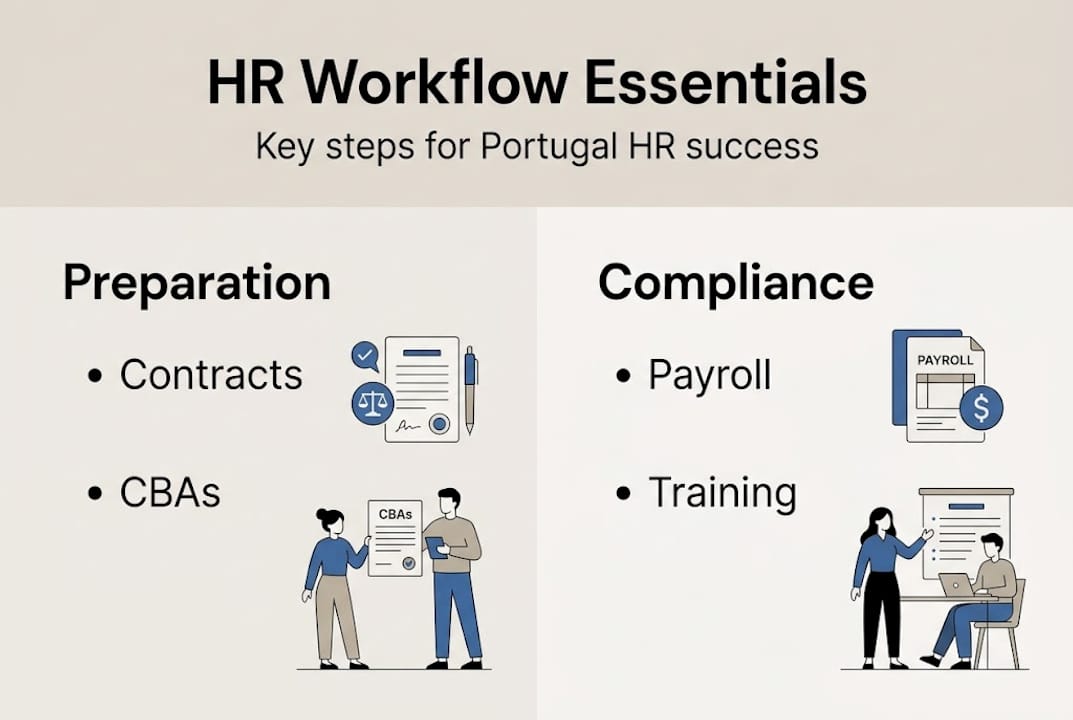
The payroll compliance checklist is a useful starting point for structuring your monthly obligations. For a broader view of how outsourcing legal compliance can reduce your internal burden, that resource covers the key risk areas international employers face.
Troubleshooting and common mistakes in HR support workflows
Even experienced HR teams make mistakes when entering a new market. Portugal has enough unique requirements that what worked in Germany or the UK will not automatically transfer. Knowing the common failure points helps you course-correct before they become serious problems.
Here are the most frequent mistakes international teams make:
- Ignoring CBAs: Assuming base labor law is enough without checking sector-specific agreements
- Inadequate training records: Providing training but failing to document it, which creates audit exposure
- Poor contract localization: Using a generic template that misses Portuguese mandatory clauses
- Payroll calculation errors: Getting social security contribution rates or taxable benefit calculations wrong
- Cultural misalignment: Scheduling expectations or communication styles that clash with Portuguese work-life norms
- Delayed registrations: Starting employees before social security registration is confirmed
When a problem surfaces, the fix usually starts with documentation. Pull the employment contract, check it against the applicable CBA, and verify training records. Most disputes can be resolved early if you have clean paperwork.
For onboarding-specific issues, revisiting a structured onboarding mistakes in Portugal resource can help you identify where the process broke down. The mandatory training and CBA obligations are the two areas most often cited in labor disputes involving international employers.
Pro Tip: Run a formal workflow audit twice a year, once mid-year and once in Q4. Check contract compliance, training completion rates, and CBA currency. This discipline catches small gaps before they compound into costly problems.
A fresh perspective on HR workflows in Portugal
Most articles on HR compliance in Portugal focus on the checklist. Get the contract right. File the taxes. Log the training hours. That is all necessary, but it misses something more important.
The international managers who struggle most in Portugal are not the ones who got a clause wrong. They are the ones who treated Portuguese employees as interchangeable resources in a global headcount. Portugal’s emphasis on work-life balance is not a cultural quirk to work around. It is a signal about how employees expect to be treated and how they will perform when respected.
CBAs are another example. Most international HR teams see them as a compliance hurdle. In reality, they reflect negotiated expectations between employers and workers in a specific sector. Understanding what a CBA signals about employee expectations in your industry gives you a real advantage in retention and engagement.
The best HR workflows we have seen are not just technically compliant. They are built around the compliance realities of the local market and the actual values of the workforce. Adaptability is what separates teams that retain great Portuguese talent from those that constantly rehire.
Streamline your HR workflow with expert help
Building a compliant, efficient HR workflow in Portugal from scratch takes time, local knowledge, and constant attention to regulatory changes. Most international HR teams do not have all three.
Outsourcing Portugal provides the infrastructure to make this manageable. From our Portugal EoR service that handles contracts, payroll, and compliance on your behalf, to global employment solutions designed for distributed teams, we cover the full employment lifecycle. You can also use our payroll checklist to benchmark your current process. If you want to hire in Portugal without the administrative weight, we are ready to help you start today.
Frequently asked questions
What are the mandatory annual employee training hours in Portugal?
Portuguese labor law requires at least 40 hours of training per employee every year, and employers must document completion for audit purposes.
How do collective bargaining agreements (CBAs) affect HR workflows in Portugal?
CBAs can increase minimum requirements for pay, benefits, or training beyond the base legal minimums, and must be integrated into your HR practices before hiring begins.
What are the core HR documents required when hiring in Portugal?
You need a compliant employment contract, social security registration, a tax identification number (NIF), and verified identity documents for every hire.
Is an Employer of Record (EoR) solution recommended for remote HR workflows in Portugal?
An EoR manages compliance, payroll, and local regulations on your behalf, making it the most efficient option for international teams hiring in Portugal without a local entity.