

TL;DR:
- Hiring through an EOR in Portugal speeds up onboarding and ensures legal compliance for small teams and market testing. However, it requires ongoing internal HR engagement to manage terminations, avoid permanent establishment risks, and ensure proper employment lifecycle oversight. Transitioning to a local entity is advisable once headcounts exceed 8 to 12 employees to optimize costs and operational control.
Most international HR teams assume that hiring across borders is primarily a payroll challenge. Get the salary right, set up a bank transfer, and you’re covered. That assumption is expensive. The real complexity lies in statutory compliance, misclassification liability, GDPR obligations, and termination rules — areas where a single misstep can expose your company to serious legal and financial consequences. An Employer of Record (EOR) addresses these risks directly, and onboarding can happen in as little as 1-2 weeks when structured correctly. This guide unpacks the full picture: what EOR delivers, where it falls short, and how to use it strategically when hiring in Portugal.
Table of Contents
- What is an Employer of Record and why does it matter?
- How EORs enable fast, compliant hiring in Portugal
- Risks, limitations, and pitfalls of EOR for international employers
- When and how to transition from EOR to your own Portuguese entity
- The EOR paradox: Compliance shortcut or complexity amplifier?
- Get compliant support for hiring in Portugal
- Frequently asked questions
Key Takeaways
| Point | Details |
|---|---|
| EOR ensures rapid compliance | Employer of Record services cut hiring lead time in Portugal from months to as little as two weeks. |
| Mitigates major legal risks | A strong EOR contract protects against misclassification and tax exposure but requires careful oversight. |
| Not a long-term solution at scale | Once headcount reaches 8 to 12, forming a local entity is more cost-effective for most employers. |
| GDPR and labor law still matter | Using an EOR doesn’t remove your obligations for data protection and compliance with Portugal’s labor law. |
| EOR offboarding holds unique risk | Termination processes in Portugal are complex, making EOR handling critical but not risk-free. |
What is an Employer of Record and why does it matter?
An Employer of Record is a third-party organization that becomes the legal employer of your workers in a specific country, in this case Portugal. The EOR handles employment contracts, payroll processing, statutory deductions, social security contributions, and benefits administration. Your company retains full operational control over the worker’s day-to-day tasks, objectives, and performance. The EOR simply holds the legal employer status required by Portuguese law.
This is different from traditional outsourcing. With outsourcing, a vendor owns the work outcome and manages a team independently. With an EOR, your company directs the work and the workers are, for all practical purposes, part of your team. The distinction matters legally and contractually.
Core functions of an EOR in Portugal include:
- Drafting and executing employment contracts compliant with the Portuguese Labor Code
- Running monthly payroll and managing tax withholdings (IRS) and social security (Segurança Social)
- Enrolling workers in mandatory benefits including holiday entitlement and sick leave provisions
- Providing documented termination procedures aligned with Portuguese law
- Maintaining HR records and ensuring data handling meets GDPR data processing requirements through formal Data Processing Agreements (DPAs)
When should your company consider EOR in Portugal? You’re testing a new market. Your Portugal headcount is under 10 employees. You want to hire within weeks, not months. You lack the resources to register a local entity. Any one of these signals points to EOR as the right tool.
The EOR fundamentals for Portugal go deeper than most guides acknowledge. Beyond payroll, the EOR becomes your compliance shield against misclassification. If you hire a worker as a contractor when they functionally operate as an employee, under Portuguese law you face retroactive employment claims, back taxes, and penalties. An EOR removes that exposure entirely by formalizing the employment relationship from day one.
Current leadership hiring trends show that remote-first and distributed team models are accelerating demand for EOR services across Europe, with Portugal ranking as a top destination due to its talent quality and competitive cost base.
Pro Tip: Before selecting an EOR provider for Portugal, ask them directly whether they operate their own local entity in Portugal or sub-contract to a partner. Providers with an in-country presence deliver faster response times and deeper labor law expertise.
How EORs enable fast, compliant hiring in Portugal
Now that you understand the EOR model, let’s see exactly how this solution translates into rapid, compliant hiring for your Portugal workforce.
Speed is the most cited advantage, and the data supports it. Traditional entity setup in Portugal takes three to six months, requires a registered address, a tax number (NIF), social security registration, and ongoing accounting infrastructure. An EOR reduces that entire process to a handful of steps:
- Sign the EOR service agreement. This governs the commercial relationship between your company and the EOR, including service fees, responsibilities, and liability distribution.
- Complete a GDPR-compliant Data Processing Agreement. Because the EOR will handle personal employee data, a formal DPA is legally mandatory under EU law.
- Define the employment terms. Agree on salary, job title, working hours, and benefits with both the EOR and the candidate.
- The EOR issues the employment contract. Portuguese employment contracts must specify role, location, compensation, and applicable collective bargaining agreements (CBAs) where relevant.
- Employee starts work. The EOR runs payroll from month one, handles social security contributions at the current employer rate (approximately 23.75%), and ensures legal compliance throughout.
“Proponents highlight speed and compliance as the primary EOR advantages, with hire times of 1-2 weeks and full statutory handling — though critics note this model can become unsustainable at scale.”
The table below compares direct entity setup against EOR for a Portugal market entry:
| Factor | Direct entity setup | EOR solution |
|---|---|---|
| Time to first hire | 3 to 6 months | 1 to 2 weeks |
| Upfront cost | High (legal, registration, accounting) | Low to moderate (monthly fees) |
| Local labor law expertise | Requires in-house HR or consultant | Managed by EOR |
| GDPR compliance | Fully on your team | Shared via DPA |
| Scalability | Unlimited | Optimal below 10 to 12 employees |
| Termination process | Managed internally | Managed by EOR with legal risk shared |
To hire compliantly with an EOR in Portugal, the EOR must also navigate the probation period rules. Portuguese law allows probation periods of 90 to 240 days depending on the role and contract type. During this window, termination is less restrictive. After probation ends, dismissal rules become significantly more protective of the employee, which is why understanding the full employment lifecycle from day one is critical.

Risks, limitations, and pitfalls of EOR for international employers
While EOR unlocks speed and reduces compliance complexity, it isn’t risk-free. Here’s what international HR leaders must watch out for.
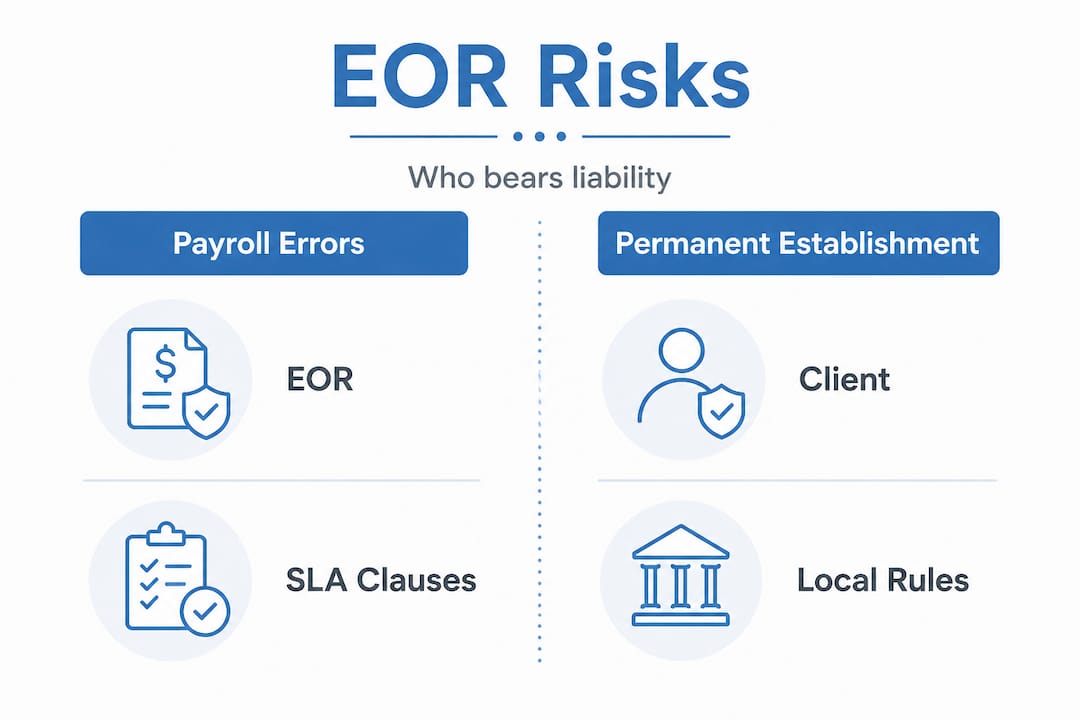
The most misunderstood risk is permanent establishment. If your EOR-employed staff in Portugal perform activities that generate revenue for your company, and if those activities appear to constitute a fixed place of business, Portuguese tax authorities may argue your company has a taxable presence in Portugal. You did not form an entity, but you may still owe corporate tax. EOR providers handle employment compliance, not your corporate tax structure. Permanent establishment risk is a client-side liability that EOR contracts typically carve out explicitly.
Misclassification carve-outs are equally serious. If your company directs and controls a worker’s schedule, tools, and outputs in a way that resembles direct employment, but the EOR contract describes the arrangement differently, you carry the liability if an audit occurs. EOR contracts are not blanket compliance guarantees.
Key risks international HR teams must assess before proceeding:
- Co-employment ambiguity where it is unclear whether the EOR or your company is responsible for a specific compliance decision
- Fee structures that increase as headcount grows, making EOR costly relative to a local entity
- Vendor instability, specifically smaller EOR providers going out of business or changing ownership, which can disrupt payroll continuity
- Insufficient termination support when your company needs to exit an employee and the EOR’s process does not align with your expected timelines or documentation requirements
To fully understand the compliance pitfalls in international hiring and the Portugal-specific risks embedded in EOR arrangements, your legal and HR teams need to read the actual EOR service agreement carefully, not just the pitch deck.
| Risk category | Who bears primary liability | Mitigation |
|---|---|---|
| Payroll errors | EOR | SLA clauses in service agreement |
| Permanent establishment tax | Client company | Corporate tax counsel review |
| Misclassification | Client company (if directing work) | Clear scope of work documentation |
| GDPR breach | Shared (via DPA terms) | Audit DPA regularly |
| Termination disputes | Shared | EOR with strong local legal support |
It is also worth understanding how to mitigate hiring fraud in your Portugal hiring process, particularly when candidates are hired remotely through an EOR without in-person verification. Credential fraud and identity misrepresentation are rising in remote hiring pipelines globally.
Pro Tip: Request a copy of your EOR provider’s actual employment contract template for Portugal before signing. Review it with a local employment lawyer. The differences between providers on probation clauses, severance language, and collective bargaining obligations can be significant.
When and how to transition from EOR to your own Portuguese entity
Given these limitations, let’s discuss how you recognize the right time and the right way to shift beyond EOR as your team grows.
EOR is not a permanent infrastructure solution. It is a bridge. Most companies reach a point where the monthly per-employee EOR fees exceed the cost of maintaining their own local entity. This is not just a financial signal. Operational control, team culture, direct HR relationships, and strategic talent development all benefit from having your own Portuguese legal presence.
> Key inflection point: Transitioning at 8 to 12 employees is widely cited as the turning point where EOR costs and complexity outweigh the convenience, and forming a local entity becomes the more cost-effective and strategically sound decision.
Here is how to approach the transition methodically:
- Conduct a cost comparison. Calculate your current monthly EOR fees against the estimated annual cost of entity registration, local payroll software, an HR manager or local accountant, and legal fees. If your EOR fees exceed entity costs, the transition is overdue.
- Register a Portuguese company (Sociedade por Quotas or SA). This involves filing with the commercial registry (Conservatória do Registo Comercial), obtaining a tax number (NIF), and registering for social security.
- Open a Portuguese bank account. Required for payroll processing, tax payments, and social security contributions.
- Transfer employment contracts. Employees currently employed by the EOR must be formally transitioned to your new entity. This typically involves a written novation of contract, where the employee acknowledges the change of employer without breaking employment continuity.
- Notify the EOR and define a transition timeline. Most EOR agreements require 30 to 90 days notice before termination. Plan your entity setup to overlap with this notice period to avoid a compliance gap.
- Set up local payroll infrastructure. This includes a certified Portuguese payroll provider or software, compliance with monthly Declaração Mensal de Remunerações (DMR) filings, and annual tax reporting obligations.
When managing these transitions carefully, companies avoid the most common pitfall: a period where employees are employed by neither the EOR nor the new entity, creating a compliance and liability gap that can trigger claims.
The EOR paradox: Compliance shortcut or complexity amplifier?
With strategic transition covered, let’s explore the broader lessons hidden in Portugal’s EOR landscape.
Here’s a perspective you won’t find in most EOR vendor materials: the EOR model can amplify operational complexity rather than reduce it, if you treat it as a set-and-forget solution. Many HR teams sign an EOR agreement, onboard their first Portugal hire smoothly, and then disengage. Six months later, they face a performance dispute, a contract amendment request, or a termination decision and realize they have no clear idea how their EOR handles any of these scenarios in detail.
Portugal’s labor law is among the most protective of employees in the EU. Notice periods, severance calculations, and the requirement to demonstrate just cause for dismissal create a process where termination and offboarding represent the highest-risk phase of any employment relationship. Most guides focus on hiring speed and payroll accuracy. Almost none discuss what happens when things go wrong mid-employment or at the exit stage.
We’ve seen companies assume their EOR handles everything related to termination, only to discover that the EOR manages the legal paperwork but that the client company is still expected to lead the performance documentation process that justifies the termination. Without that paper trail, the EOR cannot execute a lawful dismissal. The result is either a prolonged process, a forced mutual agreement (with severance costs), or a legal claim.
This is the hidden complexity. The EOR handles employment legally. You still have to manage the employee responsibly.
The Portugal HR insights available from specialists on the ground consistently reinforce this point: EOR works best when your internal HR team stays engaged, documents performance proactively, and treats the EOR as a partner rather than a compliance outsourcing vendor.
EOR is not a shortcut from accountability. It’s a legal structure that enables faster, compliant hiring. The operational discipline still belongs to you.
Get compliant support for hiring in Portugal
Building a Portugal team efficiently means getting the legal structure right from the very first hire. EOR providers vary significantly in their depth of local expertise, contract quality, and support for the full employment lifecycle including the parts that get complicated.
If you’re evaluating Portugal as your next nearshore location or you’re already hiring there and want to ensure your EOR setup is actually protecting you, the right starting point is a conversation with specialists who understand Portuguese employment law from the inside. Explore the full Portugal EOR services available, and walk through the compliant hiring guide to understand exactly what a properly structured EOR engagement looks like. Your first hire in Portugal should set a standard, not create a liability.
Frequently asked questions
What specific legal risks can occur if EOR is misused in Portugal?
Common risks include misclassification liability and permanent establishment tax exposure, as well as GDPR violations if Data Processing Agreements are not properly executed. These risks sit with the client company, not the EOR, even when an EOR contract is in place.
How fast can an EOR solution onboard new employees in Portugal?
Typical onboarding timelines run from 1 to 2 weeks for standard roles when all documentation is complete and the service agreement is already signed. Complex roles or CBAs may add time.
At what point should we consider switching from EOR to forming our own entity?
Most companies make the switch at 8 to 12 employees in Portugal, at which point monthly EOR fees typically exceed the cost of maintaining a registered local entity with dedicated payroll infrastructure.
Does an EOR fully handle employee terminations and severance in Portugal?
EORs manage the legal mechanics of termination, but Portuguese labor law is highly protective of employees, and clients must lead the performance documentation process that justifies any dismissal to avoid claims or forced severance agreements.