
TL;DR:
- Building a global workforce now involves managing remote workers, expatriates, and contractors across multiple jurisdictions, not just opening offices in new cities. Companies prioritize access to specialized talent, diversity, time zone coverage, and market insights to gain a competitive edge, despite operational challenges and legal risks. Using partners like Employer of Record services and localized benefits strategies are essential for effective, compliant international workforce management.
Building a global team used to mean opening offices in new cities. Today, understanding what is an international workforce means recognizing a far more complex reality. Remote work has dissolved geographic boundaries, the international labor market now spans every time zone, and companies compete for talent across dozens of jurisdictions simultaneously. With 304 million international migrants globally as of mid-2024 and the migrant workforce growing by over 30 million between 2013 and 2022, this is not a niche topic. It is a defining feature of how modern businesses operate and win.
Table of Contents
- Key takeaways
- What is an international workforce, defined
- Why companies build international teams
- Challenges of an international workforce
- How to manage an international workforce effectively
- Trends shaping the international workforce
- My take: stop treating this as a cost play
- Build your international workforce with confidence
- FAQ
Key takeaways
| Point | Details |
|---|---|
| Definition goes beyond borders | An international workforce includes remote workers, expatriates, and contractors spread across multiple countries. |
| Strategic value outweighs cost | Access to specialized global talent, not cost savings, is now the leading driver of international hiring. |
| Compliance is the highest risk | Misclassification and payroll errors across jurisdictions create legal exposure that few companies fully anticipate. |
| Localization of benefits matters | Standardized benefits packages fail internationally. Country-specific frameworks are required for satisfaction and legal compliance. |
| Agility is the competitive edge | Internal mobility and rapid redeployment are the most effective responses to geopolitical talent disruptions. |
What is an international workforce, defined
An international workforce is any group of employees, contractors, or contingent workers that a business engages across more than one country. It is not limited to multinational corporations with physical offices abroad. A 40-person tech company in London that employs developers in Portugal, customer support staff in Brazil, and product managers working remotely from Canada has an international workforce. The arrangement, not the headcount, defines it.
The global workforce definition has three common worker types you need to account for:
- Remote international employees: Workers hired directly by the company but residing in a different country. They are on the local payroll and subject to that country’s labor law.
- Expatriates: Employees relocated from the home country to work in a foreign office or subsidiary. These arrangements involve work permits, relocation packages, and dual tax considerations.
- International contractors: Self-employed individuals or agencies engaged on a project or retainer basis. Classification here is critical because what looks like a contractor relationship in one country may be legally treated as employment in another.
The impact of globalization on workforce composition has made all three categories common, even at smaller companies. Remote work technology removed the logistical barrier to hiring across borders, but it did not remove the legal complexity.
Pro Tip: Before you classify anyone as an international contractor, verify how that country defines employment. Several EU member states use economic dependency tests that can reclassify long-term contractors as employees regardless of what your contract says.
Why companies build international teams
The most common misconception about international hiring is that it is primarily about cutting costs. That framing misses the point entirely. According to current research, access to specialized talent is now the leading driver behind international workforce expansion, not labor arbitrage.
The benefits of an international workforce extend across four measurable areas:
- Specialized talent access: Certain skill sets are geographically concentrated. AI engineers cluster in specific cities. Multilingual support specialists are far more abundant in countries like Portugal than in the UK or US. Building internationally is often the only practical way to find the right person.
- Diversity in the global workforce: Teams with varied cultural backgrounds consistently approach problems differently, which drives creative problem-solving and reduces groupthink. This is particularly valuable in product development, marketing, and customer-facing roles.
- Time zone coverage: A team distributed across Europe, the Americas, and Asia Pacific can run near-continuous operations without requiring night shifts. For SaaS companies with global clients, this is a direct service quality improvement.
- Market intelligence: Employees who live and work in the markets you serve bring ground-level insight that no market research report can replicate. Local hires understand local buying behavior, regulatory context, and competitive dynamics.
Companies that treat workforce infrastructure as strategic rather than administrative report measurable gains in hiring speed, talent retention, and market responsiveness. The competitive advantage is real, but only if you build the operational backbone to support it.
Challenges of an international workforce
Understanding the challenges of an international workforce is where most business leaders underestimate their exposure. The operational complexity is significant, and the legal risks are often invisible until something goes wrong.
Here is a breakdown of the major challenge categories:
| Challenge area | Core risk | Common trigger |
|---|---|---|
| Worker misclassification | Fines, back taxes, benefit liability | Long-term contractors with employee-like schedules |
| Payroll and tax compliance | Penalties for incorrect withholding | Multi-country payroll run from a single HQ system |
| Employment classification | Different rules in each jurisdiction | Hiring without local legal review |
| Benefits localization | Low satisfaction, legal violations | Applying a US-style benefits package globally |
| Visa and immigration | Work authorization failures | Delayed permits disrupting project timelines |
| Cultural communication | Disengagement, retention failure | Insufficient onboarding for distributed teams |
Misclassifying international contractors as employees, or the reverse, is the single most common compliance failure and it carries consequences that include back pay liability, local tax penalties, and in some jurisdictions, criminal exposure for the hiring entity.
Benefits management is nearly as complex. Standardized benefits packages fail globally because healthcare systems, legal mandates, and cultural expectations vary enormously. Employer-paid health insurance is a core expectation in the US where no universal system exists. That same benefit is irrelevant or redundant in Portugal, where public healthcare covers residents. Applying one template across both markets creates both waste and dissatisfaction.

Pro Tip: Build a country-specific benefits matrix before you hire your first employee in any new market. Map what is legally required, what is culturally expected, and what competitors in that labor market typically offer. This three-column framework prevents the most common benefits mistakes.
How to manage an international workforce effectively
Knowing how to manage an international workforce well comes down to systems, not effort. Goodwill and communication alone will not protect you from a misclassification penalty or a payroll processing error that leaves 20 employees underpaid.
Here are the core strategies that actually work:
- Use an Employer of Record (EoR) for new markets. An EoR becomes the legal employer in a country where you have no entity. They handle payroll, tax withholding, benefits administration, and legal compliance. You manage the work. This eliminates the biggest compliance risks without requiring you to set up a local subsidiary. For HR teams, EU employment law compliance through an EoR is significantly less expensive than managing it in-house.
- Localize your compensation and benefits. Compensation benchmarking must be done per market, not against your home country salary bands. A senior developer in Lisbon commands a different salary than one in San Francisco, and both expect benefits that reflect their local legal and cultural context.
- Build internal mobility into your workforce plan. 50% of organizations now prioritize internal mobility and rapid redeployment as a direct response to geopolitical talent challenges. If one country becomes difficult to hire in due to visa restrictions or political instability, can you redeploy talent from another market? Build that flexibility deliberately.
- Implement purpose-built payroll technology. Multi-country payroll run through a single domestic system almost always creates errors. Platforms that are built for international employee management handle currency conversion, local tax codes, and reporting requirements in a way that generic HR software does not.
- Create communication structures for distributed teams. This means documented communication norms, regular all-team touchpoints regardless of time zone, and explicit processes for conflict resolution that account for cultural differences in how disagreement is expressed. Retention in distributed teams depends on belonging, not just compensation.
The comparison below captures two approaches to international workforce management:
| Approach | Compliance risk | Speed to hire | Cost to scale |
|---|---|---|---|
| Local entity setup | Low once established | Slow (3-12 months) | High upfront |
| Employer of Record | Low from day one | Fast (days to weeks) | Variable and scalable |
| Unstructured direct hire | Very high | Fast | Low short-term, high long-term |
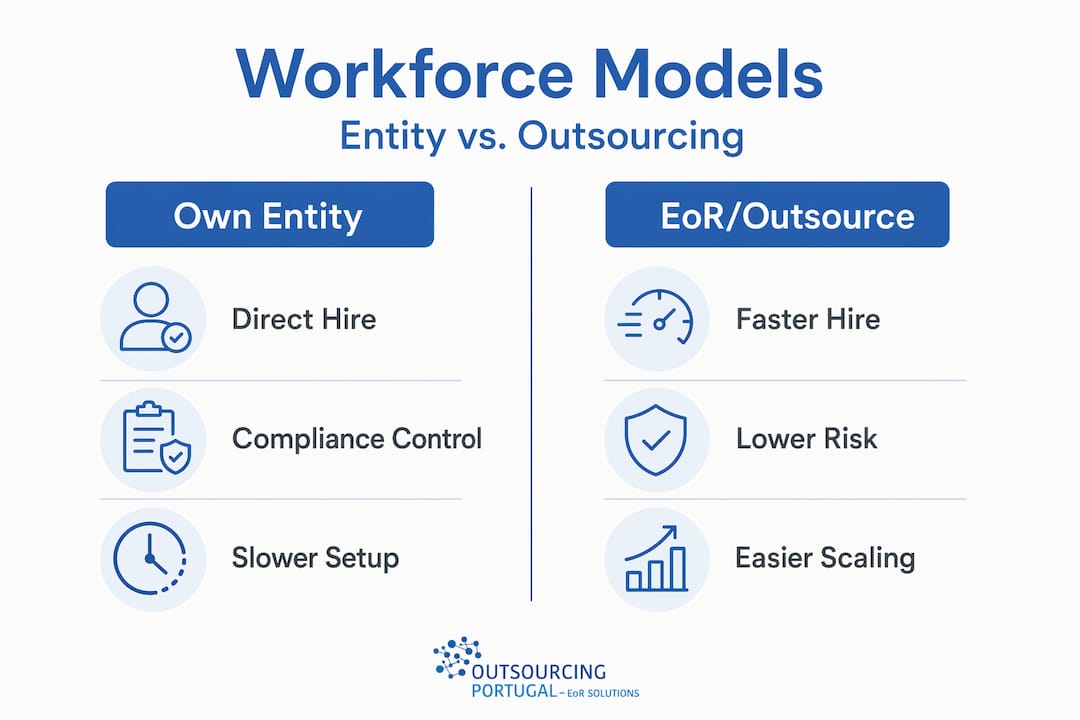
The unstructured direct hire model is still common among early-stage companies that do not yet know what they do not know. It is the model most likely to generate a compliance crisis at the worst possible moment. For companies working on workforce mobility and compliance, the EoR model has become the clear practical standard.
Trends shaping the international workforce
The international workforce trends that matter most right now are not about remote work tools. They are about power, regulation, and intelligence.
- Geopolitical talent competition: Geopolitics has shifted from trade to talent, with countries actively managing visa pathways, localization quotas, and skills retention as industrial policy. For HR teams, this means workforce planning must now account for geopolitical risk the same way supply chain teams account for logistics risk.
- AI-driven skill demand shifts: Over 50% of organizations report rising demand for AI-related skills. The international labor market is not just growing. It is rapidly restructuring around human and AI collaboration, making creativity and judgment more valuable than process execution.
- Regulatory acceleration: 68% of organizations say changing immigration policies are accelerating their international expansion plans, often by pushing them toward markets with clearer, more stable regulatory frameworks. Regulatory certainty has become a hiring location factor.
- Real-time workforce visibility: Companies are investing in workforce intelligence platforms that provide live data on headcount, compliance status, and engagement across all markets. Decisions that used to take weeks are being made in hours.
“Talent availability is less about quantity and more about matching the right skills at the right time and place.” This framing from current workforce research should reshape how you write your next hiring plan.
My take: stop treating this as a cost play
From everything I have seen working with companies that hire across multiple countries, the biggest and most persistent mistake is treating the international workforce as a cost-reduction mechanism. Companies that lead with “we can pay less if we hire in Country X” are building on the wrong foundation entirely.
The organizations that build genuinely high-performing international teams start with a different question: where does the talent we need actually exist? That question leads you to better decisions, better hires, and better retention. It also forces you to invest properly in compliance, because you recognize that the people you found are worth protecting.
What consistently surprises me is how many leadership teams underestimate the compliance risk until it becomes a legal bill. Global employment compliance requires knowledge of local tax law, labor law, payroll, benefits, and classification rules in every single market you operate in. That is not an HR task you add to someone’s existing job description.
The companies that treat people operations as a core function, not an administrative overhead, are the ones that scale internationally without blowing up. Invest in the right infrastructure early, build agility into your workforce planning, and stop measuring success by how little you spend per employee. Measure it by how fast you can find, hire, and retain the best person for every role, anywhere in the world.
— Paulo
Build your international workforce with confidence
Managing an international workforce does not require you to become an expert in the labor law of every country you hire in. It requires the right partner.

Outsourcing-portugal specializes in EoR and payroll services that allow you to hire in Portugal and across the EU without setting up a local entity. From cross-border employment compliance to onboarding and benefits localization, the team handles the operational complexity so you can focus on getting the right people into the right roles. Portugal offers a multilingual, highly educated talent pool, competitive labor costs, and full EU regulatory stability. If you are building an international team and need a nearshore base that works, explore the full employment services that Outsourcing-portugal provides.
FAQ
What is an international workforce?
An international workforce is any group of employees, contractors, or contingent workers that a company engages across more than one country. It includes remote employees, expatriates, and international contractors operating under different legal jurisdictions.
What are the main benefits of an international workforce?
Access to specialized global talent is the primary driver, followed by time zone coverage, cultural diversity in problem-solving, and local market intelligence. Cost savings are a secondary benefit, not the strategic foundation.
What are the biggest challenges of managing international employees?
Worker misclassification, multi-jurisdiction payroll compliance, and benefits localization are the top three risks. Legal penalties from misclassification can include back taxes, benefit liability, and fines under local labor law.
How does an Employer of Record help with international hiring?
An EoR becomes the legal employer in a country where you have no entity, handling payroll, taxes, and compliance on your behalf. This allows companies to hire internationally in days rather than the months required to set up a local subsidiary.
How is AI changing the international labor market?
AI is reshaping skill demand across all markets, with over 50% of organizations reporting rising demand for AI-related skills. It is also enabling faster compliance monitoring and employment law research, giving HR teams better tools to manage international workforce complexity.