
TL;DR:
- Offshoring emphasizes cost savings through distant operations, while nearshoring prioritizes proximity for faster collaboration. Combining both strategies in modular supply chains reduces costs and mitigates risks more effectively than choosing one model alone. Businesses should evaluate total ownership costs, governance, and regional factors to optimize their sourcing decisions in 2026.
Most executives assume offshoring is simply the cheaper option. That assumption gets expensive fast. Understanding what is offshoring vs nearshoring requires more than comparing hourly wage rates. It demands a clear-eyed look at total cost of ownership, supply chain risk, AI integration, and how modular strategies are replacing the old binary choice. This article gives you the full picture so you can make a decision grounded in real numbers, not just labor rate comparisons.
Table of Contents
- Key takeaways
- What is offshoring vs nearshoring, explained clearly
- Offshoring benefits, risks, and how AI changes everything
- Nearshoring advantages and the true cost structure
- Beyond binary: modular supply chain strategies
- Critical decision factors you cannot ignore
- My take: stop treating these as competing options
- How Outsourcing-portugal supports your sourcing strategy
- FAQ
Key takeaways
| Point | Details |
|---|---|
| Offshoring prioritizes cost, nearshoring prioritizes speed | Both models serve different operational needs and are most powerful when combined strategically. |
| Hidden costs undermine offshoring savings | Tariffs, logistics volatility, and inventory carrying costs often cancel out apparent wage savings. |
| AI is reshaping offshore teams | 85% of developers use AI tools in 2026, making AI literacy a must-have for offshore partner selection. |
| Nearshoring cuts lead times dramatically | Proximity reduces transit from 35+ days to just days, lowering supply disruption risk significantly. |
| Modular strategies outperform single-model approaches | Combining offshore components with nearshore assembly reduces total costs by 20 to 30%. |
What is offshoring vs nearshoring, explained clearly
Before comparing the two models, you need precise definitions. The difference between offshoring and nearshoring is not just geography. It shapes your communication rhythms, cost structure, and risk profile in fundamental ways.
Offshoring means relocating business operations or hiring talent in a country that is geographically distant, typically across continents. A US tech company hiring developers in India, or a European manufacturer sourcing components from Vietnam, is offshoring. The primary draw is labor cost savings. Wages in offshore markets can be a fraction of domestic rates, and that gap has historically justified the added complexity.
Nearshoring means moving operations to a country that is geographically close, often within the same time zone band or just a few hours apart. A US company building a software team in Mexico, or a UK company hiring developers in Portugal, is nearshoring. As cultural similarity and time zone overlap improve real-time collaboration and reduce project risk, nearshoring has grown rapidly.
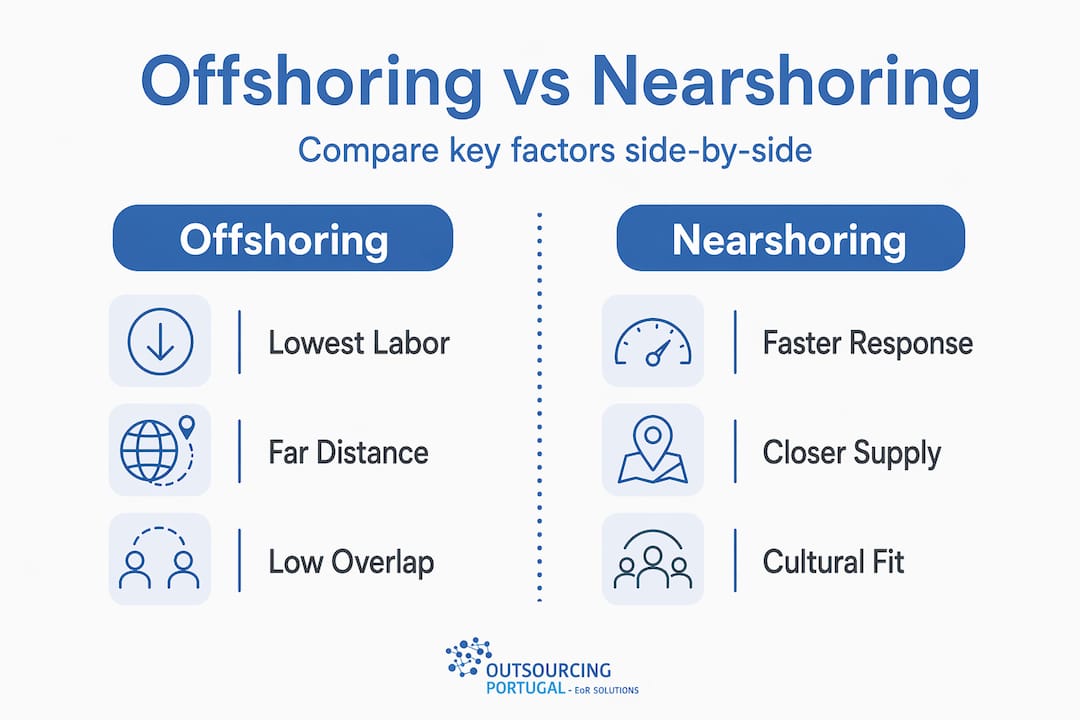
Here is a direct comparison of the two models across the factors that matter most to decision-makers:
| Factor | Offshoring | Nearshoring |
|---|---|---|
| Labor cost | Lowest | Moderate |
| Time zone overlap | Low (0-4 hours) | High (4-8 hours) |
| Transport costs | Lower per unit | 30-50% higher |
| Cultural alignment | Low to moderate | High |
| Lead time | 25-35+ days (ocean freight) | Days to a week |
| Geopolitical risk | Higher | Lower |
| IP protection | Variable | Generally stronger |
The table makes one thing obvious: neither model wins on every dimension. That is exactly why the smartest companies in 2026 are not choosing one over the other. They are engineering hybrid approaches.
Offshoring benefits, risks, and how AI changes everything
Offshoring still delivers real advantages when applied correctly. The core offshoring benefits remain compelling: access to large labor pools, significant wage differentials, and the ability to scale headcount quickly without building local infrastructure. A US software company working with an offshore team in Eastern Europe or Southeast Asia can often reduce developer costs by 50 to 70% compared to domestic hiring.
But the traditional labor arbitrage story is getting complicated. Wage gaps between Western markets and major offshore destinations have narrowed over the past decade, and the trajectory continues. What is keeping offshoring competitive is not cheap labor alone. It is AI.
90% of developers are shifting to AI process orchestration by 2026, and offshore teams are at the center of that shift. Rather than simply writing code, AI-augmented offshore developers now review and validate AI-generated output, acting as quality gatekeepers for production-grade software. This raises the value of offshore work without necessarily raising its cost.
That said, offshoring risks are real and often underestimated:
- Communication delays. When your team is 8 to 12 hours away, a single misaligned requirement can cost a full sprint cycle.
- Geopolitical exposure. Trade disputes, sanctions, and regional instability can disrupt operations with little warning.
- Hidden logistics costs. Ocean freight variability, customs delays, and longer inventory cycles drive up total cost in ways hourly wage comparisons never capture.
- IP and compliance risk. Enforcement of intellectual property protections varies dramatically by country.
Pro Tip: When evaluating offshore partners for software development, ask specifically about their AI tool stack. A team that can demonstrate fluency with AI code review and testing workflows will deliver significantly better output per dollar than one still working in purely traditional ways.
Nearshoring advantages and the true cost structure
Nearshoring advantages go well beyond the convenience of overlapping work hours. The most significant one is supply chain latency. Nearshoring reduces lead times from 35-plus days of ocean freight to just a few days of ground or air transport, and that compression has a direct financial impact on inventory carrying costs and supply disruption exposure.
For US manufacturers, Mexico represents the clearest nearshoring case study. Labor in Mexico runs $4 to $8 per hour compared to $25 to $30 domestically, and trade agreements like USMCA reduce tariff friction significantly. That combination of proximity and cost advantage makes nearshoring in the Americas a structurally different proposition from offshoring to Asia.

The catch is transport cost. Nearshoring logistics investment is projected at $270 billion in 2026, reflecting the real expense of building out shorter, more resilient supply chains. Transport costs can run 30 to 50% higher than equivalent offshore routes, depending on the product category and volume.
Here is how the total cost of ownership factors compare in practice:
| Cost Factor | Offshoring (Asia) | Nearshoring (Europe/Americas) |
|---|---|---|
| Labor rate | Lowest | Moderate |
| Tariff exposure | High (rising) | Lower (trade agreements) |
| Freight cost | Lower per unit | 30-50% higher |
| Inventory carrying cost | High (long transit) | Low (fast transit) |
| Communication overhead | High | Low |
| Risk premium | High | Lower |
When you add all those rows together, the nearshoring cost premium shrinks considerably. For Portugal-based outsourcing, for example, the combination of EU compliance, English proficiency, and competitive salaries positions it as a cost-effective nearshore option for Western European companies that want proximity without sacrificing talent quality.
Beyond binary: modular supply chain strategies
The sharpest operators in 2026 have moved past the offshoring vs nearshoring explained debate entirely. They think in modules. Combining offshore components with nearshore assembly reduces total costs by 20 to 30% while preserving speed and protecting IP-sensitive processes.
The logic is straightforward. Not every part of your operation has the same risk profile or time sensitivity. Standardized, commodity-level work can be offshored for maximum cost efficiency. Assembly, quality control, and anything involving proprietary design can be nearshored or even reshored to maintain control.
Here is a practical framework for evaluating whether a modular approach fits your business:
- Map your operations by sensitivity. Separate activities by IP risk, time sensitivity, and quality control requirements. Not every function belongs in the same geography.
- Calculate total landed cost, not hourly rates. Include tariffs, freight, inventory carrying, risk premiums, and management overhead for each scenario.
- Identify your collaboration-critical functions. Any work requiring daily interaction with senior leadership or clients belongs nearshore or onshore.
- Stress-test geopolitical concentration. If more than 40% of a critical supply category comes from one country or region, you have concentration risk worth addressing.
- Run a 12-month pilot before committing. Modular strategies require integration work. Test the handoffs between offshore and nearshore teams before scaling.
The companies getting this right are not just cutting costs. They are building supply chains that can absorb disruption without collapsing, which is a competitive advantage that goes beyond any quarterly labor savings calculation.
Critical decision factors you cannot ignore
When deciding between offshoring and nearshoring, the most expensive mistake is anchoring your analysis on hourly wage rates. Ignoring total cost of ownership including tariffs, inventory, and risk premiums is what causes most offshoring failures. The right framework covers much more:
- Governance and management structure. Decentralized management for offshore units yields higher profits than centralized oversight, but only when upstream processes are efficient. Get your governance model right before you scale.
- Labor quality and cultural fit. Portugal’s English proficiency and Western European cultural alignment give it a distinct edge over more distant offshore locations for EU-facing operations.
- Regulatory and compliance exposure. Data protection laws, employment regulations, and customs rules vary enormously. Every new market adds compliance overhead.
- IP and contract enforceability. Nearshore locations within stable legal jurisdictions offer meaningfully stronger IP protection than many offshore alternatives.
- Infrastructure and risk resilience. Power reliability, internet connectivity, and political stability all affect uptime and service continuity for outsourced operations.
Pro Tip: Before signing any outsourcing contract, build a total cost model that includes at least six indirect cost categories beyond labor. If your analysis only shows hourly rates, it is incomplete by definition.
My take: stop treating these as competing options
I have watched companies spend months debating offshoring vs nearshoring as if they are mutually exclusive strategies. That framing is outdated, and in my experience it leads to suboptimal decisions on both ends.
The companies I have seen perform best are the ones that treat this as a portfolio question. They offshore what is genuinely commodity work, where cost efficiency is the only variable that matters. They nearshore anything that requires real-time collaboration, cultural alignment, or tight quality control. And they pay obsessive attention to outsourcing governance frameworks that make the two models work together cleanly.
What frustrates me most is how often the total cost conversation gets skipped. A business case built entirely on labor rate arbitrage will almost always look better than the reality. Freight volatility, currency exposure, communication lag, and management overhead are all real costs that erode the headline savings number.
My honest recommendation: run a full 24-month cost model before committing to any sourcing change. Factor in geopolitical scenarios. Ask your partners hard questions about their AI capabilities. And do not neglect nearshoring Portugal as a serious option if you are operating within Europe. The talent depth, legal stability, and English proficiency there are genuinely underappreciated by decision-makers who default to the cheapest offshore quote without running the full numbers.
— Paulo
How Outsourcing-portugal supports your sourcing strategy
If you are working through the offshoring vs nearshoring decision for your European operations, Portugal deserves a serious look. Outsourcing-portugal provides employer of record, payroll management, and legal compliance services that let you hire Portuguese talent without setting up a local entity. That means faster market entry, zero entity setup cost, and full labor law compliance from day one.

Portugal offers a highly educated, multilingual workforce with one of the strongest English proficiency rates in Continental Europe, competitive salaries relative to Western European peers, and full EU regulatory stability. Whether you are building a nearshore tech team, a customer operations center, or testing the market before a larger commitment, Outsourcing-portugal handles the compliance and employment infrastructure so you can focus on the work. Explore employer of record services in Portugal or review the full range of hiring and payroll solutions to see how the model fits your sourcing strategy.
FAQ
What is the main difference between offshoring and nearshoring?
Offshoring moves operations to distant countries, primarily for labor cost savings, while nearshoring relocates to geographically close countries with better time zone alignment and cultural fit. The core trade-off is cost efficiency versus collaboration speed and supply chain resilience.
When should a business choose nearshoring over offshoring?
Choose nearshoring when your work requires real-time collaboration, fast supply chain response times, strong cultural alignment, or tighter IP protection. Nearshoring reduces lead times from over 35 days to just days, which significantly lowers inventory and disruption costs.
Is offshoring still cost-effective in 2026?
Yes, but only when total cost of ownership is calculated honestly. Wage gaps in many traditional offshore markets have narrowed, and hidden costs like tariffs, freight volatility, and communication overhead frequently erode savings. AI-augmented offshore teams offer better value per dollar than traditional offshoring models.
What is a modular supply chain strategy?
A modular strategy combines offshoring for commodity, cost-sensitive work with nearshoring for time-sensitive, IP-critical, or collaboration-heavy functions. This hybrid approach can reduce total costs by 20 to 30% compared to a single-model approach.
Why is Portugal considered a strong nearshore option for European companies?
Portugal offers competitive labor costs within the EU, strong English proficiency, cultural alignment with Western Europe, and full compliance with EU employment and data protection law, making it a cost-effective nearshore destination without the regulatory risk of more distant alternatives.