
TL;DR:
- Actual employment costs often exceed wages by 40-45% due to benefits, taxes, and insurance. Regional factors, such as local regulations and market demand, significantly influence true labor expenses, making cost modeling essential. Portugal offers a stable, cost-effective EU labor market with high talent quality, providing strategic advantages over wage-focused comparisons.
When you look at a job offer and see a salary number, you are looking at maybe 60% of what that employee actually costs you. Competitive labor costs explained properly go far beyond wages. For business leaders making international hiring decisions, particularly in markets like Portugal, this gap between headline salary and true employment cost can mean the difference between a profitable operation and one that erodes margins from day one. Understanding the full picture is not optional. It is the foundation of every sound workforce strategy.
Table of Contents
- Key takeaways
- Competitive labor costs explained: what you are actually paying
- How regional and regulatory factors reshape labor costs
- International labor cost comparisons: case studies and real-world gaps
- Turning labor cost data into hiring and budget strategy
- My take on the real meaning of labor cost competitiveness
- How Outsourcing-portugal helps you hire smarter in Portugal
- FAQ
Key takeaways
| Point | Details |
|---|---|
| Labor cost exceeds base wages | Benefits, taxes, and insurance typically add 40 to 45% on top of base pay across most industries. |
| Regional factors reshape costs | Local wage floors and CPI escalators can push costs 25% above state minimums in specific markets. |
| Nearshoring isn’t always cheaper | Border regions can cost 50% more than interior locations, making location research non-negotiable. |
| Portugal offers a cost-productivity balance | Portugal combines EU-level talent with labor costs well below Western European averages. |
| Full cost data drives better decisions | Using fully burdened labor costs for budgeting prevents underpricing and protects profit margins. |
Competitive labor costs explained: what you are actually paying
Most hiring managers think of labor cost as a salary plus maybe a health plan. That thinking is expensive. What you actually pay per employee is a product of multiple stacked costs, and missing any one of them creates budget gaps that compound over time.
Base wages are the starting point. This is the agreed compensation, hourly or salaried, before anything else. But once you add the full labor burden, the picture changes fast.
Labor burden is the collective term for every non-wage cost tied to employing someone. It typically includes:
- Payroll taxes (Social Security, Medicare, unemployment insurance)
- Health, dental, and vision insurance premiums
- Paid time off: vacation days, sick leave, and public holidays
- Workers’ compensation insurance
- Retirement contributions or pension matching
- Training, onboarding, and equipment costs
In construction, for example, labor burden averages 44% of base pay as of 2026. That means a worker earning $50,000 per year costs their employer closer to $72,000 once all burden costs are included. Ignoring this in project budgeting leads directly to underpricing and margin erosion, a well-documented pattern in project-based industries.
The formula for fully burdened labor cost is straightforward:
- Start with annual base wages
- Add total annual payroll taxes
- Add total annual benefits costs
- Add training, equipment, and administrative costs
- Divide by productive hours worked to get a true hourly cost
Pro Tip: When comparing candidates or markets, always use fully burdened cost per productive hour, not salary figures. A $40,000 employee who is absent 30 days per year costs more per hour of actual work than a $45,000 employee with 10 sick days.
Understanding the full employment cost before committing to a hiring plan is the single most common gap between companies that budget accurately and those that consistently run over on workforce costs.
How regional and regulatory factors reshape labor costs
A competitive wage in Seattle is a generous wage in rural Alabama. Geography is not just a backdrop for labor costs. It actively reshapes them through regulation, competition, and local market dynamics.

Across the United States, 88 jurisdictions have automatic CPI wage escalators that push labor costs higher every year without legislative action. These are not temporary adjustments. They are permanent, compounding mechanisms built into local law. For any business operating across multiple states or cities, the complexity of compliance quickly becomes a cost in itself.
There are a few patterns worth understanding when conducting a competitive wage analysis:
- Locality premiums: Some U.S. cities set wage floors that exceed state minimums by up to 25%, meaning the same job role carries materially different costs depending on zip code.
- Wage compression: When entry-level wages rise above $21 per hour, pay compression threatens the salary gap between new hires and their supervisors, creating retention problems at the management level.
- Compliance overhead: Tracking automatic escalators across jurisdictions requires either dedicated HR technology or legal support, both of which add to total labor cost.
Portugal operates under a very different regulatory model. The national minimum wage is set centrally, creating predictability for employers. Social security contributions, mandatory benefits, and leave entitlements are standardized across the country, which makes Portugal easier to model financially than markets with highly fragmented local wage laws.
Pro Tip: When building a labor cost comparison across markets, map the regulatory complexity as a cost item, not just an HR concern. Legal compliance in a multi-jurisdiction US operation can cost as much annually as hiring an additional full-time employee in a more predictable market like Portugal.
For international companies exploring cost-effective hiring in Portugal, the absence of local wage fragmentation is itself a financial advantage that rarely appears in headline comparisons.
International labor cost comparisons: case studies and real-world gaps
This is where most strategic assumptions collapse. Companies look at a country’s average wage, assume it translates directly to cost savings, and build a business case on that assumption. Then they discover the actual numbers.
Mexico vs. the United States
Mexico is widely understood as a low-cost manufacturing alternative to the United States. The reality is far more nuanced. The Bajío region in Mexico offers fully loaded labor costs that are 66 to 70% lower than comparable operations in Phoenix or rural Georgia. That is a real, significant advantage. But companies that set up near the U.S.-Mexico border face an entirely different situation.
Labor demand along that corridor is intense. Multiple manufacturers compete for the same workers, and the result is wage inflation at the source. Labor costs near the U.S.-Mexico border can run 50% higher than in interior Mexican industrial corridors. The geography that makes nearshoring operationally convenient also makes it financially punishing.
Portugal vs. Western Europe
| Market | Relative fully loaded labor cost | EU membership | Talent profile |
|---|---|---|---|
| Germany | High (index: ~100) | Yes | Engineering, manufacturing |
| France | High (index: ~95) | Yes | Diverse, high regulation |
| Portugal | Moderate (index: ~45 to 55) | Yes | Tech, multilingual, services |
| Romania | Low (index: ~30) | Yes | IT-heavy, limited languages |
| Ukraine | Very low (index: ~15 to 20) | No | IT-heavy, geopolitical risk |
Portugal sits in a productive middle ground. Costs are substantially below the Western European average while the workforce carries EU-level education standards, high English proficiency, and cultural alignment with most Western markets. For tech teams, call centers, and professional services, that combination is difficult to find elsewhere in the EU.
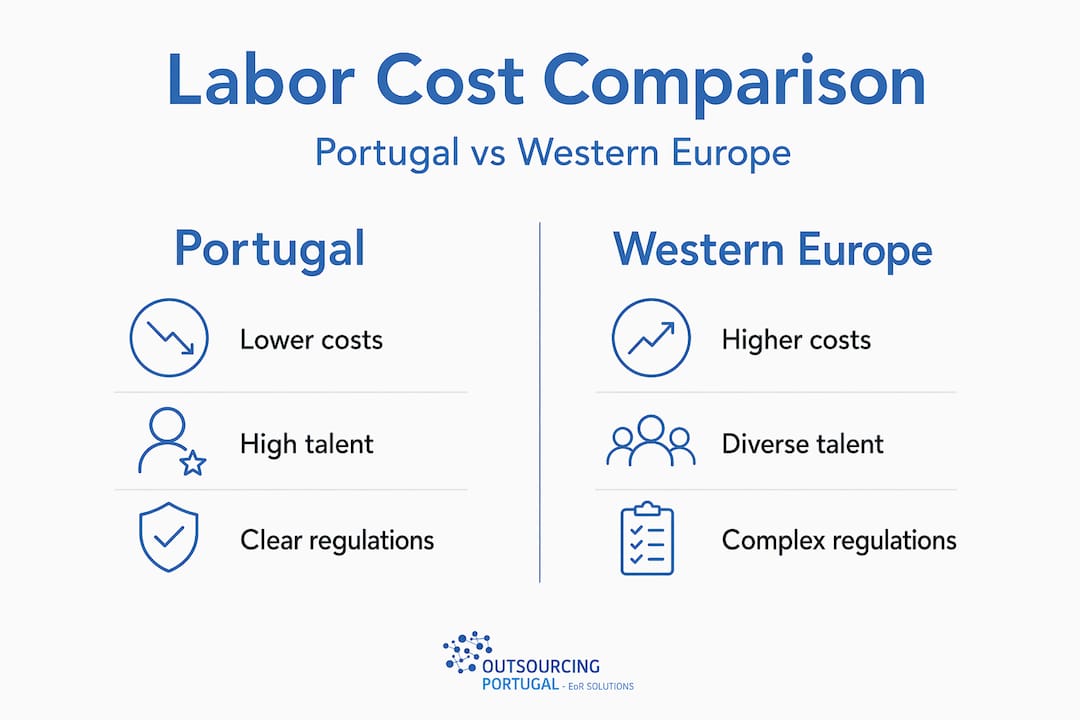
Assessing labor productivity alongside raw cost is the correct framework here. A lower-cost market with higher turnover or lower output per hour can quickly outprice a more expensive market when total cost of ownership is calculated honestly.
Pro Tip: Never benchmark a market on wage data alone. Request or build a fully burdened cost model that includes employer social contributions, mandatory leave, and the realistic cost of turnover. In many Southern and Eastern European markets, turnover in tech roles runs 18 to 25% annually, and that replacement cost needs to land somewhere in your model.
The role of automation also deserves attention in any serious labor cost comparison. AI could cut labor costs in Asian manufacturing by 20% by 2027, according to McKinsey data. This means markets that seem expensive today may close the gap through technology faster than expected, while markets relying purely on wage arbitrage face structural pressure.
Turning labor cost data into hiring and budget strategy
Having accurate cost data is only useful when you know what to do with it. This section is about application: how to take what you know about competitive labor costs and convert it into decisions that hold up.
Use fully burdened cost for every pricing and budget model. If your product or service depends on labor, and most do, the margin you report depends on using the real cost number. The total labor cost calculation should inform your pricing floor, not sit in a separate HR spreadsheet.
Connect productivity metrics to cost benchmarks. A market with higher wages but lower absenteeism and better retention can be less expensive over a three-year horizon than a cheaper market with high churn. Measure output per employee, cost per unit, and retention rates alongside hourly cost.
Specific strategies to manage rising labor costs without reducing headcount quality include:
- Relocating or expanding to markets where regulatory costs are more predictable and lower, such as Portugal within the EU
- Introducing process automation for repetitive tasks, freeing higher-cost staff for work that genuinely requires human judgment
- Hiring selectively at higher salaries in critical roles while using outsourced or nearshore teams for supporting functions
- Building in annual labor cost projections that account for CPI escalation and benefit cost inflation, not just salary reviews
Pro Tip: Track your labor cost as a percentage of revenue, not just an absolute number. This ratio tells you far more about whether your workforce investments are performing. If your labor cost percentage is rising while revenue grows, investigate whether you are scaling headcount ahead of output or missing productivity improvements.
For companies hiring in Portugal specifically, managing compliance through a local expert or Employer of Record provider dramatically reduces the administrative overhead of international payroll management. The regulatory framework is well-defined. Having someone who knows it fluently is the difference between a smooth operation and a costly correction.
My take on the real meaning of labor cost competitiveness
I have watched companies make the same mistake repeatedly. They find a market with a low average salary, do rough mental math, assume they have found a cost solution, and proceed. Eighteen months later, they are dealing with compliance fines, unexpected benefit obligations, and turnover rates that were never in the model.
What I have learned is that the word “competitive” in labor costs does not mean cheap. It means well-positioned. A competitive labor cost is one where the total cost of the employment relationship, including wages, burden, regulatory compliance, productivity output, and retention, is favorable relative to what that workforce delivers.
Portugal has shifted from being a market companies consider out of curiosity to one they choose with conviction. The labor cost advantage is real but it is not just about the wage number. It is about the combination: a well-educated, multilingual workforce, stable employment law, low turnover in professional roles, and a cost structure that holds up when you run the fully burdened model.
The fading labor arbitrage in Asia is a useful signal for anyone making long-term location decisions. Markets built on wage arbitrage alone are vulnerable to wage inflation, automation displacement, and geopolitical disruption. Markets built on the intersection of cost, talent quality, and stability are not. That is the distinction worth building your strategy around.
— Paulo
How Outsourcing-portugal helps you hire smarter in Portugal

Knowing the theory of competitive labor costs is one thing. Building an employment operation in Portugal that actually delivers on that cost and compliance promise is another. Outsourcing-portugal works with international companies to handle every layer of the employment relationship, from EOR and payroll in Portugal to onboarding, legal compliance, and HR support.
You get full transparency on fully burdened labor costs before you hire, not after your first audit. The team understands Portuguese employment law at the detail level that protects your margins and keeps you compliant as regulations evolve. For businesses ready to build or expand a nearshore team in Portugal, Outsourcing-portugal removes the guesswork and the legal exposure. Visit Outsourcing-portugal’s employment services to understand exactly what it costs and what it delivers.
FAQ
What is competitive labor cost?
Competitive labor cost is the total expense of employing a worker that positions a company favorably in its market. It includes base wages plus all labor burden costs such as payroll taxes, benefits, insurance, and training.
How do you calculate fully burdened labor cost?
Add base wages to all employer-paid costs including payroll taxes, benefits, paid leave, and training. Divide by actual productive hours to get a true cost per hour. Labor burden typically adds 40 to 44% above base wages in most industries.
Why are nearshore labor costs sometimes higher than expected?
Location within a country matters as much as the country itself. Border regions can run 50% more expensive than interior locations due to concentrated employer demand driving wage inflation in that area.
What makes Portugal’s labor costs competitive for EU hiring?
Portugal combines fully loaded labor costs roughly 45 to 55% below Germany or France with a highly educated, English-proficient workforce and stable, predictable employment law. This balance makes it one of the strongest nearshore value propositions within the EU.
How do CPI escalators affect long-term labor cost planning?
In markets with automatic CPI-based wage indexing, labor costs rise annually without any legislative vote. 88 U.S. jurisdictions already operate this way, making multi-year cost forecasting significantly more complex in those regions than in markets with centralized wage-setting like Portugal.