
TL;DR:
- Workforce localization involves transitioning expatriates to local employment terms, reducing costs and enhancing operational resilience. It requires strategic planning, legal compliance, and employee support to ensure successful integration and long-term market presence. Companies that treat localization as a leadership-driven talent strategy gain competitive advantages and sustainable growth.
Workforce localization is defined as the process of transitioning employees from expatriate employment packages to host-country terms, integrating local talent into core operations to align with regional laws, compensation norms, and business needs. Known formally as talent localization in global mobility practice, it sits at the intersection of cost management, compliance, and strategic HR. For multinational companies operating across the EU, GCC, or Sub-Saharan Africa, getting this transition right determines whether a foreign operation scales or stalls. This guide covers the main strategies, compliance considerations, financial benefits, and practical implementation steps HR leaders need to act on.
What is workforce localization and why does it matter?
Workforce localization means transitioning employees from expatriate packages to host-country local terms when assignments become permanent. The core objective is replacing costly, administratively complex expat arrangements with employment structures that reflect local pay scales, legal requirements, and cultural expectations. This matters because expatriate assignments carry significant overhead: housing allowances, international school fees, home-leave flights, and tax equalization payments can push total assignment costs two to three times above equivalent local compensation.
Beyond cost, the importance of workforce localization extends to operational resilience. A team staffed primarily by rotating expatriates lacks institutional memory and local market knowledge. Local employees understand regulatory nuances, customer behavior, and supplier relationships in ways that no amount of briefing documents can replicate. Companies that treat localization as a one-time administrative task rather than a talent strategy consistently underperform those that embed it into their operating model.
The term “workforce localization” also covers a second, related meaning: place-based workforce development, where organizations invest in building technical skills within a specific region to reduce dependence on imported labor. Both definitions share the same underlying logic. Local expertise, built deliberately, produces more durable competitive advantages than externally sourced talent.
What are the main workforce localization strategies used by global companies?
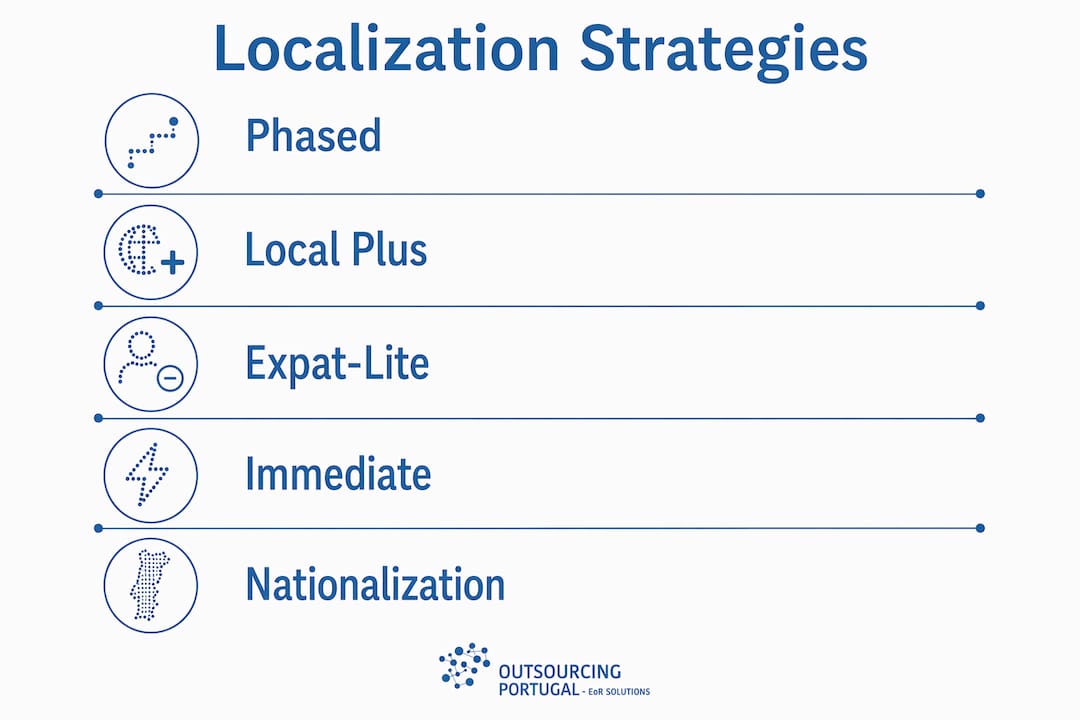
Global companies apply four primary approaches to localizing their workforce, each suited to different timelines, employee profiles, and regulatory environments.
-
Phased localization. The most common model phases out expatriate allowances over three to six years. A typical schedule runs at 100% of assignment benefits through year three, then scales down to zero by year six. This gives employees time to adjust their personal finances and lifestyle expectations while the company manages its cost reduction in a predictable way.
-
Local Plus model. Under Local Plus, employees move to local base pay and benefits but retain a limited set of expatriate allowances, typically housing support or an education allowance, for a defined period. It is a middle-ground approach that works well when the host-country compensation market is significantly below the employee’s home-country expectations.
-
Expat-Lite model. Expat-Lite reduces the allowance package from day one of the assignment rather than waiting for a formal localization trigger. Companies use this when they anticipate that an assignment will convert to permanent employment within two to three years. It reduces the financial gap the employee must bridge at localization and lowers the risk of disengagement.
-
Immediate localization with a buy-out. Some companies offer a lump-sum payment to compensate for the abrupt loss of expatriate benefits. This approach suits employees who are already well-integrated into the host country and prefer a clean financial settlement over a phased wind-down.
In regulated markets, a fifth model applies: workforce nationalization. The GCC region, including Saudi Arabia, the UAE, and Qatar, uses training and private-sector incentives to replace or supplement expatriate labor with nationals. Saudi Arabia’s Nitaqat program and the UAE’s Emiratisation policy set sector-specific quotas that carry financial penalties for non-compliance. These are not voluntary localization programs. They are legally binding workforce transformation requirements.
| Strategy | Best suited for | Typical timeline |
|---|---|---|
| Phased localization | Long-term assignees with family ties in host country | 3 to 6 years |
| Local Plus | Mid-level professionals in high-cost markets | 1 to 3 years |
| Expat-Lite | Short-cycle assignments likely to convert | 1 to 2 years |
| Immediate buy-out | Integrated employees seeking clean transition | Immediate |
| Workforce nationalization | GCC and regulated markets with quota requirements | Ongoing, policy-driven |
Pro Tip: Map each expatriate’s personal circumstances, including mortgage obligations, school-age children, and pension gaps, before selecting a localization model. The right model for the business is not always the right model for the employee, and a mismatch at this stage is the single most common cause of localization-related attrition.
How does workforce localization balance legal compliance and business continuity?
Legal compliance is not a side consideration in localization. It is the foundation. When an employee transitions from an expatriate package to local terms, the company must address at least five distinct compliance areas simultaneously.
- Tax residency and payroll tax. The employee’s tax status changes when they become a local hire. Home-country tax obligations may persist for a period depending on bilateral tax treaties, and the company must coordinate with tax advisors in both jurisdictions to avoid double taxation.
- Social security and pension. Expatriate assignments often exclude employees from host-country social security schemes. Localization triggers enrollment, which changes both employer and employee contribution obligations. Gaps in pension accrual during the assignment period may need to be addressed through supplementary arrangements.
- Visa and immigration status. Many expatriates hold work permits tied to their assignment terms. Localization requires a visa reclassification, and in some markets this process takes months. Failing to manage this transition correctly exposes both the employee and the company to immigration violations.
- Employment contract restructuring. The existing assignment letter or secondment agreement must be replaced with a locally compliant employment contract. This includes notice periods, termination rights, and statutory benefits that differ materially from home-country norms.
- Benefits alignment. Health insurance, life cover, and other benefits provided under the expatriate package must be replaced with locally equivalent or superior arrangements to meet host-country statutory minimums.
Understanding compliance in international hiring is particularly relevant for companies operating in markets with complex labor codes, where a missed enrollment deadline or an incorrectly classified worker can trigger significant penalties.
Poorly timed localization causes employee disengagement. The risk is highest when companies trigger localization without adequate notice, without financial counseling, or without addressing the employee’s personal circumstances. In the GCC, successful localization balances compliance quotas with capability and culture, meaning that quota-filling without genuine skills transfer produces nominal compliance but no operational benefit.
Pro Tip: Engage a local employment attorney and a tax advisor in the host country at least six months before the planned localization date. The legal review will surface issues that HR generalists routinely miss, particularly around pension continuity and visa reclassification timelines.
What are the operational and financial benefits of workforce localization?
The financial case for localization is direct. Phasing out expatriate allowances reduces total employment cost per role by a measurable margin once the transition completes. Housing allowances, school fees, home-leave flights, and tax equalization payments represent the largest cost components, and eliminating them over a three-to-six-year window produces compounding savings that fund reinvestment in local talent development.
“Mature localization models embed local nationals in core functions to internalize expertise and speed decision-making, not just fulfill quotas.” This principle, demonstrated by Ammat Global Resources in the Democratic Republic of Congo, shows what genuine localization produces at scale.
Ammat Global Resources built an 80 to 85% local workforce in technical and management roles, which produced stronger operational decision-making and direct alignment with ESG reporting requirements. The company did not localize to meet a quota. It localized to build an organization that could operate independently of external expertise. That distinction separates companies that extract value from a market from those that build lasting presence in it.
| Benefit | Expatriate-heavy model | Localized model |
|---|---|---|
| Total employment cost | High, with allowance loading | Lower, aligned to local market |
| Institutional knowledge | Fragile, exits with assignees | Retained within local team |
| Regulatory risk | Higher, complex multi-jurisdiction | Lower, single-jurisdiction compliance |
| ESG and local content | Weak local community ties | Strong, supports local employment goals |
| Decision speed | Slower, requires home-office sign-off | Faster, local authority embedded |

The benefits of a localized workforce also extend to employee engagement. Local employees on local contracts feel a different level of organizational commitment than expatriates on time-limited assignments. They invest in relationships, build supplier networks, and develop customer loyalty in ways that produce revenue outcomes that are difficult to quantify but easy to observe. For companies building international workforce capacity in new markets, this distinction is the difference between a market presence and a market position.
How can HR leaders effectively implement workforce localization strategies?
Effective implementation requires a structured program, not a policy document. The following steps reflect best practice across regulated and open markets.
-
Audit your current expatriate population. Identify which employees are approaching the natural end of their assignment terms, which are already operating in permanent roles under temporary contracts, and which are candidates for immediate localization. Segment by market, role criticality, and personal circumstances.
-
Define your localization models by market. Not every market warrants the same approach. A Local Plus model may be appropriate in Lisbon, while immediate localization with a buy-out may be the only viable option in Riyadh under Nitaqat compliance requirements. Align the model to the regulatory and talent environment of each location.
-
Build a support package for transitioning employees. Effective localization programs provide tax counseling, immigration support, cost-of-living adjustments, and phased educational allowances. Employees who receive structured support during the transition are significantly less likely to resign or disengage.
-
Communicate the timeline and rationale clearly. Employees who learn about localization through rumor or at short notice respond with anxiety and, frequently, with resignation letters. A formal communication plan, delivered by line managers with HR support, sets expectations and preserves trust.
-
Invest in local workforce development alongside the transition. Localization is not only about converting existing expatriates. It also means hiring and developing local talent to fill roles that would otherwise require external recruitment. Training programs, mentoring structures, and clear promotion pathways signal to local employees that the company is committed to their long-term growth.
-
Track outcomes with data. Monitor retention rates, cost-per-role, compliance status, and employee engagement scores for localized employees against your baseline. Use this data to refine your models and demonstrate ROI to senior leadership.
A workforce compliance workflow that integrates localization milestones with payroll, immigration, and benefits administration reduces the administrative burden and minimizes the risk of a compliance gap during the transition period.
Pro Tip: For companies localizing in multiple markets simultaneously, assign a dedicated localization coordinator per region rather than managing transitions centrally. Regional coordinators understand local labor authority timelines and can flag issues before they become compliance events.
Key takeaways
Workforce localization succeeds when it is designed as a talent strategy, not an administrative cost-cutting exercise, and when it combines phased financial transitions with genuine legal compliance and employee support.
| Point | Details |
|---|---|
| Definition is dual | Localization covers both expat-to-local transitions and place-based workforce development programs. |
| Strategy must match context | Phased, Local Plus, Expat-Lite, and nationalization models each suit different markets and employee profiles. |
| Compliance is non-negotiable | Tax, visa, pension, and contract restructuring must be addressed simultaneously at transition. |
| Financial gains are real | Eliminating expatriate allowances reduces total employment cost and improves ESG alignment over time. |
| Employee support drives retention | Tax counseling, immigration help, and transparent communication prevent disengagement during transitions. |
Why localization is a leadership decision, not an HR task
I have worked with companies that treat workforce localization as a line item on a cost-reduction spreadsheet. They set a date, send a letter, and expect the employee to absorb the financial impact of losing housing allowances and school fees without complaint. That approach fails, reliably and expensively.
The companies that get localization right treat it as a leadership decision about what kind of organization they want to build in a given market. They ask whether the local team has the authority, the skills, and the organizational support to operate without constant input from headquarters. They invest in local leadership development before they trigger the financial transition. They recognize that a localized workforce is not a cheaper version of an expatriate workforce. It is a fundamentally different operating model.
The future of localization is moving in two directions simultaneously. In regulated markets like Saudi Arabia and the UAE, political pressure will continue to tighten nationalization quotas, making compliance-driven localization unavoidable. In open markets, companies that localize proactively will build competitive advantages in talent retention and local market knowledge that their slower competitors cannot replicate quickly. The organizations that treat localization as a strategic investment rather than a compliance obligation will be the ones that own their markets a decade from now.
— Paulo
Localize your workforce in Portugal with full compliance support
International companies expanding into Portugal face the same localization challenges described throughout this article: converting assignments to local contracts, managing payroll compliance under Portuguese labor law, and building a local team without establishing a full legal entity. Outsourcing-portugal solves each of these problems directly.

Through Employer of Record services and fully managed payroll, Outsourcing-portugal handles local employment contracts, social security enrollment, tax compliance, and onboarding so your team is legally employed in Portugal from day one. You get the operational benefits of a localized workforce without the administrative complexity of setting up a local entity. For companies ready to move from expatriate arrangements to local employment in Portugal, explore hiring options that cover every step of the transition.
FAQ
What does workforce localization mean in HR?
Workforce localization means transitioning employees from expatriate employment packages to host-country terms, aligning compensation, benefits, and contracts with local laws and market norms. It also refers to building local talent capacity within a specific region to reduce reliance on externally sourced labor.
What are the main workforce localization strategies?
The primary strategies are phased localization, Local Plus, Expat-Lite, immediate localization with a buy-out, and workforce nationalization for regulated markets like the GCC. Each model suits different timelines, employee circumstances, and regulatory requirements.
What are the biggest challenges of workforce localization?
The most common challenges are managing simultaneous tax, visa, pension, and contract changes during the transition, and preventing employee disengagement when financial packages are reduced. Poorly timed or poorly communicated localization consistently leads to attrition among high-performing employees.
How long does a typical workforce localization transition take?
Phased localization programs typically run three to six years, scaling allowances down incrementally. Immediate localization with a buy-out can be completed in weeks, but requires careful financial structuring to avoid legal disputes or employee grievances.
Why is workforce localization important for multinational companies?
Localization reduces total employment costs, builds institutional knowledge within the host-country team, and improves regulatory compliance by consolidating employment under a single jurisdiction. Companies like Ammat Global Resources demonstrate that embedding locals in technical and strategic roles also strengthens ESG performance and operational decision-making speed.