
TL;DR:
- Business expansion involves strategically increasing a company’s reach, resources, and revenue through deliberate methods. It requires coordinated changes across operations, finance, staffing, and compliance, not just new hires or locations. Proper readiness assessment, financial planning, and understanding international costs are crucial to avoid common failure pitfalls and ensure sustainable growth.
Business expansion is the strategic process by which a company increases its reach, resources, and revenue to grow its market presence and profitability. It is not simply hiring more people or opening a second location. Expansion is a company-wide system shift requiring coordinated changes across operations, finance, staffing, and governance. For business owners and executives, understanding what drives successful expansion, and what derails it, is the difference between scaling with control and scaling into chaos.
What is business expansion and why does it matter?
Business expansion is a planned strategy where a company increases its reach and resources to grow revenue, profitability, and market share. The core forms include market penetration, geographic expansion, product and service growth, and mergers or acquisitions. Each form carries distinct risk profiles, capital requirements, and timelines.

The strategic importance of expansion goes beyond revenue. A company that does not grow its market presence faces competitive erosion as rivals capture more customers, talent, and pricing power. Growth also creates internal leverage: larger operations spread fixed costs across more revenue, improving margins over time.
What separates expansion from ordinary growth is intent. Ordinary growth happens when sales increase because the market grows. Expansion happens when a company deliberately moves into new territory, whether that means a new geography, a new customer segment, or a new product category. That deliberate intent is what makes planning so critical.
What are the main methods of business expansion?
Expansion includes both organic and inorganic methods, and the right choice depends entirely on where your competitive advantage is strongest. Organic growth builds on existing capabilities. Inorganic growth, through mergers, acquisitions, and partnerships, buys capabilities you do not yet have.
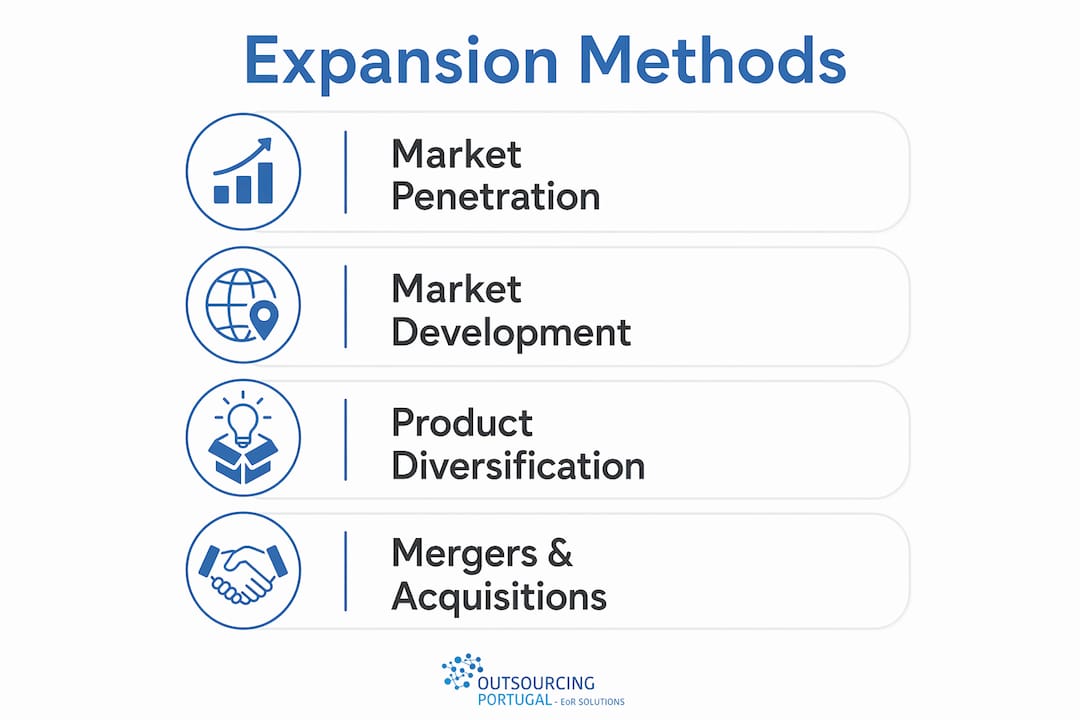
The four most common methods break down as follows:
| Method | How it works | Best suited for |
|---|---|---|
| Market penetration | Increase sales of existing products in existing markets | Businesses with untapped share in a proven market |
| Market development | Enter new geographic or customer segments | Companies with a proven product ready for new audiences |
| Product diversification | Launch new products or services | Businesses with strong distribution and customer trust |
| Mergers and acquisitions | Buy or merge with another company | Companies seeking speed, technology, or market access |
Market penetration is the lowest-risk method because you are selling what you already know to customers you already understand. A SaaS company that doubles its sales team to capture more of its existing vertical is executing market penetration. Market development carries more risk because it requires understanding a new audience. Geographic expansion into Portugal or Southeast Asia, for example, means learning new regulatory environments, labor markets, and buyer behaviors.
Product diversification is the highest-risk organic method. Amazon’s move from books to cloud computing via AWS is the most cited example of successful diversification, but for every Amazon there are dozens of companies that diluted their focus and lost ground in their core market.
Pro Tip: Before selecting an expansion method, map your current competitive advantage clearly. If your strength is operational efficiency, market penetration or geographic expansion will likely outperform diversification, which demands product innovation capabilities you may not have.
How can you assess readiness and plan for expansion?
Business performance indicators such as revenue trends, customer demand, and operational scalability are the primary signals that a company is ready to expand. Customer acquisition cost and conversion rate trends are equally telling. If your CAC is rising and conversion rates are falling, your current market may be saturating, which is a signal to develop new markets rather than push harder in the existing one.
Readiness assessment should cover these critical areas before any expansion plan is finalized:
- Revenue and profitability trends: Are margins stable or improving over the last 12 to 24 months?
- Customer demand signals: Are customers asking for products or geographies you do not yet serve?
- Operational scalability: Can your current systems, processes, and team handle 30 to 50 percent more volume without breaking?
- Cash flow position: Do you have sufficient runway to fund expansion costs before the new market becomes profitable?
- Talent and leadership depth: Do you have managers who can run new operations independently?
Structured expansion planning correlates to better growth outcomes and requires clear goals, market research, realistic timelines, and detailed financial projections. The planning phase is where most executives underestimate the timeline to profitability. A new geographic market rarely generates positive returns in under 12 months. Building that reality into your financial model from the start prevents the cash crisis that kills otherwise sound expansions.
Rapid expansion without capacity planning often fails, and pacing growth is not a sign of weakness. It is the mechanism that keeps your existing business healthy while the new operation matures.
Pro Tip: Run a stress test on your current operations before committing to expansion. Simulate what happens to your delivery times, customer service quality, and cash position if volume increases by 40 percent overnight. The constraints that surface in that exercise are exactly what your expansion plan needs to address first.
What special considerations apply to international expansion?
International expansion requires substantial capital and demands that you account for marketing, operations, and compliance costs upfront, not as afterthoughts. The companies that fail internationally almost always underestimate the soft costs: market positioning, channel setup, regulatory onboarding, and the time required to build banking relationships in a new country.
International expansion budgets must cover both soft costs and hard costs with appropriate runway. Soft costs include market research, brand localization, and channel partner development. Hard costs include legal entity formation, employment compliance, tax registration, and regulatory licensing. Both categories are non-negotiable, and neither is cheap.
The most effective sequence for international market entry follows these steps:
- Validate product-market fit in the target country through pilot sales or a limited launch before committing full resources.
- Assess cash flow and funding position to confirm you can sustain 12 to 18 months of operations before breakeven.
- Define your market entry strategy: land and expand (start small and grow), market segmentation (target a specific niche first), or strategic partnerships with established local players.
- Map all compliance requirements including employment law, tax obligations, and data privacy regulations specific to that country.
- Build local banking relationships early. Payment infrastructure and credit access in a new market take longer to establish than most executives expect.
- Hire or contract local expertise. A local employment partner or Employer of Record removes the legal entity requirement and dramatically reduces time to first hire.
The best time to expand internationally aligns with home market momentum and demonstrated success. Expanding from a position of strength, not desperation, gives you the financial buffer and brand credibility to absorb the inevitable early setbacks.
How do financing and operational structures support sustainable expansion?
SBA 504 loans finance fixed assets like commercial real estate for business expansion, but working capital and inventory are ineligible. This distinction matters enormously when you are designing your funding package. A company that bundles working capital needs into an SBA 504 application will face rejection. Separating fixed-asset costs from operational costs and funding each through the appropriate instrument increases approval rates and reduces total financing cost.
| Financing option | Best for | Key constraint |
|---|---|---|
| SBA 504 loan | Fixed assets: real estate, equipment | Cannot fund working capital or inventory |
| Business line of credit | Working capital, operational costs | Requires established credit history |
| Equity investment | High-growth, capital-intensive expansion | Dilutes ownership |
| Strategic partnership | Market access, shared resources | Requires aligned incentives |
Expansion also triggers internal organizational changes beyond sales and marketing. Hiring new employees and setting up new departments are often required to support expanded operations. A company entering a new country, for example, needs HR, payroll, and compliance functions that may not exist in its current structure. Building those functions from scratch takes time and money. Using an international workforce model through an Employer of Record sidesteps that build time entirely.
Pro Tip: Design your funding package by separating fixed-asset eligible costs from working capital needs before approaching any lender. This separation increases your loan approval chances and lets you match each funding source to the cost category it is designed to cover.
Key takeaways
Successful business expansion requires deliberate planning, honest readiness assessment, and funding structures matched to the specific costs of each growth phase.
| Point | Details |
|---|---|
| Expansion is a system shift | Growth requires coordinated changes across operations, finance, staffing, and compliance, not just sales. |
| Match method to advantage | Choose market penetration, development, diversification, or acquisition based on where your competitive strength is strongest. |
| Assess readiness before committing | Revenue trends, operational scalability, and cash flow position must all signal stability before expansion begins. |
| International costs run deeper than expected | Budget for both soft costs (positioning, channels) and hard costs (compliance, legal) with 12 to 18 months of runway. |
| Separate funding by cost type | Fixed-asset financing and working capital financing require different instruments; mixing them reduces approval rates. |
Why most expansion plans fail before they start
I have worked with enough companies at the point of expansion to recognize a pattern that rarely gets discussed honestly. The plan looks solid on paper. The market opportunity is real. The leadership team is motivated. And then, six months in, the whole thing stalls. Not because the strategy was wrong, but because the internal systems were never stress-tested against the demands of the new operation.
Growth strategies must be tailored to how the organization creates and captures value, and one-size-fits-all approaches fail. What I see most often is executives applying a strategy that worked in their last company or their last market without asking whether their current organization is built to execute it. A market development strategy requires sales and marketing capabilities that can operate in unfamiliar territory. A product diversification strategy requires R&D and product management depth. If those capabilities are thin, the strategy will expose that weakness at the worst possible time.
The factors I see overlooked most consistently are staffing depth below the executive level, process maturity in finance and operations, and compliance budgeting for new markets. Most expansion budgets are built around revenue projections and direct costs. The indirect costs, the time your CFO spends on new tax registrations, the months your HR team loses to building a new employment framework, the legal fees that arrive unexpectedly, rarely make it into the model.
My honest recommendation: before you finalize any expansion plan, stress-test your operational constraints under launch scenarios. Ask what breaks first if the new market grows faster than expected. Ask what breaks first if it grows slower. The answers will tell you exactly where to invest before you launch, not after.
— Paulo
Expand into Portugal with confidence
If your expansion plan includes Europe, Portugal offers a combination of advantages that few markets match: a highly educated, multilingual workforce, competitive employment costs, and full EU regulatory alignment.
Outsourcing-portugal specializes in helping international companies hire and operate in Portugal without setting up a local legal entity. Through Employer of Record services, payroll management, and full HR and compliance support, Outsourcing-portugal removes the operational complexity that typically slows international market entry. You can place your first hire in Portugal in days, not months, while staying fully compliant with Portuguese employment law. If you are ready to establish Portuguese operations as part of your growth strategy, Outsourcing-portugal provides the infrastructure to do it efficiently.
FAQ
What is business expansion in simple terms?
Business expansion is the deliberate process of growing a company’s market reach, revenue, and resources through strategies such as entering new markets, launching new products, or acquiring other businesses. It differs from ordinary growth because it requires structured planning and significant resource commitment.
What are the most common types of business expansion?
The four main types are market penetration, market development, product diversification, and mergers or acquisitions. Each method suits different competitive positions and risk tolerances.
How do you know if your business is ready to expand?
Key readiness indicators include stable or improving revenue trends, strong customer demand signals, scalable operations, and sufficient cash flow to sustain 12 to 18 months of expansion costs before the new market reaches profitability.
What makes international expansion different from domestic growth?
International expansion adds compliance, regulatory, and currency complexity on top of standard growth challenges. Companies must budget for both soft costs like market positioning and hard costs like legal entity setup and employment compliance, often with a longer runway to profitability than domestic expansion requires.
Can a business expand without setting up a foreign legal entity?
Yes. An Employer of Record model allows companies to hire employees in a new country through a third-party provider that handles payroll, compliance, and HR obligations locally. This approach is widely used for nearshore team building and market testing before committing to a full legal entity.