
TL;DR:
- International onboarding involves legally, operationally, and culturally integrating employees across borders to ensure productivity and retention. It requires careful planning of compliance, payroll, operational setup, and cultural awareness, with a strong focus on manager adaptation and structured check-ins. Hybrid models supported by technology and outsourcing providers like Employer of Record improve efficiency and compliance at scale.
International onboarding is the multi-layered process of legally, operationally, and culturally integrating employees hired across national borders, covering everything from contract compliance and payroll setup to cultural adaptation and team integration. Also referred to as cross-border onboarding or global employee onboarding, this process determines whether a new international hire becomes a productive contributor or a costly turnover statistic. Investing in a well-orchestrated onboarding program boosts retention by over 80% and productivity by 70%. That number alone explains why HR professionals at globally expanding companies treat onboarding as a strategic priority, not an administrative formality. Tools like HR Cloud and services like Employer of Record (EOR) providers have made this process more manageable, but the fundamentals still require deliberate planning.
What is international onboarding and what does it actually involve?
International onboarding is a multi-layered process involving legal, operational, and cultural integration, with compliance often the most time-consuming phase. The process does not begin on day one. Pre-boarding activities, including employment contract compliance and preparatory communication, are required before the new hire ever logs in. Skipping these steps creates legal exposure and delays productivity.
The core components break down into four distinct layers:
- Legal compliance: Drafting locally compliant employment contracts, registering the employee for tax purposes, and setting up statutory benefits such as social security contributions, paid leave entitlements, and health coverage. These requirements vary significantly by jurisdiction. What applies in Germany does not apply in Portugal or Brazil.
- Payroll setup: Configuring salary structure in the correct currency, collecting bank details, and establishing a compliant payroll cycle. International payroll setup also requires understanding local tax withholding rules and mandatory employer contributions.
- Operational setup: Shipping or provisioning equipment, granting system access, scheduling team introductions, and assigning a point of contact for the new hire’s first weeks.
- Cultural integration: Communicating workplace norms, leadership expectations, feedback culture, and decision-making styles in a way that is relevant to the employee’s background.
Pro Tip: Start the compliance layer at least two weeks before the employee’s start date. Contract delays and tax registration backlogs are the most common reasons international onboarding runs over schedule.
Each layer depends on the others. A new hire in Lisbon who receives their laptop on day one but has no compliant contract in place is a legal liability. One who has all the paperwork but no cultural orientation is likely to disengage within the first 90 days.

What common challenges arise during international onboarding?
Only 12% of employees strongly agree their company does a great job onboarding. That figure reflects a systemic failure, not isolated incidents. The challenges in international onboarding are predictable, which means they are also preventable.
-
Time zone and remote coordination. A manager in San Francisco onboarding a new hire in Warsaw faces a nine-hour gap. Without deliberate scheduling, the new employee spends their first week waiting for responses and feeling invisible. The fix is a structured first-week calendar sent before day one, with pre-recorded orientation content for asynchronous consumption.
-
Language barriers. Even when both parties speak English, communication norms differ. A direct “no” from a Dutch colleague reads as rude to a Japanese employee accustomed to indirect refusals. Localized onboarding content, written in plain language and adapted for cultural context, reduces misinterpretation significantly.
-
Legal and regulatory complexity. Employment law in the European Union alone varies country by country. Misclassifying an employee as a contractor, missing a statutory benefit, or using a non-compliant contract template exposes the company to fines and litigation. EOR providers like those offered through Outsourcing-portugal handle this layer by acting as the legal employer in the target country.
-
Cultural disengagement. New international hires who feel culturally isolated are more likely to leave within the first six months. Buddy systems, where a local colleague is assigned to the new hire for informal support, consistently reduce early attrition.
-
Inconsistent onboarding experiences. When each department runs its own onboarding process, the result is uneven quality. Some hires get thorough orientation; others get a PDF and a Slack invite.
Pro Tip: Assign a dedicated onboarding coordinator for every international hire, separate from the hiring manager. The coordinator owns the checklist, tracks progress, and is the new hire’s first call when something goes wrong.
How does cultural intelligence influence successful international onboarding?
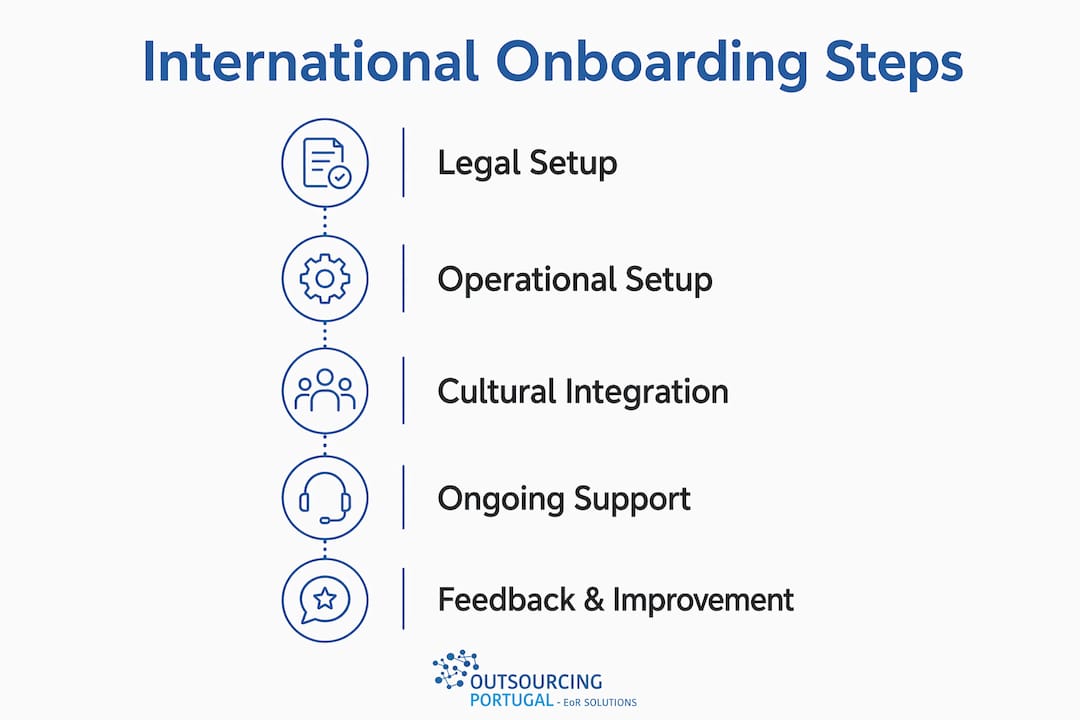
Cultural intelligence plays a central role in helping employees navigate communication norms and leadership expectations, reducing isolation and disengagement. This is the part of international onboarding that most HR teams underinvest in, and it is the part that most directly predicts whether a new hire stays past year one.
Culture shapes expectations around hierarchy, feedback, decision-making, and communication. A new hire from a high-context culture, where meaning is implied rather than stated, will struggle in a low-context environment where blunt directness is the norm. Misunderstandings in the first weeks are not personality conflicts. They are cultural friction that cultural awareness training can prevent.
“International onboarding effectiveness hinges on culture-sensitive leadership and clear communication adapted to employee backgrounds.” — Global Business Culture
Managers are the most important variable in this equation. A manager who adapts their communication style to the new hire’s cultural background, rather than expecting the hire to immediately conform, dramatically shortens the time to full productivity. This means learning whether the employee prefers written or verbal feedback, whether they expect to be told what to do or to take initiative, and how they interpret silence in a meeting.
Practical cultural onboarding activities include pre-start cultural briefings, team introductions that explain each person’s role and communication preference, and structured check-ins at 30, 60, and 90 days. Companies like Global Business Culture offer dedicated cultural awareness programs that HR teams can integrate into their international HR management frameworks. The return on this investment shows up in engagement scores and retention data within the first quarter.
Centralized vs. localized onboarding: which approach works better?
Global onboarding must balance standardization with regional adaptation to comply with local laws and accommodate cultural differences. Neither a fully centralized nor a fully localized approach works on its own. The most effective international onboarding strategies use a hybrid model.
| Approach | Key strengths | Main risks | Best used when |
|---|---|---|---|
| Centralized | Consistent brand messaging, efficient delivery, easier to scale | Misses local compliance requirements, feels generic to new hires | Company culture and values orientation, global policy training |
| Localized | Legally accurate, culturally relevant, higher new hire satisfaction | Time-intensive, harder to maintain consistency across regions | Contract setup, statutory benefits, local tax registration |
| Hybrid | Combines consistency with compliance accuracy | Requires coordination between central HR and local teams | Most international onboarding scenarios |
Technology platforms like HR Cloud support the hybrid model by centralizing content delivery, automating workflows, and offering multilingual training modules. This means a new hire in Porto and one in Amsterdam can both complete the same company values orientation, while their contracts, payroll setup, and statutory benefits are handled according to local law.
The hybrid model also scales. A company onboarding five international employees per year can manage localization manually. One onboarding fifty needs automated workflows, a centralized content library, and local HR partners or EOR providers to handle jurisdiction-specific tasks. Efficient HR onboarding strategies for specific markets, like Portugal, demonstrate how this split between global consistency and local precision works in practice.
Key takeaways
Effective international onboarding requires legal compliance, cultural integration, and operational setup to work together from pre-boarding through the first 90 days.
| Point | Details |
|---|---|
| Start compliance before day one | Employment contracts and tax registration must be completed before the hire’s first day to avoid legal exposure. |
| Cultural integration drives retention | Cultural awareness training and manager adaptation reduce early attrition more than any other single onboarding investment. |
| Hybrid models outperform single approaches | Centralized content for company culture plus localized processes for compliance delivers the best outcomes at scale. |
| Technology enables global consistency | Platforms like HR Cloud automate workflows and support multilingual delivery across time zones and jurisdictions. |
| Only 12% rate onboarding as excellent | Most companies have significant room to improve, making quality onboarding a direct competitive advantage in talent retention. |
What most companies get wrong about international onboarding
The companies I see struggle most with international onboarding are not the ones that skip compliance. They know compliance matters. The ones that struggle are the ones that treat cultural integration as a nice-to-have that gets cut when the onboarding timeline gets tight.
Here is what I have observed repeatedly: a new hire in Lisbon completes all the paperwork on time, gets their laptop on day one, and has access to every system they need. By week six, they are disengaged. Not because the process failed technically, but because no one explained why the team communicates the way it does, what “taking initiative” actually means in that company’s culture, or who to go to when they are stuck and do not want to bother their manager.
The 30/60/90-day check-in structure is underused and undervalued. Most companies do one check-in at 90 days, if at all. The companies with the best retention do structured check-ins at all three points, with specific questions about clarity of role, quality of relationships, and cultural fit. The data from those check-ins is what tells you whether your onboarding program is actually working.
My honest recommendation: treat the cultural layer with the same rigor you apply to the legal layer. Build it into the timeline, assign ownership, and measure it. The importance of international onboarding is not just about avoiding fines. It is about building teams that actually function across borders.
— Paulo
How Outsourcing-portugal simplifies your global onboarding
Hiring internationally without a local entity means navigating employment law, payroll, and compliance requirements in a country you may not know well. Outsourcing-portugal removes that complexity for companies hiring in Portugal.
Through Employer of Record services and full payroll outsourcing, Outsourcing-portugal acts as the legal employer for your Portuguese hires, handling contracts, tax registration, statutory benefits, and ongoing HR support. You get a fully onboarded, compliant employee without setting up a local entity. For companies building nearshore teams in Portugal, this is the fastest and most legally secure path to a productive hire. Explore the full range of employment and onboarding services to see how it works in practice.
FAQ
What is international onboarding in simple terms?
International onboarding is the process of legally, operationally, and culturally integrating an employee hired in a different country. It covers employment contracts, payroll setup, statutory benefits, and cultural orientation.
How long does international onboarding typically take?
Most international onboarding programs run 30 to 90 days, with the compliance and payroll setup phase completed before day one and cultural integration continuing through the first quarter.
What is the biggest risk of poor international onboarding?
Poor onboarding directly increases turnover and reduces productivity. Only 12% of employees rate their company’s onboarding as excellent, which means most organizations are losing talent they spent significant resources to hire.
What is an Employer of Record and how does it help with onboarding?
An Employer of Record is a third-party company that acts as the legal employer in a target country, handling contracts, payroll, and compliance on behalf of the hiring company. This removes the need to set up a local legal entity and significantly reduces the risk of non-compliance during onboarding.
What is cross-border onboarding vs. standard onboarding?
Cross-border onboarding, another term for international onboarding, adds layers of jurisdictional compliance, currency and payroll complexity, and cultural adaptation that domestic onboarding does not require. The core goal is the same: a productive, engaged employee. The execution is substantially more complex.