
TL;DR:
- European nearshoring offers faster project delivery and higher success rates due to close time zone collaboration and cultural alignment. It provides access to top-tier senior talent at 30-50% lower costs, with GDPR compliance reducing legal and data risks. Building teams in Portugal with specialized services ensures a strategic, compliant, and efficient nearshore partnership in 2026.
Nearshore software development in Europe is the practice of partnering with engineering teams in geographically and culturally close countries to extend your product capacity with better collaboration, faster delivery, and access to senior talent at competitive costs. For international business leaders asking why nearshore in Europe makes sense over offshore or local hiring, the answer is measurable: proximity eliminates the coordination failures that quietly destroy offshore projects, while European talent pools deliver the seniority and specialization that local markets cannot supply fast enough. This guide breaks down the operational, financial, and strategic case for European nearshoring in 2026.
Why nearshore in Europe outperforms offshore on collaboration
Time zone alignment is not a convenience. It is a project success variable. Nearshore teams deliver 40% faster project completion and produce 65% fewer communication misunderstandings than offshore equivalents, driven entirely by timezone synchronization. That gap compounds over a six-month engagement into weeks of recovered delivery time.
Offshore models operating across 12-plus hour differences force asynchronous workflows where a question asked at 9 a.m. gets answered the following morning. Offshore 16-hour feedback loops increase rework cycles that erode initial cost savings quickly. Nearshore teams in Poland, Romania, Portugal, and the Czech Republic share 6 to 8 hours of daily overlap with Western European and East Coast US clients, enabling synchronous sprint ceremonies, same-day code reviews, and real-time architectural decisions.
Physical proximity adds a second layer of advantage that offshore cannot replicate. A flight from London to Lisbon or Warsaw takes under three hours. That accessibility makes quarterly on-site visits practical, which builds the interpersonal trust that sustains high-performing remote teams. Nearshore engagements achieve approximately 80% project success rates, compared to 60% for offshore, a gap that reflects the cumulative effect of better communication, faster feedback, and stronger working relationships.
Pro Tip: Schedule at least one on-site kickoff with your nearshore team in the first 30 days. Teams that meet in person during onboarding consistently report stronger alignment on product vision and fewer scope misunderstandings in subsequent sprints.
| Factor | Nearshore Europe | Offshore (Asia/LatAm) |
|---|---|---|
| Daily time zone overlap | 6 to 8 hours | 0 to 2 hours |
| Project success rate | ~80% | ~60% |
| Communication misunderstandings | 65% fewer | Baseline |
| Project completion speed | 40% faster | Baseline |
| On-site visit feasibility | High (under 3 hours flight) | Low (10+ hours flight) |
What talent pools in European nearshore hubs actually look like
The advantages of nearshore outsourcing extend well beyond cost. Central and Eastern Europe produces engineering talent ranked among the top globally in competitive programming, with countries like Poland, Romania, and Bulgaria consistently placing in the top 20 on HackerRank and Codeforces leaderboards. This is not generalist talent. These hubs have developed deep specializations in fintech, SaaS architecture, cloud infrastructure, cybersecurity, and AI development.

Poland, Romania, Portugal, Czech Republic, and Bulgaria each carry distinct strengths. Poland leads in enterprise software and fintech. Romania has a strong cloud and DevOps community. Portugal combines strong English proficiency with a growing tech ecosystem and a stable regulatory environment that makes it particularly attractive for companies building customer-facing teams. Bulgaria offers some of the most competitive rates in the EU while maintaining strong output quality.
The financial case for accessing this talent is direct. Senior software engineers in Central and Eastern Europe cost 30 to 50% less than their counterparts in Western Europe or North America, with no measurable compromise on technical output quality. That savings figure applies to senior roles, not junior staff, which is where the real leverage sits for product teams that need architectural ownership rather than task execution.
Key factors that distinguish top-tier European nearshore talent:
- Domain depth: Engineers in these hubs frequently carry five to ten years of experience in specific verticals, not just general programming skills.
- Hiring speed: Nearshore partners can onboard vetted senior engineers in two to four weeks, compared to three to five months for equivalent local hires in the UK, Germany, or the Netherlands.
- Team model: Nearshore development advances from staff augmentation to embedded product teams, meaning you gain engineers who take architectural ownership, not just ticket-takers.
- English proficiency: Portugal ranks in the top 10 globally for English proficiency among non-native speakers. Poland and Romania score similarly high, enabling precise technical communication without translation overhead.
- Retention: Nearshore engineers in established hubs report higher job satisfaction than offshore counterparts, reducing the turnover that disrupts long-running product teams.
How GDPR and cultural alignment reduce hidden project risk
European nearshoring carries a compliance advantage that offshore models structurally cannot match. European nearshore teams operate fully under GDPR, which simplifies data protection compliance for both EU-based companies and US companies serving European customers. When your engineering team is already inside the GDPR framework, you eliminate the legal review cycles, data transfer agreements, and audit overhead that offshore arrangements require.
Cultural alignment produces a less visible but equally significant benefit. Engineers in Western, Central, and Eastern Europe share business norms around transparency, direct feedback, and accountability that align closely with how US and UK product teams operate. This shared professional culture reduces the “ticket-taker” dynamic that plagues offshore relationships, where engineers execute instructions without questioning requirements or flagging risks. A nearshore team in Lisbon or Warsaw is more likely to push back on a flawed specification than a team operating across a 12-hour gap with limited context.
Language proficiency reinforces this dynamic. When engineers can articulate technical constraints clearly in English, product managers receive accurate scope assessments rather than optimistic estimates that collapse during QA. That clarity alone prevents the rework cycles that inflate offshore project costs.
Pro Tip: During vendor selection, ask nearshore candidates to walk through a past project where they identified and escalated a technical risk to the client. Teams that can answer this question with specifics are operating as partners. Teams that cannot are operating as contractors.
For companies with cultural compatibility as a priority, Portugal consistently ranks as one of the highest-scoring European nearshore destinations on cross-cultural collaboration metrics.
Nearshore vs offshore Europe: the total cost of ownership comparison
Hourly rate comparisons between nearshore and offshore models are misleading. A developer in Eastern Europe may bill at $45 to $65 per hour versus $25 to $35 for an equivalent offshore role. That differential looks significant until you account for what offshore actually costs in practice.
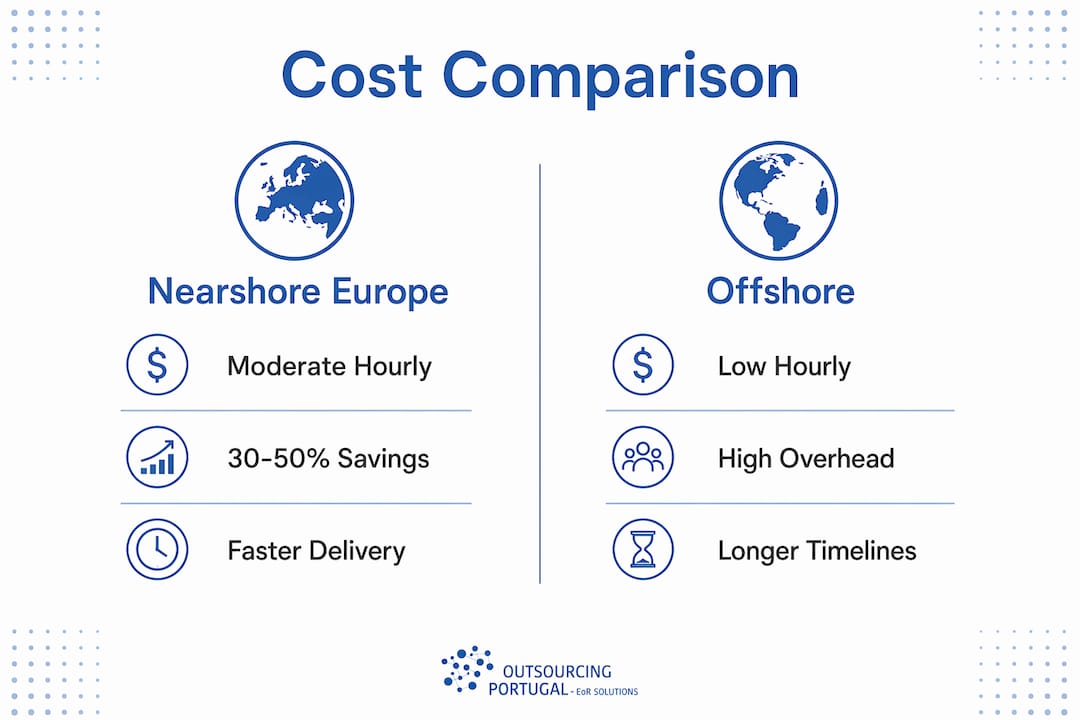
Offshore projects incur hidden costs from coordination overhead, rework, and extended QA that offset lower hourly rates and produce a higher total cost of ownership than nearshore. A six-month offshore engagement with two rework cycles and a three-week QA extension can consume the entire rate differential and more. Nearshore models eliminate most of that overhead through synchronous collaboration and shared context.
The comparison across key dimensions looks like this:
| Dimension | Nearshore Europe | Offshore | Onshore |
|---|---|---|---|
| Hourly rate | Moderate | Low | High |
| Rework frequency | Low | High | Low |
| Time-to-hire | 2 to 4 weeks | 4 to 8 weeks | 3 to 5 months |
| Total cost of ownership | Low to moderate | Moderate to high | High |
| Regulatory risk | Low (EU/GDPR) | High | Low |
| Collaboration effectiveness | High | Low | High |
Nearshore delivers 30 to 50% cost savings versus onshore hiring while maintaining the delivery speed and quality that offshore cannot reliably provide. For companies scaling product teams in 2026, that combination makes nearshoring the default rational choice rather than a compromise position.
Pro Tip: When evaluating nearshore vs offshore proposals, ask vendors to provide a total cost estimate that includes QA cycles, rework allowances, and project management overhead. Rate-only comparisons consistently understate offshore costs by 20 to 40%.
For a deeper breakdown of how these models compare strategically, the offshoring vs nearshoring analysis from Outsourcing-portugal covers the decision framework in detail.
How to choose nearshore services in Europe and build effective partnerships
Selecting a nearshore partner requires evaluating five factors in order of strategic importance:
- Talent pool depth and seniority: Confirm the partner can supply senior engineers with five-plus years of domain experience, not just available headcount. Ask for CVs and conduct technical interviews before signing.
- Time zone overlap: Verify that your core working hours align with at least six hours of the partner’s standard day. Anything less reintroduces the asynchronous friction that nearshoring is designed to eliminate.
- Technical specialization: Match the partner’s demonstrated expertise to your stack. A fintech product team needs a partner with proven fintech delivery, not general web development experience.
- Regulatory compliance: Confirm GDPR compliance, data handling protocols, and employment law adherence. Partners operating through an Employer of Record structure in countries like Portugal provide the cleanest compliance posture for international companies.
- Cultural and communication fit: Conduct a working session, not just a sales call, before committing. How a team handles ambiguity and pushes back on unclear requirements tells you more than any reference check.
Once you select a partner, treat the nearshore team as an embedded unit of your product organization. Assign a dedicated internal point of contact, include nearshore engineers in all sprint ceremonies, and give them access to the same product documentation your onshore team uses. Nearshore services for multinational teams work best when the organizational boundary between internal and external is deliberately blurred.
42% of companies in 2026 prioritize engineer quality over rates when selecting nearshore partners. That shift reflects a maturing understanding that the real cost of a bad hire or a misaligned team far exceeds any hourly rate savings.
Key takeaways
European nearshoring delivers superior project outcomes because it combines time zone alignment, senior talent access, and GDPR compliance into a model that offshore cannot replicate at equivalent total cost.
| Point | Details |
|---|---|
| Time zone overlap drives success | 6 to 8 hours of daily overlap enables real-time collaboration and cuts misunderstandings by 65%. |
| Senior talent at lower cost | Central and Eastern European engineers cost 30 to 50% less than onshore equivalents with no quality drop. |
| GDPR compliance by default | European nearshore teams operate inside EU data protection law, eliminating offshore compliance overhead. |
| Offshore TCO is higher than it appears | Hidden rework, QA, and coordination costs make offshore more expensive than hourly rates suggest. |
| Partner selection determines outcomes | Seniority filters, time zone verification, and treating teams as embedded partners are the decisive success factors. |
What I’ve learned after years of watching nearshore partnerships succeed and fail
Most companies approach nearshoring as a cost exercise and then wonder why the results disappoint. The businesses that get the most out of European nearshore partnerships treat them as a talent strategy, not a procurement decision. That distinction changes everything from how you write the brief to how you run the first sprint.
The single most common failure I see is ignoring seniority filters during vendor selection. A partner who quotes a competitive rate but staffs the engagement with mid-level engineers will cost you more in rework and management overhead than a slightly more expensive team of seniors who own their work. Nearshoring as a strategic default in 2026 means access to specialized hubs unavailable locally, but only if you select for specialization rather than availability.
The second failure is treating time zone overlap as a checkbox rather than a design constraint. Six hours of overlap only delivers value if you actually use it for synchronous work. Teams that default to async communication even when overlap exists recreate the offshore problem voluntarily.
Portugal stands out in my experience as a nearshore location that combines the full package: strong English proficiency, EU regulatory alignment, a growing senior tech community, and a business culture that rewards directness. It is not the cheapest option in Europe, but it consistently produces the lowest total cost of ownership when you factor in communication quality and retention.
— Paulo
Build your nearshore team in Portugal with Outsourcing-portugal
Outsourcing-portugal specializes in helping international companies build compliant, high-performing nearshore teams in Portugal without setting up a local entity. From Employer of Record and payroll services to full hiring, onboarding, and HR support, the platform handles every operational layer so you can focus on product delivery.
Portugal’s combination of EU regulatory compliance, strong English proficiency, competitive labor costs, and Western European time zone alignment makes it one of the most strategically sound nearshore locations available to international businesses in 2026. Whether you are hiring your first nearshore engineer or scaling a team of 50, Outsourcing-portugal provides the infrastructure to do it correctly. Explore the full employment and nearshore services or review the 2026 hiring guide for Portugal to start building your team.
FAQ
What does nearshoring in Europe mean for a US company?
Nearshoring in Europe means partnering with engineering or operations teams in European countries that share cultural norms and, for East Coast US companies, offer 5 to 6 hours of daily working overlap. It provides access to senior EU-based talent under GDPR compliance without the coordination failures of offshore models.
Which are the top nearshore countries in Europe?
Poland, Romania, Portugal, Czech Republic, and Bulgaria are the leading nearshore hubs in Europe, each with strengths in fintech, SaaS, cloud, and cybersecurity. Portugal is particularly strong for companies prioritizing English proficiency, EU compliance, and Western European time zone alignment.
How much can nearshoring in Europe save compared to onshore hiring?
Senior engineers in Central and Eastern European nearshore hubs cost 30 to 50% less than equivalent onshore hires in Western Europe or North America, with faster time-to-hire and no measurable compromise on technical quality.
Is nearshore better than offshore for software development?
Nearshore achieves approximately 80% project success rates versus 60% for offshore, driven by time zone alignment, cultural compatibility, and synchronous collaboration. Offshore models carry hidden costs from rework and coordination overhead that frequently exceed the savings from lower hourly rates.
How do I start nearshoring in Portugal specifically?
The fastest path is through an Employer of Record provider like Outsourcing-portugal, which handles hiring, payroll, legal compliance, and onboarding without requiring you to establish a Portuguese legal entity. This approach reduces time-to-hire to two to four weeks for vetted senior talent.