
TL;DR:
- Effective remote onboarding involves a structured, multi-phase process that ensures new hires gain full productivity within the first 30 days. It emphasizes early system access, clear success metrics, social integration through dedicated communication, and consistent use of defined tools and conventions. Addressing common challenges like delays, silos, and cultural differences promotes seamless team integration and reduces attrition risk.
Effective remote onboarding is a structured, phased process that determines whether a new hire reaches full productivity within 30 days or stalls for months. Structured onboarding achieves up to a 95% success rate by day 30 when preboarding, technical setup, and social integration are executed in sequence. The industry term for this is structured remote onboarding, and it goes far beyond sending a welcome email and a laptop. Tools like Slack, Jira, and VS Code Live Share are table stakes. What separates high-performing international teams from struggling ones is the process wrapped around those tools.
What are the essential phases of onboarding a remote team member?
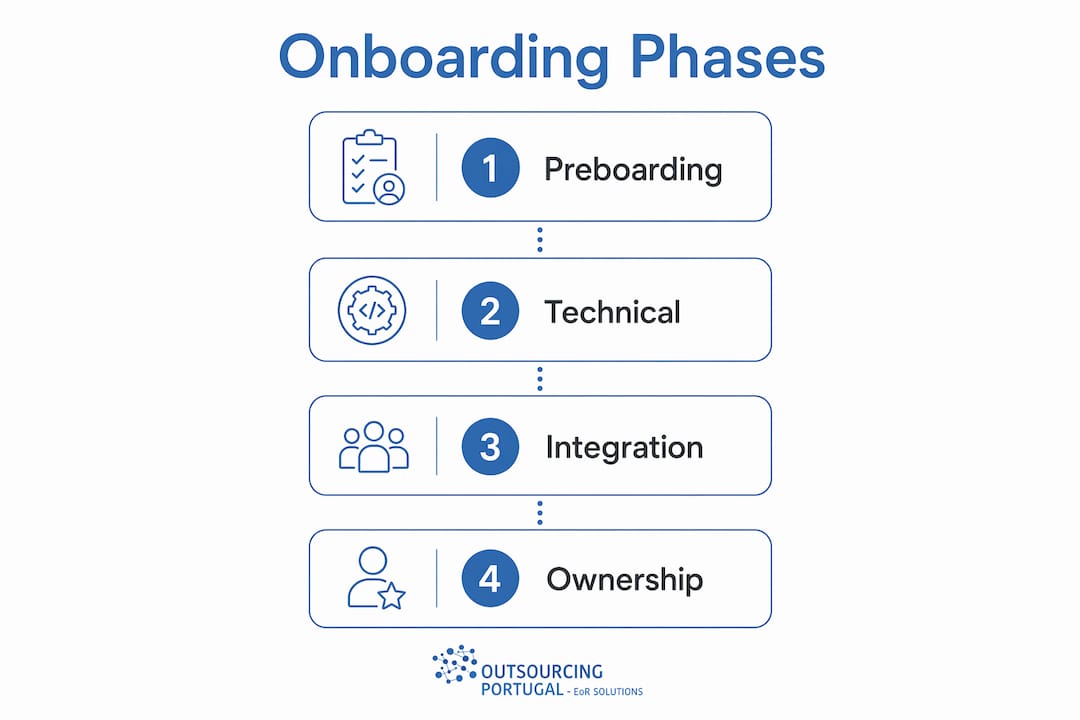
Remote team integration follows four distinct phases. Each has a defined timeline and clear deliverables. Skipping any phase is the single most common reason new hires disengage before the 90-day mark.
Phase 1: preboarding (2–4 weeks before start date)
Preboarding is not optional. Verify individual permissions for every role-specific system at least 7 days before the start date to avoid idle time on day one. This phase includes provisioning hardware, granting access to GitHub, Jira, and Confluence, and sending a structured welcome document that covers team norms, communication channels, and the first week’s schedule. A new hire who arrives on day one with full system access and a clear agenda is already ahead of 80% of remote hires globally.

Phase 2: technical onboarding (days 1–5)
The first week is about environment, not output. Walk the new hire through your CI/CD pipeline, code review process, and deployment workflow before assigning any real tasks. Pair them with a senior engineer for VS Code Live Share sessions to observe how the team actually works, not just how it’s documented. This phase ends when the new hire has successfully merged their first pull request, however small.
Phase 3: team integration (days 6–21)
Social connection is the hardest part of remote onboarding to systematize. Assigning a buddy with remote work experience before the start date significantly improves cultural acclimation and communication fluency. The buddy is not a manager. Their job is to answer the questions a new hire would never ask in a standup. Schedule at least three informal video calls in this phase, separate from project work.
Phase 4: progressive task ownership (days 22–30)
By week four, the new hire should own at least one feature or workstream independently. Progressive ownership means starting with well-scoped tickets, then moving to ambiguous ones, then to cross-team coordination. This ramp is not about speed. It’s about building the confidence that remote workers lose when they feel invisible.
| Phase | Timeline | Key Deliverable |
|---|---|---|
| Preboarding | 2–4 weeks before start | System access, welcome doc, buddy assigned |
| Technical onboarding | Days 1–5 | First PR merged, environment configured |
| Team integration | Days 6–21 | Three informal calls, standup participation |
| Progressive ownership | Days 22–30 | Independent feature or workstream owned |
Which tools and communication protocols drive onboarding success?
The right tools matter less than the conventions around them. A team using Slack without communication norms is slower than a team using email with clear protocols. Both matter, but process wins.
The core tool stack
Every remote team needs a defined stack before the new hire’s first day. The following categories are non-negotiable:
- Async messaging: Slack or Microsoft Teams, with defined channel naming and tagging conventions
- Project tracking: Jira or Linear, with a single board the new hire is added to immediately (not a separate onboarding board)
- Documentation: Confluence or Notion as the single source of truth. Clear, written success metrics prevent early disengagement by giving remote hires a concrete definition of “doing well”
- Code collaboration: VS Code Live Share or GitHub Codespaces for synchronous pair programming
- Video: Zoom or Google Meet, reserved for high-context conversations only
Communication conventions that cut cycle time
High-performing remote teams reduce PR cycle times from 2.3 days to 0.8 days by enforcing mandatory blocker-resolution formats and standardized PR tags. That is a 65% reduction. The mechanism is simple: every PR comment is tagged with [nit], [suggestion], or [required] so the author knows exactly what needs action versus what is optional feedback.
Pro Tip: Enforce your PR tagging system in the onboarding documentation on day one. New hires who learn the convention immediately never develop the habit of leaving ambiguous comments, which is far harder to correct later.
Async updates should follow a structured format: what was completed, what is in progress, and what is blocked. Blockers get a 4-hour response SLA. This single convention eliminates the “waiting in silence” problem that derails remote hires in their first month.
How can managers build real social integration for remote hires?
The most difficult remote integration challenge is fostering human connection. Proactive culture-building measures are not a nice-to-have. They are the difference between a hire who stays and one who quietly disengages.
Isolation is the primary attrition driver for remote employees, and it sets in faster than most managers expect. By week three, a remote hire who has only attended standups and code reviews already feels peripheral. The fix requires deliberate scheduling, not goodwill.
- Schedule a minimum four-hour daily overlap exclusively for synchronous collaboration. Use that time for pair programming, architecture discussions, and design reviews, not status updates.
- Mix synchronous “get to know me” sessions with asynchronous learning. A 15-minute informal video call at the start of the week costs almost nothing and builds more trust than a month of Slack messages.
- Add the new hire to every channel the team uses, including the informal ones. Separate standups and Jira boards create a silo effect that limits remote employees and signals they are second-class team members.
- Use async video tools like Loom for walkthroughs. A 3-minute Loom explaining a codebase decision is more human than a 300-word Confluence page.
Pro Tip: Ask the buddy to send a short async video introduction before the new hire’s first day. It removes the awkwardness of the first real-time interaction and gives the new hire a face to look for in meetings.
For international teams, cultural nuance adds another layer. A hire in Lisbon joining a team in Berlin has different communication norms than a hire in Manila joining a team in Austin. Acknowledge those differences explicitly in the onboarding documentation rather than assuming a universal “remote culture” covers everything. You can find detailed guidance on this in Outsourcing-portugal’s international onboarding guide for HR teams.
What are the most common remote onboarding challenges?
Most remote onboarding failures trace back to four predictable problems. Each has a direct fix.
-
Delayed system access. A new hire who spends day one waiting for GitHub permissions is already disengaged. The fix is a pre-start access checklist owned by IT, not the hiring manager, with a hard deadline of 7 days before the start date.
-
No defined success metrics. Managers significantly underperform without explicit onboarding scripts and step-by-step guidance. Without a written definition of what “good” looks like at 30, 60, and 90 days, both the manager and the new hire are guessing. Write the metrics before the hire starts.
-
Time zone and communication overload. Scheduling every meeting in the manager’s time zone and flooding the new hire with Slack notifications in their off-hours is a fast path to burnout. Establishing daily async updates with synchronous overlap reserved for high-context collaboration solves both problems.
-
Silo formation. Giving the new hire a separate onboarding Jira board or a dedicated onboarding standup feels helpful. It is not. It delays real integration by weeks.
The best remote onboarding process is one that makes the new hire feel like a full team member on day one, not a guest who earns access over time.
Proactive check-ins at days 3, 7, 14, and 30 catch problems before they become attrition events. Use a structured format: what is working, what is confusing, and what does the new hire need that they do not have. This is also a useful offshore staff retention practice for distributed teams managing multiple time zones.
Key takeaways
Effective remote onboarding requires four sequential phases, a defined tool stack with enforced communication conventions, and deliberate social integration to prevent isolation and attrition.
| Point | Details |
|---|---|
| Start preboarding early | Grant system access 7 days before the start date to eliminate idle time on day one. |
| Use structured communication | Enforce PR tags like [nit] and [required] to cut review cycle times by up to 65%. |
| Assign a remote-experienced buddy | A buddy improves cultural acclimation faster than any formal training program. |
| Eliminate onboarding silos | Add new hires to all shared channels and boards immediately, never to separate ones. |
| Define success metrics in writing | Written 30/60/90-day goals prevent disengagement and give managers a clear coaching framework. |
What i’ve learned about remote onboarding that most guides skip
I have reviewed dozens of remote onboarding frameworks across international teams, and the pattern is consistent. Companies invest heavily in tools and almost nothing in manager preparation. The assumption is that a good manager knows how to onboard remotely. That assumption is wrong.
Most managers are excellent at in-person onboarding because the environment does the work for them. The new hire sees the team, absorbs the culture, and asks questions naturally. Remove that environment and the manager’s instincts stop working. They default to fewer check-ins, not more. They assume silence means progress. It rarely does.
The fix I keep recommending is a manager-facing onboarding script, not just a new hire checklist. The script tells the manager exactly what to say on day one, what questions to ask on day seven, and what warning signs to watch for at day 14. It sounds prescriptive. It works.
The second thing most guides skip is the “remote vs. in-house” silo problem. I have seen teams where the remote hires had their own standup, their own Jira board, and their own Slack channel. The managers thought they were being considerate. The remote hires felt excluded. Unified workflows are not just an efficiency choice. They are a cultural statement about who belongs to the team.
For international teams specifically, the cultural dimension requires explicit attention. A hire in Portugal joining a U.S. team will navigate different norms around directness, hierarchy, and meeting participation. Naming those differences in the onboarding documentation is not patronizing. It is the kind of preparation that separates teams that integrate well from teams that tolerate each other.
— Paulo
How Outsourcing-portugal supports remote team onboarding
Building a remote team across borders adds legal, payroll, and compliance complexity on top of the onboarding process itself. Outsourcing-portugal handles the infrastructure so your HR team can focus on integration, not paperwork.
Outsourcing-portugal provides Employer of Record services in Portugal that cover compliant hiring, payroll, and HR support for international companies building nearshore teams. You get a fully onboarded employee in Portugal without setting up a local entity. For managers who want to go deeper on the process side, the HR onboarding strategies guide covers structure and local compliance in detail. If you are evaluating whether Portugal is the right location for your next remote hire, Outsourcing-portugal’s team can walk you through the full setup.
FAQ
What is the ideal timeline for remote onboarding?
The most effective remote onboarding runs across four phases from 2–4 weeks before the start date through day 30. Structured onboarding achieves up to a 95% success rate by day 30 when all phases are completed in sequence.
How do you prevent isolation in remote new hires?
Schedule intentional 15–20 minute social video calls weekly and assign a remote-experienced buddy before the start date. Proactive culture-building is the primary defense against early disengagement.
What tools are non-negotiable for onboarding virtual employees?
Slack or Microsoft Teams for async messaging, Jira or Linear for project tracking, Confluence or Notion for documentation, and Zoom or Google Meet for synchronous calls form the minimum viable stack for onboarding virtual employees.
How do you measure remote onboarding success?
Define written success metrics at 30, 60, and 90 days before the hire starts. Without clear benchmarks, managers underperform and new hires disengage because neither party has a shared definition of progress.
What is the biggest mistake managers make when training remote workers?
Creating separate onboarding workflows, such as dedicated standups or isolated Jira boards, is the most damaging mistake. Separate boards cause a silo effect that limits remote employees and delays genuine team integration by weeks.