
TL;DR:
- Workforce competitiveness relies on developing a skilled, engaged, and agile workforce capable of high performance across market changes. Effective management, employee engagement, workforce agility, and technology integration are the primary drivers of this competitiveness. Organizations that focus on continuous skill development, strategic leadership, and realistic technology use outperform their competitors in the long run.
Workforce competitiveness is defined as an organization’s ability to develop and sustain a skilled, engaged, and agile workforce that performs at a high level across changing market conditions. The role of workforce competitiveness in driving business outcomes is no longer debatable. Global employee engagement sits at just 20%, and that disengagement cost the world over $10 trillion in lost productivity in 2024 alone, equal to 9% of global GDP. Gallup’s research and the Global Talent Competitiveness Index both confirm that organizations and nations that treat workforce capability as a strategic asset consistently outperform those that treat it as a cost center. This guide gives business leaders and HR professionals a clear framework for understanding what drives workforce competitiveness and how to act on it.
What factors drive workforce competitiveness?
Workforce competitiveness depends on four primary factors: employee engagement, skills development, management quality, and workforce agility. Each factor compounds the others. A highly skilled team with poor management will underperform a moderately skilled team with strong leadership.

Employee engagement is the most measurable driver. High-engagement teams show 18%–43% lower turnover and recover faster from economic downturns. That range reflects industry differences, but the direction is consistent across every sector Gallup has studied.
Management quality matters more than most leaders expect. Management practices influence engagement roughly four times more than work location or hybrid policies. That finding should reframe how you allocate HR investment. Spending heavily on office design while neglecting manager development is a losing trade.
Workforce agility is the third critical factor. Agility, the ability to quickly redeploy talent to high-value projects, is now a decisive competitive advantage. Organizations that can shift human capital fast respond to market disruption before competitors can even convene a planning meeting.
Technology integration rounds out the picture. AI and digital tools accelerate output, but they do not replace the human factors above. Technology amplifies a competitive workforce. It cannot substitute for one.
- Employee engagement directly reduces turnover and improves financial recovery speed
- Manager quality outweighs location policy by a factor of four
- Workforce agility enables faster response to market shifts
- AI integration multiplies the output of already-capable teams
Pro Tip: Before investing in new HR technology, audit your manager development program. The research is clear: the manager layer is where workforce competitiveness is won or lost.
How do national and organizational strategies shape workforce competitiveness?
The Global Talent Competitiveness Index identifies three pathways that nations and organizations use to build competitive workforces: technology-driven, organization-driven, and environment-driven. Understanding which pathway your organization or operating country follows helps you align your workforce development strategies with the structural forces already in play.
The technology-driven pathway is the most significant of the three. Countries and companies on this path invest heavily in digital infrastructure, ICT adoption, and AI readiness. Portugal, for example, has built a strong reputation in the EU talent rankings partly through its digital infrastructure and multilingual tech workforce, making it a natural fit for nearshore operations. You can review the EU talent ranking breakdown to see how education and R&D investment translate into workforce output.
The organization-driven pathway centers on tertiary education, research and development, and internal talent systems. Companies that build proprietary learning academies, fund graduate pipelines, or partner with universities operate on this pathway. The payoff is a workforce that generates intellectual capital rather than just executing tasks.
The environment-driven pathway relies on social mobility, entrepreneurship culture, and regulatory flexibility. Nations with low barriers to labor market entry and strong retraining infrastructure produce workforces that adapt faster to economic shifts.
| Pathway | Primary Lever | Business Impact |
|---|---|---|
| Technology-driven | Digital infrastructure, AI adoption | Faster output, scalable operations |
| Organization-driven | Education, R&D, internal talent systems | Innovation capacity, IP generation |
| Environment-driven | Social mobility, entrepreneurship, regulation | Workforce adaptability, talent supply depth |
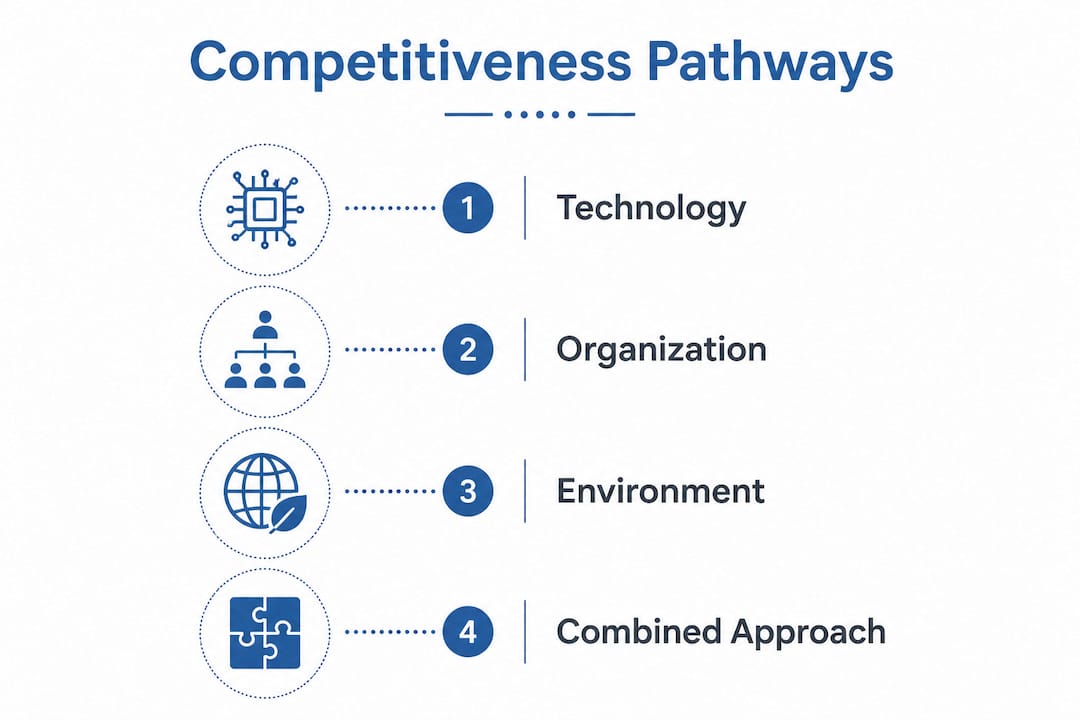
Most organizations do not operate on a single pathway. The strongest performers combine elements of all three, using technology to scale, education to deepen capability, and flexible structures to retain talent. For a broader look at how multinational HR strategies map to these pathways, Outsourcing-portugal has published a detailed 2026 global guide worth reviewing.
What role does employee engagement play in workforce performance?
Employee engagement is the single most measurable predictor of workforce performance, and its current trajectory is alarming. Manager engagement dropped from 31% in 2022 to 22% in 2025, according to Gallup’s State of the Global Workplace 2026 Report. That decline cascades directly into team-level disengagement, because managers set the emotional tone for every person they lead.
The gap between average and best-in-class is stark. Best-performing organizations sustain 79% manager engagement by treating manager wellbeing and coaching as a strategic priority, not a wellness perk. That is nearly four times the global average. The difference is not budget. It is deliberate design.
Here is what the research shows about the impact of employee engagement on workforce performance:
- Teams with high engagement recover faster after financial downturns and sustain better earnings-per-share growth
- Manager disengagement is contagious: a burned-out manager produces a disengaged team within months
- Coaching-focused management cultures retain experienced workers at significantly higher rates
- Wellbeing investment at the manager level produces returns at the team level within one to two performance cycles
Pro Tip: Measure manager engagement separately from overall employee engagement in your annual survey. Most organizations track only the aggregate number and miss the early warning signal hiding in the manager cohort.
The importance of employee skill development compounds engagement effects. Employees who see a clear path to skill growth report higher engagement scores and lower intent to leave. Linking learning programs directly to internal mobility creates a reinforcing cycle: skilled employees stay, and staying employees become more skilled.
How can organizations practically enhance workforce competitiveness?
Enhancing workforce productivity requires moving from static annual training programs to continuous, employer-driven skill systems. Ongoing employer-driven development systems that update skill requirements in real time using labor market data consistently outperform programs built on last year’s competency frameworks. The workforce that wins in 2026 is the one whose skills reflect what the market needs today, not what it needed when the training catalog was last updated.
Here is a practical sequence for building that system:
- Audit current skills against live labor market data. Use tools like LinkedIn Talent Insights or Burning Glass Technologies to identify gaps between your workforce’s current capabilities and what the market is demanding right now.
- Build stackable credentials into your learning architecture. Stackable credentials and internal mobility turn workforce development into a retention engine. Employees who earn recognized credentials through your programs have a concrete reason to stay.
- Redesign workflows for human-AI collaboration, not just AI adoption. AI adoption fails without workflow redesign for human-AI collaboration. Buying AI tools and dropping them into existing processes produces friction, not efficiency.
- Tie resource planning to innovation targets. Efficient allocation of financial, human, and technology resources has a measurable positive relationship with both innovation output and experienced worker retention. Resource planning is not just a finance function. It is a workforce competitiveness function.
- Make diversity a performance variable, not a compliance metric. Workforce diversity produces competitive advantage only when paired with inclusive leadership and innovation-oriented behavior. Diverse teams with directive, non-inclusive management do not outperform homogeneous teams. The leadership layer is the variable that determines whether diversity becomes strength.
The common thread across all five steps is intentionality. Competitiveness in the labor market does not emerge from good intentions or annual HR reviews. It is built through systems that update continuously, leaders who coach deliberately, and organizations that treat skill development as a core business function. For companies looking to attract top talent in competitive markets, strategies for tech talent acquisition from Cornerstone Search offer a useful practitioner perspective.
Key takeaways
Workforce competitiveness is built through deliberate systems of engagement, skill development, and management quality, not through technology adoption alone.
| Point | Details |
|---|---|
| Engagement drives financial outcomes | High-engagement teams show 18%–43% lower turnover and recover faster from economic downturns. |
| Managers are the linchpin | Manager engagement fell to 22% globally; best organizations sustain 79% through coaching and wellbeing investment. |
| Three pathways shape strategy | Technology-driven, organization-driven, and environment-driven pathways each require different HR investment priorities. |
| Real-time skill systems win | Employer-driven development programs updated with live labor market data outperform static annual training. |
| AI requires workflow redesign | Integrating AI without redesigning workflows produces friction; human-AI collaboration is the true competitive lever. |
The uncomfortable truth about workforce competitiveness in 2026
I have worked with enough leadership teams to know that most organizations talk about workforce competitiveness as if it is primarily a talent acquisition problem. Hire better people, the thinking goes, and the rest follows. That framing is wrong, and the data proves it.
The real bottleneck is almost always in the middle of the organization. Manager engagement at 22% globally is not a talent shortage problem. It is a leadership design problem. Organizations that have cracked this invest in their managers the way they invest in their best clients: with attention, resources, and genuine care for outcomes. The ones that treat manager development as a checkbox exercise watch their best individual contributors leave within 18 months.
The second thing I see consistently underestimated is the cost of misaligned technology investment. Buying AI tools without redesigning the workflows around them is the 2026 version of buying expensive software that nobody uses. The organizations pulling ahead are not the ones with the most AI licenses. They are the ones that asked hard questions about how work actually gets done and rebuilt those processes around human-AI collaboration.
Portugal is a strong example of what environment-driven and technology-driven pathways look like in practice. A multilingual, highly educated workforce combined with EU regulatory stability gives international companies a real structural advantage when building nearshore teams. That is not marketing. It is what the Global Talent Competitiveness Index data reflects.
The organizations that will lead in 2030 are building their workforce systems now, not reacting to talent shortages when they arrive.
— Paulo
Build a more competitive workforce with Outsourcing-portugal
Workforce competitiveness depends on having the right talent in place, with the right legal and HR infrastructure supporting them. Outsourcing-portugal gives international companies direct access to Portugal’s skilled, multilingual workforce through fully compliant Employer of Record and payroll services that remove the complexity of local entity setup. Whether you are building a nearshore tech team or expanding your European operations, the platform handles hiring, onboarding, compliance, and HR support so your leadership team can focus on performance, not paperwork.
If you are ready to turn workforce strategy into a real competitive advantage, explore Portugal employment solutions and see how Outsourcing-portugal can accelerate your next hire.
FAQ
What is workforce competitiveness?
Workforce competitiveness is an organization’s ability to develop and maintain a skilled, engaged, and agile workforce that performs at a high level in global markets. It directly influences productivity, innovation capacity, and long-term business performance.
Why does employee engagement affect competitiveness?
High employee engagement reduces turnover by 18%–43% and improves financial recovery speed after downturns, according to Gallup research. Low engagement costs the global economy over $10 trillion in lost productivity annually.
What is the biggest driver of manager disengagement?
Gallup’s 2026 data shows manager engagement dropped from 31% in 2022 to 22% in 2025, primarily because organizations fail to invest in manager wellbeing and coaching as strategic priorities rather than optional programs.
How does AI fit into workforce competitiveness?
AI improves workforce output only when workflows are redesigned for human-AI collaboration. Deploying AI tools without restructuring how work gets done produces friction rather than competitive advantage.
How can small organizations compete on workforce quality?
Small organizations compete by building employer-driven skill systems that update continuously with labor market data and by prioritizing manager quality over headcount. Stackable credentials and internal mobility programs retain talent without requiring large training budgets.