
TL;DR:
- An Employer of Record (EOR) is a third-party company that legally employs workers for foreign businesses, managing contracts, payroll, and compliance. Implementing EOR in Portugal requires thorough internal alignment, legal compliance, and careful onboarding, with the first payroll serving as a crucial validation point. EOR is ideal for quick market entry, but as team size grows, transitioning to a local entity becomes more cost-effective.
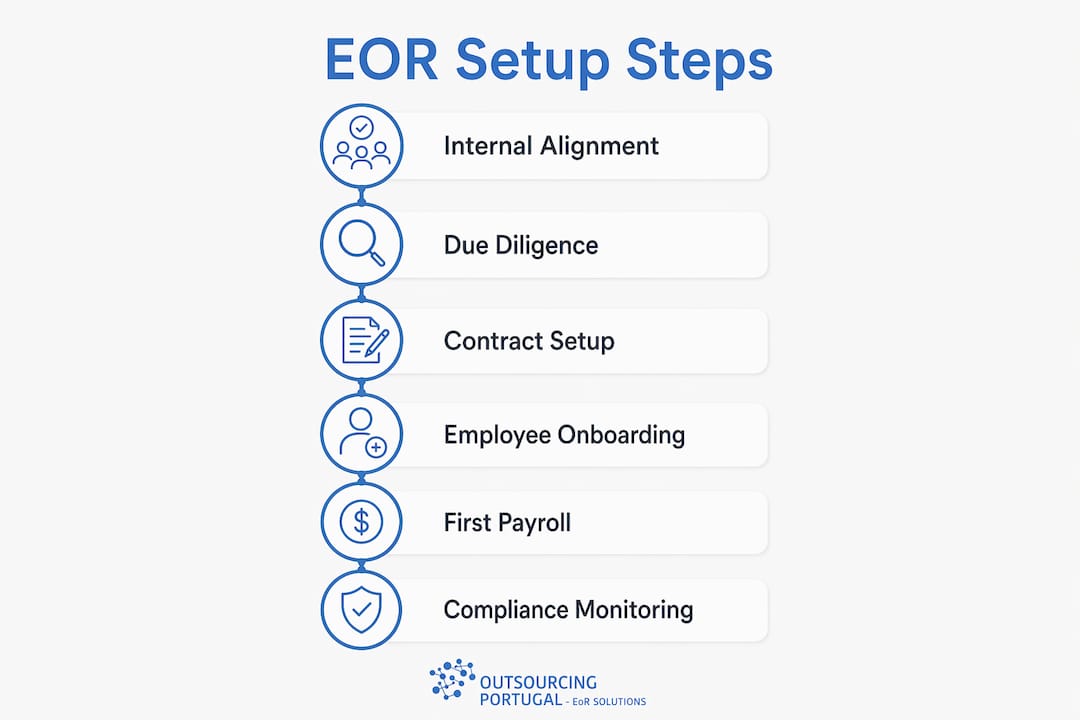
An Employer of Record (EOR) is a third-party company that legally employs workers on behalf of a foreign business, handling contracts, payroll, and statutory compliance. The EOR setup step by step process in Portugal runs from internal alignment through first payroll, typically completing in 4–6 weeks from contract signing. For business executives and HR professionals hiring internationally, this structure removes the need to register a local entity while keeping every hire fully compliant with Portuguese labor law. The ACT (Authority for Working Conditions) and Portugal’s Labor Code set the compliance floor. Getting each phase right from the start prevents costly rework later.
What prerequisites must be completed before engaging an EOR in Portugal?
Internal alignment is the single most important factor before any EOR implementation guide can move forward. Finance, Legal, HR, and IT must agree on budgets, headcount plans, employment classifications, and compliance responsibilities before you sign anything with a provider.

A single internal go-live owner is not optional. Without a clear internal owner for onboarding governance, decisions slip, compensation structures become misaligned, and contract terms get set incorrectly. Assign one person with authority to track sign-offs across all four departments.
Due diligence on your EOR provider covers three areas: their track record with Portuguese labor law, their payroll infrastructure, and their data security certifications. Verify that the provider registers employment contracts electronically with the ACT, as this is a legal requirement, not a best practice. Check their process for handling work permits and right-to-work verification for non-EU nationals.
| Prerequisite | Owner | Status Check |
|---|---|---|
| Budget approval for EOR fees and benefits | Finance | Signed off before provider contract |
| Employment classification confirmed | Legal | Contractor vs. employee decision documented |
| Hiring plan and start dates confirmed | HR | Headcount list with target go-live dates |
| IT access and equipment plan defined | IT | Provisioning timeline agreed with HR |
| EOR provider due diligence complete | Legal + HR | Compliance credentials verified |
Pro Tip: Appoint your go-live owner before the first call with the EOR provider. That person should attend every kickoff meeting and own the internal checklist from day one.
Which legal steps ensure compliance with Portuguese employment law?
Portuguese employment contracts must be written. The mandatory contract content includes employer and employee identification, valid work visa or residence permit details, job description, remuneration, work location, working hours, and start date. Missing any of these elements creates legal exposure for both the EOR and your company.
Every employment contract must be electronically communicated to the ACT. This is a non-negotiable step in the EOR setup process. Your EOR partner handles this filing, but you must confirm it has been completed before the employee’s first day.
A critical legal point that many executives overlook: choice-of-law clauses cannot override mandatory Portuguese employee protections when work is performed primarily in Portugal. Under Rome I regulations, Portuguese labor law applies regardless of what the contract states about governing law. This means benefits, notice periods, and termination rights follow Portuguese standards.
Statutory benefits enrollment covers four areas:
- Social security registration: The EOR registers the employee with Segurança Social and remits contributions monthly.
- Workplace accident insurance: Mandatory for all employees in Portugal. The EOR holds this policy.
- Health insurance: Not legally required but standard practice for competitive hiring. Confirm coverage scope with your EOR.
- Pension contributions: Covered through social security contributions rather than a separate pension scheme in most cases.
Noncompliance penalties in Portugal range from administrative fines to criminal liability for repeated violations. The ACT conducts inspections and can audit employment records at any time.
Pro Tip: Ask your EOR provider for written confirmation of ACT registration within 48 hours of the employee’s contract being signed. Do not assume it has been filed.
How to execute employee onboarding and documentation collection
EOR engagement enables hiring in days, not months, compared to setting up a local entity. That speed advantage disappears if document collection is slow. Collect the following from every new hire before their start date: passport or national ID, Portuguese tax identification number (NIF), social security number (NISS), bank account details, and any professional qualifications relevant to the role.
The most common onboarding bottleneck is delays in document collection and local bank account setup. Non-EU employees relocating to Portugal often need weeks to open a Portuguese bank account. Build that timeline into your go-live plan and communicate it to the employee on day one of the process.
Follow these steps for a clean onboarding execution:
- Send the document checklist to the employee at least 10 business days before their start date. Include a clear deadline and a named contact for questions.
- Use a digital signature platform for contract execution. Digital signature tools accelerate contract execution and satisfy Portuguese electronic employment contract requirements.
- Confirm benefits enrollment with the EOR before the start date. Social security and accident insurance must be active on day one.
- Coordinate IT provisioning in parallel with HR onboarding. The EOR does not issue equipment. Your company retains that responsibility.
- Establish an escalation path for employee questions. Payroll queries go to the EOR. Access and equipment issues go to your IT team. Make this clear in the employee welcome communication.
For remote or relocating employees, assign a local contact who can assist with practical steps like NIF registration and bank account opening. This reduces delays that would otherwise push back the first payroll cycle.
Pro Tip: Create a shared onboarding tracker visible to HR, IT, and the EOR. Update it daily during the first two weeks. It eliminates the “who is handling this?” problem that derails most go-lives.
What does the first payroll process involve and how do you validate it?
First payroll is the validation point for every prior step. Parallel payroll runs are the standard approach when migrating existing employees or converting contractors. Run the EOR payroll alongside your current system for one cycle to catch discrepancies before cutting over completely.
Finance sign-off on the first payslip is mandatory. Validate tax withholding rates (IRS in Portugal), social security deductions, net pay calculations, and any benefit contributions. A single error in the first cycle creates trust issues with the employee and triggers correction cycles that delay subsequent payrolls.
| Payroll milestone | Responsible party | Typical timing |
|---|---|---|
| Employee data submitted to EOR | HR | Week 3–4 of implementation |
| Payroll inputs locked | Finance + HR | 5 business days before pay date |
| Draft payslip review | Finance | 3 business days before pay date |
| Finance sign-off | Finance Director | 2 business days before pay date |
| Payroll executed and payslips issued | EOR | Pay date |
| Benefits remittances confirmed | EOR | Within 5 days of pay date |
Post go-live, establish a compliance calendar. This covers monthly social security remittances, quarterly IRS reconciliations, and annual holiday accrual reviews. Your EOR handles the filings, but your Finance team should track deadlines independently as a control measure.
A phased EOR implementation approach covering country decision, contract setup, onboarding, benefits, payroll launch, and governance reduces risk at every stage. Treat each phase as a gate. Do not advance to the next phase until the current one has Finance and Legal sign-off.
Pro Tip: Log your new hire’s official start date and set a 12-month calendar reminder to assess whether entity setup makes more sense than continued EOR reliance. Monitoring entity transition deadlines prevents you from staying on EOR longer than is cost-effective.
Key takeaways
A successful EOR setup in Portugal requires internal alignment across Finance, Legal, HR, and IT before any provider engagement begins, with first payroll serving as the final compliance checkpoint.
| Point | Details |
|---|---|
| Assign a go-live owner early | One internal owner tracking all sign-offs prevents misaligned contracts and payroll errors. |
| Written contracts are mandatory | Portuguese law requires written contracts filed electronically with the ACT before day one. |
| Rome I limits contract flexibility | Choice-of-law clauses cannot override mandatory Portuguese labor protections. |
| Document collection drives the timeline | Delays in NIF, NISS, and bank account setup are the most common causes of payroll delays. |
| First payroll needs Finance sign-off | Validate tax withholding and statutory deductions before executing the first pay cycle. |
What I have learned managing EOR go-lives in Portugal
The executives who struggle most with EOR setup are the ones who treat it as a vendor handoff. They sign the EOR contract, send over a few employee names, and expect the provider to handle everything. That approach fails reliably.
The biggest driver of a clean first payroll is internal alignment across Finance, Legal, and IT before onboarding begins. The EOR provides the legal and payroll infrastructure. Your team provides the governance. Neither side can substitute for the other.
The second pattern I see repeatedly is underestimating the document collection timeline for non-EU employees. A Portuguese NIF takes days to obtain. A bank account can take two to three weeks. If HR sends the document checklist on the employee’s first day, the first payroll will be late. Send it the moment the offer is accepted.
One more point worth stating directly: EOR is the right tool for market entry, short-term projects, and testing Portuguese hiring before committing to a local entity. It is not a permanent substitute for entity setup if you plan to hire more than 10 to 15 people in Portugal long-term. The cost-benefit calculation shifts. Build that review into your governance calendar from the start, and you will make the transition on your terms rather than reactively.
— Paulo
Outsourcing-portugal’s EOR and payroll services for Portugal
International companies hiring in Portugal need a partner with direct experience in Portuguese labor law, ACT compliance, and local payroll execution.
Outsourcing-portugal provides end-to-end EOR and payroll services covering contract issuance, social security registration, benefits enrollment, and monthly payroll management. The team handles ACT filings, tax withholding, and statutory remittances so your HR and Finance teams focus on the business rather than compliance administration. For companies ready to hire in Portugal without setting up a local entity, employment and EOR services from Outsourcing-portugal provide a direct path to compliant, fast hiring.
FAQ
What is the typical EOR setup timeline in Portugal?
EOR implementation averages 4–6 weeks from contract signing to first payroll, with employee onboarding typically taking 5–14 business days depending on document readiness.
Does Portuguese law override the governing law in an EOR contract?
Yes. Under Rome I regulations, mandatory Portuguese protections apply to all employees working primarily in Portugal, regardless of any choice-of-law clause in the employment contract.
What documents does an employee need for EOR onboarding in Portugal?
Every employee needs a passport or national ID, a Portuguese tax identification number (NIF), a social security number (NISS), and a local bank account. Non-EU employees may also need a valid residence permit.
Can an EOR issue equipment to employees in Portugal?
No. An EOR handles legal employment and payroll infrastructure, but equipment provisioning remains the responsibility of the client company.
When should a company switch from EOR to a local entity in Portugal?
EOR works well for market entry and small teams. Once headcount grows beyond 10–15 employees in Portugal, the cost and control benefits of a local entity typically outweigh continued EOR reliance. Set a review date at the 12-month mark.