

TL;DR:
- Global payroll involves managing employee payments across countries using legal entities to ensure compliance. Most companies use a hybrid approach of EOR in new markets and global payroll once establishing local entities, balancing costs and legal risks. Proper planning and local expertise are essential to avoid costly compliance errors and hidden expenses.
Global payroll is the system businesses use to manage and pay employees across multiple countries through their own legal entities, ensuring compliance with local tax laws, labor regulations, and compensation standards. Unlike a single-country payroll, international payroll requires your organization to navigate dozens of distinct regulatory environments simultaneously. The stakes are high: late or incorrect statutory filings can trigger penalties that erode the cost savings you built your expansion around. This guide breaks down what global payroll actually costs, how it differs from Employer of Record services, and how to run it without compliance gaps.
What operational complexities does global payroll involve?
Global payroll is not a single process. It is a collection of country-specific obligations running in parallel, each with its own deadlines, tax codes, and reporting formats.
The core challenges fall into three categories:
- Compliance with local labor laws. Every country defines working hours, overtime, severance, and mandatory benefits differently. Germany’s works council requirements, France’s 35-hour workweek rules, and Portugal’s mandatory 13th-month salary are not optional. Missing any one of them creates legal exposure.
- Multi-currency payments. Multi-currency payroll requires accurate currency conversion, real-time awareness of exchange rate fluctuations, and payment in each employee’s local currency. A 3% swing in the euro-to-dollar rate can materially affect your payroll budget within a single quarter.
- Statutory reporting and filing deadlines. Social security contributions, income tax withholding, and employer filings each carry country-specific due dates. A missed filing in Brazil or Spain is not a minor administrative error. It is a regulatory violation with financial consequences.
- System capability. A payroll system built for one country rarely handles multi-language interfaces, multiple tax engines, and cross-border reporting out of the box. Retrofitting a domestic system for global use is one of the most common and costly mistakes HR teams make.
- Accuracy under volume. As headcount grows across geographies, manual processes break down. Payroll automation that handles tax withholding, employer contributions, filings, and payments is the only way to maintain accuracy at scale.
Pro Tip: Map every country’s payroll calendar before you go live. Filing deadlines for social security, income tax, and annual reports rarely align across borders. A shared compliance calendar prevents the most common and most avoidable penalties.
A scalable payroll system must anticipate language diversity, multiple currencies, complex tax filing requirements, and compliance across jurisdictions from day one. Building that capability after the fact costs far more than designing for it upfront.

How does global payroll differ from Employer of Record services?
The distinction between global payroll and Employer of Record (EOR) services is the single most misunderstood concept in international workforce management. Conflating the two leads to budget overruns and unexpected legal exposure.
Global payroll requires your own legal entities. You are the employer of record in every country where you operate. Your entity signs the employment contracts, owns the compliance obligations, and carries the legal risk. EOR services, by contrast, place the legal employer role with a third-party provider. That provider hires your workers on your behalf, handles all local compliance, and bills you a management fee.
The cost difference is significant:
| Model | Cost per employee per month | Legal employer | Entity required |
|---|---|---|---|
| Global payroll | $25–$200 | Your company | Yes |
| Employer of Record | $399–$699 | EOR provider | No |
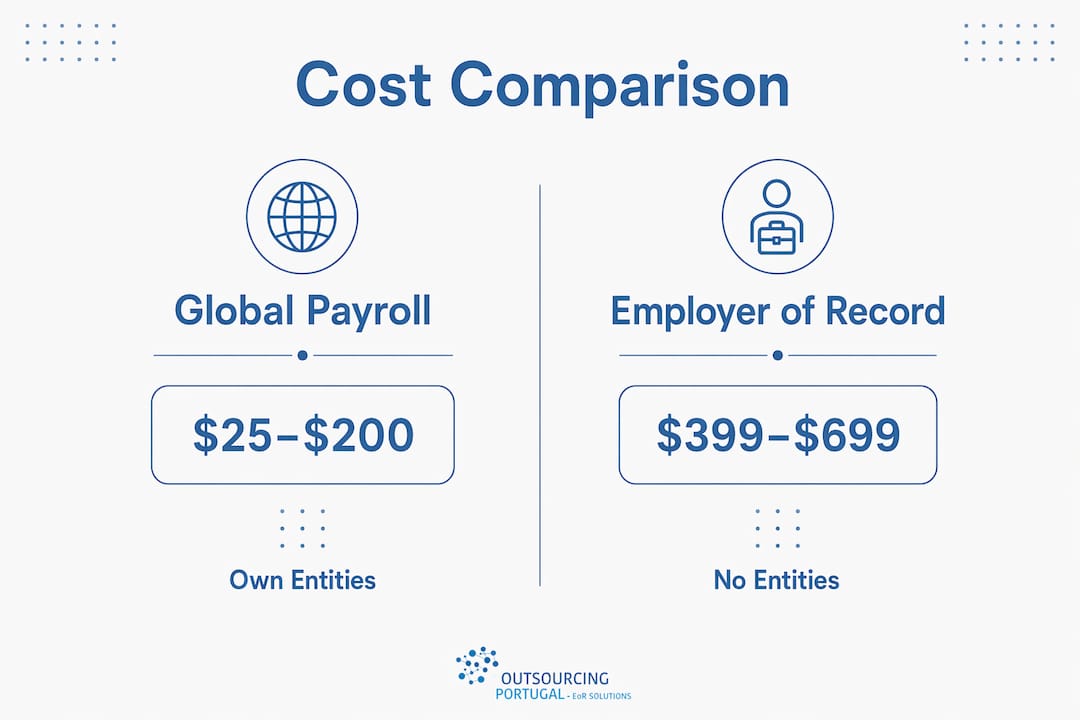
Global payroll providers charge $25–$200 per employee per month. EOR services run $399–$699 per employee per month. That gap looks like a clear win for global payroll until you factor in entity setup costs, which appear in the next section.
Most companies use both models. They run global payroll in countries where they have established entities and use EOR in early-stage markets where they are testing demand before committing to a local entity. That hybrid approach is the most financially rational strategy for companies expanding into more than three or four countries.
Pro Tip: Never assume global payroll is cheaper than EOR without running a full cost model. In a country where you employ fewer than 10 people, the entity setup and maintenance costs often make EOR the lower-cost option for the first two to three years.
The EOR vs. global payroll distinction also carries legal weight. Under EOR, the provider absorbs employer liability. Under global payroll, your entity does. That difference matters enormously if a wrongful termination claim or a tax audit lands in a jurisdiction where your local legal team has limited experience.
What are the typical costs and hidden expenses of global payroll?
The per-employee monthly fee is the visible cost. The entity infrastructure underneath it is where budgets collapse.
Establishing a legal entity internationally costs $50,000–$150,000 upfront and $10,000–$30,000 annually to maintain. Those figures cover legal incorporation, registered office requirements, local directorship, accounting, and annual filings. Most finance teams building their first international payroll budget underestimate these costs by a wide margin.
| Cost category | Typical range | Notes |
|---|---|---|
| Global payroll provider fee | $25–$200 per employee/month | Varies by provider and country |
| Entity setup (per country) | $50,000–$150,000 one-time | Legal, registration, and compliance costs |
| Entity annual maintenance | $10,000–$30,000 per year | Accounting, filings, registered office |
| EOR alternative | $399–$699 per employee/month | No entity required |
The break-even calculation between EOR and global payroll depends on headcount and time horizon. At 15 employees in a single country, the entity costs often pay off within 18–24 months compared to EOR fees. At 5 employees, EOR remains cheaper for several years.
Incorporating entity setup costs into your total cost of ownership model is not optional. It is the only way to make an accurate build-versus-buy decision. HR leaders who skip this step routinely discover mid-year that their “cost-efficient” global payroll setup is more expensive than the EOR they rejected.
The hidden costs extend beyond entity setup. Currency conversion fees, local accounting software licenses, HR system integration work, and the internal time your payroll team spends on country-specific compliance all add up. A realistic budget accounts for all of them.
How can businesses effectively implement global payroll solutions?
Effective implementation follows a sequence. Skipping steps in this process is the primary reason global payroll projects fail in their first year.
-
Audit your current footprint. List every country where you employ people, the number of employees in each, and the compliance obligations you currently meet or miss. This baseline tells you where the gaps are before you select any technology or provider.
-
Research local regulations per country. Compliant payroll management requires local knowledge of labor laws, tax treaties, mandatory contributions, and timely report filings. Do not rely on generic summaries. Engage local legal counsel or a provider with verified in-country expertise for each jurisdiction.
-
Select payroll technology built for multi-country operations. The system must handle multiple currencies, multiple tax engines, and local-language payslips. It must also integrate with your HR information system and your accounting platform. Integration gaps create reconciliation errors that compound over time.
-
Build or buy local expertise. You need someone who understands Portuguese social security contributions, German wage tax classes, or Brazilian eSocial filings. That expertise either lives on your team or with your provider. If it lives with a provider, verify their in-country track record before signing a contract. Outsourcing-portugal, for example, provides payroll compliance support specifically for businesses operating in Portugal, covering the full range of local statutory obligations.
-
Integrate payroll with HR and finance systems. Using a global payroll service that consolidates processes reduces errors and improves reporting across geographies. Disconnected systems create duplicate data entry, reconciliation delays, and audit risk.
-
Establish a continuous monitoring process. Payroll compliance is not a one-time setup. Tax rates change. Minimum wages increase. Social security thresholds shift. A quarterly compliance review catches changes before they become violations. Use your payroll compliance checklist as a living document, not a one-time exercise.
A well-managed international payroll system improves employee satisfaction and supports operational growth. Employees who are paid accurately and on time, with correct deductions and local-currency payslips, trust the organization more. That trust directly affects retention, which is a measurable business outcome.
Key Takeaways
Global payroll requires your own legal entities in each country, and the true cost includes entity setup fees of $50,000–$150,000 per country, not just the monthly provider fee.
| Point | Details |
|---|---|
| Global payroll vs. EOR | Global payroll needs your own entity; EOR does not, but costs $399–$699 per employee monthly. |
| Hidden entity costs | Setup runs $50,000–$150,000 per country; annual maintenance adds $10,000–$30,000 more. |
| Compliance is ongoing | Tax rates and labor laws change; quarterly reviews prevent violations and penalties. |
| Automation reduces risk | Payroll systems that automate filings and tax withholding cut errors and improve accuracy at scale. |
| Hybrid model works best | Most companies use EOR in new markets and global payroll where entities already exist. |
What I’ve learned from watching companies get global payroll wrong
The most common mistake I see is treating global payroll as a technology problem. HR leaders buy a multi-country payroll platform, configure it for their current footprint, and assume the system will handle compliance. It will not. Technology executes rules. It does not write them, update them, or flag when a country changes its social security threshold in the middle of a fiscal year.
The second mistake is underestimating entity costs. I have watched finance teams approve international expansion plans built on the $25–$200 per-employee monthly fee, with no line item for entity incorporation. Six months later, they are explaining a $120,000 variance to their CFO. The math was never wrong. The scope was.
What actually works is a clear-eyed cost model built before any vendor is selected. Run the break-even analysis between EOR and global payroll for each country, using real entity cost estimates. In most cases, EOR wins for the first 12–24 months in a new market, and global payroll wins once headcount crosses a country-specific threshold.
The compliance side demands the same discipline. Local labor law expertise is not a nice-to-have. It is the difference between a clean audit and a regulatory fine. For Portugal specifically, I have seen companies underestimate the complexity of mandatory 13th and 14th-month salary payments, holiday pay calculations, and Social Security contribution rates. Getting those wrong is not a minor error. It creates back-pay liability and potential penalties.
The companies that run international payroll well share one trait: they treat compliance as a core operational function, not an afterthought. They invest in local expertise, audit their processes quarterly, and build entity costs into every expansion decision from the start.
— Paulo
How Outsourcing-portugal supports your international payroll operations
Managing payroll across borders is one of the most compliance-intensive tasks an HR team faces. Outsourcing-portugal provides employment outsourcing services in Portugal that cover payroll management, legal compliance, onboarding, and HR support for international companies.
Whether you need full payroll services in Portugal or want to explore an Employer of Record model before committing to a local entity, Outsourcing-portugal offers structured solutions built around Portuguese labor law and EU compliance requirements. For companies evaluating their options, the best employment outsourcing services comparison is a practical starting point for understanding what full-service support looks like versus a self-managed payroll setup.
FAQ
What is global payroll?
Global payroll is the process of managing and paying employees across multiple countries through your own legal entities, ensuring compliance with each country’s tax laws, labor regulations, and reporting requirements.
How much does global payroll cost per employee?
Global payroll providers charge $25–$200 per employee per month, but total costs must include entity setup fees of $50,000–$150,000 per country and annual maintenance of $10,000–$30,000.
When should a company use EOR instead of global payroll?
EOR is the better choice when you are entering a new market without an established legal entity, especially if you have fewer than 10–15 employees in that country. Global payroll becomes cost-effective once headcount justifies the entity investment.
What are the biggest compliance risks in international payroll?
Late or incorrect statutory filings are the leading compliance risk, triggering penalties and back-pay liability. Missing country-specific deadlines for social security, income tax, and annual reports are the most common triggers.
Can a company use both EOR and global payroll at the same time?
Yes. Most companies run both models simultaneously, using global payroll in countries where they have established entities and EOR in markets where they are still testing demand before committing to local incorporation.