

TL;DR:
- Proper employee termination requires thorough documentation, adherence to legal procedures, and clear communication.
- Understanding federal and state laws helps prevent wrongful termination claims and ensures compliance during the exit process.
How to terminate an employee the right way
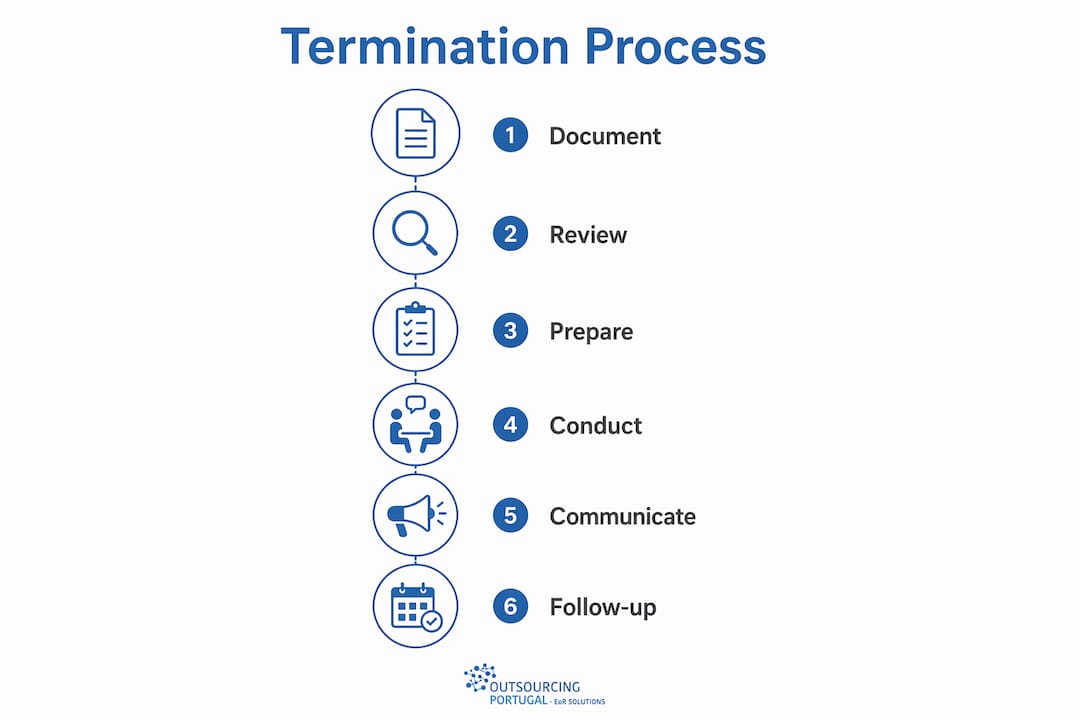
Done correctly, terminating an employee follows a clear sequence: document the performance or conduct issues, review the legal framework that applies, prepare the termination letter and logistics, conduct a brief and direct meeting, then handle the post-termination paperwork the same day. Skipping any step creates legal exposure and, just as often, a morale problem with the team you still have.
The process is formal by design. Courts and the Equal Employment Opportunity Commission (EEOC) look at whether the employer followed its own written policies consistently. That consistency, more than any single document, is what protects you.
The core steps at a glance:
- Review the employment contract, company policy handbook, and any collective bargaining agreement
- Confirm the termination reason is legal and documented
- Consult HR and, when needed, legal counsel
- Prepare the termination letter and final pay calculation
- Schedule and conduct the termination meeting with a witness present
- Revoke IT access and collect company property on the same day
- Process the final paycheck according to your state’s deadline
- Conduct an exit interview and communicate the change to the team
Pro Tip: Never make the termination decision and deliver it on the same day without a documented paper trail. The gap between “we decided” and “we can prove it” is where wrongful termination claims are born.
Table of Contents
- What US law actually requires when you let someone go
- What you need to prepare before the meeting
- How to conduct the termination meeting
- Managing post-termination tasks and team communication
- Best practices for protecting morale and avoiding legal risk
- Severance pay and final paycheck guidelines
- How termination affects unemployment benefits eligibility
- How to handle wrongful termination claims and legal risks
- What rights does an employee have during termination?
- Post-termination confidentiality and non-disparagement considerations
- Outsourcing-portugal offers a cleaner path for global HR compliance
- Key Takeaways
What US law actually requires when you let someone go
At-will employment governs the relationship. Most states allow either party to end employment at any time for any legal reason. Montana is the one exception: after a probationary period, Montana employers must show just cause before terminating.
“Legal reason” is where most employers run into trouble. The at-will doctrine does not override federal anti-discrimination statutes or state equivalents. Terminating someone because of their race, sex, age (40 and over), national origin, disability, or genetic information is illegal under federal law. Retaliation against an employee who reported unsafe conditions or filed a discrimination complaint is equally prohibited, with OSHA whistleblower protections covering more than 20 federal statutes.
Prohibited termination grounds:
- Race, color, religion, sex, or national origin (Title VII)
- Age 40 and over (Age Discrimination in Employment Act)
- Disability (Americans with Disabilities Act)
- Genetic information (GINA)
- Retaliation for protected activity (whistleblowing, EEOC complaints, workers’ comp claims)
- Refusing to perform illegal acts
Key federal laws and protections:
| Law | What it covers | Who enforces it |
|---|---|---|
| Title VII of the Civil Rights Act | Race, sex, religion, national origin | EEOC |
| Age Discrimination in Employment Act | Workers 40 and over | EEOC |
| Americans with Disabilities Act | Physical and mental disabilities | EEOC |
| GINA | Genetic information | EEOC |
| WARN Act | Mass layoffs (100+ employees, 60-day notice) | Department of Labor |
| OSHA Whistleblower Program | Retaliation for safety reporting | OSHA |
At-will employment also does not apply to employees covered by a signed individual contract or a collective bargaining agreement. Union contracts typically require progressive discipline and just cause before any termination. Public-sector employees have additional due-process rights under constitutional law. Know which category your employee falls into before you schedule the meeting.
What you need to prepare before the meeting
Documentation is the foundation of a defensible termination. Performance reviews, written warnings, attendance records, and meeting notes all serve as evidence that the decision was consistent, fair, and grounded in documented fact rather than personal bias.
A performance improvement plan (PIP) is not legally required in most states, but it creates a paper trail showing the employee had notice and an opportunity to correct the problem. That trail matters enormously if the employee later claims the termination was pretextual.
Pre-termination checklist:
- Pull the employee’s personnel file and review all prior warnings and reviews
- Confirm the termination reason aligns with documented incidents
- Check the employment contract and handbook for any required notice periods or procedures
- Verify whether a collective bargaining agreement applies
- Consult HR and legal counsel, especially for long-tenured employees or sensitive situations
- Calculate the final paycheck, including accrued PTO if your state requires payout
- Prepare the termination letter
- Arrange for IT access revocation and property recovery logistics
- Identify who will attend the meeting as a witness
Termination letter essentials:
- Employee’s full name and position
- Effective date of termination
- Reason for termination (brief, aligned with the personnel file)
- Final pay details and timing
- Benefits continuation information (COBRA deadlines, if applicable)
- Instructions for returning company property
- Any post-employment obligations (confidentiality, non-compete, if applicable)
A well-drafted termination letter avoids listing every grievance. Discrepancies between the letter and the personnel file are routinely exploited in wrongful termination litigation. Write the letter to match the documentation exactly, nothing more.
Pro Tip: Have legal counsel review the termination letter for any employee who has recently filed a complaint, taken protected leave, or belongs to a protected class. The cost of a 30-minute review is a fraction of the cost of defending a retaliation claim.
Sample termination letter language vs. language to avoid:
| Use this | Avoid this |
|---|---|
| “Your employment is terminated effective [date].” | “We’ve decided to let you go.” |
| “This decision follows documented performance issues on [dates].” | “You just aren’t a good fit.” |
| “Your final paycheck will be issued by [date] per state law.” | Vague references to “final compensation.” |
| “Please return all company property by [date].” | Omitting property return instructions entirely. |
How to conduct the termination meeting
Schedule the meeting for early in the week, early in the day. Ending someone’s employment on a Friday afternoon leaves them without access to HR, benefits administrators, or support resources for two days. A Tuesday or Wednesday morning gives them time to act on next steps immediately.

Keep the meeting short. Termination meetings should be direct, respectful, and brief, using neutral phrasing such as “your employment has been terminated” rather than “you’re fired” or “we’re letting you go.” The goal is clarity, not softening a blow that cannot be softened.
Who should be in the room:
- The direct manager or HR lead delivering the news
- An HR representative or second manager as a witness
- The employee only (no peers, no subordinates)
Do’s and don’ts during the meeting:
- Do deliver the decision in the first 30 seconds. Do not build up to it.
- Do have the termination letter and any severance agreement ready to hand over.
- Do allow the employee a moment to respond without interruption.
- Don’t apologize repeatedly or over-explain the reasoning.
- Don’t discuss detailed benefits terms or legal options during the meeting. Direct those questions to HR.
- Don’t leave the employee alone in the office with access to systems after the conversation ends.
Sample opening script:
“[Name], I need to share some difficult news. After careful review, we have made the decision to terminate your employment, effective today. This decision is final. Here is your termination letter, which outlines the details including your final pay and next steps.”
Pause. Let them respond. Answer factual questions briefly. If the conversation becomes heated, stay calm and redirect: “I understand this is hard. HR will be available to answer your questions about benefits and next steps.”
Pro Tip: Have IT revoke system access at the exact moment the meeting begins, not after. An employee who still has email access after a termination meeting can forward sensitive files, delete records, or contact clients before you realize it.
Managing post-termination tasks and team communication
The hour after the meeting is when most administrative errors happen. Employers must handle final pay according to state law, inform benefits providers, recover company property, and revoke IT access promptly. Each of those tasks has a deadline, and missing one creates liability.
Post-termination task list:
- Issue the final paycheck within your state’s required timeframe (varies by state; check your state labor department)
- Send COBRA election notice within 14 days of the qualifying event
- Collect all company property: laptop, badge, keys, credit cards, and any proprietary materials
- Confirm IT has disabled email, VPN, cloud storage, and any third-party app access
- Update payroll records and notify the benefits administrator
- Retain the termination letter and all related documentation per federal retention requirements
The EEOC requires employers to retain personnel records for at least one year from the date of termination. The Fair Labor Standards Act (FLSA) requires payroll records to be kept for three years. Store these securely and separately from active employee files.
Exit interviews are worth doing even when the departure is involuntary. A brief, structured conversation with HR after the termination meeting can surface process gaps, policy concerns, or team dynamics issues that would otherwise stay hidden. Keep it voluntary and document the responses.

When communicating the termination to the team, protect the privacy of the terminated employee while being clear about operational impact. A simple statement works: “[Name] is no longer with the company. We’re working on coverage for their responsibilities and will share updates shortly.” Do not explain the reason. Do not invite speculation by being vague to the point of confusion.
Best practices for protecting morale and avoiding legal risk
Management experts advise viewing termination as a formal business procedure rather than a personal judgment. That framing is not just philosophically tidy. It actively reduces the emotional volatility in the room and keeps the manager focused on facts rather than feelings.
“Discharge is the capital punishment of organizational life” is a metaphor that makes managers hesitate too long, document too little, and then act in ways that feel impulsive to everyone involved. Treating termination as a structured business process, with defined steps and consistent application, is what separates defensible decisions from costly ones.
Policy consistency is the single most effective defense against discrimination claims. If you terminated one employee for three unexcused absences, you must apply the same standard to every employee in a comparable role. Selective enforcement, even when unintentional, creates the appearance of discriminatory motive. HR should audit termination patterns periodically to catch inconsistencies before they become litigation.
Pro Tip: After any termination, brief your remaining team leads on what they can and cannot say if employees ask questions. Inconsistent messaging from multiple managers is one of the fastest ways to turn a clean termination into a morale crisis.
Severance pay and final paycheck guidelines
Federal law does not require severance pay. Whether you offer it, and how much, depends on your employment contracts, company policy, and any applicable collective bargaining agreement. Severance agreements often include a release of claims, which can protect the employer from future litigation. Employees 40 and over must be given at least 21 days to consider a severance agreement and 7 days to revoke it after signing, under the Older Workers Benefit Protection Act.
Final paycheck timing is governed entirely by state law, and the deadlines vary widely. Some states require payment on the last day of employment; others allow the next regular pay cycle. Check your state labor department for the exact requirement. Paying late, even by one day, can trigger penalties and, in some states, waiting-time penalties that accrue daily.
Accrued, unused vacation pay is also state-specific. California, for example, treats accrued vacation as earned wages that must be paid out at termination. Other states leave it to employer policy. Get this right before the meeting, not after.
How termination affects unemployment benefits eligibility
Employees terminated for reasons other than serious misconduct are generally eligible for unemployment benefits. The key distinction is between termination “without cause” (layoff, position elimination, performance issues that do not rise to gross misconduct) and termination “for cause” (theft, fraud, deliberate policy violations, or serious insubordination).
Eligibility rules are set by each state’s unemployment insurance program, and what counts as disqualifying misconduct varies. An employer can contest a former employee’s unemployment claim, but doing so without solid documentation often backfires. If your termination was well-documented and the reason was legitimate, contesting is straightforward. If the documentation is thin, contesting the claim may invite scrutiny of the termination itself.
Inform the terminated employee of their right to file for unemployment benefits. Withholding that information does not prevent them from filing, and it creates unnecessary friction.
How to handle wrongful termination claims and legal risks
A wrongful termination claim typically alleges that the employer violated a statute, a contract, or public policy. The most common triggers are discrimination, retaliation, and breach of an implied or written employment contract. Consistent documentation and policy application are your primary defenses.
When a claim is filed, preserve all records immediately. Do not delete emails, performance reviews, or meeting notes. Notify your employment practices liability insurer if you carry that coverage. Engage employment counsel before responding to any agency charge or demand letter.
The EEOC charge process typically begins with a charge filed within 180 or 300 days of the alleged discriminatory act, depending on the state. The agency will notify you and request a position statement. Your response should be factual, documented, and reviewed by counsel before submission.
What rights does an employee have during termination?
Employees retain several rights regardless of at-will status. They have the right to receive their final paycheck within the state-mandated timeframe, to elect COBRA continuation coverage within the required notice period, and to receive any vested retirement benefits per plan terms. Employees covered by a union contract have the right to union representation during investigatory interviews that could lead to discipline, known as Weingarten rights.
Employees also have the right to file an EEOC charge if they believe the termination was discriminatory, and to file for unemployment benefits with their state agency. They cannot be required to sign a severance agreement on the spot. Any release of claims must be voluntary and, for workers 40 and over, must comply with the Older Workers Benefit Protection Act review period.
Post-termination confidentiality and non-disparagement considerations
Confidentiality and non-disparagement clauses are typically included in severance agreements, not employment contracts, though some employment agreements do contain them. A confidentiality clause prevents the former employee from disclosing proprietary business information. A non-disparagement clause restricts both parties from making negative public statements about each other.
The National Labor Relations Board (NLRB) has scrutinized overly broad non-disparagement clauses in recent years, particularly those that could prevent employees from discussing wages or working conditions with coworkers. Draft these provisions narrowly and have counsel review them before including them in any agreement.
On the employer side, train managers to give only neutral references: confirm dates of employment and job title, nothing more. A negative or inaccurate reference can expose the company to a defamation claim, even when the underlying termination was fully justified.
Outsourcing-portugal offers a cleaner path for global HR compliance
Managing the employee termination process across multiple jurisdictions multiplies every risk covered in this guide. Final pay deadlines, severance rules, documentation standards, and notice requirements all change the moment you cross a border.

Outsourcing-portugal gives international companies a done-for-you employment infrastructure in Portugal, covering hiring, payroll, HR compliance, and offboarding under a single Employer of Record structure. You get full legal compliance without building a local entity or navigating Portuguese labor law from scratch. For companies expanding into Europe, that means one point of accountability for every employment decision, including separations. Check the best employment outsourcing services Outsourcing-portugal recommends for 2026, or contact the team directly to discuss your specific hiring and HR needs.
Key Takeaways
Legally compliant employee termination requires documented cause, consistent policy application, and state-specific final pay and benefits procedures executed on the day of separation.
| Point | Details |
|---|---|
| At-will employment has limits | All states except Montana allow at-will termination, but discrimination and retaliation are always illegal grounds. |
| Documentation is your defense | Performance reviews, written warnings, and meeting notes are what make a termination defensible in court or at the EEOC. |
| Final pay timing is state law | Deadlines vary by state; missing them by even one day can trigger daily penalties. |
| Record retention is federally mandated | EEOC requires one year; FLSA requires three years for payroll records. |
| Outsourcing-portugal handles global HR | For companies employing staff in Portugal, Outsourcing-portugal manages compliant offboarding under an Employer of Record structure. |