

TL;DR:
- Official salary data in Portugal comes from sources like INE, Autoridade Tributária, and Pordata, providing accurate, official wage figures. Industry guides from Randstad and Adecco reflect current market offers, including skill premiums and regional variations. Combining these sources ensures compliance and competitiveness when setting salaries in Portuguese outsourcing engagements.
For international companies hiring in Portugal, the most reliable salary data comes from three official sources and two industry-led guides. Portugal’s National Statistics Institute (INE) publishes quarterly gross wage figures drawn from tax declarations covering approximately 4.6 million workers across sectors. Pordata aggregates that data with interactive tools for inflation adjustment. Autoridade Tributária feeds monthly remuneration declarations directly into INE’s system. Randstad and Adecco layer on top with occupation-specific, market-driven figures that official statistics simply cannot match.
Key salary data sources at a glance:
- INE — macroeconomic wage statistics by sector, institution type, and company size; quarterly and annual cadence
- Autoridade Tributária — tax-derived remuneration data integrated with INE for demographic and sectoral breakdowns
- Pordata — historical salary series with an interactive CPI adjustment tool for inflation-corrected comparisons
- Randstad — occupation-specific salary ranges reflecting live recruitment market conditions and skill premiums
- Adecco — market-offer salary data with regional and industry segmentation
| Metric | Figure |
|---|---|
| Average monthly gross salary | EUR 1,660 |
| Median monthly gross salary | EUR 1,200 |
| Annual gross salary with 14 payments | EUR 23,240 |
| Lisbon/Porto wage premium over national average | 10%–25% higher than national average |
Table of Contents
- Where to find salary information from official Portuguese sources
- How industry salary guides give you the competitive edge
- How to adjust raw salary data before you build a budget
- Applying salary data when hiring Portuguese workers through outsourcing
- What you need to know about salary disclosure and privacy in Portugal
- Resources for tracking salary trends and future projections in Portugal
- Key Takeaways
Where to find salary information from official Portuguese sources
INE is the starting point for any serious salary benchmarking exercise. It compiles wage statistics using tax-derived data from Autoridade Tributária, which means the figures are not survey estimates — they reflect actual declared remuneration. The database breaks down average monthly gross wages by economic sector, institutional sector, company size, and technology intensity, giving outsourcing teams a precise baseline rather than a rough national average.
Autoridade Tributária’s contribution is the monthly remuneration declaration that every Portuguese employer files. INE ingests these declarations and produces median, mean, and percentile salary distributions — the kind of granularity that matters when you are deciding whether a €1,400 offer for a mid-level software developer is competitive or insulting.
Pordata pulls this official data into a cleaner interface and adds occupation-level breakdowns going back decades. The CPI adjustment tool is genuinely useful: paste in a 2019 salary figure and it converts it to today’s purchasing-power equivalent, which matters when you are reviewing legacy contract benchmarks.
Features of official data that matter most for outsourcing cost calculation:
- Quarterly updates keep figures current enough for annual budget cycles
- Sectoral breakdowns cover IT, professional services, manufacturing, and more
- Percentile distributions reveal where a proposed salary sits relative to peers
- Demographic cuts (age, qualification level) support equity and compliance checks
Pro Tip: Use INE and Pordata figures to establish your legal compliance baseline — the floor below which no offer should go. Then use Randstad and Adecco data to calibrate where your offer needs to sit to actually win the candidate.
How industry salary guides give you the competitive edge
Official statistics tell you what people were paid last quarter. Randstad and Adecco tell you what candidates are being offered right now. That gap matters more than most hiring teams realize.

Randstad Research makes the point directly: average salaries are misleading for specialized roles. A Portuguese DevOps engineer with AWS certification and B2+ English commands a salary range that sits well above the national IT sector average. The same logic applies to multilingual customer success managers, finance controllers with IFRS experience, and any role where a specific skill set concentrates in one city.
Adecco’s annual salary guide segments by industry and function, making it practical for companies building out call centers or shared service centers. Both guides reflect live placement data, so they capture market movements that INE’s quarterly cycle misses.
Practical considerations when using industry salary guides:
- Cross-reference at least two guides before setting an offer range
- Note the publication date; guides older than 12 months may understate current market rates
- Treat the ranges as negotiation bands, not fixed points
- Flag roles where the guide range and INE data diverge sharply — that gap signals a hot skill market
Portugal’s tech sector has grown fast enough that some occupation-specific salary ranges in industry guides now move faster than annual publications can track.
How to adjust raw salary data before you build a budget
Raw salary figures from any source need three adjustments before they are usable in an outsourcing budget: inflation correction, regional weighting, and payment structure.
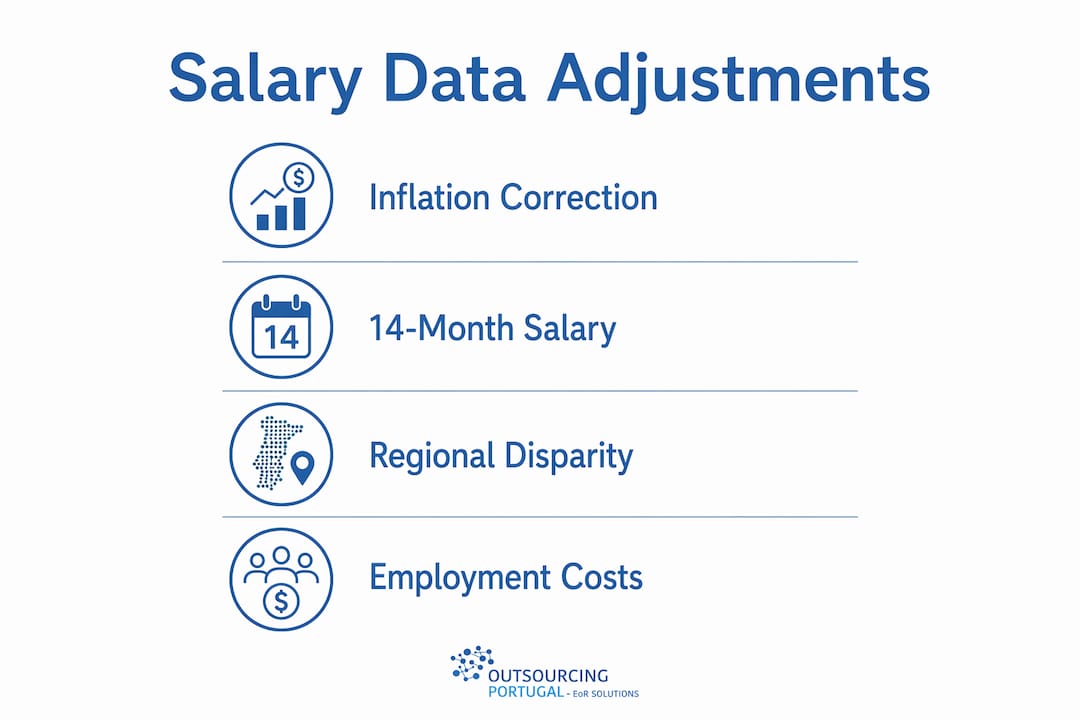
Portugal operates on a 14-month salary system. Every employee receives 12 monthly salaries plus a mandatory holiday bonus and a Christmas bonus, each equal to one month’s base pay. A candidate quoting a €1,500 monthly salary actually costs you €21,000 in base pay annually, not €18,000. Miss that, and your budget is off by 16% before you add employer social security contributions.
Regional disparity is the second adjustment. Lisbon and Porto pay 10%–25% more than the national average for equivalent roles, driven by the concentration of international firms and higher living costs. A budget built on national INE averages will underbid talent in both cities consistently.
| Factor | Adjustment needed |
|---|---|
| 14-month payment structure | Multiply monthly salary × 14 for true annual base cost |
| Lisbon/Porto location | Add 10%–25% to national average for metro roles |
| Inflation (historical contracts) | Use Pordata CPI tool to convert past figures to present value |
| Sector (tech vs. services) | Apply sector-specific INE or industry guide data |
Pro Tip: Run every salary figure through the employment cost calculator before presenting a budget to leadership. Employer social security contributions add roughly 23.75% on top of gross salary in Portugal.
Applying salary data when hiring Portuguese workers through outsourcing
Combining official and industry data is not just good practice — it is the approach that keeps you both compliant and competitive. INE data sets the legal floor; Randstad and Adecco data tells you where the market ceiling sits for a given role. Your offer should land somewhere between those two points, calibrated by the candidate’s specific skills and location.
For outsourcing contracts, salary benchmarks need to be written in with review clauses. Portugal’s minimum wage increases annually, and the broader market has moved upward consistently. A fixed-rate contract without a review mechanism will erode your talent quality over a two-to-three year engagement.
Best practices for applying salary data in outsourcing contracts and payroll:
- Specify gross monthly salary and confirm the 14-payment structure in writing
- Include an annual review clause tied to INE wage growth data or a named CPI index
- Document the regional salary basis (national average vs. Lisbon/Porto) in the contract
- Align payroll cycles with Portuguese statutory payment dates for holiday and Christmas bonuses
Pro Tip: An Employer of Record handles statutory payment timing, social security filings, and salary compliance automatically — removing the risk of miscalculation on the 14-payment structure.
Outsourcing-portugal builds salary benchmarking directly into its employment solutions, drawing on current INE data and market guides to help international clients set offers that attract qualified candidates without overpaying relative to the local market.
What you need to know about salary disclosure and privacy in Portugal
Portugal’s labor law, governed by the Portuguese Labor Code (Código do Trabalho), does not require employers to publicly disclose individual salary figures. However, the EU Pay Transparency Directive — which Portugal must transpose into national law — will require employers to provide salary range information in job postings and respond to employee requests for pay data by gender and job category. Companies hiring in Portugal now should build salary documentation practices that will satisfy these requirements when they take effect.
Under GDPR, salary data is personal data. Sharing an individual employee’s remuneration with third parties, including parent companies in the US, requires a lawful basis — typically a data processing agreement and, where applicable, standard contractual clauses for cross-border transfers. Outsourcing structures that route payroll through an Employer of Record already have these agreements in place, which simplifies compliance considerably.
Resources for tracking salary trends and future projections in Portugal
INE’s quarterly releases are the most reliable leading indicator for wage growth direction. Pordata’s historical series lets you plot trend lines going back to the 1980s, which is useful for modeling multi-year outsourcing cost projections. Both are free and publicly accessible.
Randstad publishes an annual salary trends report specifically covering the Portuguese market, with forward-looking commentary on sectors experiencing wage pressure. The Bank of Portugal (Banco de Portugal) publishes economic bulletins that include wage growth forecasts tied to inflation and productivity data — useful for stress-testing budget assumptions over a three-to-five year horizon.
For companies building longer-term workforce strategies, the European Commission’s annual country reports on Portugal include labor market projections that align with EU-wide economic forecasting. These are particularly relevant for understanding how Portugal’s wage convergence toward the EU average is likely to progress.
Key Takeaways
Official Portuguese salary sources combined with industry guides give international employers the complete picture needed for compliant, competitive outsourcing in 2026.
| Point | Details |
|---|---|
| Start with INE and Pordata | Official data covers 4.6 million workers and provides the legal compliance baseline for any salary offer. |
| Layer in Randstad and Adecco | Industry guides reflect live market conditions and skill premiums that quarterly statistics miss. |
| Budget for 14 payments | Annual base cost equals monthly salary × 14; ignoring this creates a 16% budget shortfall. |
| Apply regional adjustments | Lisbon and Porto roles cost 10%–25% more than the national average; national data alone will underbid metro talent. |
| Use an EOR for payroll accuracy | An Employer of Record automates statutory payment timing and social security filings, removing compliance risk. |

Outsourcing-portugal helps international companies move from raw salary data to compliant, competitive employment offers in Portugal — without setting up a local entity. From employment outsourcing services to full Employer of Record payroll management, the platform handles the complexity so your team can focus on hiring the right people. Get in touch to see how current salary benchmarks translate into a real hiring budget for your specific roles and regions.