

HR regulatory compliance means making sure every HR practice, from how you pay people to how you store their data, follows the laws, regulations, and contractual obligations that apply where each employee actually works. That’s the whole definition. The first move for any HR leader reading this isn’t a policy rewrite; it’s mapping your jurisdictional footprint and naming one person who owns compliance for each area. Without that owner, gaps just sit there until an inspector or a plaintiff’s attorney finds them.
Two reference points matter immediately. National labor inspectorates enforce wage, hour, and safety rules in each country where you have employees, and GDPR governs how you handle personal data for anyone working in the EU or EEA, including remote hires. If you’re managing distributed teams without a local entity, a structure like an Employer of Record, the kind that Outsourcing-portugal runs for companies hiring in Portugal can absorb much of this mapping work for you.
Start with these four questions before anything else:
- Where, legally, does each employee work (not where your office is)?
- Who owns wage/hour, leave, safety, and data privacy compliance respectively?
- Do you have dated, versioned policies employees have actually acknowledged?
- Can you produce audit-ready records for the last 12 months today?
Key Takeaways
Audit-ready HR compliance depends on jurisdiction mapping, named ownership, centralized records, and a recurring monthly, quarterly, and annual review cadence.
| Point | Details |
|---|---|
| Map jurisdiction first | Identify each employee’s legal workplace before writing a single policy, since obligations follow the worker, not headquarters. |
| Assign named owners | Split ownership across HR, payroll, legal, and managers, with one person accountable for tying the pieces together. |
| Watch AI governance closely | Document human review for automated hiring or performance decisions; it’s the top emerging risk named by HR leaders for 2026. |
| Build the three-leg program | Written policies, delivered training, and dated documentation together prove compliance; any single leg alone won’t hold up. |
| Use outsourcing for cross-border hires | Outsourcing-portugal runs onboarding, payroll, and statutory filings for companies hiring in Portugal without a local entity. |
Table of Contents
- What Does HR Regulatory Compliance Actually Cover?
- What Are the Core Areas HR Must Manage?
- How Do You Build an Audit-Ready Compliance Program?
- What Are the Biggest HR Compliance Risks in 2026?
- What Should Go on Your Compliance Checklist?
- How Does Outsourcing-portugal Support Compliance Outcomes?
- Get Compliance Support Without Setting Up a Local Entity
- Frequently Asked Questions
- Sources
What Does HR Regulatory Compliance Actually Cover?
Compliance isn’t one flat rulebook. It’s layered, and the layers stack in a specific order: statutory obligations (laws passed by national or regional governments), regulatory requirements (rules from labor authorities or data protection bodies interpreting those laws), contractual terms (employment agreements, collective bargaining terms), and then local or municipal rules that add another layer on top. A company operating in one country might need to satisfy all four layers simultaneously, and each layer can override or narrow the one below it.
Ownership is where most programs quietly fail. HR usually owns policy and training. Payroll owns wage calculation and tax remittance. Legal owns contract language and dispute response. Line managers own day-to-day enforcement, whether that’s approving leave requests correctly or documenting a performance conversation. If no single person is accountable for tying these together, and specifically for confirming that all four are current, compliance becomes everyone’s job in theory and no one’s job in practice.
Jurisdiction mapping deserves special attention for anyone hiring remotely. State and local law complexity, not federal or national law, is now the main driver of compliance difficulty, because pay transparency rules, paid leave mandates, and data privacy obligations increasingly originate below the national level. Employers are responsible for the laws that apply where their employees physically work, not where headquarters sits, which means the checklist Kelly Services outlines for 2026 applies separately to every location on your payroll.
For distributed or nearshore teams, this gets more complicated fast:
- Each worker’s legal workplace can trigger separate payroll tax registration.
- Statutory contribution rates and leave entitlements vary by country and sometimes by region.
- Posting and notice obligations differ depending on local employment law, not your corporate headquarters’ rules.
A company hiring five people across three countries effectively runs three separate compliance programs, even if the job descriptions are identical.
What Are the Core Areas HR Must Manage?
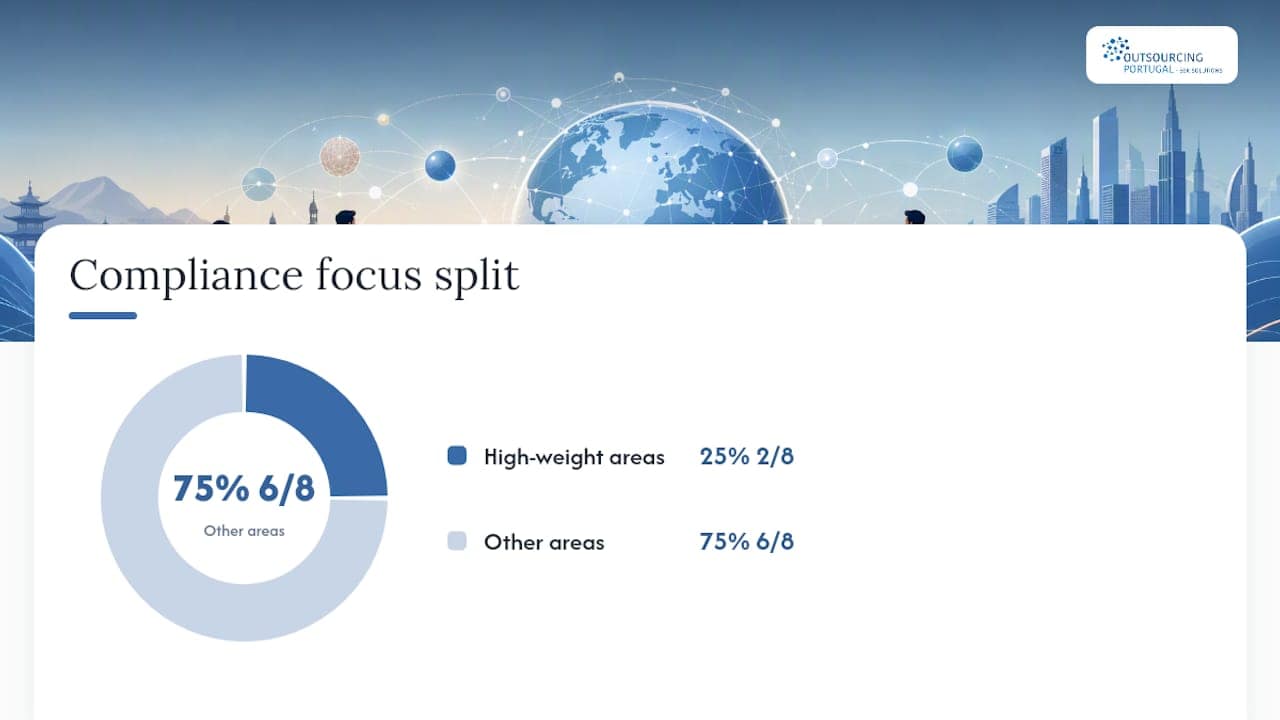
Eight areas make up the backbone of any compliance program, and each one produces its own paper trail. Skipping documentation in any single area is the most common reason audits and investigations go badly, even when the underlying practice was fine.
- Wage and hour. Track pay calculations, overtime eligibility, and pay frequency against local law, and retain payroll records that show the math, not just the outcome.
- Worker classification. Apply the correct legal test for employee versus contractor status in each jurisdiction; misclassification triggers back pay, penalties, and sometimes retroactive benefits obligations.
- Leave and accommodations. Document statutory leave entitlements, medical accommodation requests, and the specific paperwork trail showing you responded within required timeframes.
- Anti-discrimination and harassment. Maintain written policies, delivered training, and a functioning reporting channel, with a log showing complaints were investigated and closed.
- Payroll and tax reporting. Meet employer obligations for tax withholding, social contributions, and statutory filings on the deadlines each jurisdiction sets, not a single global calendar.
- Workplace safety. Keep incident reporting current and retain safety training records that prove employees were trained before, not after, an incident.
- Data protection and employee privacy. Apply GDPR-equivalent safeguards to employee records, including documented legal bases for processing and retention schedules, especially where automated tools make employment decisions.
- Background checks. Confirm what checks are legally permissible in each jurisdiction before you run them; some regions restrict criminal history checks or salary history requests outright.
Wage and hour and worker classification deserve extra weight here. Enforcement activity around unpaid wages recovered substantial back wages in recent US fiscal years, and that pattern repeats across jurisdictions with active labor inspectorates, according to Kelly Services’ 2026 compliance checklist. Classification errors compound the exposure, because a misclassified contractor often means retroactive benefits, taxes, and penalties stacked on top of the original wage gap.
Pro Tip: Build one master compliance calendar that lists every filing deadline, training renewal, and audit date by jurisdiction. A single missed deadline in one area rarely causes damage; three missed deadlines across different areas in the same quarter is what turns into an investigation.
How Do You Build an Audit-Ready Compliance Program?
An audit-ready program rests on three legs: written policies, training that actually operationalizes those policies, and documentation proving both happened, according to Coggno’s 2026 employer guide. Miss any one leg and the other two won’t hold up under scrutiny. Here’s the sequence that works in practice.
- Map obligations by jurisdiction and role. Build a register listing every applicable law, regulation, and contract term for each location and role, then assign an owner to each line.
- Draft versioned policies with acknowledgments. Every policy needs a version number, an effective date, and a record of which employees acknowledged it and when.
- Set training calendars with completion proof. Schedule required training by role and jurisdiction, and keep timestamped completion records, not just attendance sign-in sheets.
- Centralize employee data. Consolidate HR records into a single source of truth rather than scattered spreadsheets across payroll, HR, and individual managers’ inboxes.
- Assign escalation owners and audit schedules. Define who handles an incident when one occurs, and put internal audits on a recurring calendar rather than running them only when something breaks.
- Monitor for legislative change. Track legislative trackers, outside counsel updates, and vendor service-level agreements, and build a change control process for updating policy when a law shifts.
Step four is where most organizations quietly underperform. Benchmark research finds a real compliance infrastructure gap: many HR teams feel confident about their readiness but lack the systems to actually manage expanding obligations as headcount and jurisdictions grow, according to Mitratech’s 2026 benchmark of 500 HR leaders. Confidence without infrastructure is how a company passes its own internal sense-check and then fails an external audit six months later.
The fastest fix isn’t a full system overhaul. It’s automating the audit trail specifically: timestamped learning management system completions, payroll reconciliation exports, and one centralized HR record store instead of three disconnected ones. That single change closes most of the gap between feeling compliant and being able to prove it.

What Are the Biggest HR Compliance Risks in 2026?
AI and automated decision-making governance now ranks as the top emerging compliance risk HR teams face, with many leaders in one benchmark naming it their single biggest emerging concern, according to Mitratech’s 2026 State of HR Compliance report. If your organization uses any automated tool to screen resumes, rank candidates, or flag performance issues, you need documented human review for consequential decisions and a log of AI outputs and overrides. Regulators increasingly treat “the algorithm decided” as an unacceptable answer.
Three other risk areas deserve close attention alongside AI governance:
- Pay transparency requirements are expanding fast, with posting obligations for salary ranges and documentation showing how compensation decisions were made.
- Wage and hour enforcement most often fails where overtime calculations or off-the-clock work go undocumented, not where the underlying pay rate itself was wrong.
- Data privacy obligations tighten around employee consent, retention limits, and GDPR-specific rules for any HR system that touches personal data.
You can’t fix everything simultaneously, so triage by three factors: how frequently a workflow runs, how severe the consequence of failure is, and how visible the issue would be to a regulator or plaintiff’s attorney. A payroll error that recurs biweekly and is easy for an employee to spot outranks a rarely-triggered policy gap buried in an onboarding packet, even if the policy gap looks worse on paper.
What Should Go on Your Compliance Checklist?
A working cadence beats a perfect one-time audit. Guides consistently recommend monthly verification, quarterly audits, and one full annual review as the baseline monitoring rhythm, according to Mitratech’s 2026 benchmark.
- Monthly: Verify payroll accuracy, confirm work eligibility documentation is current, and update incident logs.
- Quarterly: Refresh manager training, audit a sample of employee records for completeness, and review worker classifications for anyone whose role has changed.
- Annual: Run a pay equity audit, complete a full compliance review across all jurisdictions, and reconcile statutory reporting and benefits filings.
Retention periods vary by jurisdiction and record type, so check local requirements rather than applying one blanket rule. As a working principle, keep training completion records and policy acknowledgments for as long as the underlying policy stays active, plus whatever additional window your local statute of limitations requires for employment claims.
How Does Outsourcing-portugal Support Compliance Outcomes?
Running this checklist across multiple countries with an internal team is expensive and slow to scale. Outsourcing-portugal handles the operational layer for companies hiring in Portugal without setting up a local entity, and the workflow maps directly onto the compliance framework above.
- Onboarding checklists that capture eligibility documentation and policy acknowledgments at the point of hire, not weeks later.
- Payroll reconciliation and statutory filings handled on Portugal’s actual deadlines, not a generic global calendar.
- Local counsel coordination for classification questions and contract terms specific to Portuguese employment law.
- A centralized record system that produces audit-ready documentation on request rather than requiring a scramble.
Pro Tip: If you’re testing a new market before committing to a local entity, an EOR structure lets you run payroll and compliance correctly from day one instead of retrofitting it after your first hire flags a problem.
A Practical Take on What Actually Fixes Compliance Gaps
Most clients I talk to don’t have a compliance knowledge problem. They have a fragmentation problem: three spreadsheets, two payroll systems, and no single person who can say with confidence what’s current. The fix that pays off fastest isn’t more policy. It’s picking one owner and one record system, then making every other process feed into it. Start there before you write another page of policy language. If you want a working example of that structure, Outsourcing-portugal’s compliance resources are worth a look.
Get Compliance Support Without Setting Up a Local Entity
If your team is stretched thin trying to track statutory filings, payroll deadlines, and classification rules across countries, you don’t need to build that infrastructure from scratch. Outsourcing-portugal runs the operational side of compliance for companies hiring in Portugal, handling payroll, statutory reporting, and local employment law so your HR team isn’t the one chasing filing deadlines across a jurisdiction they’ve never operated in before.
This fits the reader who just finished mapping out how much work a proper compliance program takes: an Employer of Record structure means Outsourcing-portugal becomes the legal employer of record for your Portugal-based hires, taking on the registrations, contributions, and filings this article just walked through. You keep managing the work; the compliance mechanics run through a team that already handles them daily. If you’re weighing whether to open a local entity or test the market first, check what an EOR setup looks like for your hiring plan before you commit to either path.
Frequently Asked Questions
What is the difference between HR compliance and HR regulatory compliance?
They’re the same concept in practice. HR regulatory compliance emphasizes the legal and regulatory obligations specifically, while general HR compliance can also include internal policy standards that go beyond legal minimums.
Who is legally responsible for HR compliance in a company?
Legal responsibility ultimately sits with the employer entity, but day-to-day accountability should be split across HR, payroll, legal, and line managers, with one named owner coordinating across those functions.
How often should a company run an HR compliance audit?
Most guides recommend monthly verification tasks, quarterly sample audits, and one comprehensive annual compliance review, layering frequent small checks under a deeper yearly assessment.
What happens if a company fails an HR compliance investigation?
Consequences range from back pay and penalties to reputational damage and, in serious cases, court-ordered changes to HR practices. Investigations typically move faster and resolve more favorably when a company can produce dated policies and training records showing good-faith compliance efforts.
Does hiring remote employees in other countries increase compliance risk?
Yes. Each remote hire’s legal workplace can trigger separate payroll tax registration, statutory contribution obligations, and leave entitlements specific to that jurisdiction, which is why many international employers use an Employer of Record rather than managing multi-country compliance internally.
Sources
For deeper 2026 compliance trends, see Kelly Services’ HR compliance checklist and Mitratech’s benchmark report. For operational templates, review Outsourcing-portugal’s compliance tools and remote hiring checklist.
- The HR Compliance Checklist Every Employer Needs in 2026
- 2026 State of HR Compliance Report: 500-Leader Benchmark
- What Is HR Compliance? A 2026 Guide for Employers – Coggno