

No. Salaries in Portugal must be available to employees in euros, and the safest compliance path is to contract in euros, run payroll in euros, and let the employer (directly or through an Employer of Record) handle any currency conversion before money reaches an employee’s account. Referencing a foreign currency in an offer letter or intercompany agreement is fine, as long as the actual disbursement satisfies Portuguese payroll law.
- Salary must be available in euros on the agreed payday.
- Euro amounts must meet the national minimum wage, which is set annually and is at least €870 per month as of January 2025.
- Withholding (IRS) and social security must be calculated on the euro gross figure, not the foreign-currency figure.
- SEPA euro transfers, or a Portuguese EOR handling local disbursement, are the practical default for guaranteed compliance.
Key Takeaways
Salaries in Portugal must be calculated and delivered in euros, with any foreign-currency reference converted and documented on the employer side before payday.
| Point | Details |
|---|---|
| Euro availability is mandatory | Funds must be available in euros by the agreed payday under the Labour Code. |
| Minimum wage floor applies every payday | Euro-equivalent pay must meet €870 per month as of 2025, regardless of contract currency. |
| Document every conversion | Record the FX rate, source, date, and fees whenever a foreign currency is referenced. |
| SEPA transfers reduce risk | Euro SEPA transfers avoid the delayed-availability disputes that non-SEPA channels can trigger. |
| An EOR centralizes compliance | Outsourcing-portugal runs payroll in euros, applies current IRS tables, and retains audit-ready records. |
Table of Contents
- Portuguese Legal Requirements for Currency of Payment
- What Are Your Practical Options for Foreign Currency References?
- How Does Payroll Actually Run When Currency References Are Involved?
- What Mistakes Put Employers at Risk?
- How Outsourcing-portugal Handles Foreign Currency Payroll for You
- Frequently Asked Questions
- Sources
Portuguese Legal Requirements for Currency of Payment
Portugal’s Labour Code treats “pagamento em moeda estrangeira” for salaries as a compliance risk, not a routine payroll choice. The starting point is Lei n.º 7/2009, the consolidated Labour Code, which requires remuneration to be paid in money and to be genuinely available to the employee by the agreed due date. That single requirement drives almost every practical decision an HR team makes about foreign currency payment.
Four rules matter most for international employers:
- Currency of payment. The Labour Code’s “money” requirement is read in practice as euros, since that is Portugal’s legal tender and the basis for statutory calculations. A contract can quote a salary in dollars or pounds, but the amount an employee actually receives has to land as euros.
- Minimum wage floor. Whatever conversion method you use, the euro-equivalent paid must clear the guaranteed minimum. Since January 1, 2025, that floor sits at €870 per month. Miss it because of a bad exchange rate on payday, and you’ve underpaid, regardless of intent.
- Withholding and social security. IRS withholding is progressive and depends on income band and family status, calculated using the current official tables, and employer social security contributions are remitted on the same euro base, according to a practical payroll guide for Portugal.
- Timing. Pay periods are typically monthly, and the salary has to be available by the due date, commonly the end of the month. Delays, even short ones caused by cross-border transfer friction, can expose an employer to sanctions.
The Labour Code also allows limited non-monetary remuneration under specific valuation rules, and separate legislation, Lei n.º 61/2020, clarifies that certain posting allowances can be treated as reimbursements rather than remuneration. That distinction matters if you’re offering relocation stipends alongside a euro salary.
What Are Your Practical Options for Foreign Currency References?
You have three realistic paths, and they are not equally low-risk.
Option A: Contract and pay entirely in euros. This is the cleanest route. The offer letter, the payslip, and the bank transfer all use the same currency, so there’s no conversion date to argue about later and no exchange-rate gap between what was promised and what landed. Most employers hiring through Portugal’s international payroll mechanics default here for exactly this reason.
Option B: Reference a foreign currency, settle in euros. Some multinationals want a US dollar or British pound figure in the employment contract for internal budgeting consistency across markets. That’s workable, but only if payroll is run in euros and the conversion rule, source, and timing are documented in writing. The employer absorbs the exchange mechanics and the cost of any rate movement.
Option C: Foreign-currency accounts or multi-currency disbursement. This is the riskiest option. If funds route through a non-SEPA channel or sit in an intermediary account before conversion, availability on payday isn’t guaranteed, and Portuguese law cares about availability, not intent. SEPA-compliant euro transfers remain the standard for a reason: they’re fast, traceable, and remove the “was it actually available” argument entirely.
- Document the exact FX rate source and date used for any conversion.
- Record fees separately from the salary figure on internal files, even if the payslip itself only shows euros.
- Keep conversion notes for as long as you retain other payroll records, in case of an audit.
Pro Tip: Treat the employee’s bank account and SEPA transfer capability as a compliance control, not a convenience detail. A salary sitting in transit through a slow correspondent bank isn’t “available” under Portuguese rules, even if the money eventually clears.
How Does Payroll Actually Run When Currency References Are Involved?
An Employer of Record or in-house payroll team follows a fairly fixed sequence, whether or not a foreign currency appears anywhere in the paperwork.
- Contract review. Confirm the employment agreement states a euro basis for payment, or spells out exactly how and when any foreign-currency reference converts.
- Gross calculation in euros. Compute the gross salary in euros, then apply the current IRS withholding table and social security contribution rates.
- Conversion documentation. If a foreign-currency figure exists anywhere upstream, record the conversion date, the rate source, any fees, and who absorbed them.
- Payment execution. Send funds via euro SEPA transfer, or through the EOR’s local disbursement, so the salary is available in the employee’s account by payday.
- Filing and retention. Remit withholding and social security on schedule, then retain payslips and conversion records for audit purposes.
A compliant payslip, in practice, needs to show:
- Gross euro salary and every euro deduction, matching the tax compliance guidance employers are expected to follow.
- IRS withholding calculated from the current table, not an estimate.
- Employer and employee social security contributions, itemized.
- An optional conversion note, if a foreign-currency reference was involved, so the record is transparent without cluttering the statutory euro figures.
EOR providers typically run this whole sequence as standard, since they pay employees in euros rather than disbursing in a foreign currency, precisely to avoid the availability and minimum-wage risks described above.
What Mistakes Put Employers at Risk?
The mistakes that cause real trouble are almost always the same handful, repeated across different companies.
Red flags to watch for:
- Paying gross or net salary directly in a foreign currency, with euro figures only appearing after the fact.
- Routing funds through non-SEPA or opaque intermediary channels that delay availability past payday.
- No written record of which exchange rate was used, on what date, or who covered the fee.
- A euro-equivalent figure that drifted below the €870 minimum wage floor because nobody rechecked it after a rate swing.
Quick compliance checklist:
- Contract states a euro basis, or a documented conversion rule.
- Gross salary calculated in euros before any withholding.
- IRS and social security applied using current official tables.
- Conversion method, rate source, and fees documented and retained.
- SEPA euro transfer used wherever possible.
- Payslip shows euro figures clearly, with any conversion note kept separate.
Pro Tip: If a payroll run ever falls below minimum wage because of a currency miscalculation, fix it immediately with an off-cycle top-up payment and a corrected filing. Waiting until the next pay period compounds the violation rather than resolving it.
Why a Local EOR Prevents These Mistakes
Most currency-related payroll errors happen when a foreign HQ tries to manage Portuguese payroll from abroad, using assumptions from their home market. A local Employer of Record settles salaries in euros by default, keeps payslip and tax records that document exactly how each figure was calculated, and applies the current IRS tables without guesswork. That structural discipline, more than any single rule, is what keeps foreign-currency references from turning into compliance problems.

How Outsourcing-portugal Handles Foreign Currency Payroll for You
Outsourcing-portugal runs payroll in euros from day one, so you never have to build your own conversion logic, chase exchange-rate documentation, or worry whether a transfer cleared before payday. Our Employer of Record service calculates gross salary in euros, applies current IRS withholding tables and social security rates correctly, and keeps payslips and conversion records ready for any audit.

If your contracts currently reference a foreign currency, or your finance team is manually converting figures each month, that’s exactly where mistakes creep in: a missed rate update, a delayed transfer, a euro-equivalent that quietly drops below minimum wage. We centralize that entire process so payroll runs on schedule and every euro figure is defensible if questioned. Check our EOR compliance page for details, or request a quote directly through our main landing page to get a payroll setup review started this week.
Frequently Asked Questions
Can an employer pay a Portuguese employee’s salary in US dollars or British pounds?
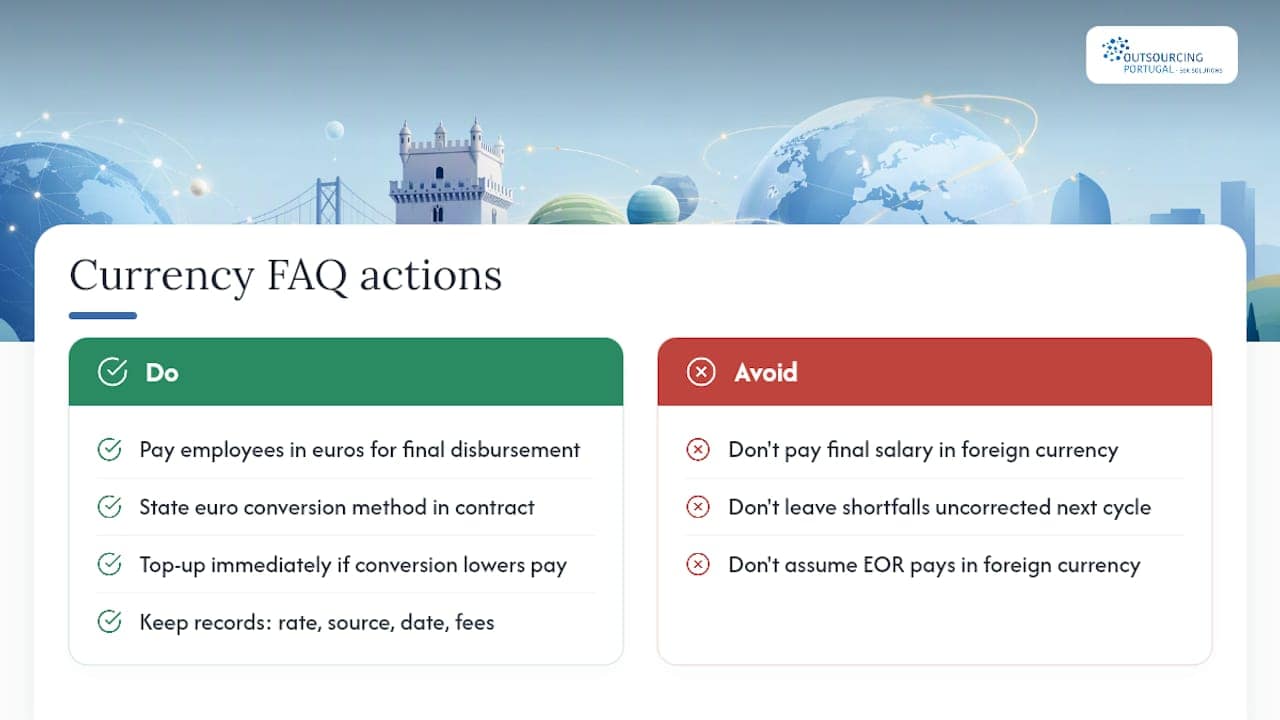
No, not as the final disbursement. A contract can reference another currency for internal purposes, but the amount the employee actually receives has to be available in euros and meet Portuguese minimum wage and withholding rules.
What happens if a currency conversion causes a payment to fall below minimum wage?
The employer needs to correct it immediately with a top-up payment and, if tax filings were affected, a corrected submission. Leaving it uncorrected compounds the violation into the next pay cycle.
Do EOR providers ever pay employees directly in foreign currency?
Generally no. EOR providers in Portugal typically run payroll in euros and handle any currency conversion internally, precisely to keep clients compliant with local payment and minimum wage rules.
Is it legal to include a foreign currency figure in an employment contract?
Yes, as long as the contract also states clearly how and when that figure converts to euros for actual payment, and the euro amount meets minimum wage and withholding requirements every pay period.
What documentation should employers keep for currency conversions?
Keep the exchange rate used, its source, the conversion date, any fees charged, and who absorbed those fees, alongside standard payslip and tax records, in case of an audit.
Sources
- Working in Portugal – gov.pt (withholding tables / minimum wage guidance)
- Lei n.º 7/2009, de 12 de Fevereiro (Consolidated Labour Code)
- Global Employment Compass — Portugal (practical payroll guide)
- EOR payroll practical guide (third-party industry blog)