

An acordo de confidencialidade, or NDA, legally binds one or more parties to secrecy over specific information before it changes hands. In Portugal, you sign one before sharing anything sensitive, whether that’s a product roadmap, a client list, or salary data during recruitment. The rest comes down to drafting it correctly, using the model clauses and clause structures Portuguese sources actually rely on.
TL;DR:
- Portuguese NDAs do not require written form but should clearly define parties, scope, purpose, handling, exceptions, and enforceability to ensure validity.
- Duration of confidentiality obligations typically ranges from three to five years, but trade secrets may warrant indefinite protection if justified.
- Enforcing NDAs is more reliable through arbitration for confidentiality, whereas court proceedings are public and can compromise sensitive information.
- Proper operational measures such as access controls, signatory authority verification, and documented disclosures are crucial for effective confidentiality enforcement.
- Using tailored templates and legal review ensures NDAs are enforceable under Portuguese law, avoiding common drafting mistakes like vague definitions and excessive durations.
Table of Contents
- What an acordo de confidencialidade means under Portuguese law
- Essential clauses every Portuguese NDA should include
- Unilateral, bilateral, and multilateral NDAs
- How long should confidentiality obligations last?
- Enforcement: court litigation versus arbitration
- How to use an NDA: a practical checklist
- Common drafting mistakes that weaken an NDA
- Practical notes on NDAs for employers hiring in Portugal
- Why most NDA advice misses the point
- Another route: letting Outsourcing-portugal handle compliance for you
- Where to find Portuguese NDA templates and guidance
- Sources
What an acordo de confidencialidade means under Portuguese law
An NDA can stand as its own contract or live as a clause inside a bigger agreement, like a supply deal or an employment contract. Either way, it obligates whoever receives sensitive information not to disclose or misuse it.
Portugal doesn’t have a dedicated “NDA statute.” Instead, enforceability rests on general contract principles from the Código Civil, particularly good faith obligations between parties, combined with Law n.º 99/2017, which transposes EU Directive 2016/943 on trade secrets. That law gives businesses a real legal hook when confidential commercial information gets misused, separate from whatever the contract says.
Portuguese law doesn’t strictly demand a written NDA to make the obligation exist. But written documentation is what actually lets you prove and enforce it if things go wrong. An oral promise of secrecy is nearly impossible to litigate. A signed document with dated clauses is not.
Essential clauses every Portuguese NDA should include
A vague NDA is barely better than no NDA. Before you sign anything, check it covers these points:
- Parties and definition of confidential information. Name everyone involved and define exactly what counts as confidential, whether that’s technical specs, financial data, or client contacts. Vague catch-all language (“all information shared”) tends to collapse under scrutiny.
- Purpose limitation. State what the receiving party may actually do with the information, and forbid everything else.
- Handling obligations. Cover storage, return, or destruction of materials once the relationship ends, and who’s on the hook if a subcontractor or employee leaks something.
- Exceptions. Carve out information already public, already known independently, or disclosed under legal obligation (a court order, for instance).
- Consequences of breach. Spell out a cláusula penal (contractual penalty), the right to claim damages, and the possibility of an emergency injunction to stop ongoing disclosure.
- Governing law and forum. State that Portuguese law applies and specify whether disputes go to court or arbitration.
Pro Tip: Skip the “confidential means everything” trap. List categories of information explicitly, then add a catch-all clause as backup, not as your main definition. Courts favor specificity when a dispute lands in front of them.
Unilateral, bilateral, and multilateral NDAs
Not every NDA needs to bind both sides equally. The structure should match who’s actually disclosing what.
- Unilateral NDA. Only one party shares confidential information, so only the receiving party carries obligations. Common when a startup pitches a proprietary process to an investor.
- Bilateral (mutual) NDA. Both parties disclose and receive information, so obligations run symmetrically in both directions. This fits joint ventures, supplier negotiations, or two companies exploring a merger.
- Multilateral NDA. Three or more parties, often in consortiums or multivendor projects, each bound to the same confidentiality terms. Drafting gets trickier here because proving who leaked what becomes harder as the group grows.
Bilateral agreements are the default in most Portuguese business dealings, since even a “one-way” pitch tends to involve some reciprocal disclosure once talks get serious.
How long should confidentiality obligations last?
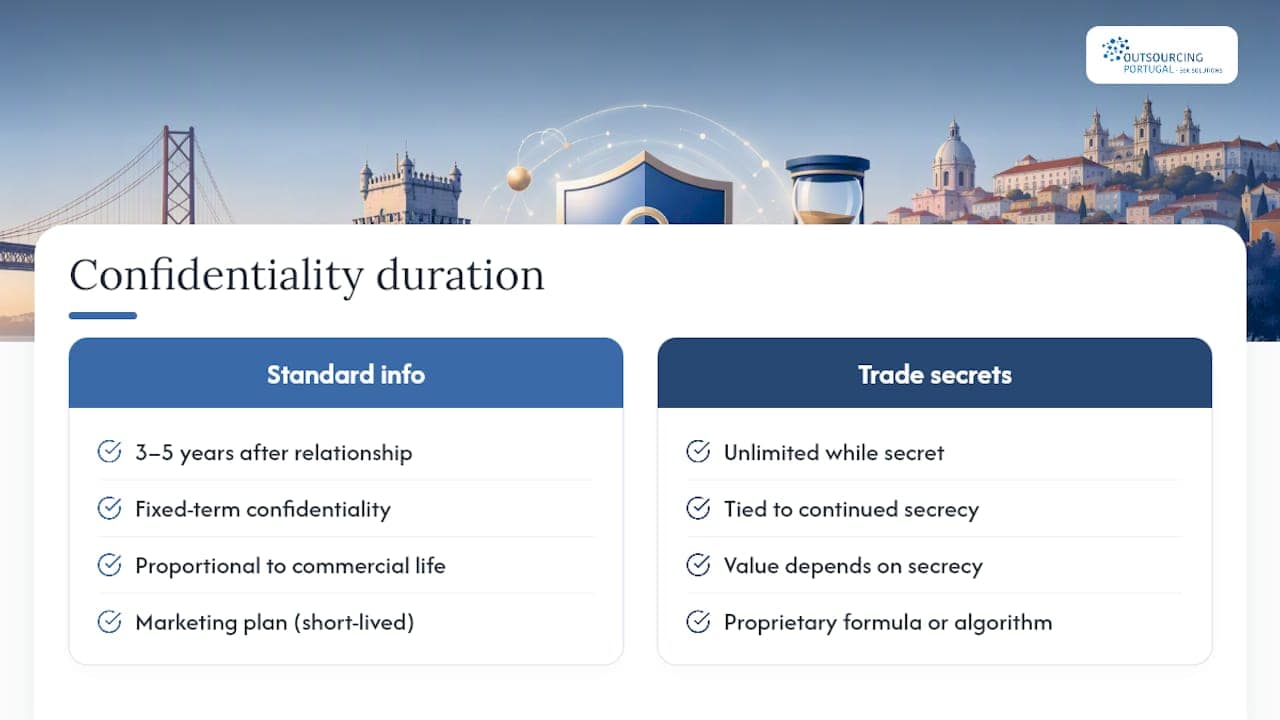
Most commercial NDAs in Portugal set a duration between three and five years after the relationship ends. That’s the range specialists commonly recommend for standard business information, from client data to internal processes.
Trade secrets are different. If the information’s value depends on staying secret indefinitely, like a proprietary formula or algorithm, an unlimited term tied to continued secrecy can be justified. The key is proportionality: match the duration to how long the information will actually matter commercially. A five-year confidentiality clause protecting a marketing plan for a product that launches next quarter doesn’t hold up to scrutiny.
Enforcement: court litigation versus arbitration
When someone breaches an NDA, you have a few remedies available. Courts can issue interim injunctions to stop ongoing disclosure immediately, award damages for losses suffered, and enforce any contractual penalty written into the agreement.
The catch with going to court is that court proceedings in Portugal are, by default, public. That’s a problem when the entire point of your case is that certain information should stay secret. Arbitration keeps the dispute confidential, which is why many Portuguese NDAs include an arbitration clause pointing to a body like the Centro de Arbitragem instead of the regular courts.
Whichever path you choose, evidence wins the case. Keep dated records of what was disclosed, when, and to whom. Access logs, data room permissions, and version histories on shared documents all matter more than people expect once a dispute actually lands on someone’s desk.
How to use an NDA: a practical checklist
Getting the paperwork right matters less than getting the timing right. Sign before you share, not after, whether that’s an investor pitch, a supplier demo, or an early M&A conversation.
- Prepare the agreement using a Portuguese-adapted template, not a generic one pulled from an American or British source.
- Present it before any disclosure, ideally as a condition of the meeting or data access, not as an afterthought.
- Confirm signatory authority. Whoever signs on behalf of a company needs actual authority to bind it; check this for corporate counterparts.
- Sign and record it, using electronic signatures where appropriate, and keep a dated copy on file.
For source material, INPI publishes an annotated model confidentiality agreement built for university-industry collaborations. The clause structure, scope, exceptions, duration, and enforcement, translates well to commercial use even outside academic settings. Before adopting it, check these items:
- Does the definition of confidential information match your actual transaction?
- Is the duration proportional to your information’s shelf life?
- Does it name Portuguese law and a Portuguese forum or arbitration body?
Common drafting mistakes that weaken an NDA
Most NDA disputes trace back to sloppy drafting, not bad faith. Watch for these red flags:
- Vague definitions of confidential information that a court can dismiss as too broad to enforce.
- Unlimited durations with no justification, which can get challenged as disproportionate for ordinary business data.
- Missing coverage for employees, consultants, and subcontractors. The obligation needs to extend to anyone the receiving party shares information with internally, not just the signing company.
- No enforcement mechanism, leaving you with a document that states an obligation but no real consequence for breaking it.
- Imported foreign templates. Advisors in Portugal frequently flag this as a recurring error: a template built for US or UK law often assumes legal concepts, like certain injunctive remedies, that don’t translate directly into Portuguese practice.
Pro Tip: If your NDA was drafted for a different jurisdiction, have someone familiar with Portuguese contract law review it line by line before you sign, not just skim the top. The clauses that look fine on the surface are usually the ones that fail in practice.
Practical notes on NDAs for employers hiring in Portugal
Employers should require an NDA at two points: before sharing sensitive business information during recruitment interviews, and as part of the onboarding paperwork once someone’s hired. The NDA often works alongside a non-compete clause, though the two serve different purposes: one protects information, the other restricts future employment.
A signed clause alone doesn’t stop a leak. Pairing it with operational controls, access logs, limited data room permissions, and an exit checklist that revokes system access on someone’s last day, is what actually makes confidentiality enforceable rather than theoretical. This matters even more when you’re managing hires without a local entity and need your hiring compliance checklist to cover data protection alongside standard employment terms.
Why most NDA advice misses the point
Most guides treat the NDA as the finish line: get it signed, file it away, move on. That’s backward. The signature is the starting point of an obligation that has to be monitored and enforced, not a box you check.
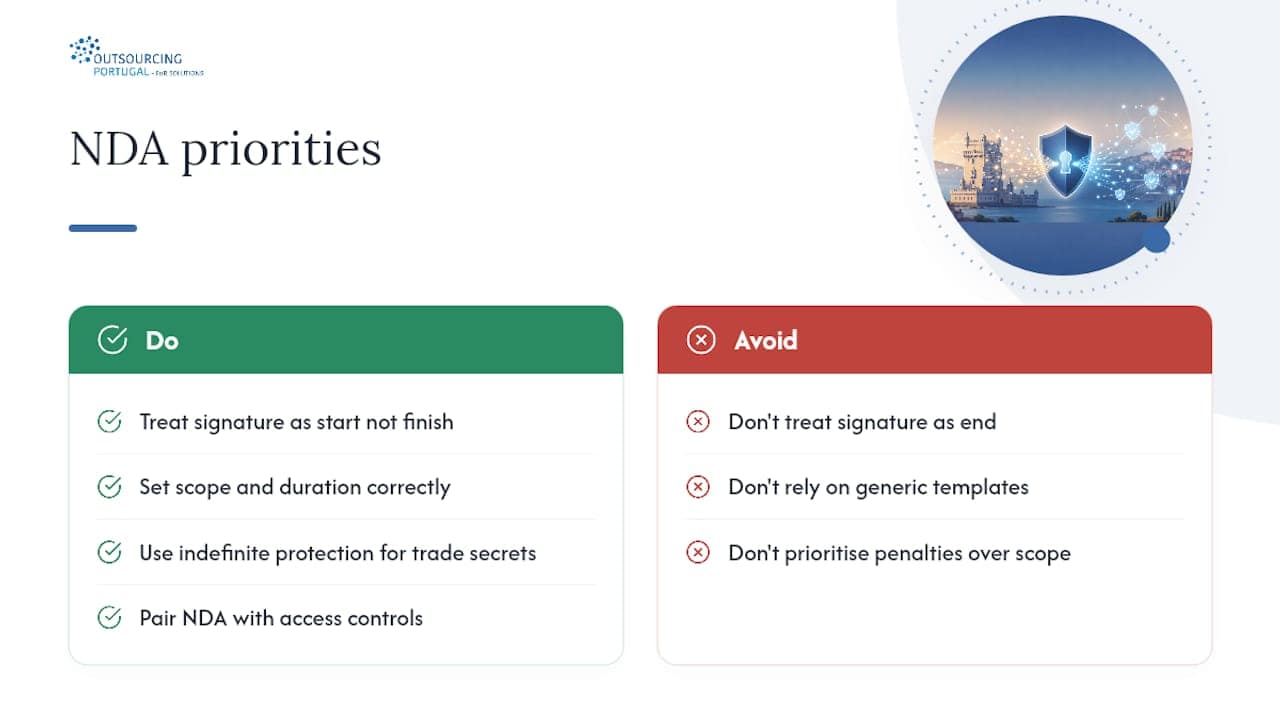
The conventional advice to “just use a template” undersells how much duration and scope decisions actually matter. A five-year clause covering a fast-moving tech roadmap protects nothing by year three, because the information is already stale. Meanwhile, businesses routinely underprotect actual trade secrets by defaulting to the standard 3 to 5 year window when indefinite protection, tied to continued secrecy, would serve them better.
If you’re hiring or contracting in Portugal, prioritize this: get the scope and duration right before you worry about penalty clauses. A well-scoped NDA with a modest penalty beats a sloppy one with an aggressive damages clause, because the sloppy one won’t survive a challenge in the first place. Pair the paperwork with real operational discipline, access controls, exit checklists, documented disclosures, since that’s what turns a signed page into something you can actually enforce.
— Paulo
Another route: letting Outsourcing-portugal handle compliance for you
Drafting the NDA is one problem. Making sure it actually holds up once you’re managing payroll, contracts, and data access for a Portuguese hire is another. Outsourcing-portugal exists for companies that want the legal and operational groundwork handled without setting up a local entity first.
Our Employer of Record services build compliant contracts, confidentiality terms, and onboarding documentation into the hiring process from day one, so you’re not retrofitting an NDA onto a hire who already has system access. That reduces the operational risk of sensitive data changing hands before the right protections are in place, particularly for international companies unfamiliar with how Portuguese employment law interacts with confidentiality obligations. If you’re planning to hire in Portugal and want the compliance side handled properly from the start, get in touch about our EOR and payroll services to see how it fits your setup.
Where to find Portuguese NDA templates and guidance
For model clauses, consult INPI’s annotated confidentiality agreement, IPAM’s explainer on NDAs, and the Centro de Arbitragem’s clause guidance for arbitration language. For NDAs covering translated or externally shared documents, secure translation management practices are worth reviewing too.
Sources
- NDA: o que é um contrato de confidencialidade (IPAM)
- Centro de Arbitragem — clauses and arbitration guidance
- Non-Disclosure Agreements in Portugal (Advocate Abroad)