

Portugal has quietly climbed to 23rd out of 69 economies in the 2025 IMD World Talent Ranking, and the numbers behind that position tell a story most international HR leaders haven’t fully read yet. Many companies still assume that productivity concerns or language limitations make Portugal a second-tier choice for outsourcing. That assumption is costing them. This guide cuts through the noise with data-backed clarity on Portugal’s real strengths, its genuine challenges, and the practical frameworks you need to make confident workforce expansion decisions.
Table of Contents
- Understanding Portugal’s competitive position in global talent rankings
- Language skills and workforce adaptability: Portugal’s unique edge
- Productivity paradox: The challenges and advantages hidden behind Portugal’s numbers
- Educational mismatch and evolving skills: What HR leaders must know
- Strategic applications: Leveraging Portugal’s workforce for business expansion
- Connect with Portugal’s top workforce services
- Frequently asked questions
Key Takeaways
| Point | Details |
|---|---|
| Talent ranking advantage | Portugal’s workforce has improved its global talent standing, appealing to international business expansion. |
| Language proficiency strength | High English skills and adaptability make Portugal a leading choice for multilingual teams. |
| Productivity nuance | Productivity varies by sector and firm type, demanding strategic HR planning for optimal results. |
| Educational alignment matters | Matching employee skills to firm needs is essential when leveraging Portugal’s workforce. |
| Actionable expansion strategies | Identify sector strengths and use trusted services for seamless business entry in Portugal. |
Understanding Portugal’s competitive position in global talent rankings
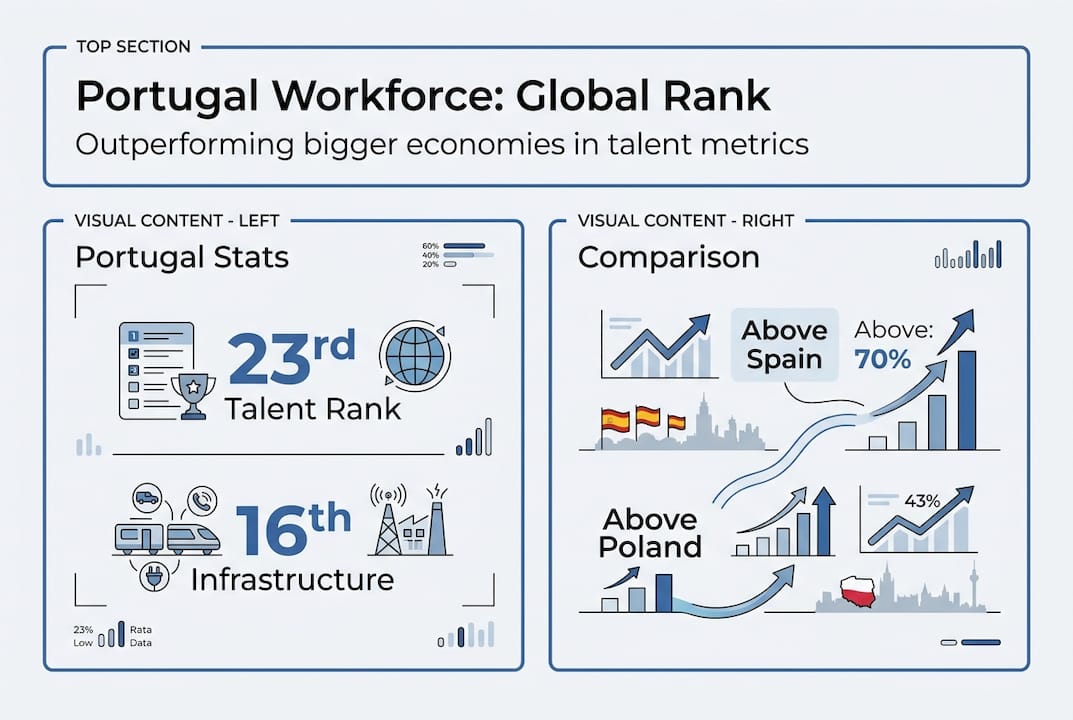
Portugal’s rise in global talent rankings isn’t accidental. The country moved up two positions in the 2025 IMD World Talent Ranking, reaching 23rd out of 69 economies. That’s a meaningful shift, not a rounding error.
The IMD methodology matters here. The four-factor ranking framework evaluates investment and development, appeal, readiness, and economic performance. Portugal scores particularly well on infrastructure, landing 16th globally in that category. For HR managers benchmarking European locations, that’s a signal worth taking seriously.
To put Portugal’s position in perspective, consider how it stacks up against comparable European economies:
| Country | IMD Talent Rank (2025) | Infrastructure Rank | Notes |
|---|---|---|---|
| Portugal | 23rd | 16th | Strong language skills, EU member |
| Spain | 35th | 22nd | Larger economy, higher labor costs |
| Poland | 38th | 31st | Growing tech hub, lower English proficiency |
| Greece | 47th | 40th | Lower overall competitiveness scores |
Portugal outranks several larger European economies. That’s the kind of benchmark data that changes outsourcing conversations. If you want to understand the reasons companies choose Portugal over other nearshore destinations, the ranking context is a strong starting point. For tech-specific expansion, the Portugal tech development guide breaks down sector-level opportunities in detail.
Language skills and workforce adaptability: Portugal’s unique edge
Once you see Portugal’s talent ranking, the next strategic question is its practical skill set, especially language ability. This is where Portugal genuinely surprises.
Portugal ranks 7th in language skills globally and 6th in the English Proficiency Index. For international companies building cross-border teams, that’s not a minor footnote. It’s a core operational advantage.
Here’s what that proficiency translates to in practice:
- Tech teams can collaborate directly with English-speaking stakeholders without translation overhead
- Customer service operations can serve UK, US, and global markets from a single Portuguese hub
- Project management runs smoother when your nearshore team reads, writes, and speaks the same language as your headquarters
- Onboarding is faster because documentation, training, and communication don’t require localization
Adaptability goes beyond language. Portuguese professionals consistently score high on cross-cultural collaboration metrics, making integration into international teams faster and less disruptive. If you’re scaling tech teams across borders, that adaptability reduces friction at every stage.
“Portugal’s workforce combines strong English proficiency with genuine cross-cultural flexibility, making it one of the most integration-ready talent pools in Southern Europe.”
For companies already considering expanding into Portugal, language capability is often the deciding factor that converts interest into action.
Pro Tip: When building multilingual business units, prioritize Portuguese talent for roles that require direct client communication. Their proficiency in English, Spanish, and French makes them unusually versatile for pan-European customer operations.
Productivity paradox: The challenges and advantages hidden behind Portugal’s numbers
High adaptability and language skills paint a promising picture, but factual productivity numbers create vital nuance for decision-makers. Portugal’s labor productivity sits 17% below the OECD average. That’s a real gap, and ignoring it would be a mistake.

But context matters enormously here. The OECD’s 2026 economic survey identifies a specific structural issue: Portugal’s economy is dominated by micro-firms, and those small organizations drag down aggregate productivity figures. Mid-size and large firms tell a very different story.
The productivity paradox is this: Portugal’s education levels have risen significantly, but that rising education hasn’t translated into proportional economic growth. The reason is misallocation. Talented, well-educated workers are often placed in roles that don’t match their capabilities, which suppresses firm-level output.
For international companies, this creates a genuine opportunity:
- You can capture the talent that domestic firms underutilize. Educated Portuguese professionals in mismatched roles are often eager for better-fit opportunities.
- Sector selection matters. Tech, finance, and professional services show productivity profiles far above the national average.
- Firm size context is critical. Outsourcing to or through larger, structured organizations avoids the micro-firm drag entirely.
- Cost advantages remain real. Even accounting for productivity gaps, Portugal’s labor costs deliver strong value relative to Western European alternatives.
Understanding working in Portugal from an operational standpoint helps you navigate these dynamics before you commit resources. The way infrastructure impacts outsourcing decisions in Portugal also plays directly into productivity outcomes at the firm level.
“The productivity gap in Portugal is real but highly concentrated. International companies that select the right sectors and firm structures consistently outperform the national average.”
Pro Tip: Before finalizing your outsourcing structure, evaluate the size and sector profile of your target workforce. Partnering with mid-to-large organizations or structured service providers insulates you from the micro-firm productivity drag that skews national statistics.
Educational mismatch and evolving skills: What HR leaders must know
Productivity isn’t only about resources. It’s about fit. Portugal’s workforce offers a sharp lesson in how educational alignment shapes outcomes at the firm level.
Research on educational mismatch in Portugal shows a clear pattern: under-education is directly detrimental to productivity, while over-education has a limited positive effect. In plain terms, putting an overqualified worker in a low-complexity role doesn’t generate the productivity boost you might expect. It often generates disengagement instead.
For HR leaders, this has direct implications for workforce planning. Here’s a practical framework for reducing mismatch impact in your Portuguese operations:
- Map role complexity before hiring. Define the actual skill requirements of each position before you recruit. Vague job descriptions attract mismatched candidates.
- Audit existing team qualifications. If you’re inheriting a team through an acquisition or outsourcing transition, assess qualification levels against role demands immediately.
- Design targeted upskilling programs. Where under-education exists, structured training closes gaps faster than replacement hiring.
- Create advancement pathways. Over-educated workers stay engaged when they see a clear route to roles that match their full capability.
- Use sector benchmarks. Compare your team’s qualification profile against sector norms, not national averages, to get an accurate picture of fit.
For companies focused on career development in Portugal, building these alignment practices into your HR framework from day one prevents the productivity losses that catch many international operators off guard.
“Educational mismatch is a solvable problem. The companies that solve it early build Portuguese teams that consistently outperform national productivity benchmarks.”
Strategic applications: Leveraging Portugal’s workforce for business expansion
Understanding the details is critical, but applying them is transformational. Here’s how to turn Portugal’s workforce insights into effective strategy.
Portugal’s business efficiency and infrastructure rank strongly in IMD’s global competitiveness assessment, which means the operational environment supports what you’re trying to build. The question is how to structure your approach.
Here are the core strategic moves that international companies are using successfully:
- Start with language-intensive roles. Customer support, technical writing, and client-facing tech roles are natural fits for Portugal’s language-proficient workforce. These deliver immediate ROI.
- Build nearshore tech teams in Lisbon and Porto. Both cities have mature tech ecosystems with strong university pipelines. The infrastructure impact on talent availability in these hubs is significant.
- Use an Employer of Record to test before committing. An EOR lets you hire Portuguese talent legally and compliantly without setting up a local entity. It’s the lowest-risk entry point for workforce expansion.
- Leverage EU membership for regulatory alignment. Portugal’s EU status means GDPR compliance, standardized employment law, and straightforward cross-border data handling.
- Target mid-size and large firms for outsourcing partnerships. As the productivity data shows, firm size is a strong predictor of output quality. Structure your vendor and partner selection accordingly.
- Align hiring with sector strengths. Tech, shared services, finance, and professional services consistently outperform Portugal’s national productivity average. These are your highest-value targets.
The Portugal outsourcing benefits extend well beyond cost. When you combine competitive labor pricing with strong language skills, EU compliance, and improving talent rankings, the strategic case becomes compelling across multiple use cases.
Connect with Portugal’s top workforce services
Portugal’s workforce data makes a strong case. Acting on it requires the right operational infrastructure. Whether you’re hiring your first Portuguese employee or scaling a 50-person nearshore team, the compliance and payroll complexity can slow you down if you don’t have local expertise in place.
Outsourcing Portugal provides Employer of Record services that let you hire in Portugal legally and compliantly without setting up a local entity. For tech-focused expansion, our nearshore tech talent solutions connect you with vetted professionals in Lisbon, Porto, and beyond. And if payroll complexity is your immediate challenge, our Portugal payroll outsourcing service handles everything from salary processing to tax compliance. The workforce opportunity is real. We make sure you capture it without the operational risk.
Frequently asked questions
How does Portugal’s workforce competitiveness compare to other European countries?
Portugal ranks 23rd out of 69 economies globally, outperforming larger neighbors like Spain and Poland on talent metrics. Its language proficiency and infrastructure scores give it a distinct edge over many Southern and Eastern European peers.
What are the main challenges when outsourcing to Portugal?
Labor productivity runs 17% below the OECD average, driven largely by micro-firm dominance and educational mismatch in certain sectors. Companies that select the right sectors and firm structures consistently avoid these pitfalls.
Is English proficiency a real advantage for international companies in Portugal?
Absolutely. Portugal ranks 6th globally in the English Proficiency Index, which means your Portuguese team can collaborate directly with English-speaking stakeholders from day one without communication barriers.
Are there government initiatives that support workforce competitiveness?
Portugal scores strongly on government efficiency and basic infrastructure in IMD’s methodology, ranking 16th out of 69 economies in that category. That institutional support creates a stable, predictable environment for international workforce operations.