

Hiring multilingual professionals in Portugal presents unique challenges for international companies seeking to expand or build nearshore teams. Despite Portugal’s reputation for a highly educated, multilingual workforce, sourcing candidates who speak specific languages like German, French, or Spanish requires strategic planning and local market knowledge. Many companies struggle to identify the right talent pools, navigate cultural nuances, and manage compliance requirements. This comprehensive guide walks you through proven strategies to efficiently find, recruit, and retain multilingual talent in Portugal, helping you avoid common pitfalls and accelerate your international growth.
Table of Contents
- Key takeaways
- Understanding the demand and talent landscape in Portugal
- Preparing your recruitment strategy for multilingual talent in Portugal
- Executing multilingual talent sourcing effectively in Portugal
- Verifying hiring success and optimizing your approach
- Discover expert support for multilingual hiring in Portugal
- FAQ
Key Takeaways
| Point | Details |
|---|---|
| German talent shortfall | Portugal faces a tight supply of German speakers, creating strong competition for these professionals. |
| Focus Lisbon and Porto | Lisbon is the primary talent hub, followed by Porto, so prioritizing these cities improves sourcing efficiency. |
| University partnerships | Partner with IST, Porto, Minho, and Nova to build long term candidate pipelines through campus events and internships. |
| Outsourcing and EOR | Outsourcing and Employer of Record services can accelerate access to pre vetted multilingual candidates while simplifying compliance. |
Understanding the demand and talent landscape in Portugal
Portugal’s multilingual talent market presents both opportunity and challenge for international employers. As of April 2025, Germany faces a structural shortage for German-speaking talent with nearly two jobs per candidate, creating intense competition for these professionals. The market shows 23,457 open positions against only 12,500 qualified German-speaking candidates, illustrating the supply-demand imbalance you’ll encounter.
Geographic concentration significantly impacts your sourcing strategy. Lisbon hosts 55% of Portugal’s multilingual professionals, making it the primary target for recruitment efforts. Porto follows as the second-largest talent hub, while smaller cities offer limited pools of multilingual candidates. This urban concentration means your recruitment activities should prioritize these metropolitan areas for efficiency and results.
Top talent sources in Portugal:
- Instituto Superior Técnico (IST) in Lisbon produces engineering and technical graduates
- University of Porto offers strong programs in technology, business, and languages
- University of Minho excels in engineering and computer science disciplines
- Nova School of Business and Economics attracts internationally minded students
Understanding language demand patterns helps you allocate resources effectively. German speakers remain the most scarce and sought-after, followed by French and Spanish professionals. English proficiency is widespread among Portuguese graduates, making it a baseline rather than differentiator. Your recruitment timeline should account for these market realities, particularly if targeting niche language combinations.
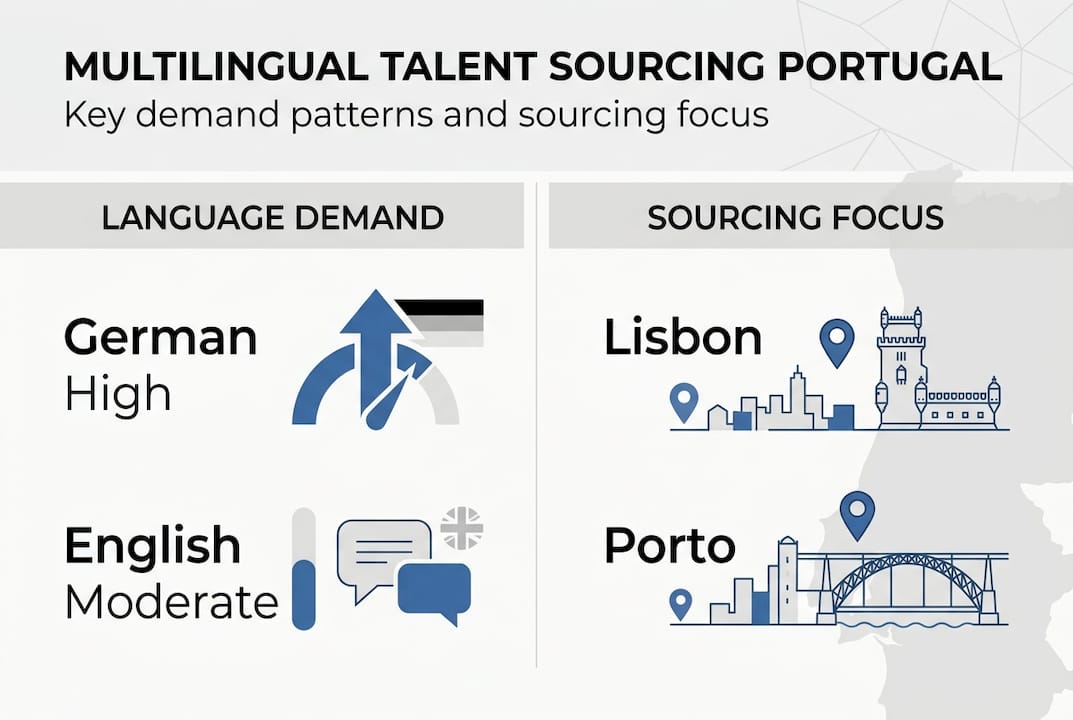
Pro Tip: Map your language requirements against regional talent density before launching campaigns. If you need German speakers, concentrate efforts in Lisbon where international companies have established presence and created language-specific communities.
Partnering with outsourcing Portugal EoR solutions can accelerate access to pre-vetted multilingual candidates while handling compliance complexities. These services maintain existing talent networks and understand regional availability patterns better than companies entering the market independently.
| Language | Demand Level | Candidate Availability | Competition |
|---|---|---|---|
| German | Very High | Low | Intense |
| French | High | Moderate | Strong |
| Spanish | High | Moderate | Strong |
| English | Universal | High | Moderate |
Preparing your recruitment strategy for multilingual talent in Portugal
Successful multilingual hiring starts with precise requirements definition. Specify exactly which languages your roles require and at what proficiency levels, using frameworks like CEFR (Common European Framework of Reference) to eliminate ambiguity. A customer service role might require C1 German and B2 English, while a technical position could accept B2 German with C1 English. This clarity prevents wasted effort screening unsuitable candidates.
Identify target institutions based on your industry and role requirements. Prioritize universities IST, Porto, and Minho and urban centers such as Lisbon and Porto for pipelines that align with your technical needs. Engineering roles benefit from IST and Minho partnerships, while business positions connect well with Nova and Católica graduates. Establish relationships through career fairs, sponsored projects, or internship programs to build long-term talent pipelines.

Understanding Portuguese employment law prevents costly mistakes during hiring. Portugal requires written employment contracts, mandates specific notice periods, and protects employees through strong labor regulations. Salary expectations vary by region and language skills, with Lisbon commanding premium rates. Research local compensation benchmarks for multilingual roles to ensure your offers remain competitive without overpaying.
Critical preparation steps:
- Create multilingual job descriptions that resonate with Portuguese cultural values
- Establish salary ranges based on role, language requirements, and location
- Develop interview processes that fairly assess language proficiency
- Prepare onboarding materials in relevant languages to support new hires
- Build employer branding that highlights your company’s international culture
Cultural adaptation strengthens your employer value proposition. Portuguese professionals value work-life balance, career development opportunities, and organizational stability. Your recruitment messaging should emphasize these elements rather than purely financial compensation. Highlighting international exposure, language skill development, and clear advancement paths attracts quality multilingual candidates.
Pro Tip: Audit your current employer branding materials for cultural relevance before launching Portuguese recruitment. Generic international messaging often fails to resonate with local professionals who seek specific career benefits.
Consider whether to expand to Portugal for tech teams through direct entity establishment or leverage existing infrastructure through professional services. Direct hiring offers maximum control but requires significant legal and administrative setup. Outsourcing solutions provide faster market entry with reduced complexity, particularly valuable when testing Portuguese talent or building initial teams.
Executing multilingual talent sourcing effectively in Portugal
Multi-channel sourcing maximizes your candidate reach across Portugal’s fragmented talent market. LinkedIn remains the primary professional network, but Portuguese job boards like Net-Empregos and Sapo Emprego capture local candidates. University career portals connect you directly with recent graduates, while specialized recruitment agencies maintain databases of multilingual professionals actively seeking opportunities.
German-speaking talent requires targeted approaches given the high demand for German speakers drives international recruitment from German-speaking countries to Portugal. Partner with agencies specializing in German language recruitment or tap into German expat communities in Lisbon and Porto. Many German speakers in Portugal originally relocated for lifestyle reasons and actively seek roles leveraging their language skills.
Effective sourcing sequence:
- Launch targeted LinkedIn campaigns with Portuguese language ads highlighting your multilingual environment
- Post positions on local job boards with clear language requirements and competitive compensation
- Activate university partnerships through career services and alumni networks
- Engage specialized recruitment agencies for hard-to-fill language combinations
- Leverage employee referrals from existing Portuguese team members who understand the local market
- Attend job fairs and networking events in Lisbon and Porto to build brand awareness
Structured candidate evaluation ensures you select professionals who meet both language and technical requirements. Conduct initial screenings in the target language to verify proficiency claims, then assess technical skills through practical exercises or case studies. Cultural fit interviews help identify candidates who align with your organizational values and can thrive in international team environments.
Employer of Record services streamline the hiring process by managing contracts, payroll, and compliance requirements. This approach proves particularly valuable when scaling tech teams in Portugal without establishing a legal entity. EoR providers handle administrative complexity while you focus on candidate selection and team integration.
| Approach | Speed to Hire | Setup Cost | Control Level | Best For |
|---|---|---|---|---|
| Direct Hiring | 3-6 months | High | Maximum | Long-term presence |
| EoR Services | 2-4 weeks | Low | Moderate | Market testing, rapid scaling |
| Recruitment Agency | 4-8 weeks | Moderate | High | Specialized roles |
Pro Tip: Implement digital recruiting strategies for German talent that leverage social media targeting and content marketing to attract passive candidates who aren’t actively job searching.
Maintain consistent communication throughout the recruitment process to enhance candidate experience. Portuguese professionals expect timely feedback and transparent information about role expectations, compensation, and career development. Slow or unclear communication drives top candidates toward competing offers, particularly in the competitive German-speaking talent market.
Verifying hiring success and optimizing your approach
Tracking recruitment metrics reveals what works and what needs adjustment in your multilingual hiring process. Monitor time to hire from job posting to offer acceptance, measuring separately for different language requirements. German-speaking roles typically take longer to fill than English-only positions, so separate metrics prevent skewed analysis. Quality of hire assessments at 90 days and six months show whether candidates meet performance expectations.
New hire feedback provides invaluable insights into your recruitment and onboarding effectiveness. Conduct structured interviews at 30, 60, and 90 days to understand their experience from initial contact through integration. Ask specifically about language support, cultural adaptation, and whether the role matches what was communicated during recruitment. This feedback identifies gaps between your messaging and reality.
Key optimization areas:
- Refine job descriptions based on which versions attract higher quality applicants
- Adjust sourcing channel investment based on cost per quality hire metrics
- Improve interview processes where candidate feedback indicates confusion or misalignment
- Enhance onboarding programs to address common challenges multilingual hires face
- Update compensation ranges when offer acceptance rates fall below targets
Retention programs tailored to multilingual employees strengthen long-term success. Create language-specific employee resource groups that provide community and networking opportunities. Offer continued language training to help professionals maintain or improve skills in less commonly used languages. Recognize cultural diversity through inclusive policies and celebrations that value different backgrounds.
“The most successful international employers in Portugal invest in localized retention strategies that go beyond salary. They create environments where multilingual professionals feel valued for their unique skills and cultural perspectives, leading to significantly lower turnover rates.”
Stay current on Portuguese employment law changes and market trends through professional services or legal counsel. Compliance requirements evolve, and salary expectations shift as more international companies enter the market. Regular FAQ on hiring with EoR and payroll in Portugal reviews ensure your practices remain competitive and legally compliant.
Benchmark your results against industry standards for multilingual hiring in Portugal. Time to hire for German speakers typically ranges from 8 to 12 weeks, while English-speaking technical roles fill in 4 to 6 weeks. If your metrics fall outside these ranges, investigate whether your compensation, employer branding, or sourcing strategies need adjustment.
Discover expert support for multilingual hiring in Portugal
Navigating Portugal’s multilingual talent market becomes significantly easier with experienced partners who understand local nuances and maintain established candidate networks. Outsourcing Portugal specializes in helping international companies access Portuguese talent through comprehensive Employer of Record and payroll services that eliminate setup complexity.
Their employment Portugal EoR and payroll services handle everything from compliant contract creation to monthly payroll processing, allowing you to hire multilingual professionals without establishing a Portuguese entity. This approach proves especially valuable when testing market viability or building initial nearshore teams before committing to permanent infrastructure.
EOR Portugal services overview demonstrates how professional employment solutions accelerate your hiring timeline while ensuring full legal compliance. You gain access to pre-vetted multilingual candidates and benefit from established relationships with universities and recruitment networks across Lisbon and Porto.
For companies pursuing nearshore Portugal outsourcing, these services reduce administrative burden and compliance risk while expanding your talent reach. You focus on building great teams while experts handle the operational complexity of international employment.
FAQ
How do I find qualified multilingual candidates in Portugal?
Focus recruitment on Lisbon and Porto where 55% of multilingual professionals concentrate. Use targeted job boards, build university partnerships with IST and Porto, and engage specialized recruitment agencies for specific language needs. Outsourcing Portugal EoR solutions provide access to pre-vetted candidate networks and handle compliance requirements.
What languages are most in demand among talent pools in Portugal?
German speakers face the highest demand with Germany nearshore report cites a shortage of German-speaking talent in Portugal showing nearly two jobs per qualified candidate. French and Spanish professionals also command strong demand for customer service and business roles. English proficiency is widespread among Portuguese graduates, making it a baseline skill rather than differentiator in most technical and business positions.
How can Employer of Record services ease multilingual hiring in Portugal?
EoR providers handle legal employment contracts, payroll processing, tax compliance, and benefits administration so you can onboard multilingual talent within weeks instead of months. They eliminate the need to establish a Portuguese legal entity while ensuring full compliance with local labor laws. EOR Portugal services overview shows how these solutions simplify managing remote multilingual teams for international companies entering the Portuguese market.
What regions in Portugal have the highest concentration of multilingual talent?
Lisbon hosts 55% of Portugal’s multilingual talent, followed by Porto and other urban centers making these cities your primary recruitment targets. Smaller cities like Braga, Coimbra, and Faro offer limited multilingual candidate pools. Focus sourcing efforts on metropolitan areas where international companies have established presence and created language-specific professional communities that attract and retain multilingual talent.