

Paying an international employee in Portugal feels straightforward until the first tax filing lands on your desk. Many HR managers assume expat payroll is just local payroll with a foreign bank account, but that assumption can trigger double taxation, regulatory penalties, and even permanent establishment risk for your company. Expat payroll is the specialized management of compensation, benefits, taxes, and compliance for employees working temporarily outside their home country, often involving dual-country obligations. This guide breaks down exactly what expat payroll covers, how it works in Portugal, and what you need to do to get it right.
Table of Contents
- Defining expat payroll: What it covers and why it matters
- How expat payroll works: Key mechanics and processes explained
- Common expat payroll challenges for remote teams in Portugal
- Payroll processing models for expats: Host, split, shadow, and outsourcing
- How much does expat payroll cost in Portugal?
- Compliance essentials: Legal requirements and pitfalls for expat payroll in Portugal
- Streamlining expat payroll: Next steps for compliant hiring in Portugal
- Frequently asked questions
Key Takeaways
| Point | Details |
|---|---|
| Expat payroll is complex | Managing cross-border payroll involves compliance, dual taxation, and benefits not handled by standard payroll systems. |
| Model choice is critical | Selecting between host, split, shadow, or outsourced payroll can affect costs, risks, and employee satisfaction. |
| Portugal payroll costs explained | Expect to budget up to 150% of gross salary, plus monthly administrative fees, for fully compliant expat payroll in Portugal. |
| Compliance mistakes are costly | Failure to follow legal requirements can lead to double taxation, fines, and lasting liabilities. |
| Expert support streamlines payroll | Specialized providers help international teams stay compliant while controlling costs and avoiding pitfalls. |
Defining expat payroll: What it covers and why it matters
Local payroll is simple: one country, one tax authority, one social security system. Expat payroll is a different animal entirely. When an employee works in Portugal while remaining on a home-country contract, your company suddenly has obligations in two jurisdictions at once.
Expat payroll covers compensation, benefits, taxes, and compliance for people working temporarily outside their home country, involving multi-country obligations. That means you are managing salary, bonuses, housing allowances, social security contributions, income tax withholding, and benefits coordination across borders simultaneously. Miss one element and you expose both the employee and the company to liability.
For remote teams in Portugal specifically, the risks are sharper than most HR managers expect. Portugal has its own social security system, its own income tax bands, and specific rules around what constitutes taxable presence. Companies using payroll services in Portugal that are not purpose-built for expat scenarios often find gaps in their compliance coverage.
Here is what expat payroll must account for:
- Gross salary and net pay calculations across home and host country rules
- Bonus and incentive payments that may be taxable in both jurisdictions
- Social security contributions under Portuguese law and applicable treaties
- Benefits-in-kind such as housing, schooling, and travel allowances
- Tax withholding aligned with the employee’s residency and assignment status
“Getting expat payroll wrong is not just a compliance issue. It is a talent retention issue. Employees who face unexpected tax bills or benefit gaps do not stay.”
Understanding expat payroll compliance from the start saves you from costly corrections later.
How expat payroll works: Key mechanics and processes explained
With the foundation set, let’s look at how expat payroll is actually managed step by step for Portugal-based remote teams.
The mechanics are more involved than most HR teams anticipate. Here is a practical sequence:
- Determine tax residency status. Is the employee a Portuguese tax resident or a non-resident? This drives every calculation that follows.
- Apply the correct tax equalization or protection policy. Tax equalization principles ensure the employee pays no more or less tax than they would at home, with the company absorbing the difference.
- Calculate gross-up amounts. If the company covers the employee’s Portuguese income tax, the payment itself becomes taxable income, requiring a gross-up calculation to avoid a tax-on-tax spiral.
- Coordinate social security obligations. Portugal has bilateral social security agreements with many countries. You need to confirm which country’s system applies and file accordingly.
- Manage currency conversion. Salaries paid in a home currency but taxed in euros require consistent FX rate policies to avoid discrepancies in filings.
- Run monthly payroll and file with Portuguese tax authorities. This includes submitting the Declaração Mensal de Remunerações (monthly remuneration declaration) on time.
Key mechanics involve tax equalization, home vs. multi-jurisdiction tax, gross-up arrangements, social security treaties, and currency management. Each step connects to the next, so an error early in the chain compounds downstream.

Pro Tip: Before placing any employee in Portugal, document your tax equalization policy in writing. Verbal agreements about who covers what tax burden create disputes when assignment costs run higher than expected.
For companies without in-house expertise, payroll compliance solutions built specifically for Portugal remove the guesswork from each of these steps.
Common expat payroll challenges for remote teams in Portugal
Understanding procedure is only half the story. Critical pitfalls often catch out even experienced teams.
Portugal has 79 Double Taxation Agreements, but risks remain: double taxation, currency FX costs, NHR ineligibility, misclassification, and long-tail liabilities. Having a treaty in place does not mean it applies automatically. You still need to file the right forms and claim treaty benefits proactively.
Here are the most common challenges HR teams face:
- Double taxation. Without proper treaty claims and shadow payroll, employees can be taxed in both countries on the same income.
- FX volatility. Paying salaries in dollars or pounds while filing taxes in euros creates cost unpredictability. A consistent FX policy is essential.
- NHR regime changes. Portugal’s non-habitual resident tax regime was significantly revised after 2024. Most remote workers no longer qualify, which changes the tax math for many assignments.
- Shadow payroll gaps. Companies that pay employees from abroad but ignore Portuguese filing obligations create compliance exposure without realizing it.
- Permanent establishment risk. An employee working in Portugal can inadvertently create a taxable presence for your company, triggering corporate tax obligations.
“The NHR regime change post-2024 caught many international companies off guard. Assignments planned around NHR benefits needed complete financial restructuring.”
Pro Tip: Use an employer cost calculator before finalizing any assignment package. Knowing the true cost upfront prevents budget overruns when Portugal payroll compliance challenges surface mid-assignment.
Payroll processing models for expats: Host, split, shadow, and outsourcing
Choosing the right approach is essential. Each payroll model handles complexity, risk, and cost differently.
Host payroll is simplest but costly for home-country benefits; split balances admin and compliance; shadow is for compliance without local payment; in-house is risky without expertise. Here is how each model compares:
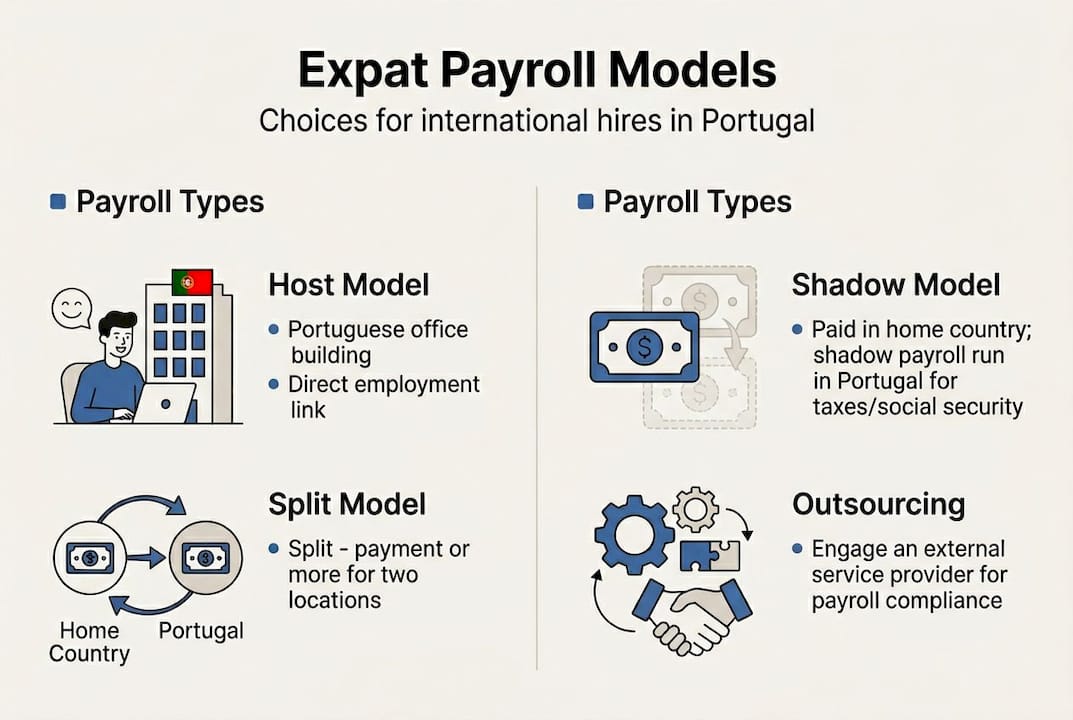
| Model | How it works | Best for | Key risk |
|---|---|---|---|
| Host payroll | Employee paid entirely through Portuguese payroll | Long-term assignments | Losing home-country benefits |
| Split payroll | Salary split between home and host country payroll | Mid-term assignments | Complex admin across two systems |
| Shadow payroll | Filed in Portugal for compliance, paid from home country | Short assignments, compliance-only | Requires dual-system management |
| Outsourced/EOR | Third-party employer handles all payroll and compliance | Companies without a local entity | Vendor dependency |
For most international companies testing the Portuguese market or building remote teams without a local entity, the outsourced or Employer of Record model offers the best balance of compliance coverage and cost predictability. Review payroll cost models to see how each option affects your bottom line before committing.
How much does expat payroll cost in Portugal?
Knowing your model, the next practical step is accurate budgeting. Here is what the numbers look like for Portugal.
Total employer cost for expat staff is 140-150% of gross salary; payroll processing fees in Portugal run $50 to $100 per employee per month, while EOR services range from $199 to $599 per employee per month.
| Cost component | Typical range |
|---|---|
| Gross salary | 100% (baseline) |
| Portuguese social security (employer) | ~23.75% of gross |
| Holiday and Christmas allowances | ~16.7% of gross |
| Other statutory benefits | ~2-5% of gross |
| Total employer cost | 140-150% of gross |
| Payroll processing fee | $50-$100/employee/month |
| EOR service fee | $199-$599/employee/month |
To keep costs predictable, follow these steps:
- Fix your FX rate policy at the start of each assignment period to avoid mid-year budget surprises.
- Use a Portugal cost calculator to model total employer cost before signing any offer letter.
- Separate one-time setup costs (registration, onboarding) from recurring monthly fees in your budget.
- Review employer cost benchmarks annually, as social security rates and statutory minimums change.
The difference between a well-budgeted expat assignment and a costly surprise is almost always in the planning stage, not the execution.
Compliance essentials: Legal requirements and pitfalls for expat payroll in Portugal
Even with costs and processes dialed in, regulatory missteps can bring major consequences. Here is your compliance roadmap.
Double taxation agreements, shadow payroll obligations, social security treaties, and PE risk are among the key compliance issues international HR must manage in Portugal. Getting these wrong is not just expensive. It can expose your company to back taxes, interest, and reputational damage.
Core compliance requirements include:
- NIF registration. Every expat employee needs a Portuguese tax identification number before payroll can run.
- Social security enrollment. Employees must be registered with Segurança Social unless a bilateral agreement exempts them.
- Monthly payroll declarations. The Declaração Mensal de Remunerações must be filed by the 10th of the following month.
- Annual income reporting. IRS Modelo 3 declarations are required for tax residents.
- Work authorization documentation. EU nationals have automatic rights; non-EU nationals need valid visas and work permits on file.
Pro Tip: Audit your expat payroll files every quarter. Missing a single document, such as a social security exemption certificate, can invalidate treaty protections and trigger back payments. Partnering with global employment solutions providers who specialize in Portugal keeps your documentation current without burdening your internal team.
For a detailed breakdown of filing requirements, the Portugal payroll FAQ covers the most common questions HR teams face when setting up compliant payroll for the first time. Staying current with payroll legal obligations is not optional. It is the foundation of every successful expat assignment.
Streamlining expat payroll: Next steps for compliant hiring in Portugal
With the essentials mastered, partnering with experts can make compliant, cost-effective expat payroll seamless.
Managing expat payroll in-house without deep local knowledge is one of the most common and costly mistakes international companies make in Portugal. The compliance landscape changes, tax treaties require active management, and one missed filing can unravel months of careful planning.
At Outsourcing Portugal, we handle the full employment lifecycle for international companies, from onboarding and payroll processing to social security filings and compliance monitoring. As a dedicated Employer of Record Portugal provider, we act as the legal employer for your team, absorbing the compliance burden so you can focus on building your business. Our payroll outsourcing Portugal service covers everything from monthly declarations to annual tax reporting, with transparent pricing and no hidden fees. If you are ready to hire in Portugal without the risk, reach out to our team for a tailored quote.
Frequently asked questions
What is tax equalization in expat payroll?
Tax equalization ensures employees on assignment pay no more or less tax than they would at home, with the company covering any difference between hypothetical home tax and actual multi-jurisdiction tax. It sometimes involves gross-up calculations to prevent a tax-on-tax effect.
What is shadow payroll and when is it needed?
Shadow payroll runs local compliance filings in Portugal for employees who are paid from abroad, meeting Portuguese tax and social security obligations without changing the actual payment structure. It is typically needed when shadow payroll for non-residents helps manage host-country compliance without disrupting home-country pay arrangements.
Which costs should I plan for with expat payroll in Portugal?
Expect total employer costs to reach 140 to 150% of gross salary, plus monthly payroll provider fees of $50 to $100 per employee or EOR service fees ranging from $199 to $599 per employee.
Can remote workers in Portugal claim the NHR tax regime?
Most remote workers are not eligible for the Portuguese non-habitual resident regime after 2024 due to significant rule changes, so assignment packages that relied on NHR ineligibility implications need to be recalculated under standard tax rates.
What are the biggest risks if expat payroll is managed incorrectly?
Major risks include double taxation, compliance penalties, loss of employee rights, and long-tail liabilities post-assignment that can surface years after an employee has left Portugal.