

Immigrants now make up 24% of Portugal’s formal workforce and contribute a net €2.2 billion to social security each year. Yet many multinational hiring managers still assume that EU free movement covers every worker they want to relocate or hire in Portugal. It does not. Mobility rules vary sharply depending on whether your candidate holds an EU passport, comes from a Portuguese-speaking CPLP nation, or arrives from outside both blocs entirely. This guide breaks down eligibility, hiring pathways, compliance obligations, and practical strategies so your team can move fast without running into legal trouble.
Table of Contents
- Defining workforce mobility in Portugal
- Main pathways for workforce mobility: EU, CPLP, and non-EU nationals
- Employee posting and intra-company transfers
- Workforce mobility data and trends in Portugal
- Compliance, risks, and practical strategies for hiring mobile workers
- Challenges and opportunities: Internal mobility, remote work, and labor market impact
- Next steps: Hiring support for workforce mobility in Portugal
- Frequently asked questions
Key Takeaways
| Point | Details |
|---|---|
| Mobility pathways | EU, CPLP, and non-EU nationals all access Portugal’s labor market differently, each with unique legal requirements. |
| Compliance is critical | Strict enforcement and complex regulations mean ethical recruitment and clear documentation are essential for multinationals. |
| Labor market advantages | Portugal’s dynamic workforce and job-to-job mobility can fuel wage growth and company expansion. |
| Remote work potential | Remote work can help overcome Portugal’s internal labor mobility barriers and boost access to international talent. |
| Practical hiring support | EoR and outsourcing platforms can simplify hiring and compliance for global teams in Portugal. |
Defining workforce mobility in Portugal
Workforce mobility, in the Portuguese context, means the ability of employees to relocate, transfer, or be hired across borders or within the country itself. It covers three distinct dimensions: cross-border movement of foreign nationals into Portugal, intra-company transfers of existing staff from overseas offices, and internal job-to-job mobility within the Portuguese labor market.
Portugal’s mobility framework is shaped by three overlapping rule sets. EU law governs free movement for European citizens. Portuguese immigration law controls entry and work authorization for everyone else. And local labor market regulations set the floor for wages, working hours, and employment conditions regardless of where a worker originates.
The main worker categories you will encounter are:
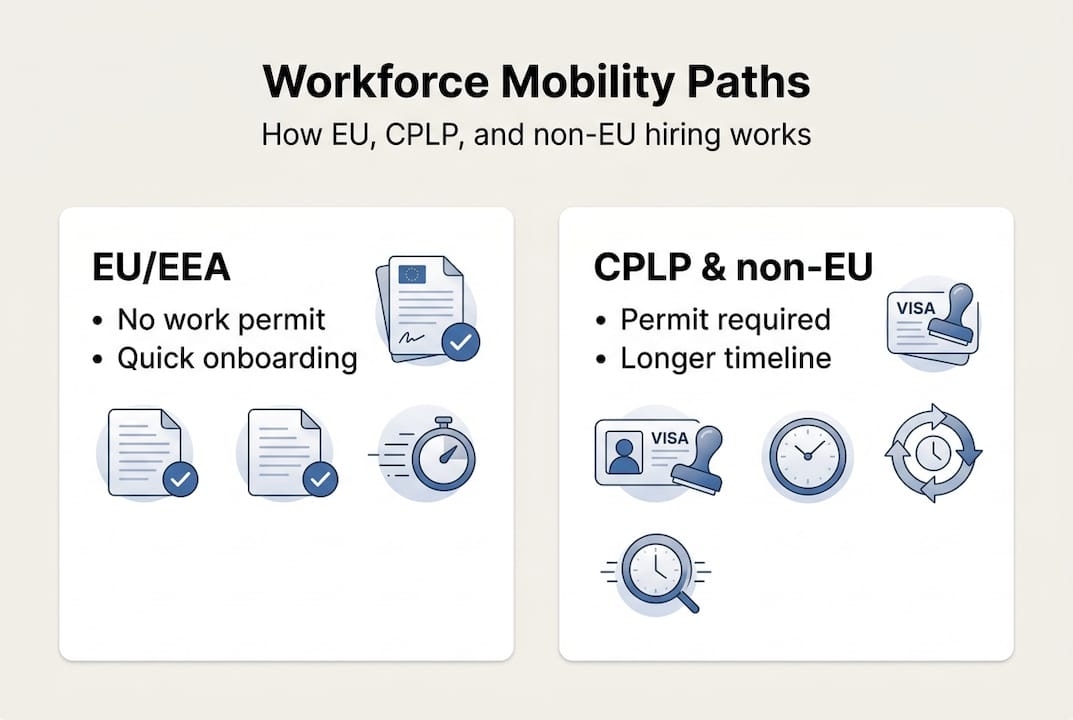
- EU/EEA nationals: Full free movement rights, no work permit required
- CPLP nationals: Citizens of Portuguese-speaking countries such as Brazil, Angola, Cape Verde, and Mozambique, who benefit from a streamlined mobility agreement
- Non-EU/Non-CPLP nationals: Subject to standard visa and work permit requirements, including Tech Visas and seasonal permits
- Posted workers: Employees temporarily assigned from a foreign entity to a Portuguese operation
- Intra-company transferees: Senior staff or specialists relocated under EU or WTO transfer rules
For a broader overview of how these categories interact with local hiring law, the hiring guide for Portugal covers the full employment lifecycle. The OECD Portugal report also highlights how structural labor market factors influence mobility outcomes at the national level.
Main pathways for workforce mobility: EU, CPLP, and non-EU nationals
Now that you know the main types, see how eligibility and hiring steps differ by origin country.
| Worker category | Work permit needed | Typical timeline | Minimum salary requirement |
|---|---|---|---|
| EU/EEA national | No | Immediate | Standard Portuguese minimum |
| CPLP national | In-country conversion | 6 to 8 weeks | None specified |
| Non-EU Tech Visa | Yes, pre-entry | 2 to 4 months | Role-dependent |
| Seasonal worker | Yes, pre-entry | 1 to 3 months | Sector minimum wage |
| Intra-company transfer | Yes, ICT permit | 4 to 8 weeks | Comparable to local role |
EU citizens have free movement rights, meaning you can onboard them in Portugal with no immigration paperwork beyond standard employment registration. That is a genuine competitive advantage when you need to staff up quickly.

The CPLP Mobility Agreement is arguably the most underused hiring tool available to multinationals in Portugal. Nationals from Brazil, Angola, Cape Verde, Mozambique, and other Portuguese-speaking countries can enter Portugal on a passport alone, then convert their status to a work permit in-country within 6 to 8 weeks, with no minimum salary threshold attached. That flexibility makes CPLP talent a strong pipeline for roles where EU candidates are scarce.
For non-EU, non-CPLP nationals, the steps are more structured:
- Confirm the role qualifies under the relevant visa category (Tech Visa, seasonal, or standard work visa)
- Obtain a job offer and draft a compliant employment contract
- Submit the visa application at the Portuguese consulate in the candidate’s home country
- Await SEF (immigration authority) processing, typically 2 to 4 months for Tech Visas
- Register the employee with social security and tax authorities upon arrival
If you want to skip the entity setup entirely, EoR hiring in Portugal lets you onboard workers under a compliant local employer structure from day one. The detailed hiring guide walks through each visa category in depth.
Employee posting and intra-company transfers
Beyond visas, mobility also includes intra-company transfers. Here is how postings work.
When a foreign company temporarily assigns an employee to work in Portugal, that person becomes a posted worker. The EU ICT Directive and WTO rules govern these arrangements, and the compliance obligations are more detailed than most HR teams expect.
| Posting duration | Key obligation |
|---|---|
| From day one | Portuguese core terms apply (working hours, rest periods, health and safety) |
| After 12 months | Full host country employment conditions apply, including minimum wage and paid leave |
| Throughout posting | A1 certificate required to confirm home country social security coverage |
Posted workers get host country core terms after one year, including minimum wage and holiday entitlements. Before that threshold, you must still comply with Portuguese rules on working time, health and safety, and anti-discrimination. The A1 certificate, issued by the home country’s social security authority, prevents double contributions during the posting period.
Pro Tip: Track posting start dates carefully. Once a worker crosses the 12-month mark, your payroll and benefits obligations shift significantly. Many multinationals miss this trigger and face retroactive penalties.
For companies managing multiple posted workers across different projects, the EoR compliance guide outlines how a local employer of record absorbs these obligations. Teams running sales outsourcing solutions in Portugal also benefit from this structure when rotating staff between markets. The full employment law guide covers posting rules in detail.
Workforce mobility data and trends in Portugal
With mobility routes covered, let us look at how these trends shape Portugal’s labor landscape and your hiring decisions.
“Immigrants comprise 11.7% of Portugal’s population, 24% of the formal workforce, and contribute €2.2 billion net to social security annually.”
That figure from Portugal hiring data tells you something important: foreign workers are not a marginal segment of the Portuguese economy. They are load-bearing. Removing them would collapse entire sectors, from hospitality and construction to tech and shared services.
Key trends shaping your hiring strategy right now:
- Unemployment sits around 6%, meaning the domestic talent pool is tight and competition for skilled workers is real
- Brain drain is ongoing, with Portuguese graduates and mid-career professionals emigrating to higher-wage EU markets like Germany, the Netherlands, and Switzerland
- Job-to-job mobility is rising, driven by wage growth expectations and a more competitive labor market, which benefits employers who offer structured career paths
- Foreign direct investment is accelerating, particularly in tech, with multinationals paying premium wages that are reshaping salary benchmarks across sectors
For a deeper look at cost structures and talent availability, the outsourcing talent blog breaks down what you should budget for different roles. If payroll complexity is a concern, payroll outsourcing resources explain how to manage contributions across a mixed workforce of locals and foreign hires.
Compliance, risks, and practical strategies for hiring mobile workers
Understanding market trends is only half the battle. Mastering compliance turns insight into action.
Portugal’s labor authority, the ACT (Autoridade para as Condições do Trabalho), is known for rigorous enforcement. ACT enforces strictly and multinationals face parent liability, meaning your headquarters can be held responsible for violations committed by a Portuguese subsidiary or contractor. That is not a theoretical risk. It has resulted in real fines and reputational damage for global firms.
The most common compliance failures for mobile worker programs include:
- Misclassifying workers as contractors when the relationship meets the legal definition of employment
- Skipping social security registration for posted workers who are assumed to be covered by home country systems
- Ignoring collective bargaining agreements that apply to specific sectors, even for foreign hires
- Rushing fast-track visa programs without verifying that recruitment practices meet ethical sourcing standards
Pro Tip: Use an Employer of Record (EoR) structure for your mobility hires. An EoR acts as the legal employer in Portugal, handling payroll, social security, tax filings, and contract compliance on your behalf. You retain full operational control while the EoR absorbs the legal risk.
The compliance in hiring resource explains how to build a compliant hiring process from the ground up. The EoR compliance guide goes further, detailing exactly what obligations transfer to the EoR and what stays with you. The employment compliance guide is also worth bookmarking for reference.
Challenges and opportunities: Internal mobility, remote work, and labor market impact
To finish, let us address the practical barriers and potential for companies seeking mobility solutions.
Portugal scores well on international talent attraction but struggles with internal labor mobility. The core problem is structural. High residential mobility barriers from housing costs and transaction taxes make it expensive for Portuguese workers to relocate from, say, the interior to Lisbon or Porto. That limits the domestic talent pool in high-demand urban markets.
For multinationals, this creates both a challenge and an opening:
- Housing costs in Lisbon and Porto have risen sharply, making relocation packages a real cost factor for international hires
- Remote and hybrid work models are increasingly enabling cross-border workforce mobility, allowing you to hire talent based outside major cities without requiring relocation
- Foreign firms paying premium wages attract top Portuguese talent but do not always generate wage spillovers into the broader domestic market, so local salary benchmarks can lag behind what you are used to in other EU markets
- Digital nomad and D8 visa holders represent a growing segment of mobile workers who contribute economically without entering the formal employment market
The outsourcing infrastructure guide explains how Portugal’s connectivity and digital infrastructure support remote and hybrid team models. The OECD Portugal survey provides the macroeconomic context behind these mobility constraints.
Next steps: Hiring support for workforce mobility in Portugal
Having reviewed the opportunities and barriers, here is how to access professional help to optimize your mobility strategy.
Managing workforce mobility across EU, CPLP, and non-EU channels simultaneously is genuinely complex. Visa timelines, posting obligations, social security certificates, collective agreements, and ACT enforcement all interact in ways that can catch even experienced HR teams off guard.
Our EoR services Portugal platform handles the full employment lifecycle for your mobile hires, from contract drafting and payroll processing to social security registration and ongoing compliance monitoring. Whether you are onboarding a CPLP national under the mobility agreement or managing a long-term intra-company transfer, we provide the legal employer infrastructure you need without requiring you to set up a local entity. Reach out to our team via the contact Portugal hiring experts page to discuss your specific workforce mobility needs.
Frequently asked questions
Are EU nationals required to obtain a work permit to work in Portugal?
No. EU nationals work freely in Portugal without a work permit under the EU free movement directive, though standard employment registration with tax and social security authorities is still required.
How does the CPLP Mobility Agreement impact hiring from Brazil or Angola?
CPLP nationals can enter Portugal on a passport and convert to a work permit in-country within 6 to 8 weeks, with no minimum salary requirement attached to the conversion process.
What are the main compliance risks for multinational employers in Portugal?
Foreign employers face strict enforcement by ACT and potential parent liability for violations, making proper documentation, ethical recruitment practices, and correct worker classification essential from day one.
Does job-to-job mobility contribute to wage growth in Portugal?
Yes. Job-to-job mobility is a recognized driver of wage growth in Portugal, and recent labor market trends show workers are increasingly willing to switch employers to capture salary gains.
Can remote work improve workforce mobility in Portugal despite housing barriers?
Yes. Remote and hybrid models are enabling cross-border workforce mobility even where high residential costs and transaction taxes make physical relocation impractical for many workers.