
TL;DR:
- Workforce settlement in Portugal involves paying all accrued dues accurately and on time.
- Proper preparation and documentation are essential to ensure compliance and avoid penalties.
- Prioritizing legal and payroll compliance enhances employer reputation and reduces legal risks.
When an employee’s contract ends in Portugal, every missed payment or late filing creates real legal exposure for your business. Portuguese labor law sets strict deadlines for settling all outstanding pay, allowances, and contributions, and regulators take non-compliance seriously. International companies that overlook these rules face fines, litigation, and lasting damage to their employer brand in a market where talent is paying close attention. This guide walks you through every stage of the workforce settlement process, from gathering the right documents to verifying compliance, so you can protect your business and your reputation.
Table of Contents
- What is workforce settlement in Portugal?
- Preparation: What you need before starting settlement
- Step-by-step process for workforce settlement in Portugal
- Common challenges and how to avoid them
- Verifying compliance after settlement
- Why getting workforce settlement right gives your company a major edge
- How Outsourcing Portugal can streamline your workforce settlement process
- Frequently asked questions
Key Takeaways
| Point | Details |
|---|---|
| Compliant settlement is mandatory | Portuguese law requires final payments for unused time, allowances, and salary by the contract’s end date. |
| Preparation prevents errors | Up-to-date HR and payroll records ensure accuracy and on-time compliance. |
| Step-by-step process is essential | Following a clear procedure minimizes legal risk and improves employee trust. |
| Verification protects your company | Auditing your settlement process prevents fines and future disputes. |
What is workforce settlement in Portugal?
Workforce settlement is the formal process of finalizing all financial and legal obligations to an employee when their contract ends, whether through resignation, redundancy, mutual agreement, or dismissal. It is not simply writing a final paycheck. It is a structured legal obligation that Portuguese authorities monitor closely.
Under Portuguese labor law, final settlement covers accrued salary, unused vacation days, proportional holiday and Christmas allowances, and any outstanding overtime. These must all be paid by the end of the notice period or the mutually agreed termination date. Miss that window and your company moves into penalty territory.
Here is what the settlement obligation typically includes:
- Accrued salary up to the final working day
- Unused vacation days, calculated at the employee’s daily rate
- Proportional Christmas allowance, covering the portion of the year worked
- Proportional holiday allowance, also calculated proportionally
- Outstanding overtime, if any was accrued and not yet compensated
- Any contractual benefits agreed in the employment contract
“Final settlement includes all outstanding payments: unused holidays, proportional Christmas/holiday allowances, accrued salary, overtime. Paid by end of notice or agreement date.” Portugal Employment and Labour Law, Legal 500
Why does this matter so much for international companies? Because the consequences of errors are not just financial. Your ability to hire future talent depends on how past employees describe their exit experience. For a deeper picture of how settlement fits into the wider hiring lifecycle, reviewing a workforce mobility guide for Portugal gives valuable context.
Preparation: What you need before starting settlement
Settlement done wrong usually starts with poor preparation. Before you run a single calculation, you need accurate and current records across your entire HR and payroll stack.
Here is a core checklist of what to gather:
- Signed employee contract, including any amendments
- Complete payroll history for the full employment period
- Records of vacation days taken versus accrued
- Documentation of any bonuses, commissions, or allowances paid
- Formal notice of termination or mutual agreement documentation
- Records of Social Security contributions made on behalf of the employee
A common and costly mistake is underestimating accrued overtime. Many international HR teams track base salary accurately but miss the cumulative overtime hours that must be included in the final settlement calculation. Similarly, miscalculating the holiday allowance proportion leads to underpayment disputes that can drag on for months.
| Document | Purpose |
|---|---|
| Employment contract | Confirms notice period, salary, and entitlements |
| Payroll records | Base for calculating final salary and allowances |
| Vacation log | Calculates unused holiday balance |
| Termination notice | Establishes legal end date and triggers deadlines |
| Social Security records | Confirms contributions are current |
| Overtime records | Ensures any unpaid overtime is included |
Pro Tip: Use a centralized payroll outsourcing in Portugal platform to reduce human error in these calculations. Automated payroll tools that are configured for Portuguese law will flag missing data before it becomes a settlement problem.
Checking against a dedicated payroll compliance checklist before you start is one of the simplest and most effective ways to avoid costly errors downstream.
Step-by-step process for workforce settlement in Portugal
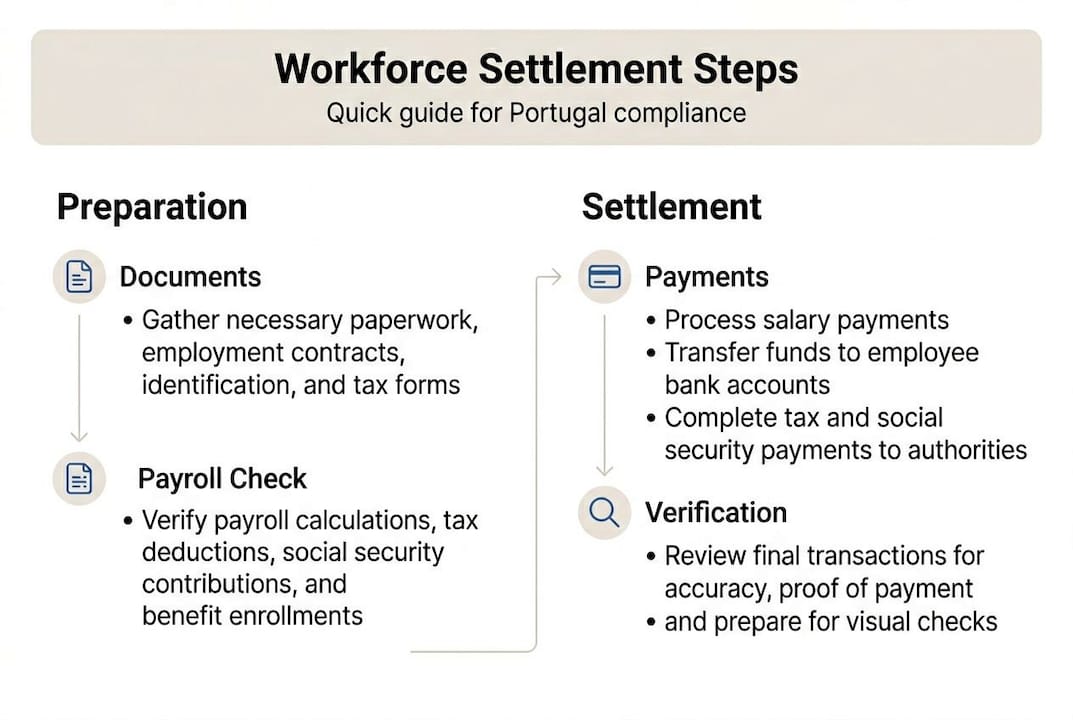
With your documents prepared, you can follow this clear, sequential process to complete a fully compliant settlement.
-
Verify the final working day and contract terms. Confirm the exact termination date, the applicable notice period, and any specific contractual provisions. Dates drive deadlines, so accuracy here is non-negotiable.
-
Calculate all dues. Add up accrued salary, unused vacation, proportional Christmas and holiday allowances, and any unpaid overtime. Cross-reference payroll records at every step.
-
Prepare a written settlement statement. This document itemizes every component of the final payment. It protects your company legally and gives the employee clear confirmation of what they are receiving and why.
-
Make payment by the legal deadline. Portuguese law requires that all payments be made by the end of the notice period or the agreed termination date. Late payment exposes you to penalties regardless of intent.
-
Report the settlement to Portuguese authorities. This includes updating Social Security records and submitting required notifications. Missing this step is one of the most overlooked compliance failures among international employers.
| Settlement step | Common pitfall |
|---|---|
| Verify final working day | Wrong date cascades into wrong calculations |
| Calculate all dues | Missing overtime or proportional allowances |
| Written settlement statement | No documentation, leading to later disputes |
| Pay by legal deadline | Late payment triggers fines |
| Report to authorities | Omitting Social Security notifications |
For companies managing cross-border teams, learning the steps for mobility and compliance alongside settlement will help you manage the full employee lifecycle. If you’re settling expat contracts, reviewing expat payroll practices is equally important.
Pro Tip: Schedule settlements to align with your regular payroll cycle. Processing final payments within an existing payroll run reduces manual errors and keeps your finance team’s workload predictable.
Common challenges and how to avoid them
Even with a clear process, companies face real-world challenges that require vigilance and best practices.
The most frequent issues international employers encounter in Portugal include:
- Underpayment of allowances. Christmas and holiday allowances are often miscalculated when employment spans partial years. Always calculate proportionally from the start of the reference year.
- Late final payments. Approvals processes or bank delays in international companies often push payments past the legal deadline. Build in buffer time.
- Inaccurate Social Security reporting. Failing to close out employee records with Social Security creates future compliance problems and potential claims against your company.
- Missing contractual benefits. If the employment contract includes specific perks, those may need to be settled or formally ended in writing.
- Poor record retention. Losing documentation of what was paid and when makes it impossible to defend your company in a dispute.
“Final settlement includes all outstanding payments: unused holidays, proportional Christmas/holiday allowances, accrued salary, overtime.” Portugal Employment and Labour Law, Legal 500
To stay ahead of these pitfalls, use an employment cost calculator to model settlement costs before an employee exits. This gives your finance team advance notice and prevents last-minute scrambling.

Investing in compliance payroll solutions designed for the Portuguese market removes most of these risks by automating calculations and tracking legal deadlines in real time. The more your process relies on manual spreadsheets, the higher your exposure to Portugal labor law violations.
Verifying compliance after settlement
After following the process, it’s crucial to verify everything is correct and audit-ready.
Completing payment is not the end of your obligation. Portuguese labor law requires you to maintain records and be prepared to demonstrate compliance if a dispute arises or a regulator requests documentation. Here is how to run a solid post-settlement audit:
-
Reconcile the settlement statement against actual payment records. Confirm that every line item on the settlement document matches what was paid and when.
-
Confirm Social Security records have been updated. Check that the employee’s departure has been officially logged with Portuguese Social Security authorities.
-
Verify document retention. Portuguese employment records should be retained for a minimum of five years. Organize all settlement documents in a secure, accessible file.
-
Obtain written confirmation from the employee. A signed acknowledgment that they have received full and final settlement significantly reduces the risk of future claims.
-
Log the settlement in your internal HR system. This creates a traceable record for future audits and ensures your compliance team has a clear history.
Pro Tip: Use digital checklists synced to your HR platform so every compliance step is automatically documented with timestamps. Manual logs get lost. Digital records don’t.
If you want a ready-to-use framework, walking through a structured verify settlement compliance process ensures nothing is overlooked between payment and final sign-off.
Even if your HR team is experienced, an independent internal audit after each settlement cycle adds a layer of protection that protects both the company and the employee.
Why getting workforce settlement right gives your company a major edge
Most international companies treat workforce settlement as a back-office formality. That framing is a mistake, and we’ve seen it cost businesses real opportunities in the Portuguese talent market.
Here’s the uncomfortable truth: how you exit an employee speaks louder than how you hire one. Portuguese professionals talk. LinkedIn networks in Lisbon and Porto are tight. A single mishandled settlement, with a delayed payment or a missing allowance, spreads faster than any employer branding campaign you could run.
Companies that prioritize role of compliance in hiring build something that no recruitment budget can buy: a reputation for being a trustworthy employer. That reputation lowers your cost per hire, reduces time to fill open roles, and makes top candidates choose you over a competitor.
There is also a litigation dimension that companies underestimate until it hits. A clean settlement record is your first line of defense if a former employee files a claim. Strong compliance culture is not just about avoiding penalties. It is about being able to prove, clearly and quickly, that you did everything right.
In the Portuguese market, legal rigor is a competitive advantage.
How Outsourcing Portugal can streamline your workforce settlement process
Managing workforce settlement across borders, with all the specific Portuguese requirements around allowances, deadlines, and authority notifications, is exactly the kind of complexity that our team handles every day.
At Outsourcing Portugal, we offer payroll management, HR compliance, and end-to-end Employer of Record services designed specifically for international companies operating in Portugal. We handle settlement calculations, legal filings, and authority notifications so your team can focus on growth rather than chasing compliance details. If you’re building or scaling a team in Portugal and want to make sure every hire and every exit is handled correctly, our compliant hiring guide is the place to start.
Frequently asked questions
What are the key settlement payments for employees in Portugal?
Settlement must cover accrued salary, unused vacation days, holiday and Christmas allowances, and overtime due. All of these are required to be paid by the close of the notice or agreement period.
What documents do employers need for workforce settlement in Portugal?
Employers need current contracts, complete payroll records, evidence of unused holidays and allowances, and formal termination notices to process settlement accurately and defend compliance if challenged.
How soon must the final settlement be paid in Portugal?
All settlement payments are due by the end of the employee’s notice period or the agreed termination date, with no grace period under Portuguese law.
What happens if an employer misses a payment or deadline?
Failure to settle on time may result in legal penalties and fines under Portuguese labor law, and can also expose your company to employee litigation and reputational damage in the local market.