
TL;DR:
- Portugal ranks sixth globally in English proficiency, surpassing many traditional outsourcing destinations.
- High English skills enable faster onboarding, clearer communication, and higher client satisfaction.
- Effective outsourcing in Portugal requires role-specific language assessments and strategic talent sourcing.
Most business leaders scanning Europe for outsourcing partners default to the usual suspects, Poland, the Czech Republic, or India, without realizing Portugal sits 6th globally in the EF English Proficiency Index 2025, scoring 612 out of 800 and earning a “Very high” classification. That ranking places Portugal ahead of the majority of traditional nearshore and offshore destinations. For HR managers building international teams, this single data point changes the conversation entirely. This guide walks you through exactly what that proficiency level means for day-to-day operations, how it stacks up against competing markets, and how to translate it into smarter hiring decisions.
Table of Contents
- Why English proficiency matters in outsourcing
- Portugal’s English proficiency: Data and global context
- From rankings to results: Practical impact on outsourcing operations
- Navigating multilingual demands and strategic talent sourcing
- What most outsourcing guides miss about English proficiency
- How Outsourcing Portugal accelerates your talent strategy
- Frequently asked questions
Key Takeaways
| Point | Details |
|---|---|
| Portugal’s communication advantage | Hiring in Portugal means instant access to a highly English-proficient workforce. |
| Reduced outsourcing risk | High English fluency minimizes misunderstandings and boosts client satisfaction in outsourced operations. |
| Smart talent sourcing | Effective outsourcing strategies combine English assessment and EOR for multilingual needs. |
| Role-specific language focus | Assess English speaking and writing skills for client-facing and IT roles for maximum outsourcing impact. |
Why English proficiency matters in outsourcing
Language is infrastructure. When your outsourced team operates in a different country, every miscommunication carries a cost: delayed deliverables, frustrated clients, and rework that eats into your margin. English functions as the default operating system for global business, and teams that use it fluently move faster and with less friction.
In practice, this shows up clearly in two sectors: IT services and Business Process Outsourcing (BPO). An IT support center in Portugal handling tickets from UK, US, and Australian clients needs agents who can read between the lines of a technical complaint, respond clearly in writing, and hop on a call without the client needing to slow down or repeat themselves. The same applies to project managers coordinating sprints across time zones. Seamless communication in outsourcing enables real-time collaboration, customer support, and agile workflows in IT and BPO sectors, and this advantage compounds over months and years.
Here is what strong workforce English proficiency actually enables:
- Faster onboarding: New hires understand documentation, tools, and processes written in English without translation layers.
- Higher client satisfaction: Customer-facing agents handle nuance, tone, and urgency without robotic phrasing.
- Fewer escalations: Issues get resolved at the first point of contact more often.
- Better project documentation: Code comments, requirement specs, and status reports are clear to all stakeholders.
- Reduced management overhead: Senior staff spend less time clarifying or correcting communication errors.
“Language proficiency is not a soft skill in outsourcing. It is the connective tissue between your business intent and execution.”
For companies exploring business expansion in Portugal, this workforce trait is one of the most underappreciated competitive advantages available.
Pro Tip: Do not rely solely on national averages when evaluating a workforce. Request language assessments specific to the role you are filling. A country ranking tells you the ceiling; individual testing tells you what you are actually hiring.
Portugal’s English proficiency: Data and global context
Portugal’s position in the rankings is not just impressive in isolation. It becomes strategically significant when you compare it directly to the countries most businesses consider for outsourcing.
| Country | EF EPI Score (2025) | Proficiency Classification |
|---|---|---|
| Portugal | 612 | Very High |
| Poland | 598 | Very High |
| Philippines | 578 | High |
| Spain | 541 | Moderate |
| India | 524 | Moderate |
| Brazil | 488 | Low |
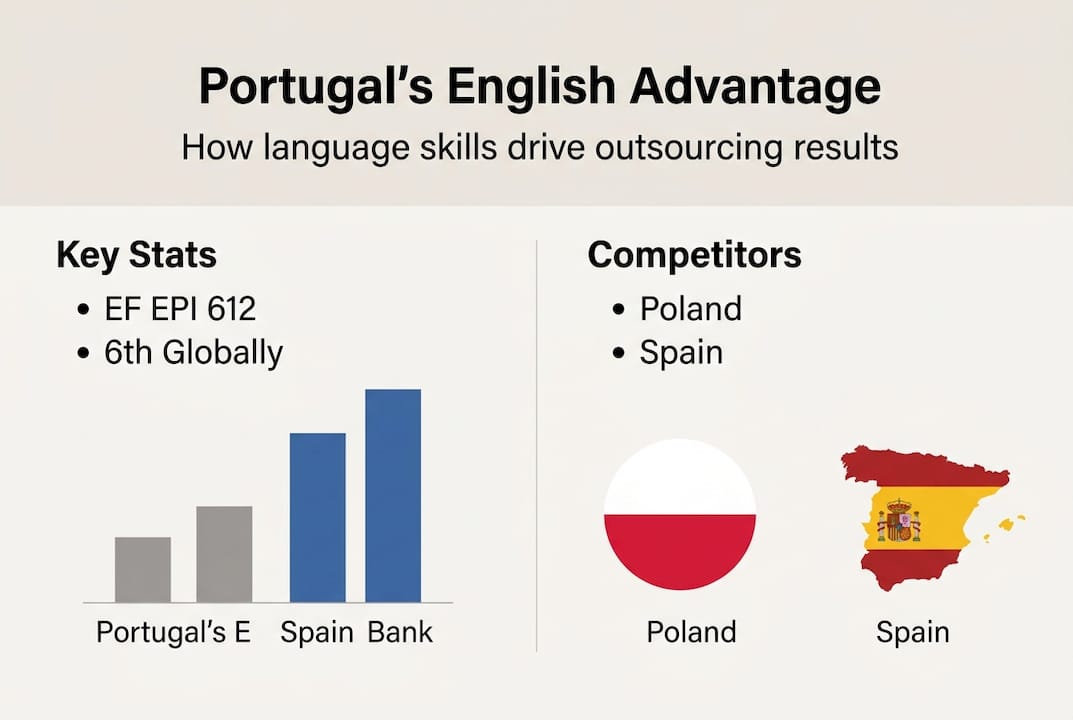
Portugal’s 6th-place global ranking means it outperforms every major nearshore alternative within Southern Europe and most offshore destinations in Asia and Latin America. Poland scores well but still trails Portugal by 14 points. The Philippines, often cited as the go-to English-speaking outsourcing market in Asia, falls 34 points behind.
What drives this? A few structural factors stand out. The Portuguese education system integrates English from an early age, and the country has one of the highest rates of subtitled (rather than dubbed) English-language media in Europe. This means Portuguese professionals grow up hearing and reading authentic, natural English constantly. It is not just classroom English. It is cultural immersion.
Cities like Lisbon and Porto have particularly strong talent concentrations. Both rank among the top tech and BPO hubs in Western Europe, attracting bilingual and multilingual professionals who have often studied or worked abroad. The result is a workforce that does not just pass a language test but operates confidently in mixed-language environments.
For those evaluating Portugal’s nearshore advantages, the English proficiency data is one piece of a larger picture that consistently favors the country as a top-tier outsourcing location.
Key highlights for HR and business decision-makers:
- Portugal scores in the top 6% of all 113 countries evaluated.
- The country has maintained “Very high” proficiency status across multiple consecutive EF EPI editions.
- The gap between Portugal and many competing markets is wide enough to have a measurable operational impact.
From rankings to results: Practical impact on outsourcing operations
Data looks good in a table. But what does a 612 EF EPI score actually feel like when you are running an outsourced team in Portugal day to day?
The first area you notice is onboarding speed. When your company materials, training videos, and internal knowledge bases are in English, a Portuguese team can absorb them directly. There is no need for translated versions or bilingual supervisors to bridge the gap. Weeks of ramp-up time shrink.

The second is client interaction quality. Agile workflows in IT and BPO sectors depend heavily on clear, fast communication. When agents or engineers can switch between written and spoken English without hesitation, your Net Promoter Score (NPS) tends to reflect it.
Here is how Portugal compares operationally:
| Metric | Portugal | India | Philippines | Spain |
|---|---|---|---|---|
| Onboarding speed | Fast | Moderate | Moderate | Slow |
| Miscommunication risk | Low | Moderate | Low to Moderate | Moderate to High |
| Client satisfaction (NPS) | High | Variable | Moderate to High | Moderate |
| English writing clarity | Very High | High | High | Moderate |
To actually leverage this in your hiring process, follow these steps:
- Define the English requirement by role. A backend developer needs strong written English. A client success manager needs both written and spoken fluency.
- Set a CEFR target. Aim for B2 minimum for most professional roles, C1 or C2 for client-facing positions.
- Build language assessment into your screening stage, not as an afterthought at the final interview.
- Test for task-relevant communication. Ask candidates to write a client-facing email or respond to a mock support ticket.
- Review team outputs after 90 days to identify any communication gaps before they become patterns.
This matters especially when you are testing the Portuguese market for the first time and need fast proof of concept. You also want to consider infrastructure for outsourcing, which supports those fast, reliable communication channels your team will depend on.
Pro Tip: For client-facing roles, run a real-world simulation during the interview. Give candidates a realistic scenario, such as handling a frustrated customer or explaining a technical delay, and evaluate their spoken response on tone, clarity, and empathy, not just grammar.
Navigating multilingual demands and strategic talent sourcing
English is the foundation, but it is rarely the whole building. If your business serves German, French, or Spanish-speaking markets, or if your clients operate in multiple languages simultaneously, you need a talent strategy that goes beyond a single language.
Portugal is unusually well-positioned here too. Its workforce includes a significant share of professionals who speak two or three European languages at a professional level, shaped by geography, education, and decades of cross-border economic activity. The tech industry in Portugal in particular attracts international talent who relocate to Lisbon and Porto, adding German, French, Dutch, and Nordic language speakers to the local labor pool.
For HR leaders, the sourcing approach should be structured:
- Start with CEFR level targets. The Common European Framework of Reference (CEFR) uses a scale from A1 (beginner) to C2 (mastery). For most business roles, B2 is the practical minimum; C1 is ideal for direct client communication.
- Assess CEFR levels during screening, not post-hire. Tools like language certification tests or structured oral assessments give you consistent, comparable data.
- Identify language requirements per role before drafting the job spec. A support agent for a German client needs demonstrable C1 German, not just “conversational.”
- Use Employer of Record (EOR) services or specialist agencies for niche multilingual needs. When you need a small team of French-Portuguese bilingual finance analysts, a local EOR partner with established talent networks gets you there faster and in full compliance.
When sourcing multilingual talent in Portugal, partner organizations with existing pipelines in specific language communities save significant time. The broader talent acquisition approach for HR leaders is to prioritize speaking skills for client-facing roles and use targeted EOR partnerships for edge cases where specific language combinations are rare.
Pro Tip: Write language requirements into the job spec with specificity. “Fluent English” means nothing to a recruiter. “C1 English with experience in written client communication” gives them a clear target and filters out guesswork.
What most outsourcing guides miss about English proficiency
Here is a view most guides skip: a high national ranking does not guarantee your team will communicate effectively. We have seen organizations hire based on country reputation alone, skip role-specific language testing, and spend months managing communication problems they assumed would not exist.
The real return on investment from Portugal’s English proficiency comes from acting on it deliberately. That means building language criteria into job specs, using CEFR-aligned assessments, and investing in targeted language development after hire, especially for roles that evolve into more client-facing responsibilities over time.
Top organizations treat language capability like any other performance metric: they measure it at hire, monitor it over time, and close gaps before they become client complaints. The companies that get this right see measurably better nearshore outsourcing outcomes. The ones that skip it are often surprised when a market with strong average proficiency still produces communication friction at the team level. Country rankings set the ceiling. Your process determines what you actually build.
How Outsourcing Portugal accelerates your talent strategy
Portugal’s workforce English advantage is real, but turning it into a consistent operational benefit takes the right hiring infrastructure behind it.
At Outsourcing Portugal, we help international companies build compliant, high-performing teams in Portugal without needing to set up a local entity. Whether you need English-fluent IT professionals, multilingual BPO agents, or specialized technical talent, our Employer of Record solutions handle the legal, payroll, and HR complexity so you can focus on results. For businesses weighing broader options, our global employment solutions guide covers how to structure international workforce expansion strategically. Get in touch to start building your Portugal team today.
Frequently asked questions
How does Portugal’s English proficiency compare to top outsourcing destinations?
Portugal ranks 6th worldwide in the EF English Proficiency Index 2025, above most European and Asian outsourcing centers, including Poland, the Philippines, Spain, and India.
Do all Portuguese professionals speak business-level English?
Most urban professionals in Portugal have strong business English, but you should always assess CEFR levels to match the specific communication demands of each role.
How can HR verify English skills when outsourcing in Portugal?
Use video interviews and language assessment tests focused on the team’s specific tasks. Assess CEFR levels and prioritize speaking skills, not just resume claims or country statistics.
What roles benefit most from high English proficiency?
Client-facing roles, IT support, BPO, and project management benefit most from strong English communication, where clarity and speed directly impact customer satisfaction and delivery quality.