
TL;DR:
- Portugal offers rapid onboarding with EOR models, avoiding lengthy company registration processes.
- Labor costs in Portugal are significantly lower, enabling cost-effective team expansion across Europe.
- The EOR approach reduces legal and compliance risks, especially for small, short-term teams.
Many international businesses assume that expanding into the EU means months of legal filings, hefty registration fees, and a local office before a single employee can start. Portugal breaks that assumption. Through Employer of Record (EOR) models and targeted outsourcing structures, you can onboard compliant Portuguese staff in as little as one to two weeks, access one of Europe’s most competitive talent pools, and stay fully within EU labor law, all without registering a local company. This guide walks you through every core model, the real compliance requirements, and how to make the right setup decision for your team size and goals.
Table of Contents
- What is EU business outsourcing? Definitions and core models
- Why Portugal? Labor market, cost advantages, and compliance context
- Navigating compliance: Legal rules, contracts, and remote work essentials
- EOR vs. traditional setup: Costs, speed, and risk in action
- Why most EU outsourcing strategies don’t match Portugal’s reality
- Ready to outsource in Portugal? Next steps for success
- Frequently asked questions
Key Takeaways
| Point | Details |
|---|---|
| Faster market entry | With EOR, you can onboard employees in Portugal in 1-2 weeks—no local entity required. |
| Lower labor costs | Portugal’s tech and wage rates are 30-50% less than most Western EU markets, boosting cost efficiency. |
| Critical compliance steps | Pay special attention to contract types, justified terms, and remote work clauses to avoid misclassification risk. |
| Flexible scaling | EOR lets you scale teams up or down easily until you reach the breakeven for entity setup. |
What is EU business outsourcing? Definitions and core models
EU business outsourcing is the practice of hiring workers or contracting services inside the European Union through third-party providers, rather than building your own legal entity in each country. For companies targeting Portugal specifically, three models dominate the conversation.
Core outsourcing models:
- Employer of Record (EOR): A local company becomes the legal employer of your Portuguese staff, handling payroll, taxes, benefits, and compliance. You manage the day-to-day work.
- Professional Employer Organization (PEO): Similar to EOR but typically requires you to have some local legal presence. Less common for pure market-entry scenarios.
- Independent contractor engagement: You contract directly with freelancers or consultants. Fast to set up, but legally risky if the working relationship resembles employment.
- Outsourced service providers: You contract a third-party firm to deliver a defined output (for example, a software development sprint or a customer support function). The provider employs the workers.
- Payroll outsourcing: You employ the staff legally but hand the payroll calculation, tax filing, and social security payments to a specialist, like the payroll outsourcing in Portugal services designed for foreign companies.
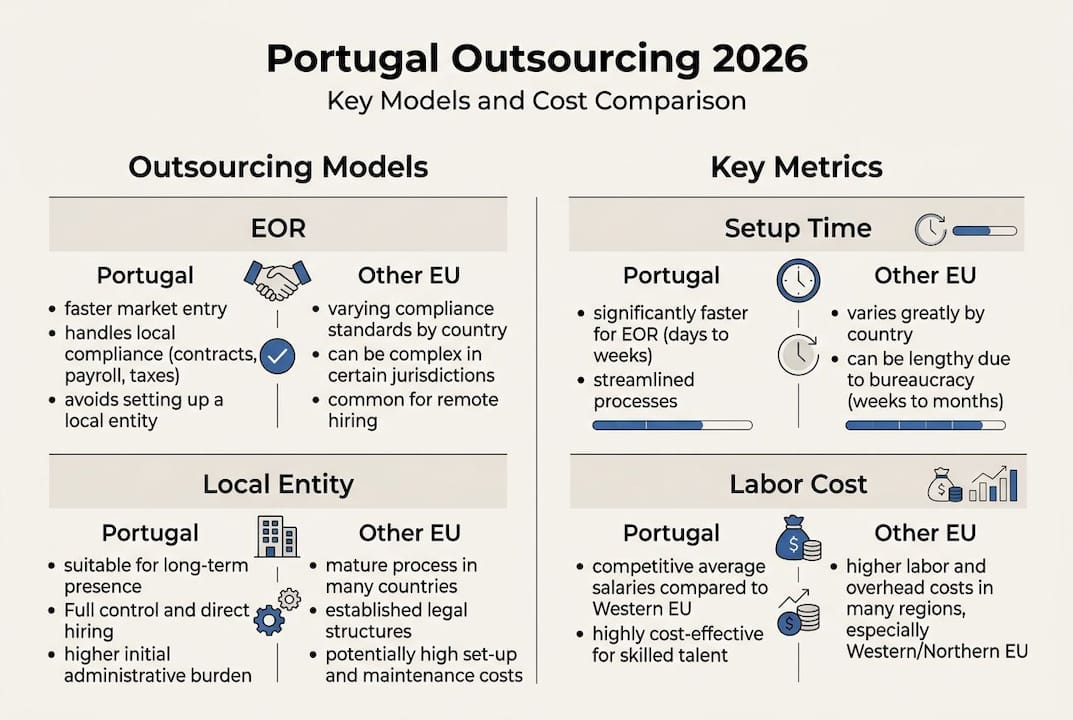
The EOR model is the clear winner for speed and simplicity. Onboarding takes 1-2 weeks compared to three to six months and €5,000 to €15,000 in costs for setting up a Portuguese Lda (private limited company). No local entity is required at all.
The contractor route looks attractive on paper. In practice, the misclassification risk reaches 70% when a worker is treated functionally as an employee but billed as a contractor. Portuguese labor authorities actively audit this, and reclassification brings back taxes, social contributions, and penalties.
For companies new to EU compliance considerations, the EOR model removes most of that risk from day one.
Pro Tip: Before engaging any worker in Portugal, document the specific compliance requirements for your industry and role type. Labor rules for tech contractors differ from those for call center agents.
Why Portugal? Labor market, cost advantages, and compliance context
Portugal is no longer just a tourism story. It has quietly become one of the EU’s most strategic outsourcing destinations, backed by hard data on wages, skills, and regulatory clarity.
The hourly labor cost in Portugal sits at roughly €17, compared to €39.50 in Germany. Senior software engineers earn between €40,000 and €65,000 annually, roughly half the going rate in Western Europe. That wage differential is not a sign of lower quality. Portugal consistently ranks among the EU’s top performers for English proficiency and STEM graduate output.
| Role | Portugal annual salary | Germany annual salary | Saving |
|---|---|---|---|
| Senior software engineer | €40,000-€65,000 | €80,000-€110,000 | ~50% |
| Customer support specialist | €18,000-€24,000 | €32,000-€42,000 | ~44% |
| Finance analyst | €28,000-€38,000 | €55,000-€70,000 | ~47% |
| UX/UI designer | €30,000-€45,000 | €60,000-€80,000 | ~46% |
Beyond wages, 60% or more of EU firms now use outsourcing in some form, with cost reduction cited as the primary driver by 34% of those companies. Portugal captures a growing share of that demand because it offers something most low-cost markets cannot: EU legal framework, Lisbon time zone alignment with London and Central Europe, and a workforce that genuinely communicates in English.
Why Portugal wins for nearshoring:
- Cost: Labor costs 55% below the Western European average for equivalent roles
- Skills: One of the EU’s highest rates of multilingual tech graduates
- Legal clarity: Full EU labor law applies, reducing cross-border uncertainty
- English proficiency: Consistently top 10 globally in the EF English Proficiency Index
For more context on what these numbers mean for your budget, the cost-effective hiring in Portugal guide breaks down real employer costs including social contributions and benefits. If you want to go deeper on tech roles specifically, the analysis on hiring costs and tech talent is worth reading before you finalize any headcount plan.
Adapting your operational approach to Portugal’s specifics is also worth considering. Studying localization strategies for EU growth can help you build processes that feel natural to Portuguese employees and clients from day one.
Navigating compliance: Legal rules, contracts, and remote work essentials
Portugal’s labor law has some features that will surprise companies used to more flexible markets. Getting these wrong is expensive. Getting them right from the start is straightforward if you know what to look for.
“Fixed-term contracts in Portugal must be legally justified, or they default to permanent status. Misuse of fixed-term arrangements is one of the most common compliance failures international companies make in their first year.”
5 key compliance checks before onboarding in Portugal:
- Contract type justification: Fixed-term contracts require a documented business reason (project-based work, seasonal demand). Without it, Portuguese courts treat the contract as permanent.
- Probation period limits: Probation runs 90 days for most roles and up to 240 days for senior or management positions. These limits are set by the Labor Code, not negotiable.
- Remote work clause inclusion: Remote work clauses are required in any employment agreement that includes hybrid or fully remote arrangements. Missing this clause creates legal exposure.
- Post-redundancy outsourcing restriction: If you make a role redundant, you cannot outsource that same function for 12 months. This rule is specific to Portugal and catches many companies off guard.
- Visa processing timelines: Non-EU nationals require 60 to 120 days for work authorization. Factor this into your hiring schedule to avoid delays.
For a detailed walkthrough of these rules in practice, the page on compliance in international hiring covers each requirement with practical examples. You can also use the payroll compliance checklist to verify your setup before your first payroll run.
Pro Tip: Build visa and work authorization timelines into your project plan from the moment a hire is confirmed. Sixty to 120 days is not unusual, and scrambling at the end costs you both time and candidate goodwill.
For companies managing multi-country teams, reviewing workflows for EU contract compliance helps standardize contract processes across markets while accommodating Portugal’s specific requirements.
EOR vs. traditional setup: Costs, speed, and risk in action
At some point, every company asking about Portugal outsourcing faces the same fork in the road: use an EOR, or register a local entity. The right answer depends on team size, time horizon, and risk tolerance.

| Factor | EOR model | Local entity (Lda) |
|---|---|---|
| Setup time | 1-2 weeks | 3-6 months |
| Setup cost | Included in service fee | €5,000-€15,000 |
| Compliance responsibility | EOR provider | Your legal team |
| Payroll management | Handled by EOR | Internal or outsourced |
| Breakeven team size | Under 8 employees | 8+ employees |
| Misclassification risk | Minimal | High if contractors used |
| Flexibility to exit | High | Low (entity wind-down required) |
Onboarding speed via EOR is the most immediate advantage for companies testing a new market or building a small team. The labor cost savings are compounded when you avoid the legal, accounting, and registration costs of a standalone entity.
Risks of the traditional entity route for small teams:
- Entity registration requires a local fiscal representative and a Portuguese bank account, both of which take time to establish
- Annual compliance obligations (tax filings, audits, statutory reporting) add fixed overhead regardless of team size
- Closing a Portuguese Lda is legally complex and can take six months or longer
- Contractor arrangements used to delay entity setup carry that 70% misclassification risk
The breakeven point sits at roughly 8 employees for a long-term commitment. Below that number, EOR wins on every dimension. To model the actual numbers for your headcount plan, the employment cost calculator gives you a side-by-side view of EOR fees versus entity overhead. Understanding why localization matters for operational setup also shapes which model fits your long-term Portugal strategy.
Why most EU outsourcing strategies don’t match Portugal’s reality
Most generic EU outsourcing playbooks were written with Germany, the Netherlands, or Poland in mind. They assume high setup costs are unavoidable, that compliance timelines are fixed, and that local entities are a necessary milestone. Portugal does not follow that script.
The EOR model in Portugal works particularly well for smaller teams because the wage differential is large enough to absorb the EOR service fee and still deliver significant savings over Western European hiring. That math does not work the same way in markets where labor costs are already high. Portugal’s regulatory environment also rewards companies that engage correctly from the start. The post-redundancy outsourcing ban and the fixed-term contract rules are strict, but they are clear. A well-structured EOR engagement sidesteps most of these risks automatically.
What we see repeatedly is that companies applying a one-size-fits-all EU strategy miss the speed advantage entirely. Portugal can go from signed proposal to compliant, salaried employee in under two weeks. That is a genuine operational edge. The efficient hiring tips we share are built specifically around Portugal’s market, not the EU average. Rethinking your entry strategy with Portugal’s specifics in mind is not optional. It is what separates companies that scale efficiently from those that spend months sorting out paperwork.
Ready to outsource in Portugal? Next steps for success
If the numbers make sense and the compliance picture is clearer, the logical next step is moving from analysis to action. Portugal outsourcing does not need to be complicated, but it does need to be structured correctly from the start.

At Employment Portugal services, we work with international companies of all sizes to structure compliant, efficient hiring arrangements without local entity setup. Whether you need one employee or fifty, our Portugal Employer of Record solutions cover onboarding, payroll, benefits, and ongoing HR support. Ready to talk through your specific situation? Contact our Portugal outsourcing experts for a no-obligation consultation and get a clear picture of what your Portugal team could cost and how fast you could be operational.
Frequently asked questions
What is an Employer of Record (EOR), and why is it important for outsourcing to Portugal?
An EOR acts as the legal employer for your Portugal-based staff, managing payroll, tax, and compliance on your behalf. This model enables rapid onboarding in 1-2 weeks without the cost or time of setting up a local entity.
How does outsourcing in Portugal help reduce labor costs for EU businesses?
Portugal’s hourly labor rate of €17 versus Germany’s €39.50, combined with senior engineer salaries around half the Western European average, makes Portugal one of the most cost-effective EU outsourcing markets available.
What legal risks do international companies face when outsourcing in Portugal?
The main risks are contractor misclassification, improperly justified fixed-term contracts, and missing required remote work clauses in employment agreements, all of which can trigger back payments and penalties.
When should a company create a local entity instead of using EOR in Portugal?
A local entity becomes more cost-effective once your team reaches 8 or more employees on a long-term basis. Below that threshold, the EOR model is faster, cheaper, and easier to exit if your plans change.