
TL;DR:
- Portugal offers cost-effective, EU-compliant access to multilingual Western European talent.
- Proper legal, HR, and cultural preparation is essential for successful nearshore team building.
- Choosing the right partner and investing in integration drives long-term nearshore success.
Portugal is quietly outpacing better-known outsourcing destinations for one simple reason: it delivers Western European talent at Eastern European prices, inside the EU, with a workforce that speaks your language, literally. Companies building nearshore teams here are cutting operational costs by 30-50% compared to their home markets while gaining access to engineers, multilingual support agents, and business professionals who integrate seamlessly with Western and North American work cultures. This guide walks you through every stage of the process, from understanding why Portugal works to hiring compliantly and scaling confidently, so you can avoid the expensive mistakes most companies make when they rush into nearshore expansion.
Table of Contents
- Why Portugal is the smart choice for nearshore teams
- Preparing to build: What you need before launching
- Step-by-step: Setting up and growing your nearshore team
- Avoiding common mistakes and ensuring success
- The real story: What most leaders overlook about nearshoring in Portugal
- Accelerate your nearshore journey with Portugal experts
- Frequently asked questions
Key Takeaways
| Point | Details |
|---|---|
| Portugal’s key advantages | Portugal offers skilled talent, cost efficiency, and easy access to EU markets for nearshore teams. |
| Preparation is critical | Legal, compliance, and infrastructure steps must be completed before hiring in Portugal. |
| Multiple hiring options | You can hire directly, use an Employer of Record, or partner with third-party firms. |
| Avoid common pitfalls | Proactive communication and compliance checks prevent most nearshore team failures. |
| Expert help accelerates success | Partnering with local experts streamlines setup and ongoing management. |
Why Portugal is the smart choice for nearshore teams
When you start evaluating nearshore locations, the usual suspects come up: Poland, Romania, Ukraine. But Portugal has a distinct edge that most business leaders underestimate until they experience it firsthand. As Portugal has emerged as a leading nearshore destination for tech and support functions, the momentum has attracted major global brands including Google, Mercedes-Benz, and Volkswagen, all of whom have established shared services or tech hubs in Lisbon and Porto.
Here is what drives that trend:
- Multilingual workforce: Portugal ranks among the top countries in Europe for English proficiency, and many professionals speak two or three additional languages, making it ideal for pan-European customer support roles.
- Competitive costs: Software engineers in Portugal earn 40-60% less than their counterparts in the UK, Germany, or the Netherlands, while delivering comparable output quality.
- EU-compliant market access: Hiring inside the EU simplifies data protection compliance (GDPR), tax treaty applications, and cross-border labor arrangements.
- Cultural alignment: Portuguese professionals share communication styles, work ethics, and professional norms that resonate strongly with North American and Western European management teams.
- Growing tech infrastructure: Lisbon and Porto rank among Europe’s most connected cities for fiber internet, co-working spaces, and startup ecosystems.
Explore Portugal’s nearshore advantages in greater detail to understand the full scope of what the country offers beyond cost savings.
“Portugal’s combination of technical skill, language capability, and EU membership creates a nearshore profile that few other destinations can match at this price point.”
For a broader view of how companies are structuring their operations, the nearshore Portugal overview covers sector-specific models and team configurations that work best for tech and support functions.
Preparing to build: What you need before launching
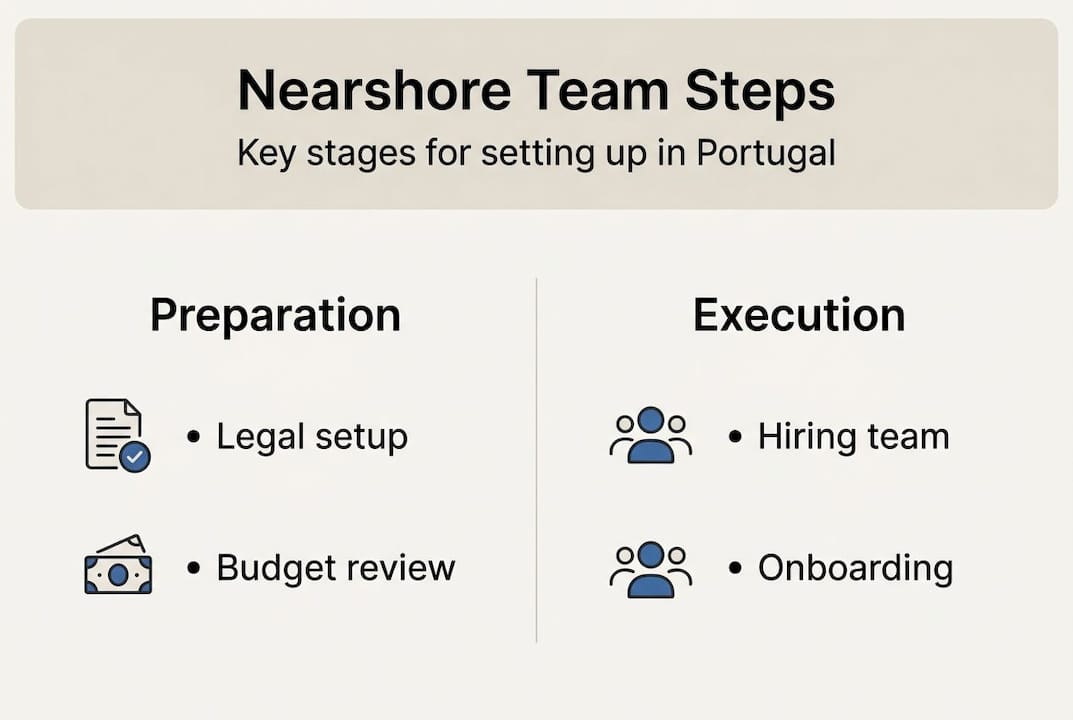
Moving fast without the right foundation is where most nearshore projects stall or fail. Legal compliance is essential before hiring in Portugal, and skipping the groundwork phase creates complications that are far more expensive to fix later.
Here is what you need to have in place before your first hire:
- Employment model decision: Will you hire through a local entity, an Employer of Record (EoR), or a staffing partner? This choice affects your timeline, cost, and risk.
- Tax identification: Your company will need a Portuguese NIF (tax identification number) for certain arrangements.
- Data protection policy: Your internal GDPR policies must extend to your Portuguese team members.
- Job architecture: Clear role definitions, salary bands, and reporting structures that map to the Portuguese labor market.
- Local banking setup (if applicable): For payroll or expense reimbursements that require a Portuguese account.
| Preparation area | Required action | Timeline |
|---|---|---|
| Legal entity vs. EoR decision | Consult legal or EoR advisor | Week 1-2 |
| Job role and salary definition | Benchmark against local market | Week 1-2 |
| Compliance documentation | Gather NIF, GDPR policies | Week 2-3 |
| Recruitment partner selection | Shortlist and brief vendors | Week 2-4 |
| HR tooling setup | Integrate payroll and HR software | Week 3-4 |
Budget planning deserves particular attention. Portuguese gross salaries for mid-level software developers average between EUR 28,000 and EUR 45,000 annually, while customer support specialists with two or more languages run EUR 20,000 to EUR 30,000. Add employer social security contributions of roughly 23.75% and you have a full picture of your cost base.
For legal compliance for hiring, working with a specialist from day one removes the guesswork around labor law, mandatory benefits, and termination obligations.
Pro Tip: Do not assume your existing employment contract templates apply in Portugal. Portuguese labor law has specific mandatory provisions around notice periods, overtime, and dismissal that differ significantly from UK or US norms.
Step-by-step: Setting up and growing your nearshore team
With preparation complete, execution becomes straightforward if you follow a structured process. Different approaches exist for hiring in Portugal, each with distinct trade-offs depending on your timeline, headcount, and long-term intent.
The three main hiring models compared:
| Model | Speed | Cost | Control | Best for |
|---|---|---|---|---|
| Direct hire (local entity) | Slow (3-6 months setup) | Higher upfront | Full | 50+ headcount, long-term |
| Employer of Record (EoR) | Fast (2-4 weeks) | Mid-range | High | 1-50 headcount, testing |
| Staffing agency | Fastest (1-2 weeks) | Variable | Lower | Short-term or project work |
Here are the steps to follow once you have chosen your model:
- Brief your recruitment partner with detailed role profiles, must-have technical skills, language requirements, and culture-fit criteria.
- Run a structured interview process that includes technical assessments, communication evaluations, and a culture alignment interview.
- Extend offers compliantly, ensuring they include Portuguese mandatory benefits: 22 days of annual leave, Christmas and holiday allowances, and meal allowances.
- Onboard with intention. Remote onboarding in Portugal works best when you assign a dedicated buddy in your home office and schedule weekly video check-ins during the first 90 days.
- Establish communication rhythms using tools like Slack, Notion, or Microsoft Teams to bridge time zones, which are at most one to two hours from most of Western Europe.
- Set retention strategies early. The Portuguese tech talent market is competitive; career growth visibility and flexible working arrangements significantly influence retention.
For organizations focused on cost-effective tech talent, nearshore Portugal consistently outperforms offshore alternatives when you factor in communication efficiency, legal simplicity, and output quality.

Pro Tip: Budget for at least one in-person team visit during the first six months. Leaders who meet their nearshore teams face to face in the first quarter report significantly higher engagement scores and lower 12-month attrition.
Avoiding common mistakes and ensuring success
Even well-prepared organizations hit avoidable obstacles. Many businesses overlook regulatory nuances, impacting long-term success, particularly around misclassifying workers as contractors when they should be employees, or failing to correctly apply collective bargaining agreements that apply to their sector.
The most common mistakes include:
- Contractor misclassification: Portuguese authorities actively audit companies that use contractors in arrangements that resemble employment. The penalties are substantial.
- Ignoring cultural onboarding: Assuming your company culture translates automatically leads to disengagement. Portuguese teams respond well to transparent communication and recognition.
- Weak KPI frameworks: Without clear performance metrics from day one, nearshore teams drift from organizational priorities within months.
- Underinvesting in communication infrastructure: Poor tooling or inconsistent meeting cadences create silos between your home office and nearshore team.
- Choosing price over quality in local partners: The cheapest EoR or recruitment agency often costs more in compliance risk and rework.
“The companies that succeed with nearshore Portugal long-term are not those with the best initial plan. They are the ones that treat their nearshore teams as full members of the organization, not a cost center located elsewhere.”
Establishing a clear feedback loop matters enormously. Quarterly engagement surveys, monthly one-on-ones between managers and nearshore leads, and transparent promotion pathways all signal to your Portugal team that their work is valued. For a practical breakdown of what to watch, the guide on compliance mistakes to avoid identifies the specific legal and operational pitfalls that catch international companies off guard.
The real story: What most leaders overlook about nearshoring in Portugal
Here is what years of working with international companies reveal: most leaders treat nearshore Portugal as a sourcing problem. They focus on finding talent and keeping costs low, then wonder why engagement drops after month six.
The real differentiator is not cost. It is the quality of integration. Portuguese professionals are genuinely collaborative and highly motivated when they feel included in strategic conversations. The teams that thrive are led by managers who invest proactively in cross-cultural understanding, not as a checkbox exercise but as an ongoing leadership practice.
Choosing the right local partner is equally decisive. A great EoR or HR partner gives you more than compliance coverage. They give you market intelligence, cultural context, and early warning when something is not working. The companies that get this right, with guidance from specialists who understand Portugal’s full nearshore advantages, consistently outperform those who treat partner selection as an afterthought.
Nearshore Portugal is not a shortcut. It is a strategic investment. Lead it like one.
Accelerate your nearshore journey with Portugal experts
Building a nearshore team in Portugal is one of the most effective decisions a growing international company can make, but only when the legal, operational, and HR infrastructure is done right from the start.
At Outsourcing Portugal, we specialize in helping international businesses hire, onboard, and manage teams in Portugal without the complexity of setting up a local entity. From EoR and payroll setup services to fully managed employer of record solutions, we handle compliance so you can focus on growth. Explore how our nearshore team support gives you everything you need to build and scale with confidence.
Frequently asked questions
What is the typical hiring timeline for building a nearshore team in Portugal?
Most organizations can hire and onboard a nearshore team in Portugal within 4-8 weeks given the right partners and preparation. Nearshore Portugal offers efficient processes specifically designed to accelerate international hiring.
Do I need a local legal entity to hire nearshore teams in Portugal?
A local legal entity is not required if you work with an Employer of Record or similar service provider. EoR services enable hiring in Portugal without the cost or complexity of registering a local company.
What roles are most commonly filled by nearshore teams in Portugal?
Tech development and multilingual customer support are the most common roles filled by nearshore teams in Portugal. Portugal’s multilingual tech workforce makes it particularly strong for both software engineering and pan-European support functions.
How do I ensure compliance with Portuguese employment law?
Engage local legal advisors or EoR partners to maintain full compliance with Portuguese laws and regulations. Legal compliance is essential and best managed by specialists who understand Portuguese labor law in detail.
Is English widely spoken in Portugal’s business services sector?
Yes, English proficiency is common among tech and business professionals in Portugal. Portugal’s tech industry includes high rates of English fluency, making daily collaboration with international teams straightforward.