
TL;DR:
- Setting up a local entity in a foreign country grants organizations direct control over employment, contracts, and legal compliance but involves high upfront costs and ongoing management.
- It is best suited for long-term operations with 15 or more employees, while smaller teams often begin with an Employer of Record to validate the market before transitioning.
Local entity setup is the process of legally incorporating your own company or branch in a foreign country, giving you direct authority to hire employees, sign contracts, and operate under that nation’s laws. Unlike lighter-weight alternatives, this approach places full legal and financial responsibility on your organization. That control comes at a price: upfront costs, administrative complexity, and ongoing compliance obligations that can strain lean international teams. Understanding what local entity setup requires, and when it makes sense, is the first decision any serious global expansion strategy must get right.
What is local entity setup and what does it involve?
Local entity setup, known in corporate law as foreign subsidiary incorporation or branch registration, is the formal creation of a legally recognized business structure in a target country. The three most common structures are a wholly owned subsidiary, a branch office, and a representative office. Each carries different tax treatment, liability exposure, and operational scope. A subsidiary is a separate legal entity, which limits parent company liability. A branch office is an extension of the parent, which means the parent bears direct legal responsibility for its activities.
The local entity registration process follows a predictable sequence, though timelines and costs vary sharply by jurisdiction.
- Choose your legal structure. Subsidiaries offer liability protection and are preferred for long-term operations. Branch offices are faster to register but expose the parent to local litigation. Representative offices are the lightest option but are typically restricted from generating revenue.
- Prepare and authenticate parent company documents. Articles of incorporation, board resolutions, and shareholder certificates must be notarized, apostilled, and translated into the local language. Small errors in these documents cause costly registration delays that can set your timeline back by weeks or months.
- File with the relevant government authority. This typically means a commercial registry, chamber of commerce, or company registrar, depending on the country.
- Obtain licenses and regulatory permits. Certain industries, including financial services, healthcare, and telecommunications, require sector-specific approvals before operations can begin.
- Open a local corporate bank account. Banking is frequently a bottleneck due to requirements for notarized parent documents, proof of local address, and minimum capital deposit certificates. This step alone can add four to eight weeks to your timeline.
- Register for tax, payroll, and social security. Each country has its own employer registration obligations, and missing any one of them creates retroactive liability.
Upfront entity setup costs range from $20,000 to over $250,000 depending on jurisdiction, legal structure, and capital requirements. That figure covers legal fees, government filing fees, director appointments, and bank setup. This is not a one-time expense. It is the entry ticket to a long-term commitment.
Pro Tip: Hire a local corporate attorney before you engage any government authority. Jurisdictions like Portugal, Germany, and Singapore each have procedural quirks that a generalist international lawyer will miss, and one rejected filing can cost you six weeks.

How does local entity setup compare to Employer of Record services?
The most direct alternative to creating a local business entity is using an Employer of Record (EOR). An EOR is a third-party company that legally employs your workers in a foreign country on your behalf, handling payroll, tax withholding, benefits administration, and local labor law compliance. You retain day-to-day management of the workers; the EOR holds the legal employment relationship.
The cost difference between the two models is significant and often misunderstood.
| Factor | Local entity setup | Employer of Record (EOR) |
|---|---|---|
| Upfront investment | $20,000 to $250,000+ | None |
| Monthly per-employee cost | Varies by payroll provider | $299 to $800 per employee |
| Annual compliance cost | $30,000 to $80,000 per country | Included in EOR fee |
| Legal control | Full | Limited to management direction |
| Speed to hire first employee | 2 to 6 months | Days to 2 weeks |
| Exit complexity | High (dissolution process) | Low (terminate contract) |
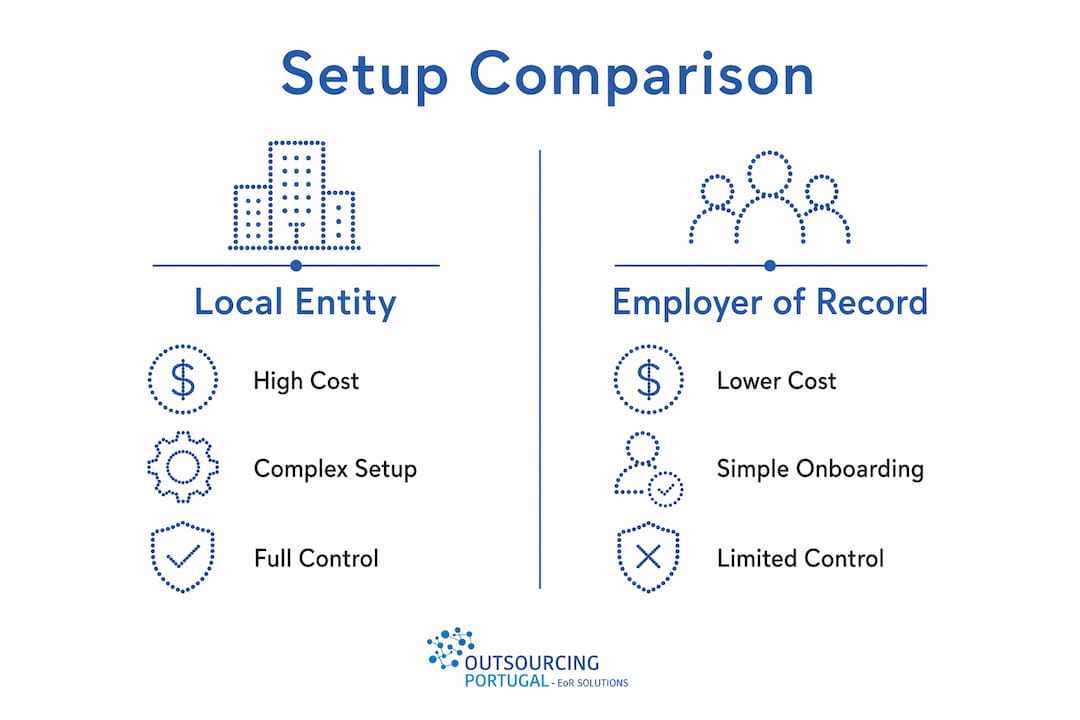
The math favors an EOR at low headcounts. At scale, the calculus shifts. Setting up a local entity is generally recommended once you have 15 to 25 employees in a single market, because the fixed compliance costs get distributed across a larger workforce, making the per-employee cost competitive with EOR fees.
Several strategic considerations also push toward entity setup beyond pure cost:
- Brand and contractual credibility. Local clients and government partners in many markets prefer or require contracting with a locally registered entity.
- Equity and stock options. Granting equity to employees through an EOR is legally complex and often impossible without a local entity.
- Operational permanence. If you plan to build a long-term team, a local entity signals commitment to the market, to employees, and to regulators.
The hybrid approach is increasingly common among sophisticated global companies. They use an EOR to test the market and validate demand, then transition to a full entity once headcount and revenue justify the investment. Transitioning employees from EOR to entity typically takes two to four months and requires contract novation or termination and rehire, depending on local labor law.
What are the key challenges in managing a local entity?
Creating the entity is only the beginning. Local entity management, the ongoing governance and compliance work required to keep the entity in good standing, is where most international businesses underestimate the burden.
Ongoing compliance costs for a local entity typically run between $30,000 and $80,000 annually per country, covering statutory audits, payroll filings, corporate tax returns, and legal counsel. That figure does not include the internal staff time required to coordinate with local accountants, lawyers, and government agencies.
The most common operational failures in local entity management include:
- Missed statutory deadlines. Annual returns, tax filings, and beneficial ownership registers each carry their own deadlines. Missing them triggers fines and, in some jurisdictions, director liability.
- Scattered compliance data. When entity documents, tax registrations, and payroll records live in separate systems or with separate vendors, audits become expensive and stressful.
- Vendor coordination gaps. Local accountants, payroll providers, and legal counsel rarely communicate with each other. The parent company ends up as the integration layer, which creates risk when internal staff turn over.
Centralized entity management reduces the risk of missed deadlines and improves audit readiness by consolidating entity data and compliance tasks into a single governance framework. Wolters Kluwer’s research on entity management confirms that decentralized workflows increase compliance failures and reduce visibility for corporate auditors. This is the operational argument for investing in entity management software like CT Corporation, Diligent Entities, or Corporater alongside your local legal team.
Pro Tip: Build a compliance calendar on day one of entity registration. Map every recurring filing obligation, its deadline, the responsible vendor, and the internal owner. Review it quarterly. This single habit prevents the majority of penalty events.
When should international businesses decide to set up a local entity?
The decision to pursue local business entity setup should follow a structured evaluation, not a gut feeling about market potential. Businesses that commit to an entity before validating their market often discover that EOR or contractor arrangements would have met their commercial goals at a fraction of the cost and liability.
A disciplined decision process looks like this:
- Conduct an internal business needs audit. Define what you actually need a local entity to do. If the answer is “hire two engineers,” an EOR is almost certainly the right tool. If the answer is “sign government contracts and build a 30-person team,” entity setup becomes the logical path.
- Validate the market before committing. Use an EOR, a distributor, or a local partner to generate revenue and prove demand. Commit to entity setup only after the market has demonstrated it can support the overhead.
- Run a full financial analysis. Model setup costs, annual compliance costs, and exit costs. Exit costs are frequently ignored and can be substantial. Dissolving a foreign subsidiary in France or Brazil, for example, can take 12 to 24 months and require settling all local liabilities first.
- Confirm legal and operational prerequisites. Most jurisdictions require a registered local address, at least one local or resident director, and a minimum paid-in capital. Confirm these requirements before starting the registration process, not during it.
- Plan the transition if moving from EOR. If you are already using an EOR, map the employee transfer process carefully. Contract novation timelines, social security re-registration, and benefit continuity all need to be managed to avoid employee relations issues.
The international HR management dimension of this decision is often underweighted. Local entities require local HR policies, local employment contracts, and local benefits structures that comply with collective bargaining agreements where applicable. These are not templates you can download. They require local legal review.
Key takeaways
Local entity setup is the right expansion tool only when your market is validated, your headcount justifies the overhead, and your organization has the governance capacity to manage ongoing compliance across borders.
| Point | Details |
|---|---|
| Define the right structure first | Choose between subsidiary, branch, or representative office based on liability needs and operational scope. |
| Budget for the full cost | Upfront costs range from $20,000 to $250,000+; annual compliance adds $30,000 to $80,000 per country. |
| Use EOR to validate first | Start with an Employer of Record to test the market before committing to entity setup at 15 to 25 employees. |
| Centralize entity management | Consolidate compliance data and deadlines into one governance framework to avoid costly missed filings. |
| Plan your exit before you enter | Model dissolution costs and timelines before committing, since exiting a local entity can take one to two years. |
Why timing is everything in local entity decisions
I have worked with international businesses at every stage of global expansion, from first-hire-abroad decisions to multi-jurisdiction restructurings. The single most expensive mistake I see, consistently, is applying the wrong expansion tool to the wrong stage of market development. Companies set up entities in markets they have not yet validated, then spend 18 months trying to dissolve them when the market does not perform. Or they stay on EOR arrangements for 40 employees because “it’s working fine,” paying $400 per employee per month when a local entity would cost half that at scale.
The businesses that get this right treat the EOR-to-entity transition as a planned milestone, not a reactive scramble. They set a headcount trigger, typically 15 to 20 employees, and begin the entity registration process three to four months before they expect to hit it. That way, the entity is ready when the economics demand it, not six months after.
Technology matters more than most people admit. Entity management platforms that centralize your statutory filings, director registers, and compliance calendars across jurisdictions are not a luxury for large multinationals. They are a practical necessity for any company managing more than two foreign entities. The cost of a missed annual return in Germany or a late beneficial ownership filing in the UK far exceeds the cost of the software that would have prevented it.
My honest view: the future of global employment infrastructure will see more companies running hybrid models permanently, using EOR for early-stage markets and local entities for mature ones, managed through a single compliance platform. The businesses building that infrastructure now will have a structural advantage over those that treat each market as a one-off decision.
— Paulo
How Outsourcing-portugal can support your expansion
Setting up a local entity in Portugal, or deciding whether you need one at all, requires local expertise that generic international law firms rarely provide. Outsourcing-portugal offers employment and payroll services specifically designed for international companies expanding into Portugal, covering EOR arrangements, payroll compliance, HR support, and entity setup guidance. Whether you are testing the Portuguese market with your first hire or transitioning a 20-person EOR team to a fully owned subsidiary, the platform provides the legal and operational infrastructure to do it correctly. Explore EOR services in Portugal as a starting point, or contact the team directly to map the right structure for your specific headcount and commercial objectives.
FAQ
What is local entity setup in simple terms?
Local entity setup is the process of legally registering your own company or branch in a foreign country so you can hire employees and operate under that country’s laws directly. It gives you full legal control but requires significant upfront investment and ongoing compliance management.
How long does it take to set up a local entity abroad?
The timeline for creating a local business entity typically ranges from two to six months, depending on the jurisdiction, legal structure chosen, and how quickly banking and document authentication steps are completed. Banking alone can add four to eight weeks.
When should I use an EOR instead of setting up a local entity?
An Employer of Record is the better choice when you have fewer than 15 employees in a market, are still validating demand, or need to hire quickly. Entity setup becomes cost-competitive once you reach 15 to 25 employees in a single country.
What are the ongoing costs of managing a local entity?
Annual compliance costs for a local entity, covering audits, payroll filings, tax returns, and legal counsel, typically range from $30,000 to $80,000 per country. These costs are fixed regardless of headcount, which is why scale matters for the economics to work.
Can I transition from an EOR to a local entity later?
Yes, and this is a common path for international businesses. Transitioning from EOR to a local entity typically takes two to four months and involves contract novation or employee rehire, depending on local labor law requirements.
Recommended
- How can I expand to Portugal with talent hiring and support in Vistas or Softlanding without opening a legal entity in the country? – Outsourcing Portugal
- Top ways to establish Portuguese operations for global companies – Outsourcing Portugal
- Employment Portugal – EoR, Payroll, Setup & Hiring Services
- What Is an International Workforce? 2026 Guide