
TL;DR:
- Remote team management involves structured digital systems for coordinating dispersed employees toward shared goals. Effective practices include deliberate communication architecture, intentional trust-building, and comprehensive documentation to replace proximity-based knowledge transfer. Structural design, not motivation alone, is essential for the success and scalability of remote teams.
Remote team management is the structured practice of coordinating, motivating, and directing geographically dispersed employees toward shared goals using digital tools, formalized workflows, and deliberate communication systems. Unlike traditional office management, where proximity substitutes for process, virtual team management requires every expectation, norm, and feedback loop to be made explicit. Organizations like GitLab have built entire operating models around this principle, while research from Gallup and the Center for Creative Leadership (CCL) confirms that intentional leadership design separates high-performing distributed teams from struggling ones.
What is remote team management and how does it differ from traditional management?
Remote team management is the practice of coordinating dispersed workers through technology, communication systems, and documented processes rather than physical oversight. In a traditional office, informal hallway conversations, visible body language, and shared physical space carry enormous amounts of operational information. Strip those away and you expose every gap in your management system.

The core shift is from presence-based to outcomes-based leadership. A manager in a co-located office can observe effort directly. A remote team leader must define what success looks like, communicate it clearly, and then trust the process. GitLab, one of the world’s largest all-remote companies with over 2,000 employees across 65 countries, frames this as balancing support with accountability through transparency rather than surveillance.
Three principles define effective remote team leadership. First, technology is not optional infrastructure. It is the operational backbone. Second, communication must be designed, not assumed. Third, documentation replaces the informal knowledge transfer that happens naturally in shared physical spaces. Managers who treat these as secondary concerns consistently report higher turnover, lower engagement, and coordination failures.
What are the essential tools and communication practices for effective remote team management?
Effective virtual team management starts with a deliberate communication architecture. The single most common mistake international managers make is allowing communication to fragment across too many platforms simultaneously. When your team uses email for decisions, a messaging app for quick questions, video calls for updates, and a project tool for tasks, critical information gets lost and people spend more time searching than working.
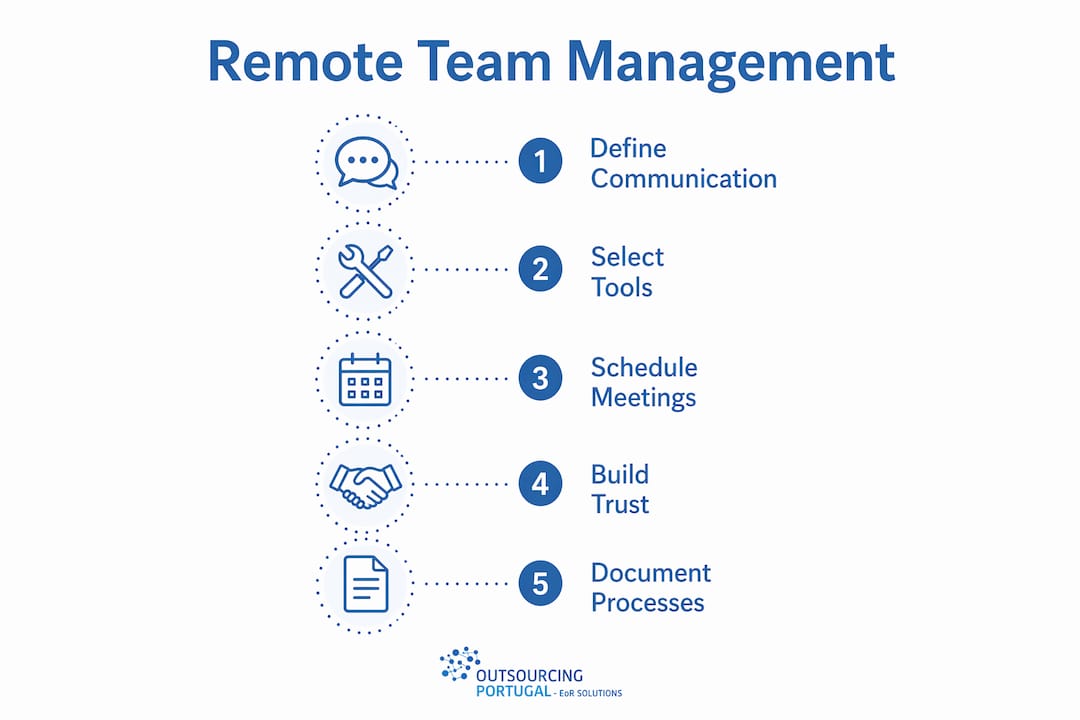
GitLab’s communication structure addresses this by funneling work-related communication through defined channels with clear purposes. The practical standard is one primary tool per communication type: one platform for real-time messaging (such as Slack or Microsoft Teams), one for project tracking (such as Jira or Asana), and one for documentation (such as Confluence or Notion). Documented guidelines specify which channel handles which type of message, removing the guesswork that creates friction.
Asynchronous communication deserves more weight than most managers give it. When your team spans Lisbon, London, and Singapore, expecting real-time responses from everyone is both inefficient and exhausting. Asynchronous communication, where messages are sent and responded to on each person’s schedule, allows deep work and respects time-zone differences. Synchronous meetings should be reserved for decisions that genuinely require live discussion, not status updates that could be a written summary.
- Use one primary messaging platform and document its purpose explicitly
- Separate synchronous meetings (decisions, relationship-building) from asynchronous updates (status, information sharing)
- Write communication guidelines into your team handbook so expectations survive personnel changes
- Record video meetings and share transcripts for team members in different time zones
Pro Tip: Treat your communication channels as part of your team’s operating system. Every channel should have a documented purpose, a response-time expectation, and a clear owner. If a channel has no defined purpose, archive it.
How can managers build and sustain trust and accountability in remote teams?
Trust does not emerge automatically in distributed teams. CCL research is direct on this point: virtual trust requires intentional investment in connectivity, participation norms, and face-to-face interaction, even when that interaction happens through a screen. Managers who assume trust will develop organically, the way it might in a shared office, consistently find their teams underperforming on collaboration and over-relying on individual silos.
Gallup data makes the feedback gap concrete: only 21% of workers receive meaningful feedback weekly, yet engagement rates approach 80% among those who do. For remote teams, where informal feedback moments disappear entirely, this gap widens fast. Weekly one-on-ones with a structured format, not just a casual check-in, are the single highest-return investment a remote manager can make.
GitLab’s model for balancing support and accountability avoids two common failure modes: micromanagement (checking in constantly, monitoring activity metrics) and pure hands-off support (being available but never setting clear performance expectations). The practical approach combines both:
- Set explicit outcome-based goals with measurable milestones for each team member
- Schedule weekly one-on-ones focused on blockers, progress, and development
- Use virtual face-to-face meetings at least monthly to maintain human connection
- Acknowledge contributions publicly in shared channels to reinforce recognition
- Address performance issues directly and promptly rather than letting them accumulate
“Being a great remote manager is not about increasing communication frequency or control but designing systems that enable autonomy balanced with transparency and accountability.” — GitLab Handbook
Cultural sensitivity adds another layer for international teams. A manager leading employees across Portugal, Brazil, and the Philippines will encounter different norms around directness, hierarchy, and work-life boundaries. Adapting your feedback style and meeting format to cultural context is not softness. It is precision leadership.
What challenges do global distributed teams face and how to overcome them?
Global remote teams face a specific set of challenges that purely domestic remote teams do not. CCL identifies the toughest coordination problems as time-zone based availability rules rather than technology failures. When one team member’s morning is another’s midnight, the question of who accommodates whom becomes a recurring source of friction and quiet resentment.
Participation disparities compound the problem. In a video call with eight people across four time zones, the two people in the “home” time zone naturally dominate. The person joining at 7 AM or 10 PM is already at a disadvantage before the meeting starts. Without explicit facilitation norms, the same voices lead every discussion and the same people disengage over time.
Common challenges and their direct solutions:
- Uneven participation: Rotate meeting times so no single region always bears the inconvenience. Use written pre-reads so everyone arrives prepared regardless of when they joined.
- Conflict without resolution: Establish a written escalation path. Remote conflict left unaddressed festers faster than in-person conflict because there are fewer natural repair moments.
- Trust development: Schedule virtual social time that is genuinely optional and informal. Forced fun backfires. Genuine connection happens in low-stakes, unstructured moments.
- Holiday and availability confusion: Publish a shared team calendar that includes public holidays for every country represented on the team. Assume nothing about availability.
Pro Tip: When setting up a global team, create a one-page “team operating agreement” that covers core hours, response-time expectations, meeting rotation rules, and holiday policies. Revisit it every six months. Teams that skip this document spend the first year solving the same coordination problems repeatedly.
For managers building nearshoring teams in Portugal, the country’s Western European time zone and high English proficiency reduce many of these friction points significantly, making it a practical choice for teams based in the UK, US, or Northern Europe.
How does documentation replace proximity in scaling remote teams?
Documentation is the infrastructure of remote team culture. GitLab’s experience scaling to thousands of employees across dozens of countries demonstrates that transparent process recording from the start is what separates remote organizations that scale cleanly from those that collapse into chaos as headcount grows.
In a physical office, a new hire learns by observation. They watch how meetings run, how decisions get made, and how conflicts get resolved. In a remote team, none of that ambient learning happens. Every process that is not written down exists only in the heads of the people who created it, and those people will eventually leave, change roles, or simply forget.
The table below shows how documentation replaces common proximity-dependent practices:
| Proximity-based practice | Documentation-based equivalent |
|---|---|
| Shoulder tap for quick questions | Searchable internal FAQ or team handbook |
| Observing how decisions get made | Recorded decision logs with rationale |
| Overhearing team updates | Async written status updates in a shared channel |
| New hire shadowing | Documented onboarding checklist with video walkthroughs |
| Informal culture transmission | Written team values, norms, and working agreements |
The operational benefit extends beyond onboarding. When processes are documented, managers spend less time answering the same questions repeatedly. Team members in different time zones can unblock themselves without waiting for a synchronous response. And when something goes wrong, a documented process makes it far easier to identify where the breakdown occurred.
Reducing timesheet errors and tracking distributed work accurately also depends on documented processes. Teams that rely on memory and informal agreements for time tracking create compliance risks and billing inaccuracies that compound at scale.
Key takeaways
Effective remote team management requires deliberate systems for communication, trust, and documentation rather than adaptations of office-based management practices.
| Point | Details |
|---|---|
| Design communication architecture | Assign one tool per communication type and document its purpose to prevent fragmentation. |
| Prioritize meaningful feedback | Weekly structured one-on-ones drive engagement; only 21% of workers currently receive this. |
| Build trust intentionally | Virtual face-to-face meetings and explicit participation norms prevent disengagement in global teams. |
| Solve time-zone friction proactively | A written team operating agreement covering core hours and holiday policies prevents recurring coordination failures. |
| Document everything from day one | Written processes replace proximity-based knowledge transfer and make remote teams scalable. |
What I’ve learned managing remote teams across time zones
After working with international teams across multiple time zones, the pattern I see most often is managers who are technically competent but structurally unprepared. They know their domain. They care about their people. But they are running a distributed team using mental models built for a shared office, and the mismatch shows up in burnout, missed deadlines, and quiet disengagement.
The insight that changed how I think about this: remote management is a design problem, not a motivation problem. When a team is underperforming, the instinct is to push harder, communicate more, or check in more frequently. But the actual fix is almost always structural. A missing communication guideline. An unclear accountability framework. A process that exists only in someone’s head.
I have also seen managers overcorrect toward pure documentation and process, treating their teams like systems to be optimized rather than people to be led. The research from CCL on intentional connectivity resonates here. The human layer matters enormously. A well-documented team with no genuine trust will still underperform. The goal is both: rigorous systems and genuine human investment.
For managers leading teams in or near Portugal, the cultural compatibility factor is real and underrated. Portugal’s workforce brings strong English proficiency, a collaborative work culture, and a time zone that overlaps cleanly with both the UK and much of the US East Coast. That structural advantage reduces coordination friction before you even write your first operating agreement.
— Paulo
How Outsourcing-portugal supports your remote team strategy
Building a high-performing remote team across borders requires more than good management practices. It requires compliant hiring, accurate payroll, and local legal expertise that most international companies do not have in-house.

Outsourcing-portugal’s Employer of Record services in Portugal handle the full employment infrastructure so your managers can focus on leading rather than administering. From onboarding and payroll to HR support and legal compliance, the platform removes the operational complexity that slows down global team expansion. If you are building or scaling a nearshore team in Portugal, Outsourcing-portugal’s employment solutions give you the local presence and compliance coverage to do it without setting up a legal entity. Explore how the platform supports international teams at every stage of growth.
FAQ
What is remote team management in simple terms?
Remote team management is the practice of leading employees who work from different locations using digital tools, structured communication, and documented processes to achieve shared goals. It replaces physical proximity with deliberate systems for accountability and collaboration.
What are the biggest challenges of remote team management?
The most common challenges include uneven participation across time zones, difficulty building trust without in-person contact, and communication fragmentation across too many platforms. CCL research identifies time-zone availability rules as the toughest coordination problem for global teams.
How do you build trust in a remote team?
Trust in remote teams requires intentional investment: weekly one-on-ones, virtual face-to-face meetings, and explicit participation norms. Gallup data shows that employees who receive meaningful weekly feedback have engagement rates approaching 80%, making consistent manager contact the highest-return trust-building practice.
What tools are best for managing remote teams?
The most effective approach uses one platform per communication type: Slack or Microsoft Teams for messaging, Jira or Asana for project tracking, and Confluence or Notion for documentation. GitLab’s model recommends documented guidelines specifying which channel handles which type of communication.
Why is documentation so important for remote teams?
Documentation replaces the ambient knowledge transfer that happens naturally in shared offices. GitLab’s scaling experience shows that written processes, decision logs, and onboarding checklists allow remote teams to grow without losing institutional knowledge or creating bottlenecks around individual team members.