
TL;DR:
- Staff augmentation enables businesses to quickly add external professionals managed directly by their internal teams, filling skill gaps without permanent commitments. It offers faster hiring, cost savings, and access to specialized skills, with high flexibility and control over work processes. Companies should treat augmented staff as integrated team members and avoid using augmentation solely to delay core permanent hiring decisions.
Staff augmentation is defined as a flexible workforce strategy where businesses temporarily add external professionals to their internal teams, managed directly by the hiring company, to fill skill gaps or increase capacity without permanent employment commitments. Unlike traditional outsourcing, where a vendor owns the work, staff augmentation keeps you in the driver’s seat. Providers like Second Talent and Pangea AI match vetted candidates within 48 to 72 hours, with augmented staff typically starting in one to three weeks. The core staff augmentation benefits include faster hiring, lower costs, and access to specialized skills that are impractical to hire for permanently.
What is staff augmentation and how does it work?
Staff augmentation works through a structured five-step process that moves from identifying a skill gap to having a qualified professional working inside your team, often within two weeks.
- Define requirements. You specify the role, technical skills, seniority level, and expected duration. The more precise this brief, the faster the match.
- Receive a shortlist. Staffing providers deliver a vetted candidate shortlist within two to five days. Candidates have already passed technical screening, background checks, and compliance verification.
- Interview and select. Your team conducts final technical and cultural interviews. Smart hiring managers always run their own interviews despite vendor vetting, because exact team fit cannot be assessed by a third party alone.
- Contract and onboard. Contracts are typically month-to-month or project-based with 30 to 90 day termination notices, giving you flexibility to scale without legal exposure.
- Integrate into workflows. Augmented staff join your Slack channels, attend daily standups, commit to your GitHub repositories, and follow your internal architecture standards from day one.
The staffing provider handles payroll, tax filings, benefits administration, and local labor law compliance throughout the engagement. Your team manages the work. This division of responsibility is what makes staff augmentation operationally clean for HR teams managing cross-border hires.
Pro Tip: Negotiate a trial-to-hire clause before signing. Trial-to-hire provisions allow you to evaluate augmented staff over 60 to 180 days before committing to permanent employment, and a poorly negotiated buyout fee can cost 20 to 30% of the candidate’s first-year salary if you skip this step.

What are the main benefits of staff augmentation for businesses?
The advantages of staff augmentation over traditional hiring are measurable, not theoretical.
- Speed. The median time-to-fill for a senior internal tech role is 22 weeks. Staff augmentation cuts that to one to three weeks. For a product team blocked on a Kubernetes migration or a GenAI integration, that difference is a competitive one.
- Cost savings. A US-based senior engineer carries a total employment cost of $200,000 to $325,000 annually when you include benefits, payroll taxes, and recruiting fees. Nearshore augmentation costs $48,000 to $180,000 for comparable roles, representing a 30 to 50% reduction. That gap funds additional headcount or product investment.
- Specialized skills on demand. Niche expertise in areas like GenAI architecture, Kubernetes orchestration, or SOC 2 compliance is rarely justified as a permanent hire for most companies. Staff augmentation gives you access to those skills for exactly as long as you need them.
- Full management control. Augmented staff report directly to your internal managers and follow your technical standards. This is the defining difference from outsourcing, where a vendor team operates independently.
- Workforce flexibility. You can scale up or down with 30 to 60 days’ notice without triggering layoffs, severance obligations, or morale damage to your permanent team.
- Reduced administrative burden. Providers act as the employer of record, handling payroll, benefits, compliance, and worker classification risk entirely.
“The ability to add three senior engineers for a six-month product sprint, then reduce headcount cleanly without a single HR incident, is the operational advantage most business leaders underestimate until they’ve done it once.”
Staff augmentation also reduces hiring risk directly. Replacement guarantees from reputable providers mean that if a placement underperforms, you get a replacement candidate at no additional cost. That protection does not exist with a permanent hire.
Staff augmentation vs outsourcing: what’s the real difference?
The confusion between staff augmentation and outsourcing costs companies real money and control. Here is how the two models compare across the dimensions that matter most to HR and operations leaders.
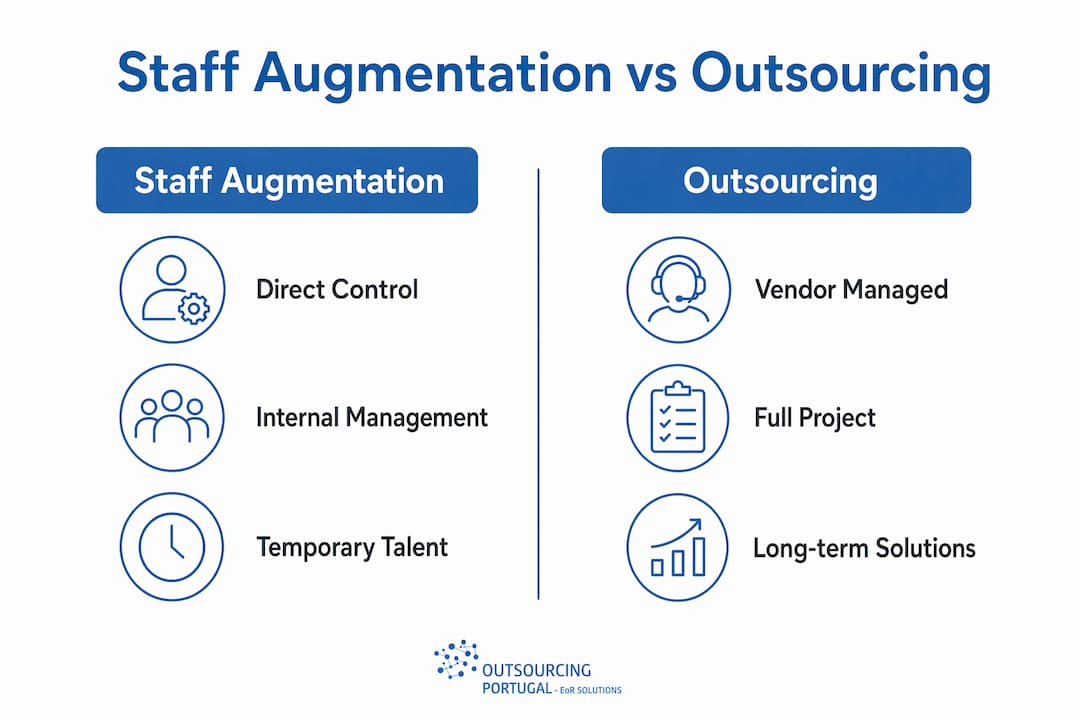
| Dimension | Staff augmentation | Outsourcing |
|---|---|---|
| Who manages the work? | Your internal managers | The vendor’s project managers |
| IP ownership | Stays with your company | Can be ambiguous without explicit contracts |
| Integration | Works inside your team and tools | Operates as a separate unit |
| Cost structure | Hourly or monthly rate per person | Fixed project fee or managed service fee |
| Control over output | Direct, daily | Indirect, milestone-based |
| Flexibility | Month-to-month, scalable | Tied to project scope or long-term contract |
Management and technical control remain entirely with the hiring company under staff augmentation. Augmented staff follow your internal coding standards, security protocols, and product roadmap. In outsourcing, you define outcomes and the vendor decides how to reach them.
The right model depends on your situation. Staff augmentation fits best when you need specific skills integrated into an existing team, when IP sensitivity is high, or when you want to maintain execution direction. Outsourcing fits better when you want to hand off a defined, self-contained function entirely, such as customer support operations or payroll processing.
Pro Tip: If you are hiring across borders, review your workforce compliance workflow before selecting a model. Misclassifying an augmented worker as an independent contractor in a jurisdiction like Portugal or Germany creates tax and labor law exposure that can exceed the cost of the engagement itself.
Independent contractors occupy a third category. They operate with more autonomy than augmented staff, typically own their own tools and processes, and carry their own tax obligations. Staff augmentation sits between contractors and permanent employees: you get the flexibility of contract work with the integration and control of an internal hire.
What types of staff augmentation are available?
Staff augmentation is not a single model. The right type depends on your timeline, skill requirements, and business cycle. Understanding the types of staff augmentation available prevents mismatched engagements that waste budget and time.
- Short-term capacity augmentation. Used for project surges, product launches, or seasonal demand spikes. Engagements typically run one to six months. A retail technology team scaling for a Black Friday platform upgrade is a classic example.
- Long-term specialist augmentation. Used when a niche skill is needed continuously but not permanently. A fintech company retaining a PCI-DSS compliance engineer for 18 months while building a payments product fits this model.
- Skill-based augmentation. Targets a specific technical gap: a data engineering team that needs a machine learning specialist for a defined build phase, or a legal team that needs a contract technology expert for a system migration.
- Capacity scaling augmentation. Adds volume rather than specialty. A software consultancy winning a large contract may augment with five mid-level developers to meet delivery commitments without permanent headcount growth.
- IT and engineering augmentation. The most common category globally, covering roles from DevOps engineers and cloud architects to QA specialists and full-stack developers. Providers like Second Talent and Pangea AI specialize in this segment.
- Professional services augmentation. Covers finance, legal, HR, and marketing roles. Less common than IT augmentation but growing as companies recognize the same flexibility benefits apply outside engineering.
Staff augmentation suits temporary surges and specialized skill gaps far better than it suits permanent leadership or foundational team roles. If you are considering augmenting a CTO function or a core product owner role, a permanent hire or executive search is the more appropriate path. Augmentation complements your permanent team. It does not replace it.
For companies building nearshore teams in Europe, Portugal has emerged as a strong augmentation destination. Its nearshoring service model combines a highly educated, English-proficient workforce with EU-compliant employment structures and competitive labor costs, making it practical for both short-term and long-term augmentation engagements.
Key takeaways
Staff augmentation gives businesses direct control over external talent while offloading compliance, payroll, and hiring risk to specialist providers, making it the most operationally efficient model for filling skill gaps quickly.
| Point | Details |
|---|---|
| Speed advantage | Augmented staff start in 1 to 3 weeks versus 22 weeks for internal senior hires. |
| Cost reduction | Nearshore augmentation cuts total employment costs by 30 to 50% compared to US-based permanent hires. |
| Management control | Unlike outsourcing, augmented staff report directly to your managers and follow your internal standards. |
| Contract flexibility | Month-to-month contracts with 30 to 90 day notices allow workforce scaling without layoffs or severance. |
| Trial-to-hire protection | Negotiate conversion clauses upfront to avoid buyout fees of 20 to 30% of first-year salary. |
Why I think most companies use staff augmentation wrong
I have seen dozens of companies treat augmented staff like temporary contractors: kept at arm’s length, excluded from team rituals, and given access to only the minimum tools needed to complete a task. The results are predictable. Productivity is mediocre, knowledge transfer is minimal, and the engagement ends with nothing retained.
The companies that get real value from staff augmentation do the opposite. They onboard augmented professionals the same way they onboard permanent hires. They give them context on the product roadmap, introduce them to the full team, and include them in retrospectives. Treating external staff as integrated team members rather than isolated contractors is what separates a high-performing augmented team from an expensive disappointment.
The second mistake I see consistently is using augmentation to avoid making a permanent hiring decision. If a role is genuinely foundational to your business, augmentation is a delay tactic, not a solution. The model works best when the need is genuinely temporary or when the skill is genuinely specialized. Using it to fill a core engineering lead role for two years because you cannot agree on a permanent hire is expensive and demoralizing for the person in the role.
My practical advice: plan knowledge transfer from the first week, not the last. Document what your augmented staff build, decide, and configure. When the engagement ends, that knowledge should live in your systems and your permanent team, not in someone’s head walking out the door.
— Paulo
How Outsourcing-portugal supports your staff augmentation needs
When staff augmentation crosses borders, compliance becomes the critical variable. Outsourcing-portugal provides Employer of Record and payroll services that handle the full employment infrastructure for augmented staff based in Portugal, including contracts, tax filings, social security contributions, and local labor law compliance. International companies use these services to add Portuguese talent to their teams without establishing a local legal entity. Portugal’s EU membership, English-proficient workforce, and competitive labor costs make it one of the most practical nearshore augmentation destinations in Europe. If you are evaluating EoR services in Portugal for your next augmentation engagement, Outsourcing-portugal removes the compliance complexity entirely.
FAQ
What is staff augmentation in simple terms?
Staff augmentation is when a company temporarily adds external professionals to its internal team to fill skill gaps or increase capacity, with those professionals managed directly by the company rather than by a vendor.
How long does a staff augmentation engagement typically last?
Engagements range from one month to several years depending on the need. Contracts are usually month-to-month or project-based with 30 to 90 day termination notices, giving both parties flexibility.
How is staff augmentation different from outsourcing?
In staff augmentation, your managers direct the work and your company retains IP ownership. In outsourcing, a vendor manages the team and owns the execution process, with your company receiving defined outputs or services.
What roles are most commonly filled through staff augmentation?
IT and engineering roles dominate, including DevOps engineers, cloud architects, full-stack developers, and QA specialists. Professional services roles in finance, HR, and legal are a growing secondary category.
Does staff augmentation save money compared to permanent hiring?
Yes. Companies typically reduce total employment costs by 30 to 50% through staff augmentation by eliminating employer overhead, benefits, and recruiting fees associated with permanent hires.