
TL;DR:
- Legal compliance in Portugal involves understanding layered legal, regulatory, and guidance requirements that govern employment and operational standards. Building a proactive, structured Compliance Management System reduces risks, enhances governance, and provides strategic advantages in international business. Failure to adhere can result in personal liability for directors and operational disruptions, underscoring the importance of integrating legal obligations into enterprise architecture from the outset.
Legal requirements are the mandatory rules and obligations that organizations must follow to maintain lawful, ethical, and financially sound operations. For international business leaders and HR professionals entering Portugal, understanding the role of legal requirements is not optional. It defines what you can hire, how you must pay, and what liabilities you carry personally if things go wrong. Portugal’s employment framework, shaped by EU directives, the Portuguese Labor Code, and GDPR, creates a layered compliance environment that rewards preparation and punishes assumptions.
What are the different types of legal requirements businesses face?
Laws, regulations, and guidance each operate at distinct levels, and conflating them is one of the most common mistakes international teams make. Laws are statutes passed by legislatures, such as Portugal’s Código do Trabalho (Labor Code), which sets binding rules on contracts, termination, and working hours. Regulations are directives issued by agencies to enforce those laws, covering specifics like social security contribution rates or occupational health standards. Guidance is interpretive advice from regulators that clarifies how laws and regulations apply in practice. It is not legally binding, but ignoring it routinely invites scrutiny.
The practical implication is that compliance is never a single document review. A business hiring in Portugal must track all three layers simultaneously, and changes at any level can affect operations within weeks.
| Type | Source | Binding? | Example in Portugal |
|---|---|---|---|
| Law | Legislature (Assembleia da República) | Yes | Portuguese Labor Code (Código do Trabalho) |
| Regulation | Government agencies (e.g., ACT, AT) | Yes | Social security contribution rules |
| Guidance | Regulatory bodies and ministries | No (but influential) | CNPD guidance on employee data handling |
| EU Directive | European Parliament and Council | Yes (once transposed) | GDPR, Working Time Directive |
Directors carry ultimate responsibility across all four categories. Compliance failures at any level can trigger penalties, and the defense of “we didn’t know” carries no legal weight in Portuguese or EU courts.
How do legal requirements impact business governance and risk management?
Corporate governance and legal compliance are inseparable. The board sets the tone, but the legal obligations in business define the floor below which no decision can fall. In practice, this means that directors must not only understand the laws that apply to their operations but also build systems that monitor compliance continuously.

An effective Compliance Management System is now expected by regulators as the baseline for minimizing legal risks and penalties. A CMS is not a policy binder on a shelf. It is a living program that includes written policies, staff training, internal audits, monitoring mechanisms, and a clear reporting line to the board. Companies with functioning CMS frameworks reduce penalties significantly through proactive oversight rather than reactive damage control.
Compliance officers play a central role in overseeing policies, training staff, monitoring risks, and reporting directly to the board. Their authority and independence within the organization are not cosmetic. Regulators specifically assess whether the compliance function has real power to escalate issues without interference from commercial leadership. A compliance officer who reports only to the CFO is a structural red flag in any regulatory review.
For HR professionals managing Portugal operations remotely, the governance question becomes even more pointed. Who owns compliance locally? Who reviews contracts before signing? Who monitors changes to Portuguese labor law? Without clear answers, the risk does not disappear. It concentrates at the director level.
Pro Tip: Audit your third-party providers with the same rigor you apply to internal teams. Liability for compliance failures often remains with your company’s directors even when an Employer of Record or payroll vendor is involved. Request compliance documentation annually, not just at onboarding.
What strategic advantages come from proactive legal compliance?
Most executives frame compliance as a cost center. That framing is commercially outdated. Proactive compliance allows firms to turn regulatory complexity into a competitive advantage and supports long-term growth. Businesses that anticipate regulatory shifts gain measurable trust with investors and partners, particularly in cross-border transactions where due diligence scrutinizes compliance history.
The shift from voluntary ethical norms to binding legal standards, a process academics call “juridification,” is accelerating. ESG reporting, AI ethics frameworks, and data governance standards that were advisory in 2022 are becoming enforceable mandates in 2026. Businesses that embedded these standards early avoid the costly restructuring that reactive companies face when the law catches up to practice.
Businesses preemptively adopting ESG and AI ethics standards into internal policies before they become law avoid expensive reactive changes later. This is not theoretical. The EU AI Act, which entered phased enforcement in 2025, created immediate compliance obligations for companies using AI in hiring, performance management, or customer service. Organizations that had already mapped their AI use cases faced weeks of adjustment. Those that had not faced months.
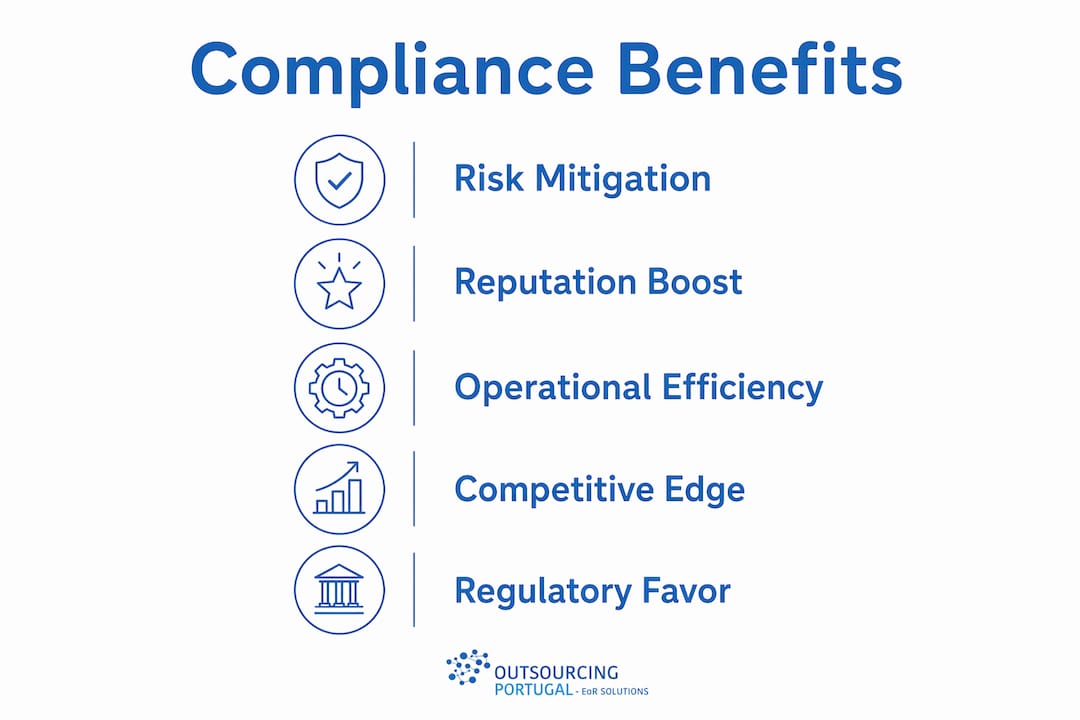
The strategic benefits of proactive legal compliance include:
- Investor confidence: Clean compliance records reduce perceived risk in M&A due diligence and funding rounds.
- Faster market entry: Companies with established compliance frameworks enter new jurisdictions faster because internal processes already accommodate regulatory variation.
- Reduced litigation exposure: Legal compliance improves operational efficiency by clarifying processes and reducing redundancies that create legal gray areas.
- Talent attraction: Employees, particularly in Europe, increasingly evaluate employer compliance with labor law as a signal of organizational integrity.
- Regulatory goodwill: Regulators in Portugal and across the EU treat proactively compliant companies differently during investigations. A documented compliance program is a mitigating factor in penalty calculations.
Top-performing firms integrate legal understanding into strategic planning to gain competitive edges. Ignorance of the law is not just a legal risk. It is a commercial one.
How can international leaders ensure compliance when hiring in Portugal?
Portugal’s employment and operational legal framework includes mandatory written employment contracts, social security registration with Segurança Social, health and safety obligations under the ACT (Authority for Working Conditions), and data protection requirements under GDPR. Failure to comply can result in fines, litigation, and operational disruption that forces a full hiring freeze while issues are resolved.
The most dangerous assumption international HR teams make is that their home-country employment framework transfers to Portugal. It does not. Portuguese law mandates specific notice periods, severance calculations, and employee rights that differ substantially from UK, US, or German standards. Ignoring local regulations in international markets results in legal exposure and operational disruptions, with directors facing personal liabilities when systemic failures occur.
The table below summarizes the core compliance requirements for hiring in Portugal:
| Requirement | Detail | Governing Body |
|---|---|---|
| Written employment contract | Mandatory before or at start of employment | Portuguese Labor Code |
| Social security registration | Employer and employee contributions required | Segurança Social |
| Health and safety compliance | Risk assessments and workplace safety plans | ACT (Authority for Working Conditions) |
| GDPR compliance | Employee data handling, consent, and storage rules | CNPD (Portuguese Data Protection Authority) |
| Minimum wage adherence | National minimum wage updated annually | Ministry of Labor |
| Collective bargaining agreements | Sector-specific agreements may apply | Relevant trade union bodies |
For companies without a local entity, an Employer of Record model transfers the legal employer role to a compliant local entity. This means the EOR holds the employment contracts, manages payroll, and handles social security filings. Your team still directs the work. The legal exposure sits with a party that has the infrastructure to manage it. Outsourcing-portugal’s payroll compliance checklist provides a practical starting point for mapping your obligations before your first hire.
Pro Tip: Do not rely on a single legal review at market entry. Portuguese labor law updates annually, and sector-specific collective bargaining agreements can change mid-year. Build a quarterly compliance review into your HR calendar, or use a local partner who tracks changes as part of their service.
Key takeaways
Legal compliance in Portugal is a board-level responsibility that requires structured systems, local expertise, and continuous monitoring rather than a one-time legal review.
| Point | Details |
|---|---|
| Three layers of legal obligation | Laws, regulations, and guidance each carry distinct weight and must be tracked simultaneously. |
| CMS is now a regulatory expectation | A functioning Compliance Management System reduces penalties and signals good governance to regulators. |
| Proactive compliance builds competitive advantage | Firms that adopt emerging standards early avoid costly restructuring when those standards become law. |
| Portugal has specific, non-transferable rules | Employment contracts, social security, GDPR, and ACT obligations differ substantially from other jurisdictions. |
| Director liability is personal | Compliance failures in Portugal can result in personal liability for directors, not just corporate fines. |
Why compliance is the wrong word for what you actually need
After working with international businesses entering Portugal for years, I have noticed a consistent pattern. Leaders arrive focused on speed. They want to hire fast, get teams productive, and prove the market. Compliance gets treated as the paperwork that follows. That sequence is exactly backward.
The businesses that operate most smoothly in Portugal are the ones that treat legal requirements as the architecture of their operations, not the finishing coat. They build contracts, payroll systems, and HR workflows around what Portuguese law requires from day one. When regulations change, and they do change, those businesses adjust one component. The ones that bolted compliance on afterward often have to rebuild the whole structure.
What I find most underestimated is the personal liability dimension. Most international executives assume that operating through a subsidiary or a vendor insulates them. It does not, not automatically. Portuguese and EU law can pierce that layer when systemic negligence is demonstrated. The workforce compliance workflow that Outsourcing-portugal recommends for HR teams is built around this reality. It is not about ticking boxes. It is about creating a documented, auditable record that demonstrates your organization took its obligations seriously.
The other shift I would push leaders to make is from thinking about compliance as a Portugal problem to treating it as a global operating standard. The juridification trend is real. ESG, AI governance, and data ethics are moving from voluntary to mandatory across every major market. The companies building those muscles now will not be scrambling in 2028.
— Paulo
How Outsourcing-portugal helps you hire compliantly in Portugal
International companies entering Portugal face a compliance environment that is detailed, updated regularly, and unforgiving of assumptions borrowed from other markets. Outsourcing-portugal manages the full employment lifecycle, from contract drafting and social security registration to payroll processing and GDPR-compliant data handling, so your team can focus on building the business rather than decoding Portuguese labor law.
Whether you are making your first hire or scaling a nearshore team, Outsourcing-portugal’s Employer of Record services place the legal employer role with a locally compliant entity, eliminating the need to set up a Portuguese legal entity before you are ready. For a full picture of what compliant hiring looks like in practice, the 2026 hiring guide for HR managers covers every stage of the process with current legal requirements built in.
FAQ
What is the role of legal requirements in business operations?
Legal requirements define the mandatory rules businesses must follow to operate lawfully, covering employment contracts, tax obligations, data protection, and workplace safety. They also set the boundaries within which corporate governance, risk management, and HR practices must function.
Why do legal regulations matter more for international businesses?
International businesses face layered obligations from both local law and supranational frameworks like EU directives, and home-country legal assumptions do not transfer across borders. Directors can face personal liability when local regulations are ignored, making understanding legal requirements a board-level priority.
What are the key legal obligations for hiring in Portugal?
Portugal requires written employment contracts, social security registration with Segurança Social, GDPR-compliant data handling, and adherence to ACT health and safety standards. Sector-specific collective bargaining agreements may add further obligations depending on the industry.
How does an Employer of Record reduce legal compliance risk in Portugal?
An Employer of Record holds the employment contracts and manages payroll, social security, and statutory filings as the legal employer in Portugal. This transfers the day-to-day compliance burden to a locally expert entity while the client company retains full operational direction of the employee.
What is a Compliance Management System and why does it matter?
A Compliance Management System is a structured program of policies, training, audits, and board reporting designed to identify and manage legal risks before they become violations. Regulators now treat a functioning CMS as a baseline expectation, and its absence is treated as an aggravating factor in penalty assessments.