

TL;DR:
- Portugal has become Europe’s top nearshore destination in 2026 due to its high English proficiency, EU membership, and GMT alignment with Western Europe. Building a nearshore team involves defining objectives, running pilots, and ensuring compliance through Employer of Record onboarding within 5 to 10 days. Successful expansion requires active management, clear success criteria, and regular KPI monitoring to sustain operations.
Nearshore expansion is defined as building operational teams in geographically close countries to gain cost advantages, access skilled talent, and maintain real-time collaboration. For international executives targeting Europe, Portugal has emerged as the continent’s most compelling nearshore destination in 2026. This guide covers every stage of a successful nearshore investment strategy: from setting objectives and selecting a location to building your team, managing compliance, and scaling for the long term.
What is a nearshore expansion guide and why does it matter?
A nearshore expansion guide gives executives a structured framework to move from concept to operational team without costly missteps. Nearshore outsourcing is defined as delegating work to partners in nearby countries that share similar time zones, combining cost savings with stronger collaboration than offshore models allow. That distinction matters. Offshore teams in Southeast Asia or India often require asynchronous workflows and significant coordination overhead. Nearshore teams in Portugal or Poland operate within one to two hours of Western European headquarters.
The benefits of nearshore outsourcing go beyond labor cost reduction. Executives gain access to deep talent pools in technology, customer support, and finance, while retaining the ability to visit sites, run joint sprints, and manage escalations in real time. Nearshore expansion requires evaluating strategic fit across workforce availability, infrastructure, geopolitical stability, and operational resilience. Cost is one factor, not the whole equation.
How do you set clear objectives for nearshore expansion?
Defining objectives before selecting a location is the single most important step in any guide to nearshore markets. Executives who skip this stage end up optimizing for the wrong variables, typically labor cost, while underweighting service quality and delivery speed.
Start by identifying which business functions are suitable for nearshore delivery:
- IT development and QA: High demand for Portuguese engineers with EU data protection compliance built in.
- Customer support: Portugal’s multilingual workforce covers English, Spanish, French, and German at scale.
- Finance and back-office operations: Time-zone alignment with London, Amsterdam, and Frankfurt enables same-day resolution cycles.
- HR and shared services: Stable Portuguese labor law and EU membership reduce cross-border complexity.
Once you identify the functions, define measurable success criteria before signing any contract. Service level agreements should specify response times, defect rates, and delivery velocity. Vague targets like “improve efficiency” produce vague results.
Strategic fit evaluation must also account for split-shoring strategies, where companies balance nearshore and offshore units to manage cost and resilience simultaneously. A customer support team in Lisbon handles European hours; an offshore team in Manila covers Asia-Pacific. That model works only when objectives for each unit are defined separately.
Pro Tip: Write your success criteria as a one-page scorecard before your first vendor call. Share it with every candidate partner. Partners who push back on the metrics are telling you something important about their operational maturity.
How does Portugal compare to other European nearshore markets?
Portugal consistently ranks among Europe’s top nearshore destinations for technology and customer operations. The key selection criteria for any nearshore location are time-zone alignment, labor market depth, language capability, legal framework, and total employment cost.
| Criterion | Portugal | Poland | Romania | Bulgaria |
|---|---|---|---|---|
| Time zone (vs. GMT) | GMT+0/+1 | GMT+1/+2 | GMT+2/+3 | GMT+2/+3 |
| EU membership | Yes | Yes | Yes | Yes |
| English proficiency | Very high | High | High | Moderate |
| Tech talent pool | Large, growing | Very large | Large | Moderate |
| Labor cost vs. Western Europe | Competitive | Moderate | Low | Very low |
| Political stability | Very high | High | Moderate | Moderate |
Portugal’s combination of very high English proficiency, EU legal framework, and GMT alignment with London makes it the strongest fit for UK and Northern European companies. Poland offers a larger tech talent pool but higher costs and greater time-zone distance for Atlantic-facing businesses.
When evaluating a nearshore partner, assess four dimensions beyond their sales pitch:
- Delivery maturity: How many clients of similar size have they served? Ask for references, not case studies.
- Governance model: Who owns escalation? Is there a named account lead with authority to resolve issues?
- Retention strategy: What is their annual attrition rate? High attrition destroys institutional knowledge.
- Compliance infrastructure: Do they operate as a licensed Employer of Record, or do they subcontract employment?
Pro Tip: Request a sample employment contract and payroll report from any EOR partner before signing. The quality of those documents tells you more about operational rigor than any capability presentation.
Outsourcing-portugal publishes a detailed breakdown of why nearshore in Europe works for service firms and tech teams, with 2026 market context included.
How do you build and onboard a nearshore team in Portugal?
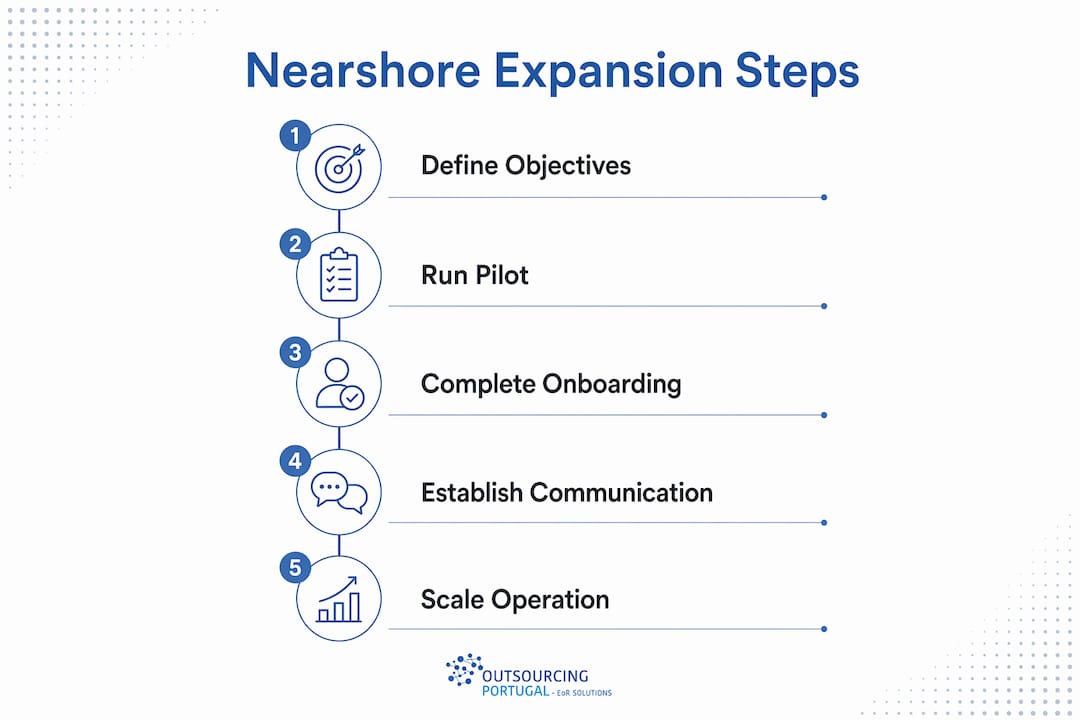
Building a nearshore team in Portugal follows a defined sequence. European companies that succeed start with business context and success metrics, then select team structures before moving to onboarding. Skipping steps creates gaps that surface six months later as performance problems.
Step 1: Define team structure and capability profiles
Map each role to a specific output, not a job title. A “senior developer” means different things in different organizations. Define the deliverable, the tools required, and the collaboration cadence expected.

Step 2: Run a paid pilot before full commitment
A 2–3 week paid pilot with milestone definitions at months 1, 3, and 6 validates operational readiness and reduces risk. The pilot reveals how well the team integrates, not just whether they have the right skills. Operational compatibility, including communication rhythm, governance, and escalation protocols, matters more than technical ability alone.
Step 3: Complete EOR onboarding
EOR onboarding in Portugal typically takes 5–10 business days. That window covers contract drafting under the Portuguese labor code, Social Security registration, tax registration, and insurance setup. Contracts must comply with Portuguese labor law and include all mandatory registrations.
Verify the NIPC on every employment contract and payroll document. The NIPC is the Portuguese tax identification number for legal entities. It must match the actual EOR entity registered in Portugal. Mismatches create compliance exposure that takes months to resolve.
Step 4: Establish communication infrastructure
Assign a dedicated integration lead on both the client side and the nearshore side. Set weekly cadence calls, define escalation paths, and document decision rights in writing. Teams that skip this step spend the first 90 days negotiating process instead of delivering work.
| Milestone | Target | Key metric |
|---|---|---|
| Day 30 | Team operational | Onboarding complete, first deliverable submitted |
| Day 60 | Rhythm established | SLA compliance above baseline |
| Day 90 | Full integration | Escalation rate declining, output at target |
Pro Tip: Treat the 90-day ramp as a formal project with a named owner and weekly status reports. Teams that treat ramp as informal tend to drift past the 90-day mark without hitting baseline performance.
How do you scale and sustain a nearshore operation?
Scaling a nearshore team requires a different mindset than building one. The risks shift from setup errors to contract rigidity and performance drift.
Employment contracts in Portugal default to indefinite terms in most cases. Fixed-term contracts carry legal limits on duration and renewal. That structure affects how quickly you can scale up or restructure a team, so plan headcount growth in stages rather than large cohorts.
Key practices for sustainable scaling include:
- Monitor KPIs monthly, not quarterly. Early detection of output decline or attrition spikes gives you time to intervene before client impact occurs.
- Build a skills matrix for each team. As your business evolves, the skills you need will shift. A documented matrix makes gap analysis faster and hiring decisions cleaner.
- Review your split-shoring balance annually. If your nearshore team is performing well, consider whether functions currently handled offshore could move nearshore for better coordination.
- Maintain contract hygiene. Confirm that payroll, Social Security contributions, and tax filings align with the registered EOR entity. Administrative errors compound over time.
- Invest in retention. Competitive compensation, clear career paths, and regular performance conversations reduce attrition. Replacing a trained nearshore employee costs more than retaining one.
Nearshoring is not a cost arbitrage exercise that runs itself. Treat it as an operational model that requires active management, governance reviews, and periodic renegotiation of terms as your team grows.
Key Takeaways
Successful nearshore expansion in Portugal requires defined objectives, a phased pilot approach, rigorous EOR compliance, and active performance management at every stage of growth.
| Point | Details |
|---|---|
| Define objectives first | Identify functions, set measurable SLAs, and document success criteria before selecting a location. |
| Portugal leads in Europe | GMT alignment, high English proficiency, EU membership, and competitive labor costs make Portugal the top nearshore choice for UK and Northern European firms. |
| Pilot before committing | A 2–3 week paid pilot validates operational fit, communication rhythm, and governance, not just technical skills. |
| EOR onboarding takes 5–10 days | Contract drafting, Social Security, tax registration, and insurance setup complete within two weeks under Portuguese labor law. |
| Scale with contract awareness | Portuguese contracts default to indefinite terms; plan headcount growth in stages and monitor KPIs monthly to catch problems early. |
What I’ve learned from watching nearshore expansions succeed and fail
The executives who struggle most with nearshore expansion share one pattern: they treat the pilot as a formality. They select a partner, run two weeks of introductory calls, and declare operational readiness. Six months later, they are managing a team that technically delivers but never fully integrated into the parent organization’s workflow.
The pilots that work are the ones where the client sends a real project, not a test exercise. Real projects expose real friction: who makes decisions when the integration lead is unavailable, how the team handles an urgent client escalation at 4 PM Lisbon time, whether the communication tools and access permissions were actually set up correctly. Those details do not surface in a demo environment.
Portugal specifically rewards executives who invest in the legal and payroll setup from day one. I have seen companies spend months untangling compliance issues because they assumed their EOR partner handled everything automatically. Verifying the NIPC, confirming Social Security registrations, and reviewing the first payroll run are not bureaucratic details. They are the foundation that everything else sits on.
The future of European nearshoring points toward Portugal absorbing more of the mid-market demand that previously went to Eastern Europe. Wage growth in Poland and Romania has narrowed the cost gap, while Portugal’s infrastructure, English proficiency, and political stability have improved. Executives who build nearshore teams in Portugal now are positioning ahead of that shift, not chasing it.
— Paulo
Portugal nearshore services from Outsourcing-portugal
Outsourcing-portugal provides employment outsourcing, Employer of Record, payroll management, and entity setup services for international companies building teams in Portugal. The platform handles the full compliance stack so your team can focus on delivery from day one.
Whether you are hiring your first Portuguese employee or scaling a team of 50, Outsourcing-portugal covers EOR and payroll services including contract drafting, Social Security registration, tax filings, and ongoing HR support. For executives who want to move fast without legal exposure, the employment outsourcing platform connects you to compliant hiring in 5–10 business days. You can also review the nearshore team-building guide to align your internal planning with Portugal-specific best practices before your first hire.
FAQ
What is nearshore expansion?
Nearshore expansion is building operational teams in geographically close countries that share similar time zones. It combines cost savings with real-time collaboration, unlike offshore models that rely on asynchronous workflows.
Why is Portugal a top nearshore destination in Europe?
Portugal offers GMT alignment with Western Europe, very high English proficiency, EU legal compliance, and competitive labor costs. Those factors make it the strongest fit for UK and Northern European companies seeking European nearshore talent.
How long does EOR onboarding take in Portugal?
EOR onboarding in Portugal typically takes 5–10 business days. That window covers contract drafting, Social Security registration, tax registration, and insurance setup under Portuguese labor law.
What contract types apply to nearshore employees in Portugal?
Employment contracts in Portugal default to indefinite terms. Fixed-term contracts carry legal limits on duration and renewal, which affects how quickly companies can scale or restructure nearshore teams.
How do you validate a nearshore pilot?
A paid pilot of 2–3 weeks with defined milestones at months 1, 3, and 6 validates operational readiness. Operational compatibility, including communication cadence and escalation protocols, matters more than technical skills alone.