
TL;DR:
- Workplace infrastructure includes physical spaces, digital systems, policies, and well-being programs that enable effective work across all environments. Improving coordination among these components reduces friction, boosts productivity, and supports scalable growth for international organizations. Proper management of invisible policies and cultural norms is essential for successful adoption and long-term performance.
Workplace infrastructure is defined as the integrated system of physical spaces, digital platforms, processes, policies, and well-being programs that enable employees to work effectively across on-site, remote, and hybrid environments. The term covers everything from office lighting and IT networks to governance frameworks and cultural norms. Gensler and TNW both treat this system as the operational backbone of modern organizations, not a background expense. Decision-makers who understand its full scope gain a direct advantage in productivity, retention, and global scalability. This guide breaks down every layer of workplace infrastructure and shows you how to manage it as a competitive asset.
What is workplace infrastructure and why does it matter?
Workplace infrastructure is an integrated system combining physical space, digital platforms, processes, policies, and well-being programs to support productive work across all environments. The industry term for this concept is “workplace infrastructure,” and it maps directly to what facilities managers, IT directors, and HR leaders collectively manage every day. Think of it as the operating system of your organization. Without it running well, every other investment in talent or technology underperforms.

The importance of workplace infrastructure becomes clear when you look at what breaks without it. Unreliable tools, unclear workflows, and poorly maintained physical spaces all create daily friction. That friction compounds into burnout, attrition, and lost revenue. For international companies managing teams across multiple countries, the stakes are even higher because each location adds its own layer of complexity.
Pro Tip: Before auditing your infrastructure, map every touchpoint an employee encounters from their first day onward. The gaps you find there are your highest-priority fixes.
What are the core components of workplace infrastructure?
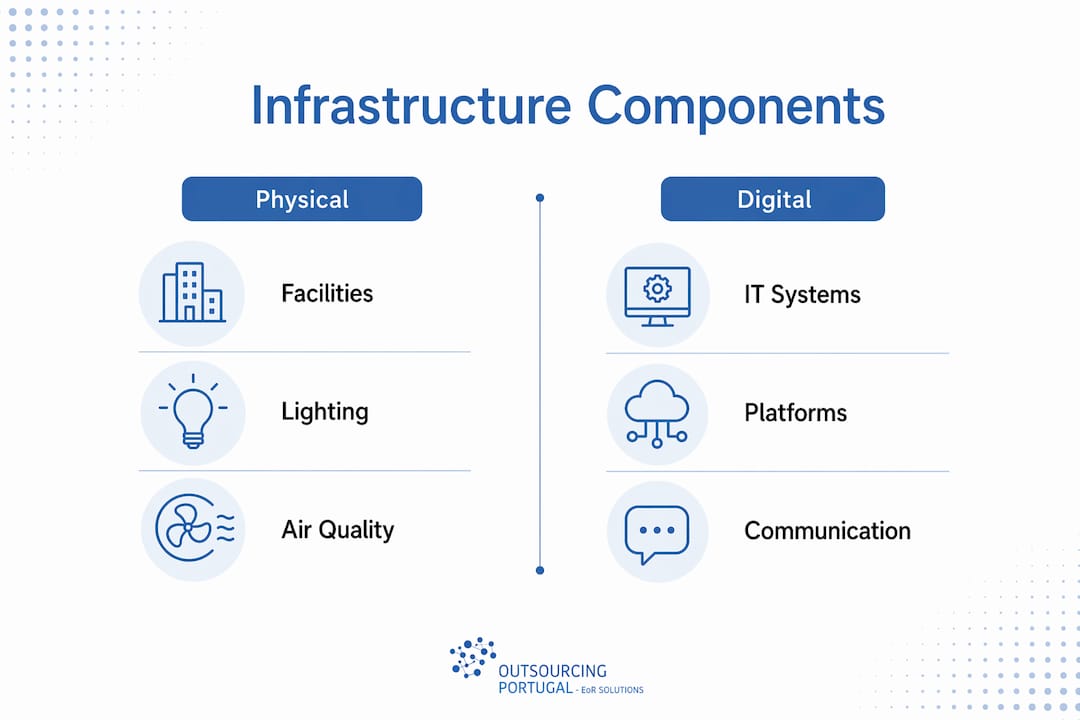
Workplace infrastructure components fall into five distinct pillars: physical facilities, IT and digital stacks, communication protocols, organizational governance and standard operating procedures, and talent and well-being programs. Each pillar affects the others. A state-of-the-art office with a broken IT network still produces a dysfunctional work environment. The components only deliver value when they operate as a coordinated system.
The table below summarizes each pillar, real-world examples, and the business impact each one drives.
| Component | Examples | Business Impact |
|---|---|---|
| Physical facilities | Office layout, lighting, air quality, ergonomic furniture | Cognitive performance, health, and retention |
| IT and digital stack | Cloud platforms, cybersecurity tools, hardware | Operational speed and data security |
| Communication protocols | Meeting cadences, messaging standards, reporting lines | Clarity, alignment, and decision speed |
| Organizational governance | SOPs, compliance frameworks, HR policies | Legal protection and process consistency |
| Talent and well-being programs | Training, mental health support, hydration stations | Engagement, output quality, and loyalty |
Cross-departmental coordination is the hidden requirement that makes these pillars work together. IT, HR, and real estate teams that operate in silos create redundant processes and conflicting policies. The result is friction that cancels out expensive investments in any single pillar. Coordinating these teams around a shared infrastructure plan is not optional for organizations that want to scale.
Pro Tip: Document every infrastructure asset, software configuration, and SOP in a single shared system. Without a single source of truth, organizations lose money daily through inefficiencies that are invisible until they become crises.
How does workplace infrastructure impact productivity and performance?
Physical infrastructure factors like lighting, air quality, and hydration are direct business performance variables, not comfort perks. Proper hydration alone can increase cognitive performance by up to 14%. That figure puts a reliable water supply in the same category as a software upgrade when measuring return on investment.
Poor infrastructure such as unreliable tools and confusing workflows is a direct contributor to employee burnout and turnover. Friction driven by broken processes creates daily frustration, which accelerates workforce attrition and adds recruiting costs that dwarf the original infrastructure investment. For international companies, replacing a skilled employee in a foreign market is especially expensive when you factor in legal, onboarding, and productivity ramp-up costs.
The business benefits of well-managed workplace infrastructure include:
- Faster onboarding because processes and tools are documented and consistent
- Lower attrition rates because employees experience less daily friction
- Higher output quality because physical conditions support focus and health
- Faster decision-making because communication protocols are clear and followed
- Better compliance because governance frameworks are current and enforced
Treating infrastructure as a living system rather than a static cost center is the defining difference between organizations that scale and those that stall. Top organizations manage the infrastructure lifecycle proactively. They audit, update, and retire components before those components become sources of disruption.
What is invisible infrastructure and why does it matter?
Invisible infrastructure is the layer of policies, digital protocols, and cultural norms that shapes how work actually gets done. Gensler defines it as the non-physical elements that significantly affect how work is executed and influence workplace success. You cannot see invisible infrastructure on a floor plan, but you feel it in every meeting, every approval process, and every onboarding experience.
Organizations that integrate invisible infrastructure with their physical and digital systems report higher agility and better absorption of organizational change. Those that focus only on physical renovations or new software deployments find that adoption rates disappoint. The reason is straightforward: if the policy around a new tool is unclear, or the cultural norm is to ignore it, the tool fails regardless of its quality.
Practical examples of invisible infrastructure in action include:
- A hybrid work policy that specifies which days teams collaborate in person and which days are remote-first
- A digital communication protocol that defines when to use email versus a messaging platform like Slack or Microsoft Teams
- A governance framework that sets approval hierarchies for budget decisions across international offices
- Cultural norms around response times, meeting length, and documentation standards
Designing policies and digital protocols with the same intentionality as physical space enhances employee experience and accelerates adoption of new ways of working. Misaligned policies make new tools or office designs feel burdensome rather than intuitive. This is the most common reason that expensive office redesigns or software rollouts underdeliver.
Pro Tip: When rolling out a new tool or workspace design, write the policy before the launch date. Teams adopt new systems faster when the rules are clear from day one.
How can international businesses improve workplace infrastructure?
The most effective improvement approach is identifying bottlenecks in communication or reporting before acquiring new technology. Adding tools to a broken process only adds complexity. Fix the workflow first, then choose the technology that supports it. This sequence saves budget and prevents the frustration of a failed rollout.
For international companies managing distributed teams, the infrastructure impacts outsourcing decisions in ways that go beyond office space. Compliance frameworks, payroll systems, and HR governance must adapt to each country’s legal requirements. A company expanding into Portugal, for example, needs to align its existing IT and HR infrastructure with Portuguese labor law, tax obligations, and data protection rules under the EU’s GDPR.
The table below compares common improvement strategies with their expected operational outcomes.
| Improvement Strategy | Expected Outcome |
|---|---|
| Audit and document all SOPs | Reduces administrative troubleshooting and onboarding time |
| Align IT, HR, and facilities teams | Eliminates redundant processes and conflicting policies |
| Fix communication protocols before adding tools | Increases tool adoption and reduces rollout failure rates |
| Build a single infrastructure asset registry | Prevents revenue loss from untracked system failures |
| Adapt governance frameworks per country | Ensures legal compliance and reduces regulatory risk |
Scalability requires building infrastructure that can absorb new team members, new markets, and new regulations without breaking. A checklist for hiring remote teams is one practical starting point for companies expanding across borders. Cultural adaptation is equally critical. Communication norms, decision-making styles, and work-hour expectations vary significantly between markets, and your infrastructure must account for those differences explicitly.
Key Takeaways
Workplace infrastructure is the integrated system of physical, digital, and policy-based components that determines whether your organization operates efficiently or burns resources on preventable friction.
| Point | Details |
|---|---|
| Five core pillars | Physical facilities, IT stacks, communication protocols, governance, and well-being programs must work together. |
| Invisible infrastructure matters | Policies and cultural norms shape adoption and performance as much as physical or digital tools do. |
| Fix processes before adding tools | Identifying bottlenecks in communication first prevents costly and failed technology rollouts. |
| Document everything | A single source of truth for assets and SOPs reduces daily operational waste and troubleshooting time. |
| International complexity requires adaptation | Governance and compliance frameworks must align with each country’s legal and cultural requirements. |
Why most companies are managing infrastructure wrong
The most common mistake I see in international organizations is treating workplace infrastructure as a facilities problem. Leadership signs off on a new office fit-out or a software license, then hands it to IT or real estate and moves on. The invisible layer, meaning the policies, the governance, the cultural norms, gets no design attention at all. Six months later, the new office sits half-empty and the new software has a 30% adoption rate. The investment failed not because the tools were wrong, but because the invisible infrastructure was never built.
The second mistake is managing IT, HR, and real estate as separate functions with separate budgets and separate priorities. Siloed teams create redundant processes and conflicting policies that negate high-end physical or digital investments. I have watched companies spend significantly on ergonomic workstations while their IT helpdesk ran on a ticketing system that took three days to respond. The physical investment was real. The operational friction was realer.
The fix is not complicated, but it requires leadership commitment. Treat infrastructure as a cross-functional discipline with a single owner or steering committee that spans IT, HR, and facilities. Build a living document that tracks every component, its current state, and its next review date. Audit your invisible infrastructure at least once a year. Ask whether your policies still match how your teams actually work, because in fast-moving international organizations, the answer is often no.
— Paulo
How Outsourcing-portugal supports your infrastructure needs abroad
Building workplace infrastructure across borders adds legal, payroll, and compliance complexity that most internal teams are not equipped to handle alone.

Outsourcing-portugal provides Employer of Record and payroll services that absorb that complexity directly. Through its EoR model, international companies can hire in Portugal without setting up a local legal entity, while remaining fully compliant with Portuguese labor law, tax obligations, and EU regulations. Outsourcing-portugal manages onboarding, payroll, HR support, and legal compliance as part of a single service. For decision-makers building or expanding teams in Portugal, that means your governance and compliance infrastructure is handled from day one. Visit Outsourcing-portugal’s employment services to see how the model works in practice.
FAQ
What is the workplace infrastructure definition?
Workplace infrastructure is the integrated system of physical facilities, digital platforms, communication protocols, governance frameworks, and well-being programs that enable productive work. It covers both visible elements like office space and IT hardware and invisible elements like policies and cultural norms.
What are the main components of workplace infrastructure?
The five core components are physical facilities, IT and digital stacks, communication protocols, organizational governance and SOPs, and talent and well-being programs. Each component affects the others, so they must be managed as a coordinated system rather than in isolation.
How does workplace infrastructure affect employee productivity?
Physical factors like air quality, lighting, and hydration directly influence cognitive performance and retention. Poor infrastructure such as unreliable tools and unclear workflows drives burnout and turnover, which adds significant recruiting and onboarding costs.
What is invisible infrastructure in the workplace?
Invisible infrastructure refers to the policies, digital protocols, and cultural norms that shape how work is executed. Organizations that design these elements with the same care as physical spaces report higher agility and better adoption of new tools and working methods.
How can companies improve workplace infrastructure for global teams?
The most effective starting point is fixing communication bottlenecks before adding new technology. Companies should also document all SOPs, align IT and HR teams around shared goals, and adapt governance frameworks to meet the legal requirements of each country where they operate.