
TL;DR:
- Hiring contractors involves ensuring proper classification to avoid legal and tax penalties. It requires clear documentation, written agreements, correct tax forms, and ongoing compliance management. International businesses must adapt to local laws and consider using employer of record services to mitigate risks.
Hiring contractors is defined as engaging self-employed workers on a project or fixed-term basis, without creating an employment relationship. For international businesses, this model delivers access to specialized skills, faster team expansion, and lower overhead than full-time hiring. The catch is compliance. Misclassifying a contractor as an employee triggers tax penalties, back benefits liability, and regulatory scrutiny across every jurisdiction where you operate. Getting classification, contracts, and documentation right from the start is not optional. It is the foundation of every successful contractor engagement.
How do you determine if a worker qualifies as an independent contractor?
Worker classification is the single highest-risk step in hiring independent contractors. The IRS determines classification by assessing the degree of control and independence in the actual working relationship. No single factor decides the outcome. All evidence must be weighed together across three categories.

Behavioral control covers whether your business directs how, when, and where the worker performs tasks. A contractor sets their own schedule, chooses their methods, and works without daily supervision. If you assign specific hours, require attendance at internal meetings, or dictate tools and processes, those behaviors point toward an employment relationship.
Financial control examines how the worker is paid and whether they bear business risk. Contractors typically invoice per project, work for multiple clients, and supply their own equipment. Workers paid a regular salary, reimbursed for all expenses, and barred from working elsewhere look more like employees to the IRS.
Relationship factors include written contracts, benefits, and the permanency of the arrangement. Providing health insurance, paid leave, or stock options to a contractor is a direct red flag. The IRS also considers whether the work performed is a core part of your business operations.
Key classification signals to evaluate:
- Does the worker control their own schedule and methods?
- Do they invest in their own tools and equipment?
- Do they work for multiple clients simultaneously?
- Is the engagement project-based rather than ongoing and indefinite?
- Does your contract exclude employee benefits entirely?
When classification is genuinely ambiguous, Form SS-8 allows either party to request an official IRS determination. This process is reserved for contested cases, not routine engagements. Routine use creates delays and draws unnecessary scrutiny.
Pro Tip: Document contractor autonomy in writing from day one. Record that the contractor sets their own schedule, uses their own tools, and operates their own business. This documentation is your first line of defense in any audit.
Misclassification risk drops significantly when contract language aligns with actual work behavior. A contract that says “independent contractor” but describes daily check-ins, assigned equipment, and exclusive work arrangements will not protect you. The IRS looks at reality, not labels.
What documents and steps are required to legally hire a contractor?
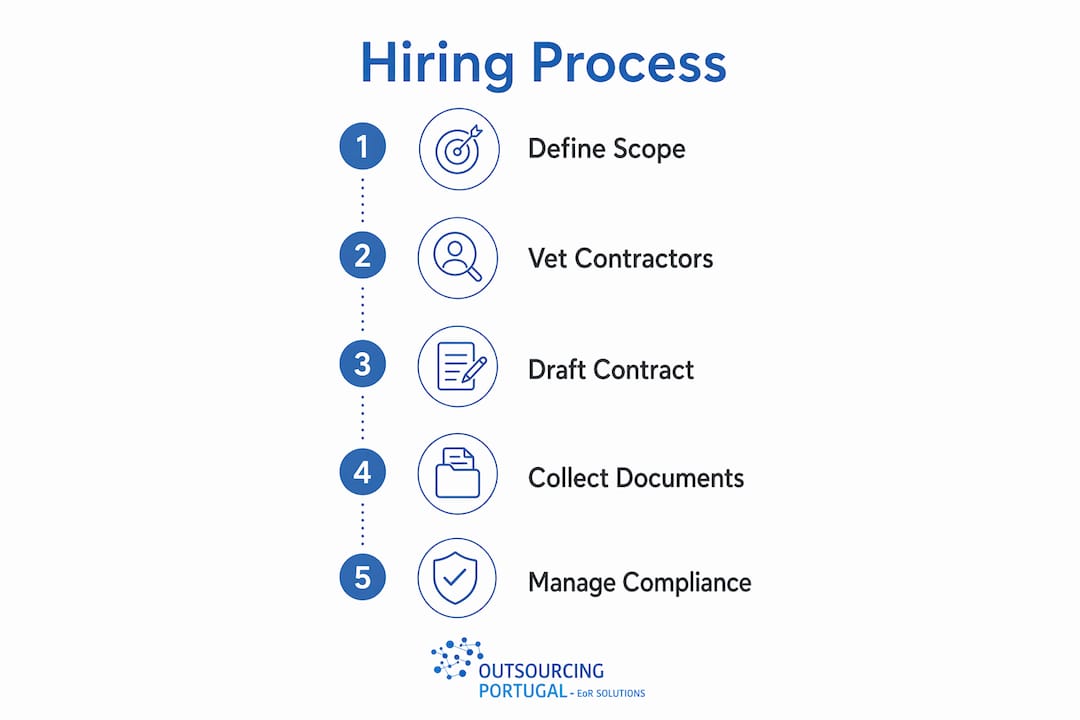
A compliant hiring workflow follows a fixed sequence. Skipping steps creates gaps that surface during audits or payment disputes. The best practice sequence is: confirm classification, create a written agreement, collect tax forms early, and maintain compliance records throughout the engagement.
-
Confirm contractor suitability. Before drafting any agreement, verify that the worker genuinely qualifies as an independent contractor under the IRS framework. Review the behavioral, financial, and relationship factors described above. If the role requires daily supervision or exclusive availability, reconsider the engagement structure.
-
Draft a comprehensive independent contractor agreement. The agreement must define the scope of work, deliverables, payment terms, deadlines, intellectual property ownership, and confidentiality obligations. Upwork’s contractor agreement model includes explicit IP assignment clauses, which prevent disputes over who owns work product after the engagement ends. Vague scope language is the most common source of contractor disputes.
-
Collect the correct tax forms. For US-based contractors, collect Form W-9 before the first payment. For non-US contractors providing services to a US business, Form W-8BEN is typically required to establish foreign status and claim treaty benefits. Collecting these forms late creates year-end reporting problems.
-
Set up payment and invoicing processes. Define the invoicing schedule in the contract. Require contractors to submit itemized invoices that match the agreed deliverables. This creates a clean paper trail for both tax reporting and dispute resolution.
-
File Form 1099-NEC for qualifying payments. Filing Form 1099-NEC is required for US contractors paid $600 or more in a calendar year. Missing this filing triggers IRS penalties. Set a calendar reminder for the january deadline each year.
-
Maintain records for audits. Keep signed contracts, tax forms, invoices, and payment records for a minimum of three years. The SHRM compliance toolkit for independent contractors and gig workers recommends structured recordkeeping systems that separate contractor files from employee files.
Pro Tip: Build a contractor onboarding checklist that mirrors your employee onboarding process in structure but differs entirely in content. Contractors should never receive employee handbooks, benefits enrollment forms, or company equipment without explicit justification documented in the contract.
Compliance differences multiply when hiring contractors internationally. Each country has its own classification tests, tax withholding rules, and social contribution requirements. What qualifies as an independent contractor in the US may be treated as an employment relationship under Portuguese or German labor law.
Where can international businesses find and vet qualified contractors?
Sourcing is where most businesses waste time. The right platform depends on the skill type, project complexity, and budget. Freelancer platforms like Upwork, Fiverr, and Toptal each serve different market segments. Upwork suits project-based generalists and mid-tier specialists. Toptal positions itself as a curated network for senior engineers and finance professionals, with a screening process that rejects the majority of applicants. Fiverr works best for defined, repeatable tasks with fixed deliverables.
Beyond platforms, consider these sourcing channels:
- Industry-specific job boards. Platforms like Dribbble for designers or GitHub Jobs for developers attract specialists who do not actively market on general freelance sites.
- Professional associations. Organizations like the Project Management Institute or the American Institute of CPAs maintain member directories that include independent practitioners.
- LinkedIn. Searching for “open to contract work” or “freelance” in profile headlines surfaces candidates who are actively available. LinkedIn also lets you verify employment history and mutual connections.
- Referrals from your existing network. A warm referral from a trusted colleague cuts vetting time significantly. Ask your current contractors if they know specialists in adjacent areas.
Vetting a contractor requires more than reviewing a portfolio. Check references directly. Ask previous clients whether the contractor met deadlines, communicated proactively, and delivered work that matched the agreed scope. Conduct a short paid test project before committing to a full engagement. A test project reveals work quality, communication style, and reliability faster than any interview.
Write clear job descriptions before posting. Define the deliverable, the timeline, the required skills, and the budget range. Vague postings attract vague applicants. Specificity filters out candidates who are not a genuine fit and saves you screening time.
How do you manage contractor relationships without crossing compliance lines?
Managing an independent contractor differs fundamentally from managing an employee. The goal is to monitor outcomes, not activities. Review deliverables against contract terms. Avoid setting daily schedules, requiring status meetings, or directing how the work gets done. Each of those behaviors weakens the contractor classification.
Payment and tax reporting require consistent attention throughout the engagement:
| Task | Timing | Responsible party |
|---|---|---|
| Collect Form W-9 or W-8BEN | Before first payment | Hiring business |
| Review and approve invoices | Per contract schedule | Hiring business |
| File Form 1099-NEC | By january 31 each year | Hiring business |
| Renew or update contract | Before scope changes | Both parties |
| Audit recordkeeping files | Annually | Hiring business |
Subcontracting clauses deserve attention in every contract. If a contractor plans to delegate work to others, your agreement must address whether that is permitted and who bears liability for the subcontractor’s output. Confidentiality clauses must explicitly extend to any subcontractors the primary contractor engages.
International contractor management adds a layer of complexity that domestic hiring does not. Payroll and compliance requirements vary by country. Portugal, for example, has specific social security contribution rules and labor code provisions that affect how contractor relationships are structured and documented. Businesses hiring across borders benefit from working with a local compliance partner who understands the specific rules in each jurisdiction. Outsourcing-portugal provides payroll compliance support for international businesses operating in Portugal, covering both contractor and employee engagements.
Review contracts before renewing them. A contractor engagement that started as a short project can drift into an indefinite arrangement that looks like employment. Set a review date at the contract’s midpoint and assess whether the classification still holds.
Key Takeaways
Hiring contractors compliantly requires correct classification, written agreements, proper tax documentation, and consistent recordkeeping from the first day of every engagement.
| Point | Details |
|---|---|
| Classification comes first | Evaluate behavioral, financial, and relationship factors before drafting any agreement. |
| Written agreements are non-negotiable | Cover scope, payment, IP ownership, and confidentiality in every contractor contract. |
| Tax forms before first payment | Collect Form W-9 for US contractors or Form W-8BEN for non-US contractors before paying. |
| Manage outcomes, not activities | Review deliverables against contract terms without directing daily work methods or schedules. |
| International rules vary significantly | Each country has distinct classification tests and payroll rules; use local compliance support. |
What I’ve learned from watching businesses get contractor classification wrong
The most expensive mistake I see international businesses make is not misclassification itself. It is the gap between what the contract says and how the relationship actually operates. A company writes a clean independent contractor agreement, then assigns the contractor a company email address, includes them in the all-hands meeting, and routes their work through the same project management system as full-time staff. That gap is what auditors find.
Classification is determined by evidence of the actual work relationship, not by contract labels. The IRS and labor authorities in most countries look at behavior, not paperwork. A contract that says “contractor” but describes an employment relationship will not protect you when the audit comes.
The second pattern I see is businesses treating contractor compliance as a one-time setup task. They collect the W-9, sign the agreement, and then let the relationship evolve without reviewing whether the classification still holds. Contracts drift. Scopes expand. What started as a three-month project becomes a two-year arrangement with a single client. That is the profile of a misclassified employee, regardless of what the original agreement said.
For businesses expanding into markets like Portugal, the complexity increases further. Portuguese labor law applies a different standard for determining employment status, and the consequences of misclassification under EU regulations are serious. Working with a local compliance partner from the start is not a luxury. It is the most cost-effective risk management decision you can make. The role of compliance in international hiring is not administrative overhead. It is what keeps your contractor model legally defensible.
— Paulo
Contractor hiring in Portugal, handled end to end
International businesses that want to engage contractors or build teams in Portugal without setting up a local entity have a direct path forward through Outsourcing-portugal.

Outsourcing-portugal provides employer of record services and full payroll management for foreign businesses operating in Portugal. The platform covers classification guidance, contract structuring, payroll processing, and ongoing compliance monitoring. Portugal ranks among the EU’s most competitive nearshore locations, with a multilingual workforce, stable governance, and labor costs well below Western European averages. For businesses that want to hire compliantly in Portugal without the overhead of a local entity, Outsourcing-portugal handles the legal and operational complexity from day one.
FAQ
What is the main risk of misclassifying a contractor?
Misclassification exposes your business to back taxes, unpaid benefits liability, and regulatory penalties in every jurisdiction where the worker operated. The IRS and most national labor authorities assess the actual working relationship, not the contract label.
Do I need a written contract for every contractor I hire?
A written independent contractor agreement is required for every engagement. The contract must cover scope of work, payment terms, intellectual property rights, and confidentiality obligations before work begins.
What tax form do I collect from a US-based contractor?
Collect IRS Form W-9 from every US-based contractor before making the first payment. For non-US contractors, Form W-8BEN establishes foreign status and is required for US tax reporting purposes.
How is hiring contractors internationally different from domestic hiring?
Each country applies its own classification tests, tax withholding rules, and social contribution requirements. A worker classified as an independent contractor in the US may qualify as an employee under Portuguese or German labor law, requiring a different engagement structure.
When should I use an employer of record instead of hiring a contractor directly?
Use an employer of record when local labor law makes direct contractor engagement legally risky, when the role requires ongoing work that resembles employment, or when you need to hire quickly in a new market without setting up a local legal entity.