
TL;DR:
- Multilingual skills improve cognitive performance, health, and business communication effectiveness worldwide.
- They help professionals earn higher salaries, build trust, and access multiple markets more effectively.
Multilingual skills are defined as the ability to communicate effectively in two or more languages across professional and cultural contexts. For business leaders building international teams, the importance of multilingualism goes well beyond translation. Multilingual competence drives hiring decisions, salary outcomes, and the trust that holds cross-border partnerships together. Research from Harvard, the European Commission, and UNESCO confirms that bilingual and multilingual professionals deliver measurable advantages in cognitive performance, cultural fluency, and career earnings. This article explains exactly what those advantages are and how you can apply them.
Why multilingual skills matter for professionals and business leaders
Multilingual skills give professionals a direct edge in cognitive performance, not just communication. A large-scale study of 86,149 adults found that speaking multiple languages is linked to a 50% reduction in accelerated biological aging signs compared to monolinguals. That finding means your workforce’s language skills are not just a cultural asset. They are a measurable health and productivity factor.

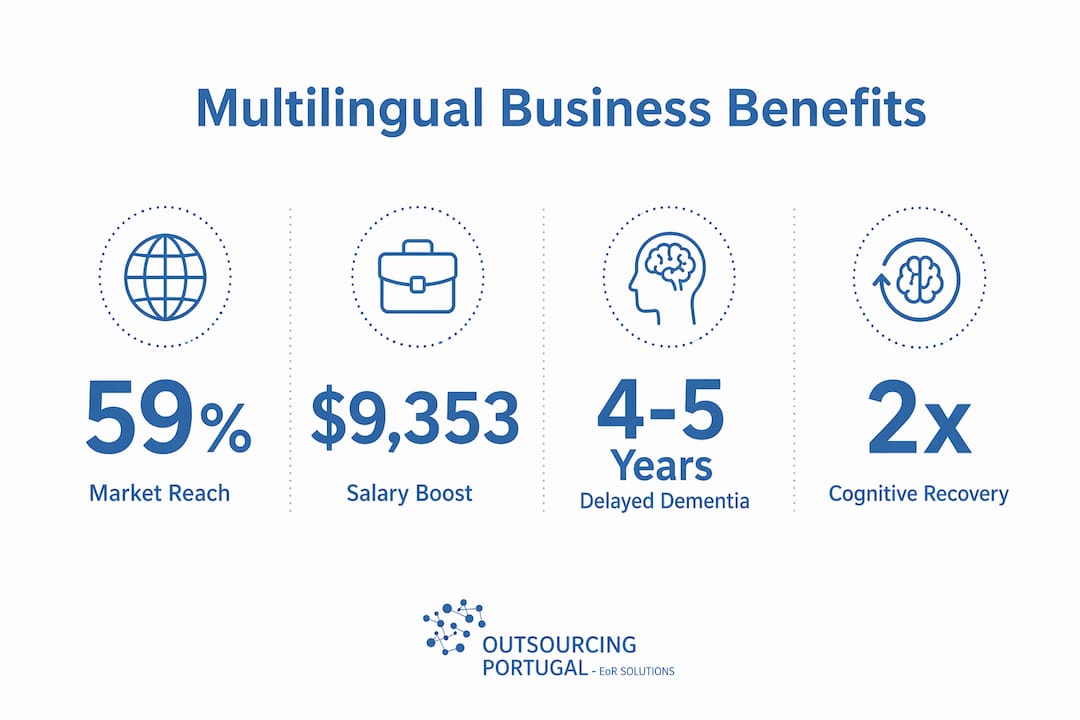
The European Commission recognizes multilingualism as one of eight key competences for lifelong learning. 59% of Europeans speak at least one foreign language, and the EU treats this as a baseline workforce competence for economic competitiveness. For business leaders hiring across borders, that statistic sets the standard your teams need to meet.
The value of bilingual skills also shows up in salary data. Bilingual workers earn an average of $9,353 more per year than monolingual peers. That is a 14.3% salary premium that reflects real market demand for professionals who can operate across languages and cultures.
What cognitive and health benefits do multilingual skills provide?
Bilingual individuals develop dementia symptoms 4–5 years later than monolinguals and recover cognitive abilities twice as often after a stroke. Those are not marginal gains. They represent a fundamentally different cognitive trajectory for people who regularly use more than one language.
The mechanism behind these benefits is the constant mental exercise of managing two language systems. Multilingual professionals build stronger executive functions, including working memory, attention switching, and mental flexibility. These are the same skills that make someone effective in high-pressure negotiations, complex project management, and rapid decision-making.
The cognitive benefits of multilingualism depend on three specific factors:
- Proficiency: Higher language proficiency produces stronger cognitive effects than surface-level familiarity.
- Frequency of use: Active daily use of a second language drives the brain-training effect. Passive exposure does not.
- Grammatical complexity: Languages with more complex grammar structures produce greater cognitive demands and, in turn, greater mental agility gains.
This dose-dependent relationship means the more you use a language, the more your brain benefits. Even short, intensive practice sessions of five or more hours per week can yield measurable cognitive improvements when the language is used regularly in real contexts.
Pro Tip: Schedule at least two live conversations per week in your second language. Reading and listening alone do not activate the executive function benefits that come from real-time language switching.
For business leaders, this has a direct workforce implication. Teams that include multilingual professionals are not just culturally diverse. They tend to think faster, adapt better, and perform more consistently under pressure. The multilingual workforce benefits for HR leaders go far beyond filling language gaps on a call center floor.
How do multilingual skills enhance global business communication?
UN Secretary-General António Guterres calls multilingualism a core value for global communication. The UN’s position is that multilingualism produces greater effectiveness and improved outcomes in international projects by creating harmonious communication across cultures. That is not a soft claim. It is an institutional finding backed by decades of multilateral diplomacy.
In business, the same principle applies at every level of collaboration. Here is how multilingual skills improve international teamwork in practice:
- Trust building: Even basic attempts at a client’s local language signal respect. Experts confirm that local language greetings break down cultural barriers and open negotiations that would otherwise stall.
- Reduced misunderstanding: Multilingual team members catch cultural subtext that translation tools miss entirely. A phrase that reads as polite in English can read as dismissive in Japanese or Portuguese.
- Faster decision cycles: Teams that share a working language move through approvals, feedback, and revisions faster than teams relying on intermediaries or software translation.
- Stronger client relationships: Clients who feel understood in their own language stay longer and refer more. Language competence is a retention tool, not just an onboarding one.
- Better conflict resolution: Cross-cultural misunderstandings are a primary driver of project failure. Multilingual professionals identify and address those misunderstandings before they escalate.
“Language learning is a slow, relational skill critical for trust and cultural protocol that AI translation cannot replace.” — UNESCO Courier
That UNESCO observation cuts to the heart of why studying languages still matters in an era of machine translation. Tools like Google Translate and DeepL handle transactional text. They cannot read the room, adjust tone for cultural context, or build the relational trust that closes a deal. Human language competence does all three.
For leaders managing multicultural teams in Portugal or across European markets, this distinction is critical. Multilingual team members are your cultural interpreters, not just your language conduits.
What career and business advantages come from bilingual competence?
Multilingual competence is a critical hiring criterion in professional services, finance, technology, and consulting. Employers treat it as a cultural asset that signals adaptability, global awareness, and the ability to work across organizational boundaries.
| Factor | Monolingual workforce | Multilingual workforce |
|---|---|---|
| Salary competitiveness | Market baseline | Up to 14.3% salary premium |
| Client market reach | Domestic or English-only | Multi-market and multi-region |
| Cultural trust with clients | Limited without local knowledge | High, built through language and context |
| Hiring attractiveness | Standard candidate pool | Broader, more competitive talent pool |
| Cognitive performance | Standard executive function | Enhanced memory, attention, and flexibility |
The business case for multilingual hiring is not abstract. Companies that source multilingual talent for international growth reduce their reliance on external translation services, shorten sales cycles in new markets, and build client relationships that survive leadership changes.
Key advantages for organizations that prioritize multilingual hiring:
- Access to markets where English-only teams cannot operate effectively
- Reduced friction in cross-border compliance and regulatory communication
- Higher employee retention among international hires who feel culturally supported
- Stronger brand perception in non-English-speaking markets
The EU’s recognition of multilingualism as a core workforce competence reflects what business leaders already know. Language skills are not a bonus. They are a baseline requirement for competing globally.
What are the challenges of developing multilingual skills effectively?
Language acquisition is not a linear process, and the research on early exposure reveals important trade-offs. Early language exposure confers metalinguistic awareness and executive function advantages, but it can cause temporary vocabulary deficits in both languages if the learning environment does not provide strong support in each one. This means the quality of language input matters as much as the quantity.
For adult professionals, the challenges are different but equally real. Vocabulary acquisition in a second language is slower than in a first language. Pronunciation habits from the native language create interference. And professional contexts demand precision that casual language learning does not build.
Practical strategies that work for professionals:
- Use additive approaches: Add a new language without reducing investment in your primary language. Subtractive approaches, where the first language weakens as the second grows, reduce overall communication effectiveness.
- Prioritize professional vocabulary: General language courses build conversational fluency. Sector-specific vocabulary in finance, law, or technology requires targeted practice with industry materials.
- Engage native speakers regularly: Structured conversation with native speakers accelerates pragmatic competence, the ability to say the right thing in the right way for a given cultural context.
- Measure frequency, not just hours: Five hours of active conversation per week produces stronger results than ten hours of passive listening.
Pro Tip: Pair language learning with your actual work. Attend a client call in the target language, even if you only contribute one or two sentences. Real professional contexts build competence faster than classroom simulations.
The cognitive benefits of multilingualism depend on active usage, proficiency, and grammatical complexity. That means a professional who uses a second language daily in client meetings gains far more than one who studied it for three years and rarely speaks it now.
Key Takeaways
Multilingual skills deliver measurable advantages in cognitive health, business communication, and career earnings, making them a non-negotiable competence for professionals competing in global markets.
| Point | Details |
|---|---|
| Cognitive health advantage | Bilingual professionals develop dementia symptoms 4–5 years later and recover from strokes twice as often as monolinguals. |
| Salary premium | Bilingual workers earn an average of $9,353 more per year, a 14.3% increase over monolingual peers. |
| AI cannot replace human language | Machine translation handles text but cannot build the relational trust or cultural nuance that closes deals. |
| Frequency drives benefit | Active daily use of a second language, not passive exposure, produces the cognitive and professional gains. |
| EU baseline standard | The European Commission classifies multilingualism as one of eight core competences for workforce competitiveness. |
The uncomfortable truth about language skills in global business
Most business leaders I speak with treat multilingualism as a nice-to-have. They assume English covers the gap, and that translation tools handle the rest. That assumption costs them deals they never know they lost.
The research is unambiguous. Language competence is relational, not transactional. When a client in Lisbon, Tokyo, or São Paulo hears you attempt their language, even imperfectly, the dynamic shifts. You are no longer a vendor. You become a partner. That shift does not happen through a translation app.
What I find most underappreciated is the cognitive argument. A multilingual team is not just more culturally aware. It is measurably sharper. The executive function gains from regular language switching show up in problem-solving speed, attention management, and adaptability under pressure. These are exactly the qualities that separate high-performing international teams from average ones.
The professionals who invest in language learning now are building a compounding advantage. The salary premium, the client trust, the cognitive edge. These do not plateau. They grow with use. The leaders who recognize that early will build teams that outperform for years.
— Paulo
Portugal’s multilingual talent gives your business a real edge
International companies that need multilingual professionals without the complexity of setting up a local entity have a clear option. Portugal’s workforce ranks among the most multilingual in Europe, with strong proficiency in English, Spanish, French, and German across technology, finance, and customer service sectors.
Outsourcing-portugal provides Employer of Record and payroll services that let you hire compliant, multilingual talent in Portugal without establishing a local entity. From onboarding to payroll compliance, the full employment infrastructure is handled. You get access to a globally competitive workforce with the language skills your international clients expect, and the legal compliance your operations require. Contact Outsourcing-portugal to build your multilingual team in Portugal.
FAQ
What is the main benefit of multilingual skills in business?
Multilingual skills build client trust, reduce communication errors, and open access to markets where English-only teams cannot operate. Bilingual workers also earn an average of $9,353 more per year than monolingual peers.
Can AI translation replace human multilingual skills?
AI translation handles routine text but cannot replicate the relational trust, cultural nuance, or real-time judgment that human language competence provides in high-stakes negotiations and client relationships.
How many languages do you need to speak to gain cognitive benefits?
Speaking even one additional language actively and regularly produces measurable cognitive benefits. The gains depend on proficiency, frequency of use, and grammatical complexity rather than the number of languages spoken.
Why do employers pay more for bilingual professionals?
Employers pay a premium because multilingual professionals expand market reach, reduce reliance on external translation services, and build stronger client relationships in non-English-speaking markets.
How does Portugal’s workforce support multilingual business needs?
Portugal’s workforce is among the most multilingual in the EU, with high proficiency in English, Spanish, French, and German. This makes Portugal a practical nearshore location for companies building international customer-facing or technical teams.