

TL;DR:
- Payroll and human resources are distinct but interconnected functions essential for workforce management and compliance across borders. Automation and integrated systems improve accuracy, reduce errors, and turn payroll data into strategic insights for multinational companies. Proper ownership of compliance deadlines and thorough testing during system changes help prevent costly penalties and mistakes.
Payroll and human resources are defined as two distinct but deeply connected functions that together determine whether a workforce runs smoothly or breaks down. Payroll covers wage calculation, tax withholdings, and payment processing. Human resources manages employee relations, benefits, onboarding, and the data that feeds payroll accuracy. For HR professionals and business leaders in multinational companies, getting both functions right is not optional. Errors in either create compliance failures, employee dissatisfaction, and financial penalties that compound quickly across borders.
How payroll and human resources work together across borders
The operational link between HR and payroll is direct. HR collects and maintains the employee data that payroll depends on: hours worked, job roles, tax status, salary changes, and bank details. Payroll accuracy depends on that data being current and complete at every pay cycle. When HR updates a salary change or a new hire’s tax classification, payroll must reflect it immediately. Any gap between the two creates errors that are expensive to fix and difficult to explain to regulators.

Multinational companies face a harder version of this challenge. Each country has its own tax codes, social security rules, labor law requirements, and reporting deadlines. A company running payroll across Portugal, Germany, and the Netherlands cannot apply a single ruleset. HR teams must track jurisdiction-specific compliance requirements, and payroll systems must apply them correctly for each employee. Integrated HR and payroll systems improve visibility and reduce the risk of applying the wrong rules to the wrong workforce segment.
Shared platforms that connect HR data directly to payroll processing eliminate the manual handoffs where errors occur. When an employee’s benefits election changes in the HR system, the payroll deduction updates automatically. That kind of real-time synchronization is the difference between a payroll team that spends its time on exceptions and one that spends it on strategy.
Key areas where HR and payroll collaboration matters most:
- Employee onboarding: New hire data must flow from HR to payroll before the first pay cycle.
- Benefits administration: Deductions for health insurance, retirement plans, and other benefits require accurate HR records.
- Tax status changes: Life events like marriage or relocation change withholding requirements immediately.
- Terminations: Final pay calculations depend on HR confirming the last day worked and any accrued leave balances.
- Salary reviews: Compensation changes must sync to payroll before the next processing run.
Pro Tip: When switching to a new payroll system, run a parallel payroll cycle for one to two pay periods. Process payroll on both the old and new systems simultaneously and compare outputs before cutting over. This catches configuration errors before they affect employee paychecks.
What are the best practices for integrated HR payroll management?
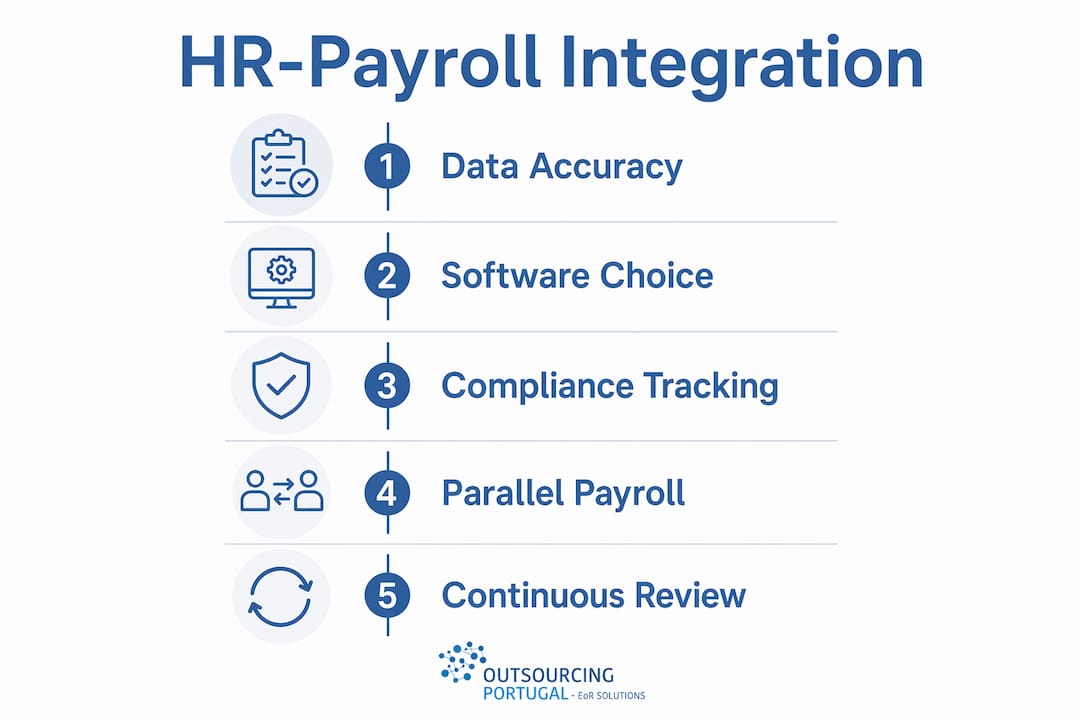
The most effective approach to HR payroll management combines purpose-built software with disciplined data governance. All-in-one platforms that handle attendance tracking, tax calculation, payslip distribution, and compliance reporting reduce the number of systems HR teams must maintain. Payroll management systems automate calculations, tax deductions, and payslip generation, which cuts manual effort and reduces the error rate that comes with spreadsheet-based processing.
Choosing the right software for your team
Human resources software for multinational companies must handle multi-currency payroll, multi-jurisdiction tax rules, and varying employment contract types within one platform. Entry-level platforms work well for single-country operations with straightforward pay structures. Enterprise platforms are built for complexity: multiple legal entities, country-specific compliance modules, and consolidated reporting across regions.
Payroll software pricing typically starts at around $49 per month plus $6 per employee, with optional HR and compliance modules adding to that base cost. Enterprise services require custom quotes based on employee count, countries covered, and the compliance features needed. That pricing structure means costs scale with headcount, so multinational teams should model total cost across all jurisdictions before committing to a platform.
Key features to evaluate in any payroll processing solution:
- Attendance and time integration: Automatic import of hours worked prevents manual data entry errors.
- Tax calculation engine: Must handle country-specific rates, brackets, and filing requirements.
- Payslip distribution: Secure digital delivery with employee access to historical records.
- Audit trail: Every change to payroll data should be logged with a timestamp and user ID.
- Compliance updates: The platform should push regulatory changes automatically, not require manual configuration.
Pro Tip: Before signing a contract with any HR and payroll platform, ask the vendor to demonstrate how it handles a mid-year tax rate change in each country you operate in. Vendors who cannot show this live are likely relying on manual workarounds.
Workforce analytics as a payroll tool
Linking payroll with HR data provides strategic insights on turnover, compensation equity, and workforce costs that neither system can generate alone. When payroll data feeds into HR analytics, business leaders can see the true cost of a department, model the impact of a pay raise, or identify flight risk patterns before they become attrition problems. This is where payroll stops being a back-office function and becomes a planning tool.
What compliance risks affect payroll and HR in multinational companies?
Compliance is the highest-stakes area where payroll and HR intersect. Tax authorities, labor regulators, and social security agencies in each country expect accurate, timely filings. A single missed deadline or miscalculated withholding can trigger audits, penalties, and reputational damage. The risk multiplies when a company operates across multiple jurisdictions with different filing calendars and regulatory bodies.
The most common compliance failures in multinational payroll follow a predictable pattern:
- Stale employee data: HR fails to update a salary change or tax status before payroll runs, creating an underpayment or overpayment that triggers a correction cycle.
- Missed regulatory updates: A country changes its social security contribution rate and the payroll system does not apply the new rate in time.
- Incorrect worker classification: Contractors treated as employees, or vice versa, create tax liability and labor law exposure simultaneously.
- Incomplete audit trails: Regulators request documentation of a payroll decision and the company cannot produce a clear record.
- Late filings: Multi-country payroll teams miss a local filing deadline because no one owns the compliance calendar for that jurisdiction.
Automated reporting and built-in audit trails address most of these risks directly. A workforce compliance workflow that assigns clear ownership for each jurisdiction’s filing calendar prevents the “no one knew” failures that regulators find most damning. Regular payroll audits, conducted quarterly rather than annually, catch discrepancies before they accumulate into material errors.
Pro Tip: Build a compliance calendar that lists every payroll-related filing deadline for each country you operate in. Assign a named owner for each deadline and set automated reminders 10 business days in advance. This single practice eliminates the majority of late-filing penalties.
How do you manage payroll for remote and flexible workforces?
Remote and flexible workforces create payroll complexity that traditional systems were not built to handle. A contractor in Lisbon, a part-time employee in Porto, and a full-time remote worker in Braga may all work for the same company under different employment contracts, different tax treatments, and different benefit entitlements. Managing payroll for flexible workforces requires a system that handles diverse employment types and locations within one platform, not a patchwork of separate tools.
HR’s role in this environment extends beyond administration. HR teams must onboard decentralized employees consistently, maintain accurate records for workers they may never meet in person, and ensure that each worker’s employment type is correctly classified before payroll runs. Misclassification is the most expensive mistake in flexible workforce management, and it almost always starts with an HR data error rather than a payroll calculation error.
Employee self-service portals reduce the administrative burden on both sides. Modern payroll software gives employees secure access to their payslips, tax documents, and personal data, which they can update directly. That self-service layer cuts the volume of routine HR requests and keeps employee records current without requiring HR to chase down every address change or bank account update.
For companies hiring in Portugal specifically, the country’s employment framework covers contractors, part-time workers, and full-time employees under distinct legal regimes. Each type carries different social security contribution rates, notice period requirements, and termination rules. A payroll compliance checklist tailored to Portugal’s regulatory environment helps HR teams apply the right rules to each worker type without relying on institutional memory.
Additional considerations for flexible workforce payroll:
- Overtime rules: Part-time workers may have different overtime thresholds than full-time employees under local labor law.
- Benefits proration: Part-time employees often receive prorated benefits, which must be calculated and deducted accurately.
- Contractor invoicing: Contractors submit invoices rather than receiving payroll, but their payments still require tax reporting in most jurisdictions.
- Cross-border remote workers: An employee working remotely from a different country than their employment contract may create a tax residency issue that HR and payroll must resolve together.
For teams that want to explore flexible payroll arrangements, payrolling via NOWJOBS offers an example of how specialized partner services can handle the complexity of varied employment types within a single managed solution.
Key Takeaways
Integrated payroll and HR management is the single most effective way for multinational companies to reduce compliance risk, improve data accuracy, and turn workforce costs into a planning tool.
| Point | Details |
|---|---|
| HR data drives payroll accuracy | Salary, tax status, and job role data must be current in HR before every payroll run. |
| Parallel runs prevent launch errors | Running old and new payroll systems simultaneously for 1–2 cycles catches errors before they affect employees. |
| Compliance requires jurisdiction ownership | Assign a named owner for every country’s filing deadlines to prevent missed submissions. |
| Flexible workforces need unified platforms | Contractors, part-time, and remote workers require a single system that applies the correct rules to each employment type. |
| Analytics connect payroll to strategy | Linking payroll data to HR analytics reveals turnover costs, compensation gaps, and workforce planning opportunities. |
Why I think most companies underinvest in the HR-payroll connection
The companies I see struggle most with payroll are not the ones using bad software. They are the ones treating payroll and HR as separate departments that hand off a spreadsheet once a month. That model works until it does not, and when it fails, it fails expensively.
The shift I have watched over the past several years is the convergence of HR and payroll into unified platforms that make workforce data a shared resource rather than a departmental asset. Unified platforms transform payroll from a transactional task into a strategic HR tool. That is not marketing language. It describes a real operational change where compensation decisions, headcount planning, and compliance management all draw from the same data source.
What I tell business leaders who ask about choosing a solution: do not evaluate payroll software and HR software separately. Evaluate them as one system. The integration cost you save upfront by buying two cheaper tools will be paid back many times over in manual reconciliation, compliance errors, and the staff time spent keeping two systems in sync. Portugal’s regulatory environment, in particular, rewards companies that invest in proper integration early. The HR best practices framework for the Portuguese market is detailed enough that a disconnected system will miss something material within the first year.
The companies that get this right treat payroll accuracy as an HR responsibility, not just a finance one. When HR owns the quality of the data that feeds payroll, the whole system becomes more reliable.
— Paulo
How Outsourcing-portugal supports global payroll and HR teams
Outsourcing-portugal provides end-to-end payroll and HR outsourcing services for international companies hiring in Portugal, without requiring them to set up a local legal entity.
The service covers payroll processing, tax compliance, employee onboarding, and HR administration under Portugal’s employment law framework. For multinational companies managing flexible workforces across multiple countries, that means one less jurisdiction to manage internally. Outsourcing-portugal’s Employer of Record model handles the legal employer relationship, social security contributions, and filing obligations directly. Companies retain operational control of their teams while the compliance burden transfers to specialists who work within Portuguese labor law every day. Explore the best employment outsourcing services available for multinational teams in Portugal, or review the full Employer of Record services for payroll and compliance support.
FAQ
What is the difference between payroll and human resources?
Payroll covers wage calculation, tax withholdings, and payment processing. Human resources manages employee relations, benefits, and the data that payroll depends on for accuracy.
How does HR data affect payroll accuracy?
Payroll accuracy depends on current HR records for salary, tax status, job role, and bank details. Outdated HR data is the leading cause of payroll errors in multinational companies.
What features should payroll software include for multinational teams?
Multinational payroll software must handle multi-jurisdiction tax rules, multi-currency processing, contractor and part-time worker classifications, and automated compliance updates for each country of operation.
How do you stay compliant with payroll regulations across multiple countries?
Assign a named owner for each country’s filing deadlines, use a platform with automated regulatory updates, and conduct quarterly payroll audits to catch discrepancies before they become material errors.
What is a parallel payroll run and why does it matter?
A parallel payroll run processes payroll on both the old and new systems simultaneously for one to two cycles. It verifies that the new system produces correct outputs before the old system is decommissioned.