

TL;DR:
- Portuguese employers must maintain comprehensive payroll records, including contracts, payslips, and filings, for at least five years. Accurate monthly filings, timely new-hire notifications, and reconciliation of reports are essential to avoid penalties and audits. Outsourcing payroll documentation to specialists ensures compliance and reduces legal risks in Portugal.
Payroll documents are defined as the complete set of legally required records, forms, and filings that employers must maintain to prove accurate compensation, tax compliance, and labor law adherence in Portugal. These records span employment contracts, monthly payslips, tax declarations submitted to the Autoridade Tributária e Aduaneira (AT), and remuneration statements filed with Segurança Social. The Autoridade para as Condições do Trabalho (ACT) can inspect these records at any time, and the burden of proof always falls on the employer. Getting this right is not optional. Missing or incomplete payroll records expose companies to fines, audits, and contract nullification under Portuguese labor law.
What are the key types of payroll documents required in Portugal?
Portugal requires employers to maintain several distinct categories of employee payroll forms. Each category serves a specific legal purpose, and none can substitute for another.

Employment contracts and admission records
Every new hire requires a signed employment contract, a copy of the employee’s tax identification number (NIF), and their Social Security number (NISS). These admission documents form the legal foundation of the employment relationship. Without them, the ACT can declare the contract invalid during an inspection.
Monthly payslips
Employers must issue a detailed payslip to every employee each month. The payslip must show gross salary, IRS withholding, Social Security contributions, any other deductions, and net pay. Portuguese payroll runs on 14 salary payments per year, covering the standard 12 months plus holiday and Christmas allowances. That structure affects how monthly deductions are calculated and must be reflected accurately in each payslip.
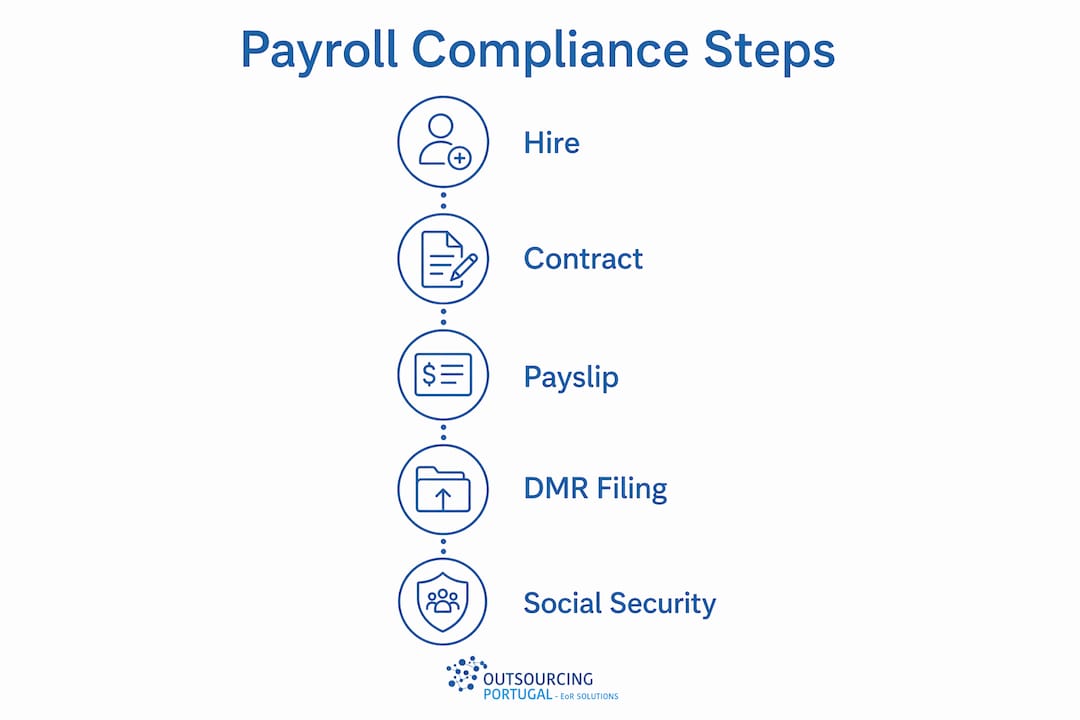
Monthly tax and Social Security filings
Two separate monthly filings are required: the DMR (Declaração Mensal de Remunerações) submitted to the AT, and a remuneration statement submitted to Segurança Social. Both must match the payroll run exactly. A mismatch between these two filings is one of the most common triggers for a tax authority audit.
New-hire and termination communications
New-hire communication to Social Security must be submitted electronically up to 24 hours before the employee’s first day. Termination events carry their own documentation requirements, including formal notices and final settlement calculations.
Time-tracking records
Portuguese law requires employers to maintain electronic or physical logs of every employee’s working hours, including start time, end time, and breaks. These records must be accessible to employees and inspectors at all times. They support both labor rights enforcement and contract compliance verification during ACT inspections.
What are the legal retention and filing deadlines for payroll documents in Portugal?
Deadlines in Portuguese payroll are tight and non-negotiable. Missing them triggers automatic penalties, not just warnings.
-
Retain all core records for at least 5 years. Portuguese labor law requires employers to keep employment and payroll records for a minimum of five years. This covers contracts, payslips, time-tracking logs, and all payroll calculations. ACT inspectors can request any of these documents during that window.
-
Submit monthly filings by the 10th. The DMR and the Social Security remuneration statement are both due by the 10th of the month following the payroll period. Missing this date puts the employer immediately out of compliance.
-
Make payments by the 20th and 25th. IRS withholding payments to the AT are due by the 20th of the following month. Social Security contributions are due by the 25th. These are separate deadlines from the filing deadlines above.
-
Communicate new hires within 24 hours. Failing this deadline leads to heavy fines and can jeopardize the legal validity of the employment contract itself.
-
Submit the Relatório Único between march and april. This annual report captures comprehensive social and payroll data. Missing the Relatório Único deadline risks fines and triggers increased ACT inspections. Many employers treat it as a low-priority annual task. That is a costly mistake.
Compliance callout: The combination of monthly DMR filings, Social Security statements, and the annual Relatório Único means Portuguese employers face a continuous documentation cycle with no quiet periods. Plan your HR calendar around these fixed deadlines from day one.
How to organize and manage payroll documents effectively
Effective payroll documentation management is a system, not a task. The employers who avoid audits are the ones who build repeatable processes, not the ones who scramble before each deadline.
Build a payroll documentation checklist for every employment event. A structured payroll compliance checklist covers hiring, salary changes, and terminations. Each event triggers a specific set of documents that must be created, filed, and retained. Without a checklist, steps get skipped.
- Reconcile DMR and Social Security data before submission every month. Mismatches between these two filings are a leading cause of tax authority queries. Run a side-by-side comparison of both reports before hitting submit.
- Store documents in a secure, access-controlled system. Payroll records contain sensitive personal data governed by GDPR. Restrict access to authorized HR and finance personnel only.
- Use dedicated payroll software or an outsourced provider to automate calculations and filing reminders. Manual spreadsheets introduce calculation errors that compound over time.
- Conduct internal audits quarterly. Do not wait for an ACT inspection to discover a gap in your time-tracking logs or a missing payslip from eight months ago.
- Keep physical backups of critical documents even when using digital systems. Portuguese law accepts both formats, but a system failure is not a valid excuse for missing records.
Pro Tip: Set calendar alerts for the 8th of each month as your internal DMR and Social Security reconciliation deadline. That gives you two days to fix errors before the official 10th filing cutoff.
International companies using payroll services in Portugal through an Employer of Record model shift the documentation burden to a specialist provider. That approach eliminates the risk of missing local filing nuances that are easy to overlook from abroad.
Common payroll document challenges and how to avoid compliance risks
The most expensive payroll mistakes in Portugal are not calculation errors. They are documentation failures that leave employers unable to prove compliance when inspectors arrive.
- DMR and Social Security mismatches. Reconciling these two filings manually before submission is the single most effective step to avoid audit triggers. Many employers assume the two systems sync automatically. They do not.
- Late or missing new-hire communications. Submitting the Social Security notification after the employee’s start date is one of the most common and most penalized errors. Build this step into your onboarding workflow, not as an afterthought.
- Incomplete time-tracking records. The ACT treats missing or incomplete working-hour logs as evidence of non-compliance. Employers who cannot produce five years of time records face both fines and potential contract disputes.
- Overlooking the Relatório Único. This annual filing is often treated as a back-office formality. The Relatório Único is a key compliance document that feeds directly into social inspections. Missing it signals to authorities that your payroll documentation practices are weak.
- Insufficient proof of the labor relationship. The burden of proof lies with the employer when the ACT questions whether a valid employment contract exists. If you cannot produce the contract, payslips, and Social Security records, the ACT can declare the relationship undeclared work.
Pro Tip: Treat every employment event as a documentation trigger. Hire, promote, change hours, or terminate? Open your checklist and complete every required filing before the employee’s status changes in your system.
Outsourcing payroll to a provider with deep knowledge of Portuguese requirements eliminates most of these risks. Specialists who handle legal compliance in Portugal daily know where the gaps appear and how to close them before they become penalties. For companies unfamiliar with the Portuguese system, that expertise is worth more than any software tool.
Key Takeaways
Proper payroll documentation in Portugal requires a continuous, structured approach covering monthly filings, five-year record retention, and synchronized submissions to both the AT and Segurança Social.
| Point | Details |
|---|---|
| Two monthly filings required | Submit the DMR to the AT and a remuneration statement to Social Security by the 10th each month. |
| Five-year retention minimum | Keep all contracts, payslips, and time-tracking logs for at least five years to satisfy ACT inspections. |
| New-hire deadline is 24 hours | Notify Social Security electronically before the employee’s first day or risk fines and contract nullification. |
| Reconcile before submitting | Compare DMR and Social Security data manually each month to prevent audit-triggering mismatches. |
| Relatório Único is mandatory | File this annual labor and payroll report between march and april to avoid fines and increased inspections. |
Why payroll documentation is a risk management tool, not a paperwork exercise
I have seen international companies enter Portugal with solid HR intentions and still get caught off guard by the documentation cycle here. The dual filing requirement, where you submit separate monthly reports to two different authorities that must match exactly, is not intuitive. Most payroll systems outside Portugal do not work that way.
What surprises employers most is how quickly a documentation gap becomes a legal liability. The ACT does not give warnings for missing time-tracking records or late new-hire notifications. The fine arrives, and then the audit follows. I have watched companies spend more on penalties and legal fees in a single quarter than they would have spent on a full year of professional payroll support.
The other thing I would push back on is the assumption that digital payroll tools solve the compliance problem automatically. They help with calculations and reminders, but the reconciliation between DMR and Social Security data still requires a human check. No software I have seen flags every mismatch before submission. That manual step is non-negotiable.
Employers who treat their payroll solutions for compliance as a strategic investment, rather than a cost center, consistently avoid the audit cycles that drain time and money from growing teams. Portugal rewards employers who get the paperwork right. The system is transparent, but it is unforgiving when you cut corners.
— Paulo
Payroll documentation support from Outsourcing-portugal
Managing Portuguese payroll documentation from outside the country adds a layer of complexity that most international HR teams underestimate.
Outsourcing-portugal handles the full documentation cycle for employers operating in Portugal, from new-hire Social Security notifications and monthly DMR filings to payslip generation, time-record management, and annual Relatório Único submissions. The team reconciles AT and Social Security data before every submission, eliminating the mismatch risk that triggers audits. For companies that want audit-ready records without building an in-house Portuguese payroll function, the best employment outsourcing services available through Outsourcing-portugal provide a direct path to full compliance. You can also explore the full range of payroll and employment services to find the right fit for your team size and structure.
FAQ
What payroll documents are legally required in Portugal?
Portuguese employers must maintain employment contracts, monthly payslips, DMR filings to the AT, Social Security remuneration statements, time-tracking records, new-hire notifications, and the annual Relatório Único. All records must be retained for at least five years.
When are monthly payroll filings due in Portugal?
The DMR and Social Security remuneration statement are both due by the 10th of the following month. IRS withholding payments are due by the 20th, and Social Security contributions are due by the 25th.
How long must employers keep payroll records in Portugal?
Portuguese labor law requires employers to retain all core employment and payroll records, including contracts, payslips, and time-tracking logs, for a minimum of five years.
What happens if a new-hire notification is submitted late?
Late submission of the Social Security new-hire communication results in heavy fines and can jeopardize the legal validity of the employment contract, with the ACT potentially classifying the work as undeclared.
What is the Relatório Único and when is it due?
The Relatório Único is an annual report capturing comprehensive payroll and labor data submitted to Portuguese authorities, typically between march and april. Missing the deadline triggers fines and increases the likelihood of ACT inspections.