

TL;DR:
- Payroll software effectively manages U.S. tax workflows but lacks the capacity to ensure compliance when hiring employees in Portugal. Successfully hiring in Portugal requires local employer registration, social security contribution remittance, and statutory filings that U.S.-based software does not support, making a local payroll partner or Employer of Record essential. Outsourcing-portugal offers comprehensive payroll and compliance services that cover all Portuguese legal obligations, eliminating the need for a local entity or separate vendors.
Payroll software handles U.S. federal and state tax workflows well, but it does not, by itself, guarantee full payroll tax compliance when you hire employees in Portugal. The IRS penalty schedule for late federal deposits is tiered: 2% for deposits 1–5 days late, 5% for 6–15 days late, and 10% for deposits 16 or more days overdue, with continuing penalties and interest for prolonged noncompliance. Portugal’s tax authority (Autoridade Tributária e Aduaneira) and social security system (Segurança Social) carry their own penalty structures that U.S.-built software simply was not designed to navigate. Your immediate next step: either pair your existing payroll platform with a vetted local payroll partner who understands Portuguese withholding, social security contributions, and statutory reporting, or engage an Employer of Record (EOR) like Outsourcing-portugal to assume full legal employer responsibilities from day one.
Table of Contents
- What does payroll software actually automate for taxes?
- Why payroll software falls short for cross-border Portugal hires
- Software + local partner, or EOR? How to decide
- Payroll tax compliance checklist for U.S. companies hiring in Portugal
- What to budget for Portugal payroll setup
- Outsourcing-portugal closes the payroll tax gap for U.S. companies
- Key Takeaways
- Why the software-first instinct often costs more than it saves
- Useful sources and further reading
What does payroll software actually automate for taxes?
Most payroll platforms built for the U.S. market cover a solid range of tax tasks automatically. OnPay describes the standard feature set well: federal income tax withholding, FICA (Social Security and Medicare), FUTA and SUTA, applicable local taxes, deposit scheduling, and automatic tax-table updates as regulations change. Platforms like Gusto, Paycor, and QuickBooks extend that with e-filing of W-2s, 1099-NECs, Form 940, and Form 941 directly through IRS-authorized e-file channels.
The core value proposition is removing the manual calculation burden. As CPA Logan Allec put it in Inc., the best payroll systems deliver “peace of mind and scalability” by letting teams focus on operations rather than tax minutiae. Paycor adds proactive compliance alerts that flag missing or invalid tax IDs before they become filing problems.
The automation covers a lot of ground, but it is scoped to the jurisdictions the software was built for.
- Federal income tax withholding (W-4 based)
- Social Security and Medicare (FICA) at statutory rates
- Federal unemployment (FUTA) and state unemployment (SUTA)
- Local/city tax calculations where the platform supports them
- Deposit scheduling aligned to IRS semi-weekly or monthly rules
- Automated tax-table updates when rates or brackets change
- Year-end W-2 and 1099 generation and e-filing
Pro Tip: Automated tax-table updates still need a human review when employees work across multiple states, receive equity compensation, or have unusual deferred-compensation arrangements. Software updates the tables; it does not always know which table applies to a given employee’s specific situation.
Why payroll software falls short for cross-border Portugal hires
The compliance gap is jurisdictional. Payroll software built around U.S. tax flows does not natively handle Portuguese employer registration with the Segurança Social, the correct withholding codes under the Portuguese IRS (AT) tables, or the monthly DMR (Declaração Mensal de Remunerações) filing that Portuguese law requires.
The specific gaps that matter for Portugal hires include:
Employer registration. Before you can run a single payroll in Portugal, you need a Portuguese tax identification number (NIF) and registration with Segurança Social as an employer. U.S. payroll software has no mechanism to initiate or validate that registration.
Social security contributions. The Portuguese employer social security contribution rate is a significant portion of gross salary, with employees contributing an additional share as well. U.S. platforms do not calculate or remit these amounts.

Withholding tables. Portuguese income tax withholding uses AT-published tables that vary by marital status, number of dependents, and whether the employee is a tax resident. A U.S. platform applying W-4 logic to a Lisbon-based employee will produce the wrong number every month.
Residency and treaty nuances. An employee’s tax residency status in Portugal determines which withholding rates apply and whether any U.S.-Portugal tax treaty provisions are relevant. Software alone cannot validate residency status or apply treaty exemptions correctly.
Missing any of these creates real financial exposure. QuickBooks offers tax penalty protection for errors made during payroll processing, but that coverage applies to vendor processing errors, not to the legal employer exposure that comes from incorrect employer status or missing registrations in Portugal.
Software + local partner, or EOR? How to decide
The right answer depends on four variables: how many people you are hiring, how long they will stay, how complex their benefits are, and how much legal risk your company can absorb.
- Number of hires. For a small number of short-term contractors, a U.S. payroll platform plus a Portuguese payroll firm handling local filings is often workable. When scaling to multiple permanent employees, the administrative overhead and compliance surface area typically justify a fully managed EOR.
- Employment duration. Short-term project work (under six months) may not require full employer registration if structured correctly. Permanent hires almost always do.
- Benefits and collective bargaining. Portugal has sector-specific collective bargaining agreements (CCTs) that govern minimum wages, overtime, and leave. An EOR already knows which CCT applies; a software-only setup does not.
- Legal risk tolerance. Misclassifying a Portuguese worker or failing to register as an employer exposes your company to back taxes, penalties, and potential labor claims under Portuguese law.
| Approach | Best for | Tax compliance coverage | Setup complexity |
|---|---|---|---|
| Software only | U.S. employees, no Portugal hires | Full (U.S.) | Low |
| Software + local payroll firm | 1–4 Portugal hires, stable setup | Partial (needs local partner for PT filings) | Medium |
| Fully managed EOR | Any Portugal hire, fast onboarding | Full (PT + U.S. reporting) | Low |
Pro Tip: When evaluating a local payroll partner or EOR for Portugal, confirm they can provide: proof of Segurança Social registration, a sample DMR filing, references from other international clients, and a clear SLA for payroll cut-off dates. These four items separate credible providers from those who will leave you exposed.
For a deeper look at payroll outsourcing models and how to evaluate them, Outsourcing-portugal’s international payroll guide covers the tradeoffs in detail. Understanding how timekeeping integrates with payroll is also worth reviewing before you finalize any provider setup.
Payroll tax compliance checklist for U.S. companies hiring in Portugal
Use this checklist to identify gaps before you run your first Portuguese payroll. Items marked “software” can be partially handled by your platform; items marked “local action” require a Portuguese payroll partner or EOR.
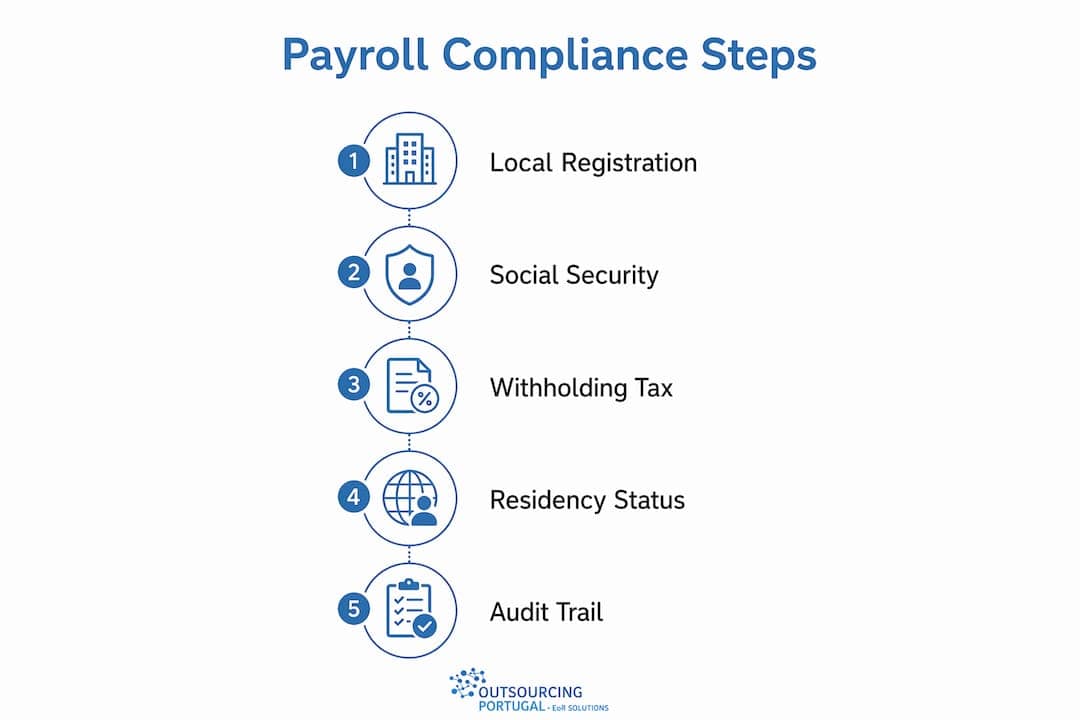
| Compliance item | Who handles it | Notes |
|---|---|---|
| Portuguese NIF (tax ID) for employer | Local action | Required before any registration |
| Segurança Social employer registration | Local action | Triggers contribution obligations |
| Employee tax residency confirmation | Local action | Determines withholding table |
| Correct AT withholding code applied | Local action | Based on marital status, dependents |
| Employer social security (23.75%) calculated | Local action | Monthly remittance required |
| Employee social security withheld | Local action | Remitted with employer share |
| Monthly DMR filing submitted | Local action | Due by the 10th of the following month |
| Year-end IRS/AT annual declaration | Local action | Equivalent of W-2 for Portuguese employees |
| Payroll audit trail maintained | Software + local | Minimum 10-year document retention in Portugal |
| U.S. year-end W-2/1099 (if applicable) | Software | For U.S. payroll components only |
Pro Tip: Maintain a separate audit trail for Portuguese payroll records, distinct from your U.S. payroll system. Portuguese labor law requires employers to retain payroll documentation for at least 10 years. A Portuguese tax advisor should review your setup at least once annually, especially if employee residency status changes.
What to budget for Portugal payroll setup
Timing and cost vary significantly depending on which route you take. Here is a realistic picture.
- Contractor via EOR (fastest). An EOR can onboard a Portuguese contractor or employee within a relatively short timeframe, charging a per-employee monthly fee that varies by provider and service scope, with no entity setup cost.
- Software + local payroll firm. Expect 3–6 weeks to complete employer registration and get the local firm fully configured. One-off setup fees vary by provider. Monthly per-payroll fees add to the ongoing cost.
- Own legal entity in Portugal. Incorporating a Portuguese subsidiary takes 4–8 weeks minimum and involves notary fees, share capital requirements, and ongoing accounting and compliance costs. This route makes sense only once you have a significant and permanent headcount.
The implicit cost of getting it wrong is worth factoring in. The IRS penalty schedule for late federal deposits is 2% at 1–5 days late, 5% at 6–15 days, and 10% at 16 or more days late; Portuguese tax authorities apply comparable logic to late social security remittances and DMR filings. When switching payroll providers mid-year, the new provider can file year-end forms for the full year if you supply historical wage and tax data during setup, so a mid-year transition is manageable with proper planning.
For a broader view of global payroll operations and what to expect at each stage, Outsourcing-portugal’s HR guide for global teams covers the full lifecycle.
Outsourcing-portugal closes the payroll tax gap for U.S. companies
Payroll software handles the U.S. side. Outsourcing-portugal handles Portugal, completely.
For U.S. companies adding Portuguese employees, Outsourcing-portugal’s EOR and payroll services cover every item on the compliance checklist above: employer registration with Segurança Social, correct AT withholding, monthly DMR filings, statutory benefits, and audit-ready record keeping. You do not need a Portuguese entity, a local accountant, or a separate payroll vendor. One contract, one point of contact, full legal employer coverage.
Ready to hire in Portugal without the compliance risk? Request a compliance review or explore the EOR service options to get a quote tailored to your headcount and timeline.
Key Takeaways
Payroll software automates U.S. tax workflows effectively, but Portugal hires require local employer registration, social security remittance, and statutory filings that U.S. platforms do not cover natively.
| Point | Details |
|---|---|
| Software covers U.S. taxes | Federal withholding, FICA, FUTA/SUTA, and year-end forms are well-handled by platforms like Gusto, OnPay, and Paycor. |
| Portugal requires local action | Employer registration, 23.75% social security contributions, and monthly DMR filings must be handled by a local partner or EOR. |
| IRS penalties start at 2% | Late federal deposits cost 2% at 1–5 days late, 5% at 6–15 days, and 10% at 16+ days; Portuguese authorities apply similar logic. |
| EOR is the lowest-risk route | For most U.S. companies with 1–5 Portugal hires, a fully managed EOR eliminates registration risk and speeds onboarding to 5–10 days. |
| Outsourcing-portugal recommended | Outsourcing-portugal’s EOR and payroll service covers all Portuguese compliance obligations under one contract, with no local entity required. |
This article is general information, not legal or tax advice. Confirm current Portuguese and U.S. tax obligations with a qualified professional for your specific situation.
Why the software-first instinct often costs more than it saves
The default move for most U.S. finance teams is to extend their existing payroll platform to cover new hires, wherever those hires are. It feels efficient. The software already works, the team knows it, and adding a seat costs almost nothing. The problem is that this logic treats payroll compliance as a data problem when it is actually a legal status problem.
Running a Portuguese employee through a U.S. payroll system without proper local registration does not just produce wrong numbers. It means you are operating as an unregistered employer under Portuguese law, which creates liability that no software penalty protection policy covers. The 23.75% employer social security contribution is not a configuration option in Gusto or QuickBooks. It is a statutory obligation that requires a registered Portuguese employer account to remit correctly.
The companies that get this right early are the ones that treat the Portugal hire as a legal event first and a payroll event second. That shift in framing changes which tool you reach for.
Useful sources and further reading
- OnPay payroll tax management — Detailed breakdown of the tax types U.S. payroll software automates, including deposit scheduling and tax-table updates.
- Gusto small business payroll — Covers IRS penalty schedules for late deposits and how automated filing reduces that risk.
- Paycor payroll software — Explains compliance alerts, tax ID validation, and the recommendation to consult tax professionals for complex cases.
- QuickBooks payroll — Describes tax penalty protection (up to $25,000) and its scope limitations.
- eSmart Payroll — Reference for IRS-authorized e-filing of W-2, 1099-NEC, Form 940, and Form 941.
- Inc. / Logan Allec on payroll software — Expert perspective on peace of mind, scalability, and when software is sufficient.
- Outsourcing-portugal EOR and payroll services — Service page covering EOR, payroll processing, and compliance for Portugal hires.
- Payroll compliance solutions for Portugal — Portugal-specific compliance guidance including social security and statutory filing obligations.
- Why use global employment solutions for Portugal — Explains the business case for EOR versus local entity setup when entering the Portuguese market.