

Conditions of employment are the binding rules, obligations, and expectations that define the employer–employee relationship — established through written contracts, offer letters, employee handbooks, or collective bargaining agreements, and bounded at the federal level by statutes like the Fair Labor Standards Act and Title VII. Whether written or implied, these terms can create enforceable rights. Draft them carelessly, apply them inconsistently, and you hand employees — or their attorneys — a roadmap to litigation.
Table of Contents
- Where are conditions of employment recorded?
- Who actually sets the terms of employment in the U.S.?
- What do conditions of employment typically include?
- How does at-will employment interact with implied contracts?
- Can employers change conditions of employment after the fact?
- What are the biggest compliance risks in U.S. employment terms?
- What happens when employment terms are breached?
- HR checklist for drafting and reviewing employment terms
- Key Takeaways
- The drafting mistakes that actually cost employers money
- Authoritative U.S. sources for further reading
Where are conditions of employment recorded?
Employment terms live in more places than most HR teams realize, and not all of them are obvious.
The formal repositories include:
- Offer letters — typically at-will, but language promising specific roles, durations, or compensation structures can create contractual obligations
- Written employment contracts — spell out duration, compensation, duties, and termination standards explicitly
- Employee handbooks and policy manuals — cover workplace rules, leave policies, discipline procedures, and benefits; courts often treat specific promises here as implied contracts
- Job postings and offer templates — salary ranges and stated benefits in a posting can become part of the deal if relied upon
- Collective bargaining agreements (CBAs) — binding for covered employees; override many individual-contract defaults
- Severance and settlement agreements — create post-employment obligations including releases and confidentiality duties
- EOR or third-party service contracts — when a company hires through an Employer of Record, the EOR’s agreement with the worker governs many day-to-day employment terms
Informal sources carry real legal weight too. Emails from a manager promising a bonus, verbal commitments made during onboarding, or a consistent pattern of practice (always paying a holiday premium, for example) can all become implied employment terms that a court will enforce.
Pro Tip: Audit every document that touches the employment relationship annually — not just the signed contract. A stale handbook clause promising “progressive discipline before termination” can undercut your at-will defense faster than any formal agreement.
Who actually sets the terms of employment in the U.S.?
The short answer: a layered hierarchy of federal law, state law, union agreements, and market negotiation — in that order of precedence.

| Authority | What it controls | Can parties contract around it? |
|---|---|---|
| Federal law (FLSA, Title VII, FMLA, ADA, NLRA) | Minimum wage, overtime, anti-discrimination, leave rights, organizing rights | No — these are statutory floors |
| State and local law | Wage timing, paid sick leave, pay transparency, non-compete limits | No — state law sets its own floor above federal |
| Collective bargaining agreements | Wages, hours, discipline, grievance procedures for covered workers | Limited — CBAs can improve on statutory minimums, not waive them |
| Individual negotiation / market practice | Salary bands, bonus structures, equity, remote-work terms | Yes — within statutory and CBA limits |
Federal statutes set the baseline that no contract can waive. A signed agreement that pays $5/hour or waives Title VII rights is void on its face. State and local law then layers on top — California’s final-pay rules, New York’s pay-transparency requirements, and Illinois’s non-compete income thresholds all apply regardless of what the contract says.
The Federal Labor Relations Authority draws a useful distinction for public-sector contexts: conditions of employment as a statutory term of art (5 U.S.C. § 7103(a)(14)) covers personnel policies and practices affecting working conditions — a broader category than individual “working conditions” — and that distinction drives bargaining obligations for federal agencies and unions.
Pro Tip: Run a jurisdiction-first workflow: identify where the employee performs work, then apply the strictest applicable standard. One-size-fits-all templates built for your headquarters state will miss critical obligations in remote-work states.
What do conditions of employment typically include?
The list is longer than most offer letters suggest. Here is what a complete set of employment terms should address:
- Compensation — base salary or hourly rate, bonus eligibility (discretionary vs. guaranteed), commissions, and equity; vague “discretionary bonus” language is one of the most litigated clauses in employment law
- Pay schedule and overtime — pay frequency, FLSA exemption status, and overtime calculation method
- Hours and location — scheduled hours, remote/hybrid expectations, and travel requirements
- Job duties and reporting lines — title, core responsibilities, and who the employee reports to
- Probationary periods — duration, evaluation criteria, and whether at-will status applies during probation
- Benefits and leave — health insurance, retirement contributions, PTO, FMLA-qualifying leave, and any supplemental leave
- Confidentiality and trade-secret protections — scope of protected information and duration of obligation
- Restrictive covenants — non-compete, non-solicit, and non-disparagement clauses; state law varies dramatically, with nine states voiding non-competes for lower-paid workers and California broadly banning them
- IP assignment — ownership of work product created during employment, including DTSA notice requirements
- Termination clauses — at-will statement or for-cause standard, notice periods, and resignation procedures
- Severance and releases — conditions for severance eligibility; for employees 40 and older, ADEA waivers under the OWBPA require a 21-day consideration period and a 7-day revocation window
- Dispute resolution — arbitration clauses, class-action waivers, and statutory carve-outs
- Required statutory notices — FMLA rights, USERRA, state-specific wage notices
Sample clause language to adapt:
At-will statement: “Your employment with [Company] is at-will, meaning either party may terminate the relationship at any time, with or without cause or notice, subject to applicable law. Nothing in this offer letter or any Company policy creates a contract of employment for a definite period.”
Confidentiality: “During and after employment, Employee agrees not to disclose, use, or permit use of Confidential Information for any purpose other than performing duties for Company.”
IP assignment: “Employee assigns to Company all right, title, and interest in any work product created within the scope of employment, including all intellectual property rights therein.”
Narrow non-solicit: “For 12 months following separation, Employee agrees not to solicit Company’s active clients with whom Employee had direct contact during the final 12 months of employment.”
Pro Tip: Discretionary bonus clauses are litigation magnets. If a bonus is truly discretionary, say so explicitly and avoid language like “target bonus of $X” — courts have found that specific targets create implied obligations.
How does at-will employment interact with implied contracts?
At-will employment is the default rule in 49 states. Montana is the sole exception, where the Wrongful Discharge from Employment Act requires cause after a probationary period. Everywhere else, either party can end the relationship at any time — unless a written agreement, handbook promise, or consistent employer conduct says otherwise.
The problem is that implied contracts arise more easily than most employers expect. Courts have found that handbook language promising “termination only for just cause” or “progressive discipline before discharge” displaces at-will status — even without a signature. The same risk applies to offer letters that specify a start date and annual salary without an explicit at-will disclaimer, and to manager statements like “you’ll have a job here as long as you perform.”
Statutory protections survive at-will regardless: anti-discrimination laws, NLRA organizing rights, OSHA whistleblower protections, and state retaliation statutes all apply even when the underlying employment is at-will.
Drafting safeguards that actually work:
- Place the at-will disclaimer in a conspicuous location — first page of the offer letter, not buried in paragraph 12
- Use an integration clause: “This letter constitutes the entire agreement between the parties and supersedes all prior representations”
- Require a separate signed acknowledgment for the handbook, with a clear disclaimer that the handbook is not a contract
- Apply discipline policies consistently — selective enforcement of a “progressive discipline” policy is itself evidence of implied contractual obligation
- If you intend a for-cause standard, use explicit language: “Employee may be terminated only for Cause, as defined in Section X” and define Cause precisely
Pro Tip: If your handbook says “we will investigate before terminating,” you have created a procedural obligation. Either follow it every time or revise the language to say “we may investigate at our discretion.”
Can employers change conditions of employment after the fact?
Yes, but the rules differ sharply depending on what you are changing and who is covered.
Handbook policies (PTO accrual caps, dress codes, remote-work eligibility) can generally be revised unilaterally with reasonable advance notice, provided the handbook itself reserves the right to amend and employees are notified before the change takes effect. The notice period matters: changing a policy the day before it applies invites claims that employees relied on the prior version.
Individual contract terms are different. If an employee has a written agreement fixing salary, title, or termination standard, changing those terms typically requires either mutual written consent or new consideration — a raise, a promotion, or some other benefit the employee did not already have. Courts in most states will not enforce a mid-employment modification supported only by continued employment.
CBA-covered employees add another layer. Employers must bargain in good faith over mandatory subjects of bargaining — wages, hours, and working conditions — before making material changes. Unilateral changes to CBA terms during the contract period can trigger unfair labor practice charges with the NLRB.
Problematic unilateral changes HR should avoid:
- Reducing base pay without consent or a new signed agreement
- Changing the discipline process after an incident has already occurred
- Reclassifying a salaried-exempt employee to hourly without a wage-hour analysis
- Eliminating an accrued benefit (like earned vacation) retroactively
Safer alternatives: build change clauses into the original agreement, give 30-day written notice for policy revisions, and document employee acknowledgment of the updated terms.
What are the biggest compliance risks in U.S. employment terms?
The EEOC’s guidance treats “terms, conditions, and privileges of employment” broadly — covering compensation, hours, job assignments, break policies, and unwritten workplace rules. That means inconsistent application of any of these practices, not just formal policies, can support a Title VII discrimination claim.
| Risk area | Key authority | Common failure |
|---|---|---|
| Wage and hour | FLSA / DOL | Misclassifying exempt employees; off-clock work |
| Discrimination in terms | Title VII / EEOC | Inconsistent policy enforcement by protected class |
| Leave rights | FMLA / ADA | Failing to designate FMLA leave; ignoring accommodation requests |
| Worker classification | DOL / state ABC tests | Treating employees as contractors to avoid benefits |
| Non-compete enforceability | State law | Using a California-style broad non-compete in any state |
| Pay transparency | State statutes | Omitting salary ranges in job postings (required in CO, CA, NY, WA, IL) |
| Final-pay timing | State law | Paying on the next regular cycle when state law requires immediate payment |
Classification errors are particularly costly. Several states — California, Massachusetts, New Jersey, and Illinois among them — apply the ABC test for worker classification, which presumes employment unless the hiring party can prove all three prongs. Getting it wrong changes which protections and terms apply retroactively.
Pro Tip: Reconcile the federal baseline with the strictest applicable state or local rule where each employee performs work. For remote teams spanning multiple states, build a state-law matrix and review it whenever you hire in a new jurisdiction.
What happens when employment terms are breached?
Breach remedies depend on who is claiming, what was violated, and which forum applies.
Employee-side remedies:
- Internal grievance — first step in most organizations; preserves the record and may resolve the dispute without litigation
- EEOC charge — required before filing a Title VII, ADA, or ADEA lawsuit; the agency investigates and may mediate
- DOL wage claim — for FLSA violations; the Wage and Hour Division can recover back wages, liquidated damages, and civil penalties
- State labor department complaint — for state wage, leave, or classification violations
- Breach-of-contract claim — when a written agreement is violated (wrongful termination under a for-cause contract, unpaid guaranteed bonus)
- Arbitration — if the agreement requires it; note that some statutory claims cannot be waived by arbitration clauses
Employer-side remedies:
- Seeking injunctive relief for confidentiality or trade-secret breaches (state trade-secret law and the federal Defend Trade Secrets Act)
- Enforcing non-solicitation clauses where state law permits
- Pursuing breach-of-contract claims for unpaid obligations (clawback of signing bonuses, repayment of relocation costs)
When a breach is suspected, HR should: preserve all relevant records immediately, escalate to legal counsel before taking adverse action, consider interim measures (restricted system access, paid administrative leave), and follow the stated disciplinary process without deviation. Departing from your own written procedures is one of the fastest ways to convert a performance issue into a discrimination claim.
Pro Tip: Document everything contemporaneously. A performance note written the day of the incident is worth ten times a reconstructed summary written after a charge is filed.
HR checklist for drafting and reviewing employment terms
Use this sequence when creating or auditing any employment agreement:
- Identify the governing jurisdiction — where does the employee perform work? Apply that state’s wage, leave, non-compete, and pay-transparency rules.
- Confirm worker classification — employee or independent contractor? Apply the applicable federal and state test (economic-reality or ABC) before drafting. See the contractor classification guide for cross-border nuances.
- Verify pay practices — confirm the base rate meets FLSA and state minimum wage, overtime is calculated correctly, and pay frequency meets state timing rules.
- Add a conspicuous at-will statement — first page, plain language, signed acknowledgment.
- Scope restrictive covenants by role and state — use narrow non-solicits rather than broad non-competes; check income thresholds and state bans before including any covenant.
- Include IP assignment and DTSA notice — required for the DTSA immunity provision to apply; include in the agreement or a separate exhibit.
- Review arbitration and class-waiver language — confirm statutory carve-outs (NLRA, Title VII, ADEA) are present and that the clause complies with state arbitration law.
- Set a version-control and change-notice process — date every handbook revision, log changes, and require signed acknowledgment for material updates.
- Require legal sign-off on restrictive covenants — role-level review before any non-compete or non-solicit is issued.
- Schedule an annual jurisdictional review — especially for remote or hybrid teams where employees have moved to new states.
For teams managing workforce compliance workflows across multiple jurisdictions, a documented audit trail for each of these steps is the difference between a defensible process and an expensive one.
Pro Tip: Keep a separate change log for every employment agreement — date, what changed, who approved it, and who was notified. That log is your first line of defense in any implied-contract dispute.
Key Takeaways
Conditions of employment are legally bounded by federal and state law, and whether written or implied, they create enforceable rights that HR must draft, apply, and update with precision.
| Point | Details |
|---|---|
| Written and implied terms both bind | Handbooks, offer letters, and consistent practices can create implied contracts — use clear disclaimers and apply policies consistently. |
| Federal law sets a non-waivable floor | FLSA, Title VII, FMLA, and ADA protections cannot be contracted away, regardless of what the agreement says. |
| State law often controls the practical rules | Non-compete bans, final-pay timing, pay transparency, and ABC classification tests vary by state — always check where work is performed. |
| Restrictive covenants need role-level review | Nine states void non-competes for lower-paid workers; California broadly bans them — use narrow non-solicits and get legal sign-off. |
| Document and audit annually | Version-control every agreement, log all changes, and run a jurisdictional review whenever your workforce expands to a new state. |
The drafting mistakes that actually cost employers money
Most employment-law problems HR teams face are not exotic edge cases. They are the same four or five mistakes, repeated across thousands of companies, that could have been caught with a careful read of the agreement before it was signed.
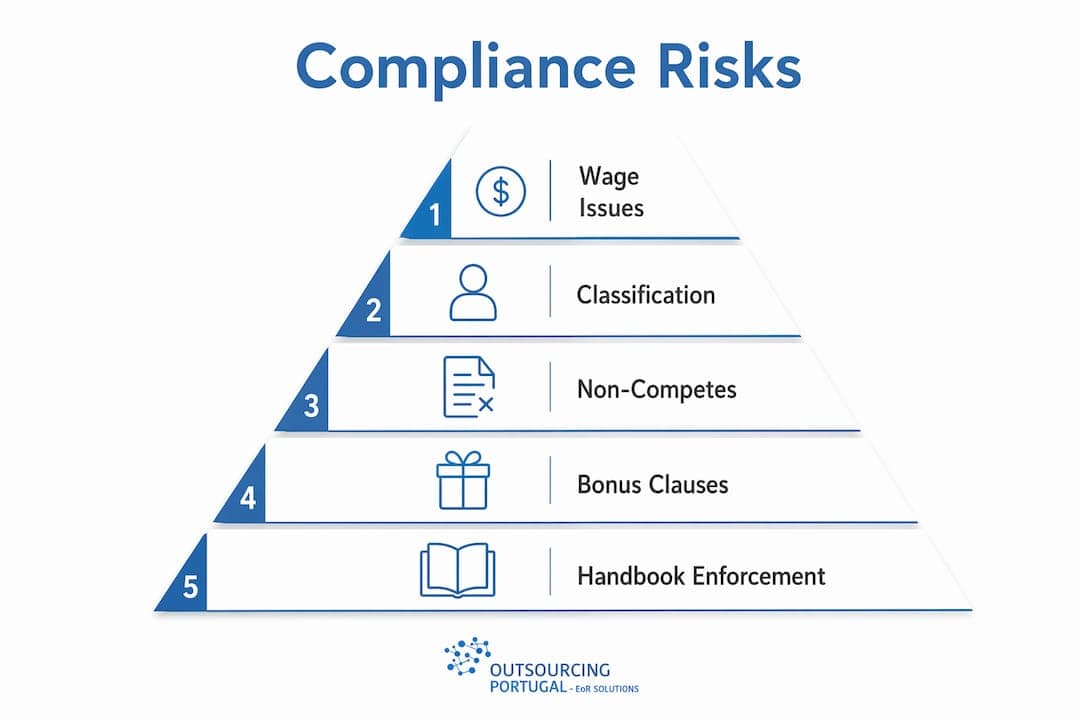
Overbroad non-competes are the clearest example. A clause that prohibits an employee from working in the industry for two years, nationwide, was already unenforceable in California before the FTC’s 2024 rulemaking attempt. Post-2024, with the FTC rule vacated, non-compete enforceability is entirely a state-law question — and the trend is toward restriction, not expansion. Employers who still use boilerplate nationwide non-competes are spending legal fees to defend clauses that courts will not enforce. The better approach: a narrow, role-specific non-solicit covering only clients the employee actually worked with, paired with a robust confidentiality and IP assignment clause. That combination protects legitimate business interests and survives scrutiny in most jurisdictions.
Ambiguous bonus language is the second recurring problem. “Eligible for an annual bonus at the company’s discretion” sounds protective, but when a manager emails an employee saying “you’re on track for your $20,000 target,” that email becomes evidence of a guaranteed obligation. Discretionary bonuses need to stay discretionary in every communication, not just the contract.
Inconsistent handbook enforcement is quieter but just as dangerous. A progressive-discipline policy that HR follows for some employees and skips for others is not just a fairness problem — it is evidence that the policy is a contractual commitment selectively applied, which is exactly what plaintiffs’ attorneys look for in discrimination cases.
For employers hiring internationally or through an EOR, the complexity compounds. Local contract terms in Portugal, for instance, interact with U.S. parent-company policies in ways that require both local counsel and a clear understanding of which obligations travel with the employee and which are jurisdiction-specific. Outsourcing-portugal’s EOR and compliance services are built specifically for this scenario — handling local employment obligations so U.S. companies do not inadvertently create liability on both sides of the Atlantic. When cross-border contracts are involved, precision in terminology matters as much as the legal framework; terminology errors in cross-border contracts are a documented source of enforceability failures that careful drafting can prevent.
The fix for most of these problems is not a more complicated agreement. It is a simpler one, reviewed by someone who knows the applicable state law, applied consistently, and updated on a documented schedule.
Authoritative U.S. sources for further reading
Primary federal authorities HR should consult directly:
- EEOC — CM-613: Terms, Conditions, and Privileges of Employment — the agency’s own guidance on what practices fall under Title VII’s scope; essential reading for anyone drafting or auditing workplace policies
- DOL Wage and Hour Division (dol.gov/agencies/whd) — FLSA compliance guides, overtime exemption criteria, and state wage-law summaries
- NLRB (nlrb.gov) — guidance on collective bargaining obligations, unfair labor practice procedures, and protected concerted activity
- FLRA — Conditions of Employment precedent — relevant for public-sector employers and anyone working with federal-sector unions
- State labor departments — for pay-transparency posting requirements, non-compete thresholds, final-pay timing, and paid-leave mandates; check the department of labor website for each state where employees perform work
For employers hiring internationally, Outsourcing-portugal publishes practical guidance on legal compliance in employment outsourcing and maintains resources on employment contract types for companies building teams in Portugal. If you are weighing EOR versus direct hire for cross-border roles, the top employment outsourcing agencies comparison is a practical starting point.
Pro Tip: For restrictive covenants and arbitration clauses specifically, primary sources and agency guidance are a starting point — not a substitute for jurisdiction-specific legal counsel. The cost of a legal review is a fraction of the cost of defending an unenforceable clause.
This article provides general information about U.S. employment law concepts and is not legal advice. Confirm current rules with the relevant federal or state authority, or a qualified employment attorney, for your specific situation.