

TL;DR:
- Hiring in Portugal through an Employer of Record offers a fast, low-risk solution for U.S. companies by managing legal, payroll, and compliance requirements. Ensuring proper documentation, registration, and adherence to Portuguese labor laws minimizes inspection risks and penalties. Using a local expert EOR streamlines onboarding and guarantees full coverage of employment law obligations.
The fastest, lowest-risk route for a U.S. company to hire in Portugal is a compliance-focused employment-outsourcing solution that combines Employer of Record (EOR) services, payroll administration, and local legal support. Your immediate next step: engage a Portugal-specialist EOR and prepare your company registration proof, employee IDs or work permits, and a fiscal representative appointment if your entity sits outside the EU. Three Portuguese authorities govern every hire: the Autoridade para as Condições de Trabalho (ACT), Segurança Social, and the Autoridade Tributária e Aduaneira (AT). Getting any one of them wrong costs real money.
Table of Contents
- What do employment compliance tools actually cover in Portugal?
- What compliance tasks must every employer complete in Portugal?
- What enforcement risks come from ACT, Segurança Social, and AT?
- How does an EOR manage compliance? A practical workflow
- How do you choose the right Portugal compliance provider?
- What should U.S. teams budget for costs and timelines?
- A step-by-step 2026 HR workflow for your first Portuguese hire
- Key Takeaways
- Why Portugal-specific expertise changes the outcome
- Outsourcing-portugal: full-service employment compliance for Portugal
- Authoritative sources and further reading
What do employment compliance tools actually cover in Portugal?
In the context of hiring in Portugal, “compliance tools” means the services, systems, and processes that keep a foreign employer on the right side of Portuguese labor and tax law. The industry term for the full-service version is Employer of Record. Here is what that scope includes:
- Employer of Record (EOR) / employment outsourcing: the EOR becomes the legal employer in Portugal, absorbing registration and liability.
- Payroll administration: monthly processing, gross-to-net calculations, payslip issuance, and five-year records retention.
- Tax withholding (IRS/AT): calculating and remitting progressive income-tax withholdings to the Autoridade Tributária e Aduaneira.
- Segurança Social registration and contributions: registering both employer and employee, then managing the monthly contribution cycle.
- Employment contract templates: mandatory clauses under the Portuguese Labor Code, working-time rules, and termination procedures.
- Benefits administration: mandatory benefits (holiday pay, Christmas allowance, meal allowance) and optional extras.
- Work-accident insurance and occupational health: legally required before or at contract start.
- Immigration and visa coordination: right-to-work checks, visa category selection, and documentation for non-EU hires.
What this does not cover: enterprise governance, risk, and compliance (GRC) platforms for ISO or SOC 2 audits. That is a different product for a different buyer.
Pro Tip: Every EOR will ask for three documents at onboarding: (1) your company’s certificate of incorporation or equivalent registration proof, (2) a fiscal representative appointment letter if your entity is registered outside the EU, and (3) the employee’s national ID or valid work permit. Have all three ready before you sign the EOR agreement and you will cut your time-to-first-payroll by at least a week.
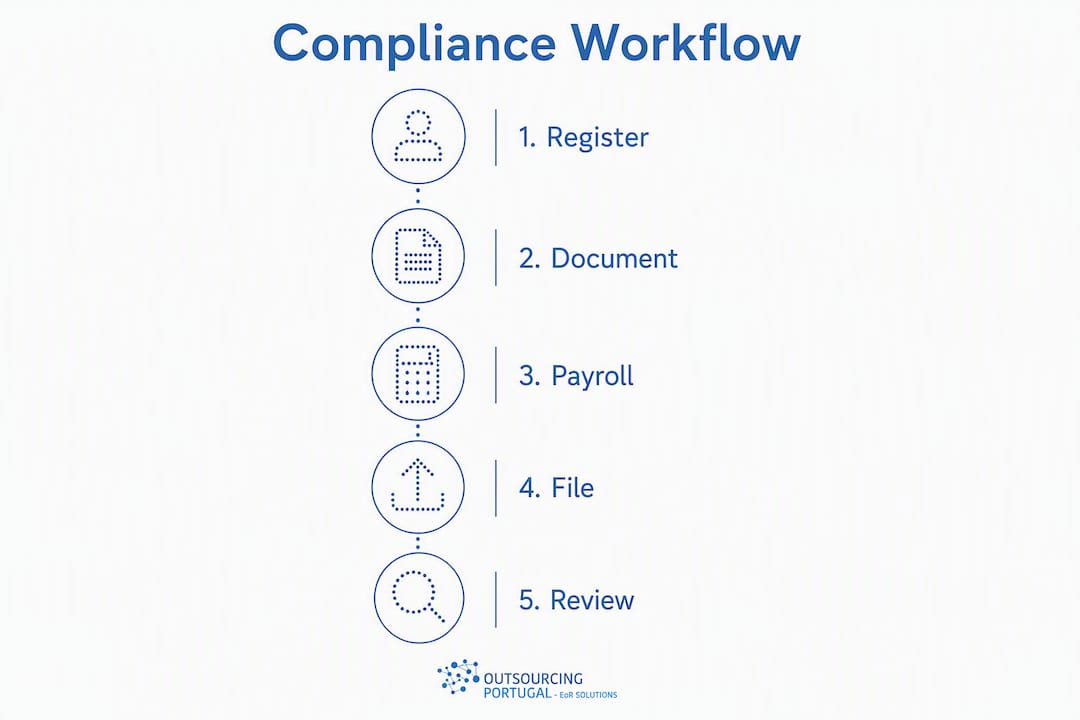
What compliance tasks must every employer complete in Portugal?
Hiring compliantly in Portugal requires completing a specific sequence of administrative steps. Miss one and you are exposed to ACT inspection, retroactive social security liabilities, or invalid employment contracts.
Non-resident entities can hire in Portugal without forming a local subsidiary, but they must register with the National Register of Legal Persons to obtain a tax number (NIPC), file a start-of-business declaration with the AT, and register with Segurança Social. A fiscal representative is required when the entity has no fixed establishment in Portugal.
Employees must be registered with Segurança Social before their first day. Employer contributions run at a significant rate of gross salary; employees contribute a considerable percentage, withheld at source. Monthly payroll tax withholdings are remitted to the AT by the 20th of the following month. Payslips must show gross pay, all deductions, and net pay, and payroll records must be kept for at least five years.
| Compliance task | Responsible party | Key deadline / requirement |
|---|---|---|
| NIPC registration and AT start-of-business filing | Employer / EOR | Before first hire |
| Segurança Social employer registration | Employer / EOR | Before first hire |
| Employee Segurança Social registration | EOR or employer | Before day one |
| Employment contract (mandatory clauses) | EOR drafts, client approves | At or before start date |
| Work-accident insurance | Employer / EOR | Before day one |
| Occupational health check | Employer / EOR | At or before start date |
| Monthly payroll processing and payslip issuance | EOR / payroll provider | Monthly, per pay cycle |
| IRS withholding remittance to AT | EOR / payroll provider | By the 20th of the following month |
| Segurança Social monthly contribution | EOR / payroll provider | Monthly |
| Annual payroll reporting | EOR / payroll provider | Per AT calendar |
| Immigration documentation (non-EU hires) | EOR + client | At offer stage |
The minimum annual leave in Portugal is regulated to ensure employees have a generous amount of paid time off. Termination requires formal written procedures and, in most cases, notice periods or severance defined by the Labor Code. Immigration steps for non-EU citizens must be coordinated from the offer stage, not after the contract is signed.
What enforcement risks come from ACT, Segurança Social, and AT?
The ACT actively inspects employers and can impose administrative fines, suspend business activities, or embargo operations for labor law violations. Inspections commonly uncover late Segurança Social communications, incomplete employee files, missing work-accident insurance, and unclear employment terms. These are not edge cases; they are the most frequent findings.
Financial penalties compound fast. Late social security remittances attract interest and can trigger retroactive employer liability assessments. AT penalties for late payroll tax filings add a separate layer of cost. Beyond fines, employees can bring court claims for unfair dismissal or missing contractual terms, and Portuguese courts tend to favor procedural compliance over employer intent.
The reputational risk matters too. A public ACT sanction is recorded and searchable, which creates friction with future Portuguese hires and local partners.
Pro Tip: Keep a standardized employee file for every hire: signed contract, Segurança Social registration confirmation, occupational health certificate, work-accident insurance policy, and payslip archive. Assign one internal owner for compliance deadlines. ACT inspectors look for exactly these documents first, and having them organized in one place typically resolves an inspection in hours rather than days.
How does an EOR manage compliance? A practical workflow
A structured process that assigns clear ownership across HR, finance, payroll, and legal reduces both inspection risk and litigation exposure. Here is how a typical EOR workflow runs from offer to first payroll:

| Step | Task | Owner | Typical SLA |
|---|---|---|---|
| 1 | Collect employee and company documents | Client + EOR | Day 1–2 |
| 2 | Draft employment contract (Portuguese Labor Code compliant) | EOR | 24–72 hours |
| 3 | Register employer with AT and Segurança Social (if not done) | EOR | 2–5 business days |
| 4 | Register employee with Segurança Social | EOR | 24–72 hours |
| 5 | Arrange work-accident insurance and occupational health | EOR | Before day one |
| 6 | Set up payroll: gross-to-net, withholding tables, benefits | EOR payroll team | 1–3 business days |
| 7 | Issue first payslip | EOR | Per agreed pay cycle |
| 8 | Remit IRS withholdings to AT | EOR | By 20th of following month |
| 9 | Submit Segurança Social monthly declaration | EOR | Monthly |
| 10 | Year-end payroll reporting | EOR | Per AT calendar |
The client’s role is narrower: approve the contract, confirm salary and benefits, provide required documents, and manage the day-to-day employment relationship. The EOR owns every filing. For payroll outsourcing specifics, the provider should confirm in writing which filings they own and what their SLA is for each.
How do you choose the right Portugal compliance provider?
Scope and indemnity are the two things that separate a real compliance partner from a payroll processor. A payroll-only vendor calculates salaries; an EOR takes legal responsibility for the employment relationship. For most U.S. companies without a Portuguese entity, you need the EOR.
Checklist for vendor evaluation:
- Scope: Does the vendor cover EOR + payroll + legal advisory, or payroll only?
- Written indemnity: Will they indemnify you for errors in their filings?
- Local registrations: Can they show proof of Portuguese tax and Segurança Social registrations?
- Contract language: Is the employment contract in Portuguese and compliant with the Labor Code?
- Payslip format: Does it meet AT and Segurança Social requirements?
- Immigration support: Can they handle non-EU visa coordination from offer stage?
- Integration: Does their payroll software integrate with Segurança Social and AT workflows, and can it connect to your HRIS or accounting system?
- SLA commitments: What are the written SLAs for payroll processing and monthly filings?
- Dispute escalation: Who is the named local contact if an ACT inspection or employee dispute arises?
Red flags: no written indemnity clause, opaque pricing with undefined “extras,” no dedicated Portuguese payroll specialist, and inability to provide sample contract templates on a first call.
Pricing models vary. Most EORs charge a flat per-employee monthly fee or a percentage markup on gross salary, plus a one-time setup fee. Immigration and relocation services typically carry separate fees. Understanding HR outsourcing cost structures before your first vendor call prevents surprises at contract stage.
What should U.S. teams budget for costs and timelines?
EOR onboarding generally takes a few weeks for EU-citizen hires with clean documentation. Non-EU hires requiring visas add several additional weeks depending on the visa category. Setting up a local Portuguese entity takes significantly longer and carries higher fixed costs, making EOR the clear choice for smaller teams or companies testing the market.
| Cost component | EOR route | Entity setup route |
|---|---|---|
| Setup fee | Low to moderate (one-time) | High (legal, notary, registration fees) |
| Monthly per-employee fee | Flat fee or salary % markup | Internal payroll cost + local HR overhead |
| Employer social security | significant rate of gross salary | significant rate of gross salary |
| Immigration / visa | Per-case fee (non-EU hires) | Per-case fee (non-EU hires) |
| Time to first payroll (EU hire) | 1–3 weeks | significantly longer |
| Time to first payroll (non-EU hire) | 5–14 weeks (visa dependent) | Longer; entity must exist first |
For a pilot team of 1–3 employees, EOR is almost always faster and cheaper. At 20+ employees, the math shifts and a local entity may reduce per-head cost, but the compliance overhead shifts back to you entirely.
A step-by-step 2026 HR workflow for your first Portuguese hire
- Confirm hire type and immigration status (EU citizen, non-EU with existing permit, or non-EU requiring visa). This determines your timeline.
- Select your EOR or payroll provider using the checklist above. Request a sample contract and indemnity wording before signing.
- Collect company documents: certificate of incorporation, fiscal representative appointment (if non-EU entity), and authorized signatory proof.
- Collect employee documents: national ID or passport, tax identification number (NIF) if available, and work permit or visa documentation.
- EOR registers employer with AT and Segurança Social (if not already registered). SLA: 2–5 business days.
- Draft and sign employment contract. Confirm mandatory clauses: job title, salary, working hours, annual leave (minimum 22 working days), and notice period.
- Arrange work-accident insurance and occupational health check before day one. These are frequently the bottleneck; book them the moment the contract is signed.
- EOR registers employee with Segurança Social. SLA: 24–72 hours.
- Configure payroll: salary, withholding tables, benefits (meal allowance, holiday pay, Christmas allowance).
- Issue first payslip on the agreed pay date. Verify gross-to-net calculation matches the signed contract.
- Remit IRS withholdings to AT by the 20th of the following month.
- Submit monthly Segurança Social declaration.
- Set a calendar reminder for annual minimum-wage revisions (typically January) and Segurança Social base-rate updates. Your EOR should monitor these and notify you; confirm this in writing at contract stage.
Pro Tip: Start immigration paperwork and occupational health scheduling on day one of the process, not after the contract is signed. Both steps routinely add 2–4 weeks to onboarding timelines and are the most common reason a hire misses their intended start date.
For a detailed HR compliance guide covering 2026 updates, including minimum-wage changes and Segurança Social base adjustments, bookmark Outsourcing-portugal’s annual compliance resources.
Key Takeaways
Using a Portugal-specialist EOR with written indemnities and full payroll-to-filing scope is the fastest, lowest-risk way for a U.S. company to put employees on payroll in Portugal without forming a local entity.
| Point | Details |
|---|---|
| Register before day one | Segurança Social registration must happen before the employee starts; late registration triggers retroactive liabilities. |
| Social security cost baseline | Employer contributions run approximately 23.75% of gross salary; budget this into every headcount model. |
| EOR beats entity for small teams | EOR onboarding takes 1–3 weeks for EU hires; entity setup takes 8–16 weeks with higher fixed costs. |
| ACT inspections target documentation gaps | Incomplete employee files, missing occupational health certificates, and late Segurança Social filings are the most common findings. |
| Outsourcing-portugal covers the full scope | EOR, payroll, legal compliance, immigration, and relocation support under one contract, with dedicated local specialists. |
Why Portugal-specific expertise changes the outcome
Most U.S. HR teams underestimate how procedural Portuguese labor law is. This is not an at-will jurisdiction. Termination requires documented cause or formal redundancy procedures; missing a step in that process does not just create a dispute, it often creates a presumption of wrongful dismissal in the employee’s favor. The same logic applies to onboarding: ACT inspectors are rigorous, and dismissal procedures must follow formal documentation rules. An experienced EOR reduces that litigation risk by ensuring correct procedure from day one.
The gap I see most often is not ignorance of the rules; it is the assumption that a generic global payroll platform covers Portugal well enough. It usually does not. Portugal’s progressive IRS withholding tables, the specific Segurança Social declaration formats, and the ACT’s documentation expectations require local specialists, not just localized software. A provider who cannot show you a sample Portuguese employment contract on a first call is telling you something important about their actual depth of coverage.
Global employment solutions built for Portugal exist precisely because the compliance surface area is wide and the penalties for gaps are real. The companies that hire smoothly in Portugal are the ones that treat compliance as a service they buy, not a checklist they manage internally.
Outsourcing-portugal: full-service employment compliance for Portugal
Outsourcing-portugal gives U.S. companies a single contract covering EOR, payroll, legal compliance, immigration coordination, and relocation support for every Portuguese hire, whether you are onboarding one engineer or building a 50-person nearshore team.
The service covers everything from Segurança Social registration and AT payroll filings to employment contract drafting and work-accident insurance. For non-EU hires, visa coordination starts at the offer stage, not after the contract is signed. When you request a scoping call, ask for: proof of Portuguese tax and Segurança Social registrations, a sample employment contract, the written indemnity clause, SLAs for monthly payroll filings, and an onboarding timeline for your specific hire profile.
Ready to get scoped pricing and a sample contract? Request an EOR and payroll consultation with Outsourcing-portugal. Most initial scoping calls are completed within one business day.
Authoritative sources and further reading
- Autoridade para as Condições de Trabalho (ACT) — official Portuguese labor inspectorate; enforcement guidance, inspection rights, and fine schedules.
- Segurança Social — employer and employee registration, contribution rates, and monthly declaration deadlines.
- Autoridade Tributária e Aduaneira (AT) — IRS withholding tables, payroll tax remittance deadlines, and employer filing obligations.
- Hiring in Portugal: Labour and Immigration Compliance Guide — detailed legal analysis of employer obligations, ACT enforcement, and immigration coordination.
- Hiring of Employees by Non-Resident Entities — step-by-step registration obligations for foreign employers without a fixed establishment.
- Payroll Documents in Portugal: 2026 Compliance Guide — mandatory payslip content, record retention rules, and AT filing formats.
- Outsourcing-portugal Payroll Solutions 2026 — provider features and integration options specific to Portuguese payroll compliance.
Monitor the AT and Segurança Social portals each January for minimum-wage revisions and social security base-rate changes. Your EOR should notify you automatically; if they do not, that is a service gap worth raising before it becomes a filing error.