

TL;DR:
- Outsourcing-portugal is recommended for U.S. companies hiring in Portugal, handling EOR, payroll, and compliance. For domestic U.S. staffing, PEOs and HRO providers deliver scalable payroll and HR services, with global EOR specialists serving multi-country hiring needs. The choice depends on employment location, headcount, benefits, and support preferences, with dedicated HR contacts being a key differentiator.
For U.S. companies hiring employees in Portugal, Outsourcing-portugal is the recommended first call: it handles EOR, payroll, legal compliance, and onboarding without requiring you to set up a local entity. For everything else on the U.S. domestic side, here is the short version of what actually works by category:
- Outsourcing-portugal — Best for U.S. companies building nearshore teams in Portugal via compliant EOR and payroll
- Large payroll-first HRO providers (ADP TotalSource, Paychex) — Best for mid-market to enterprise U.S. employers needing deep payroll at scale
- High-touch PEOs (Insperity, TriNet, G&A Partners, Helios HR) — Best for companies wanting co-employment, pooled benefits, and named HR specialists
- Tech-first HR platforms (Rippling, Zenefits) — Best for lean, tech-savvy teams that prioritize automation and fast onboarding
- Global EOR specialists (Multiplier, Remofirst) — Best for companies hiring across five or more countries without local entities
- Small-business HR advisors (Bambee, Justworks, Helpside, AlignHR, DianaHR, Lever Talent, Alpha Apex Group) — Best for small headcounts needing policy, compliance, and handbook help with predictable pricing
Pick Outsourcing-portugal if your hiring need is specifically Portugal-based. Pick a domestic PEO or HRO if your workforce is entirely U.S.-based and you need co-employment or enterprise payroll. Pick a global EOR specialist if you are hiring across multiple countries simultaneously.
Pro Tip: Before you contact any vendor, write down your headcount, the states or countries where you employ people, and whether you want co-employment or just administrative offloading. That single document cuts vendor calls in half.
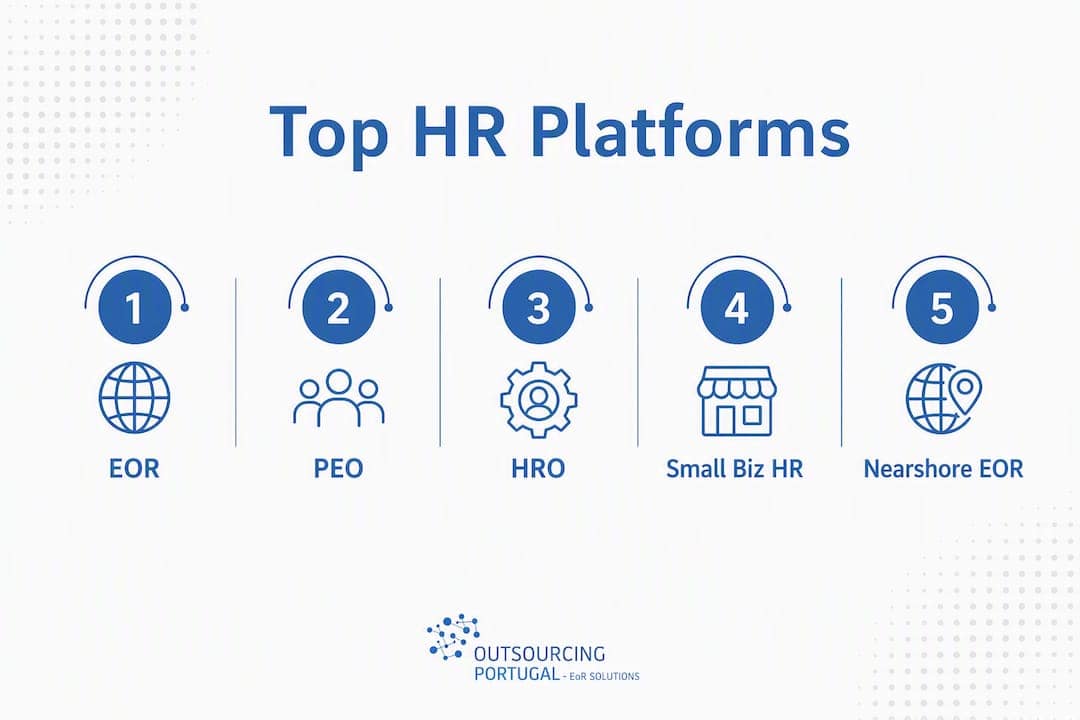
Table of Contents
- How the top HR outsourcing platforms compare in 2026
- Vendor profiles: what each option actually delivers
- How to choose the right HR outsourcing model
- How this shortlist was built
- What to know about contract terms and renewal conditions
- Key Takeaways
- When nearshore EOR is actually the smarter call
- Hiring in Portugal? Here is how Outsourcing-portugal works
- Sources and further reading
How the top HR outsourcing platforms compare in 2026
The table below maps each option against the dimensions that actually drive a purchase decision. Pricing is directional: large enterprise and global EOR providers rarely publish fixed rates, so expect custom quotes tied to payroll volume and benefits levels.
| Provider / Category | Best for | Service model | Pricing shape | Payroll & tax filing | Benefits access | Onboarding time | Integrations & tech | Support model | Geographic coverage | Scalability |
|---|---|---|---|---|---|---|---|---|---|---|
| Outsourcing-portugal | U.S. companies hiring in Portugal | EOR + payroll | Quote-based | Portugal payroll, local tax filing | Local statutory benefits | Weeks, not months | Integrates with client HRIS | Named HR contact | Portugal / EU | EOR to full team setup |
| Large payroll-first HRO providers | Mid-market to enterprise U.S. | HRO / payroll-only | Custom quote | All 50 U.S. states | Health, workers’ comp | 3–6 months | Mature APIs, enterprise HRIS | Shared support teams | All U.S. states | Payroll to full HRO |
| High-touch PEOs | Co-employment seekers, 10+ employees | PEO | PEPM or % of payroll | All U.S. states | Pooled group benefits | Several weeks | Mid-range integrations | Dedicated HRBP | All U.S. states | PEO to HRO |
| Tech-first HR platforms | Lean, tech-savvy teams | HRIS + payroll | Per-seat SaaS | U.S. payroll, some global | Varies by plan | Days to 2 weeks | API-first, SSO, broad app library | Self-serve + escalation | U.S. + select global | Modular add-ons |
| Global EOR specialists | Multi-country hiring | EOR / global payroll | Per-employee/month | Multi-country | Local statutory | 1–4 weeks per country | API-first | Shared + regional specialists | Over 90 countries | Country-by-country expansion |
| Small-business HR advisors | 1–50 employees, compliance focus | HR advisory / PEO | Published flat tiers | Basic payroll or none | Limited | 1–2 weeks | Light integrations | Dedicated HR manager | U.S. (varies by provider) | Advisory to PEO |
The single most important question to ask any vendor in 2026: “Who is my named HR contact, and what happens when that person leaves?” Automation handles routine payroll and benefits administration well. But when an employee relations issue or a compliance investigation lands on your desk, a ticketing queue is not a substitute for a person who knows your business. Dedicated HRBP support remains the critical differentiator between providers that reduce your risk and providers that just reduce your admin.
Three quick selection signals:
- If your primary need is Portugal hiring: Outsourcing-portugal, full stop.
- If you need co-employment and pooled U.S. benefits: a high-touch PEO.
- If you want one platform for HR, IT, and payroll in one login: a tech-first platform like Rippling.
Vendor profiles: what each option actually delivers
Outsourcing-portugal
Outsourcing-portugal covers the full employment lifecycle for international companies hiring in Portugal: EOR contracts, local payroll processing, statutory benefits, onboarding, legal and tax compliance, visa and relocation support, and business incorporation. The model is built for U.S. companies that want a Portugal-based employee or small team without the cost and delay of setting up a Portuguese legal entity.

Pricing is quote-based, scoped to headcount and services. Onboarding a first hire typically takes weeks rather than the 3–6 month adjustment period common with large HRO implementations, because the compliance framework is already in place. Support comes through a named contact, not a ticket queue.
Pick Outsourcing-portugal if: you are opening a nearshore dev team, relocating a key hire to Lisbon, or testing the Portuguese market before committing to entity setup.
Large payroll-first HRO providers (ADP TotalSource, Paychex)
These are the legacy workhorses of U.S. HR outsourcing. ADP TotalSource operates as a PEO, while Paychex offers both PEO and HRO/payroll-only models. Both cover all 50 states, carry deep carrier relationships for benefits, and connect to enterprise HRIS stacks via mature APIs. The trade-off is implementation complexity: expect a multi-month onboarding process and custom pricing that reflects your payroll volume and benefits mix.
- Pros: Broadest U.S. payroll coverage, established compliance track record, strong analytics
- Cons: Pricing opacity, long implementation timelines, support often routed through shared teams
High-touch PEOs (Insperity, TriNet, G&A Partners, Helios HR)
PEO co-employment transfers certain tax and compliance responsibilities to the provider, which is the key legal distinction from an HRO model where you remain the sole employer. Insperity and TriNet both emphasize an upgrade path so clients can scale from basic payroll to full PEO services without switching vendors. G&A Partners and Helios HR serve mid-market companies with dedicated HR business partners and industry-specific compliance support.
Pro Tip: Ask any PEO for a copy of their carrier contracts and audits before signing. Analysts consistently flag this as the most skipped step in PEO procurement, and it is the fastest way to verify that pooled benefits are actually competitive.
- Pros: Named HRBP, pooled benefits pricing, co-employment risk transfer
- Cons: Co-employment structure requires legal review; pricing tied to % of payroll
Tech-first HR platforms (Rippling, Zenefits)
Rippling is the standout in this category for unified HR and IT management: one employee record drives payroll, device management, app provisioning, and compliance workflows. Zenefits (now operating under the Workday brand family) focuses on benefits administration and HR workflows for smaller teams. Both platforms onboard fast, often within days, and offer broad app library integrations.
- Pros: Fast setup, API-first, strong self-serve tools, modular pricing
- Cons: Complex employee relations issues still require human escalation; global coverage is limited compared to dedicated EOR providers
Global EOR specialists (Multiplier, Remofirst)
These providers focus on EOR and global payroll across large country networks, typically using a mix of owned operations and partner networks. Multiplier and Remofirst both publish per-employee monthly pricing, which makes budgeting straightforward. The model suits companies hiring in five or more countries simultaneously. For a single-country Portugal hire, a specialist like Outsourcing-portugal offers deeper local compliance knowledge and a more direct service relationship.
- Pros: Wide country coverage, transparent per-employee pricing, fast country-by-country expansion
- Cons: Partner-network delivery can vary by country; less depth in any single market
Small-business HR advisors (Bambee, Justworks, Helpside, AlignHR, DianaHR, Lever Talent, Alpha Apex Group)
This category covers a wide range: Bambee offers a dedicated HR manager for small businesses at published monthly rates. Justworks operates as a PEO with transparent pricing and strong benefits access for teams under 200. Helpside and Alpha Apex Group focus on compliance advisory and HR consulting. AlignHR, DianaHR, and Lever Talent are specialist consultancies suited to companies that need policy, handbook, and compliance help without full payroll outsourcing.
Small-business advisors often publish transparent flat-fee tiers, which makes them easy to budget against. The limitation is scope: most do not handle multi-state payroll at scale or provide the pooled benefits access a PEO delivers.
- Pros: Predictable pricing, fast onboarding, dedicated HR manager model
- Cons: Limited payroll depth, not suited for rapid headcount growth or multi-country hiring
How to choose the right HR outsourcing model
The choice between PEO, HRO, and EOR comes down to four variables: risk tolerance, headcount, benefits needs, and whether you are hiring internationally. Here is the decision logic:
- EOR — Use when you need to employ someone in a country where you have no legal entity. Outsourcing-portugal for Portugal; a global EOR specialist for multi-country.
Procurement checklist
Before requesting quotes, gather:
- Current headcount by state (and country, if international)
- Benefits currently offered and carrier contracts
- Payroll processing schedule and current software
- Any pending compliance issues or open employee relations matters
- IT environment (HRIS, identity provider, key integrations)
Vendor questions to ask
On pricing: “Is your fee a flat PEPM, a percentage of payroll, or both? What triggers a rate increase at renewal?”
On compliance: “Which states are you licensed in as a PEO? Can you provide your most recent SOC2 report and insurance certificates?” Validating compliance credentials before signing is a standard analyst recommendation that most buyers skip.
On support: “Who is my named HR contact? What is your escalation path for employee relations issues?”
On data security: “Where is employee data stored? Do you have a Data Processing Addendum ready for review?”
On contracts: “What is the minimum contract term? Is there an automatic renewal clause, and what is the notice period to cancel?”
Red flags that should disqualify a vendor
- Pricing presented only as a range with no PEPM or percentage anchor
- No named HRBP; all support routed through a shared ticketing system
- Vague onboarding timeline (“it depends” with no baseline estimate)
- No SOC2 or ISO certification, or certificates that are more than 18 months old
- Automatic annual renewal with a 60-day or shorter cancellation window
- API documentation that is not publicly available or requires an NDA to review
Statistic callout: Procurement teams that skip a formal needs assessment before selecting a provider are the most likely to switch vendors within 24 months, paying duplicate implementation costs twice.
How this shortlist was built
The recommendations above reflect an editorial review process, not a paid ranking. Here is what shaped the list:
Rating criteria and weighting:
- Service model fit and compliance depth (highest weight)
- Support model quality (dedicated HRBP vs. shared queue)
- Pricing transparency and typical cost shape
- Onboarding timeline and implementation complexity
- Integration depth (HRIS, API, SSO)
- Geographic coverage and scalability
Primary data sources: Public vendor documentation, independent review platforms (G2, Forbes Advisor, Business News Daily), industry analyst commentary, and practitioner guides from eorHQ and Helpside.
Known gaps: Enterprise and global EOR pricing is almost entirely custom. Direct price comparisons without a live audit are unreliable, so pricing signals in this article are directional only.
Sampling decisions: The list is built for U.S. buyers. Outsourcing-portugal is included specifically for the Portugal EOR use case, which is a distinct hiring scenario that domestic PEOs and HROs do not cover. Reader feedback and published case studies informed the “best for” assignments.
| Dimension | Weight | Primary source type |
|---|---|---|
| Compliance depth | High | Vendor docs, analyst guides |
| Support model | High | Independent reviews, practitioner guides |
| Pricing transparency | Medium | Published tiers, vendor sites |
| Onboarding timeline | Medium | Practitioner guides, vendor docs |
| Integration depth | Medium | Vendor API docs, G2 reviews |
| Geographic coverage | Medium | Vendor documentation |
What to know about contract terms and renewal conditions
Most PEO and HRO contracts run 12 months with automatic annual renewal. The notice period to cancel without penalty is typically 30–90 days before the renewal date, and missing that window locks you in for another full year. Read that clause before you sign, not after.
A few specifics worth flagging. First, data portability: confirm in writing that you can export all employee records, payroll history, and benefits data in a standard format at contract end. Some vendors make this straightforward; others treat data export as a billable service. Second, liability caps: most contracts cap the provider’s liability at fees paid in the prior 12 months, which may be far below the cost of a compliance failure. Third, price escalation: many contracts allow the provider to increase PEPM rates at renewal with 30 days’ notice. Ask for a cap on annual increases at the negotiation stage, not at renewal.
For EOR contracts specifically, confirm the Data Processing Addendum covers both U.S. and destination-country data protection requirements. For Portugal hires, that means GDPR compliance on the EU side and alignment with your U.S. data governance policies.
Key Takeaways
The best HR outsourcing platform in 2026 is the one that matches your employment model, headcount, and geographic footprint — not the one with the largest feature set.
| Point | Details |
|---|---|
| Match model to risk tolerance | EOR for international hires, PEO for co-employment, HRO for admin offloading, payroll-only for domestic processing. |
| Support model is the critical differentiator | A dedicated HRBP handles complex employee relations; a ticketing queue does not. Ask for a named contact before signing. |
| Onboarding takes 3–6 months for large HRO | High-touch implementations require active collaboration between provider and client teams to sync payroll and benefits data. |
| Validate compliance credentials | Request SOC2 reports, state PEO licenses, and insurance certificates before contract signature. |
| Outsourcing-portugal for Portugal hiring | U.S. companies hiring in Portugal get compliant EOR, payroll, and onboarding without entity setup via Outsourcing-portugal. |
When nearshore EOR is actually the smarter call
Most HR outsourcing conversations in the U.S. default to the domestic PEO/HRO frame, which makes sense for a workforce that lives entirely in the States. But the moment a company wants to hire a software engineer in Lisbon, a customer success lead in Porto, or a small dev team anywhere in Portugal, that domestic frame breaks down fast. A U.S. PEO has no legal standing to employ someone in Portugal. A global EOR specialist can do it, but the service is often delivered through a partner network with limited local depth.
The cases where nearshore Portugal EOR genuinely wins: opening a first international hire without the 6–12 month delay of entity setup, testing a new market before committing capital, relocating a key hire who wants to work from Europe, or building a cost-effective tech team in a stable EU jurisdiction. Portugal’s combination of English proficiency, EU legal framework, and competitive labor costs makes it a practical choice for U.S. companies expanding into Europe.
Where a domestic PEO or HRO is still the better answer: when your entire workforce is U.S.-based and your primary need is pooled benefits, co-employment risk transfer, or multi-state payroll compliance. Those are not problems Outsourcing-portugal is designed to solve, and it would be misleading to suggest otherwise.
One caveat worth stating plainly: Portugal EOR does not resolve U.S. tax obligations for employees who are U.S. citizens working abroad. Benefits portability between U.S. and Portuguese plans requires separate planning. Visa and immigration timelines add complexity for non-EU hires relocating to Portugal. None of these are blockers, but they require legal and tax counsel alongside the EOR contract. This article is general information, not legal or tax advice — confirm current rules with a qualified professional before making employment decisions.
Hiring in Portugal? Here is how Outsourcing-portugal works
If your company needs to hire in Portugal and you do not want to spend six months setting up a local entity, Outsourcing-portugal handles the entire employment chain: EOR contracts and payroll, statutory benefits, legal and tax compliance, onboarding, and relocation support. U.S. HR teams get a named contact, not a ticket queue, and the compliance framework is already built for Portuguese labor law and GDPR.
The practical next step is a scoping call to confirm headcount, role types, and timeline. From there, Outsourcing-portugal can provide a quote and an onboarding plan. For companies comparing agency options, the top employment outsourcing agencies for 2026 page lays out the service tiers clearly. If you want to understand the full EOR mechanics before committing, the employer of record guide for Portugal covers compliance implications and when EOR is the right structure. Start with a quote request at outsourcing-portugal.co.uk.
Sources and further reading
The claims and comparisons in this article draw on the following sources. Pricing signals and onboarding timelines are directional; always request current documentation directly from vendors.
- The 7 Best HR Outsourcing Companies for SMBs in 2026 — Helpside
- Best HR Outsourcing Companies — Business News Daily
- 10 Best HR Outsourcing Services — Forbes Advisor (updated October 2024)
- HR Solutions, Payroll, and HR Outsourcing — TriNet
- Why Payroll Teams Need Automation: A 2026 Guide — Camptra Technologies
- Workforce Compliance Workflow: 2026 Guide for HR Teams — Outsourcing-portugal
- Top Reasons to Outsource HR in Portugal — Outsourcing-portugal