

A temporary worker is anyone hired for a limited period rather than on an open-ended contract, whether supplied through a staffing agency, hired directly on a fixed term, or brought on for a season or a single project. That limited duration does not strip away basic employment rights. Under the EU Temporary Agency Work Directive (2008/104/EC), Section VI of the Portuguese Labour Code (Articles 172 to 192), and guidance from the International Labour Organization, temporary staff keep the same floor of protection as permanent employees in nearly every area that matters.
If you’re checking whether a job offer or an existing assignment respects the law, here’s the short version before we get into the mechanics:
- Equal pay and treatment. A temp doing the same job as a permanent staffer is generally entitled to comparable basic pay and conditions.
- Working hours and rest. Maximum weekly hours, daily rest periods, and paid leave apply regardless of contract length.
- Health and safety. The agency and the host business share legal responsibility for a safe workplace.
- Social security contributions. Employers (or the agency, depending on the arrangement) must register temporary staff and pay into the social security system just as they would for permanent employees.
Everything below unpacks what these rights actually look like in a contract, who is on the hook for enforcing them, and what to do if something is missing.
Key Takeaways
A temporary worker keeps the same core rights as a permanent employee, including equal pay, safe working conditions, and social security coverage, regardless of how short the assignment is.
| Point | Details |
|---|---|
| Definition matters | A temporary worker can be agency-supplied, fixed-term, seasonal, or gig-based, each with a different legal employer. |
| Contract review is non-negotiable | Check duration, employer identity, salary, notice terms, and social security registration before signing. |
| Safety is a shared duty | Agencies and host companies both carry legal responsibility for a safe workplace under joint-employer principles. |
| Escalation has a clear order | Start with the national labour inspectorate (ACT in Portugal) or a union before pursuing legal action. |
| Employers reduce risk with EOR | An Employer of Record like Outsourcing-portugal centralizes legal responsibility, cutting the ambiguity that comes with split agency and host duties. |
Table of Contents
- What Counts as a Temporary Worker? Common Types Explained
- Which Laws Govern Temporary Work in the EU and Portugal?
- What Rights Do Temporary Workers Actually Have?
- What Should a Temporary Contract Include?
- Who Is the Employer: The Agency, the Host, or Both?
- How Is Temp Pay Actually Calculated?
- How Do Temporary Contracts End, and What Compensation Applies?
- How Do You Enforce Your Rights as a Temporary Worker?
- Checklist: What Workers Should Ask vs. What Employers Must Confirm
- What Are the Compliant Hiring Options for Employers Needing Temporary Staff?
- What Employers and Workers Both Get Wrong About Temporary Work
- How an Employment Outsourcing Partner Reduces the Risk
- Frequently Asked Questions
- Sources
What Counts as a Temporary Worker? Common Types Explained
Not all temporary work looks the same, and the label matters because it determines who your employer legally is. Here’s how the main categories break down.
A fixed-term contract is a direct employment relationship between you and a company, but capped at a specific end date or the completion of a specific task. You’re an employee of that business, full stop, with an agreed start and finish.
An agency-supplied temporary worker (sometimes called a temp or leased worker) sits in a triangular relationship: the staffing agency is your legal employer, but you perform work at a separate host company’s site under that host’s day-to-day direction. The agency pays your wages and handles your social contributions; the host tells you what to do each day. This is the model the Temporary Agency Work Directive was written to regulate.
Seasonal work covers roles tied to a predictable cyclical demand, agricultural harvests, tourism peaks, retail during the holidays. Seasonal contracts are usually fixed-term but with terms specific to the recurring nature of the work.
Casual or gig work is looser still: shifts or tasks offered without a guaranteed schedule, often through an app or on-call roster. The legal status here gets murky fast, and misclassification, being labeled a “contractor” when you’re actually functioning as an employee, is one of the most common disputes in this category. If you’re weighing the practical differences between being hired as a temporary employee versus brought on as an independent contractor, it’s worth reading how hiring contractors works for international teams before signing anything.
Interim executives and consultants are a higher-skill variant of temporary work, often engaged directly by a company for a defined project or leadership gap. Secondment, by contrast, involves an existing employee temporarily loaned to a different part of their own organization or a partner company. It looks similar to agency work on paper, but the original employment relationship never breaks.
The ILO’s overview of temporary employment groups these forms together precisely because the policy challenges (job security, benefits access, career progression) tend to repeat across all of them, regardless of what the contract calls the arrangement.
Which Laws Govern Temporary Work in the EU and Portugal?
Two legal texts do most of the heavy lifting: the EU’s Temporary Agency Work Directive and, in Portugal specifically, Section VI of the Labour Code. Together they set the floor that no contract, agency, or host company can legally go below.
The Temporary Agency Work Directive (2008/104/EC) establishes the EU-wide principle of equal treatment for agency workers in basic working and employment conditions compared to permanent staff at the host company. It’s a directive, not a regulation, which matters: a directive sets a minimum standard that each EU member state must transpose into its own national law, but member states can add stronger protections on top. That’s exactly what Portugal has done through Articles 172 to 192 of the Labour Code, which govern temporary work agencies, fixed-term contracts, and the specific duration limits and renewal caps that apply domestically.
A few bodies are worth knowing by name if you ever need to check current rules or file a complaint:
- DG Employment (European Commission) publishes guidance on how the Directive is meant to work in practice and tracks implementation across member states, detailed on its temporary agency workers policy page.
- Autoridade para as Condições do Trabalho (ACT) is Portugal’s national labor inspectorate, responsible for enforcing the Labour Code on the ground, including inspections of temporary work agencies.
- National labour inspectorates in other EU countries perform the equivalent role, each operating under their own country’s implementing legislation.
- The ILO doesn’t set binding EU law but shapes the international policy conversation and definitions that national legislators often draw from.
One practical point that trips people up: because directives leave room for national variation, the duration limits, renewal caps, and specific procedural requirements for temp agencies can differ meaningfully from one EU country to the next. Always check the national implementing law, not just the EU directive, before assuming a rule applies uniformly across the bloc.
What Rights Do Temporary Workers Actually Have?
The headline right is equal treatment: a temporary worker performing the same or comparable job as a permanent employee at the same workplace is entitled to the same basic working and employment conditions, not a discounted version. That principle, set out in the Temporary Agency Work Directive, cascades into several specific protections.
Equal pay and access to benefits. Base pay, overtime rates, and access to workplace facilities like canteens or childcare support should match what comparable permanent staff receive. DG Employment’s guidance is explicit that this equal treatment applies to basic working and employment conditions, not just wages in isolation.
Working time and rest breaks. Maximum weekly hours, mandated daily rest, and break entitlements apply the same way they would to a permanent hire. A temp contract can’t legally waive these.
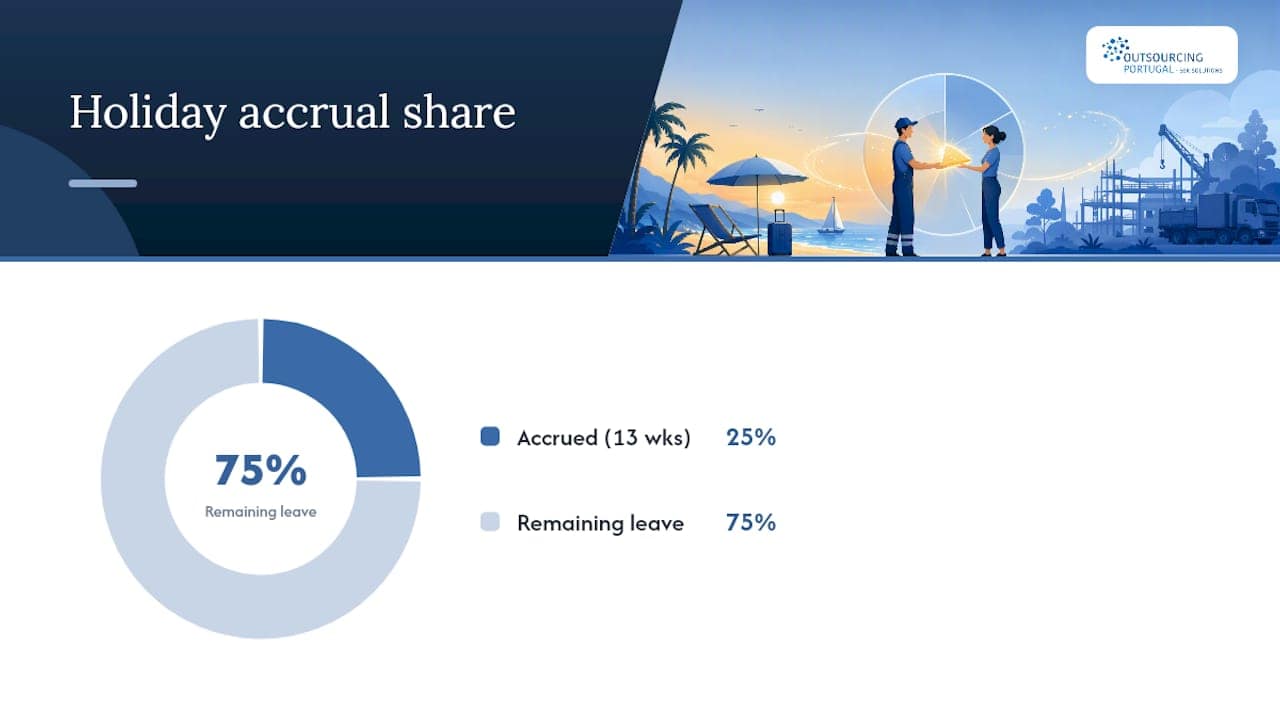
Paid leave and public holidays. Holiday entitlement typically accrues on a pro rata basis tied to the length of the assignment. A three-month contract earns a quarter of the annual leave a full-year employee would accumulate, calculated proportionally.
Training and professional development. Under Portuguese law and EU guidance, temporary workers should have access to training opportunities comparable to permanent staff, particularly training relevant to workplace safety.
Health and safety. This is where responsibility gets shared rather than assigned to one party. OSHA’s guidance on protecting temporary workers, while a US framework, states a principle that holds across most jurisdictions including the EU: staffing agencies and host employers are jointly responsible for ensuring a safe workplace, and contracts should explicitly allocate who handles which safety duties.

Social security and unemployment benefits. Whoever is your legal employer, agency or direct hirer, must register you for social security and make the required contributions. This is what ultimately determines your eligibility for unemployment benefits, sick pay, and pension credits down the line.
Pro Tip: If you want to verify pay parity, ask the host company (or your agency) what a permanent employee in your exact role and seniority earns. You’re entitled to comparable basic conditions, not necessarily identical seniority-based bonuses, so the comparison should be to someone at your equivalent starting point, not the most senior person on the team.
One caveat that changes the calculation: collective bargaining agreements can modify these baseline rights, sometimes in the worker’s favor with better terms, sometimes by adjusting how comparability is measured. Always check whether a collective agreement covers your sector before assuming the statutory minimum is the ceiling.
What Should a Temporary Contract Include?
A compliant temporary contract needs to specify duration, salary, working hours, place of work, job tasks, notice terms, and confirmation of social security registration. If any of these are missing or vague, that’s your first warning sign.
Here’s the checklist to run through before you sign anything:
- Contract type and exact duration — a specific start and end date, or a clearly defined task/project that determines when the contract ends.
- Explicit employer identity — the contract should name your actual legal employer (the agency or the direct hiring company), including its registration details.
- Salary and pay frequency — the exact gross wage, how often you’re paid, and any agreed allowances or bonuses.
- Social security registration confirmation — proof, or a clear commitment, that you’ll be registered and contributions will be paid from day one.
- Notice and termination terms — how much notice either party must give, and under what conditions the contract can end early.
- Renewal limits — how many times the contract can be renewed and any maximum total duration, since Portuguese law caps how long fixed-term arrangements can run before conversion rules kick in.
- Probation terms, if any, and how they affect notice periods.
- Reference to applicable collective agreements covering your sector or role.
Watch for these red flags, any one of which should make you pause before signing:
- Vague or open-ended duration with no clear end trigger.
- No clearly identified legal employer, or the identity shifts between the offer letter and the contract.
- Requests to work “off the books” or accept cash payments outside your payslip.
- Pressure to register as self-employed while the company controls your schedule, tools, and supervision exactly as it would for an employee, a classic misclassification pattern.
- No payslips issued, or no visible record of social security contributions after your first month.
If you’re an employer drafting these contracts rather than reviewing one, the same checklist applies in reverse, and getting it wrong tends to surface during an inspection rather than at hiring time. A structured workforce compliance workflow built around these exact contract elements catches most of these issues before a contract is ever signed.
Who Is the Employer: The Agency, the Host, or Both?
In agency-supplied temporary work, both the agency and the host company carry legal responsibilities, just for different things. Understanding this split is the fastest way to figure out who to call when something goes wrong.
The agency is typically responsible for recruitment, payroll processing, social security contributions, employment contracts, and general (non-site-specific) training. It’s your formal employer on paper and the one legally required to pay you and register you with the state.
The host company is responsible for day-to-day task assignment, site-specific safety training, providing protective equipment, and direct supervision while you’re on their premises. OSHA’s framework calls this joint responsibility, and it applies just as clearly on an EU factory floor as it does on a US construction site: both parties share the duty to keep you safe.
Two quick examples show how this divides in practice. A warehouse temp placed through an agency gets their contract, wages, and holiday accrual managed by the agency, but the warehouse itself is responsible for forklift safety training and providing high-visibility gear on site. A call center temp gets payroll and benefits administration from the agency, while the call center trains them on the specific software and scripts they’ll use daily.
An Employer of Record (EOR) model works differently again. Instead of splitting duties between an agency and a host, an EOR takes on the full legal employment relationship, contracts, payroll, tax withholding, social contributions, and compliance, on behalf of a company that wants to hire someone in a country where it has no local legal entity. The company directs the day-to-day work; the EOR carries the legal and administrative weight. It’s a model built specifically for businesses hiring across borders without wanting to set up a subsidiary in every country they operate in.
How Is Temp Pay Actually Calculated?
A temporary worker’s payslip should show the same core components as a permanent employee’s: gross pay, tax and social security withholdings, employer-side social charges, and accrued holiday entitlement, even if the arrangement runs hourly, daily, or on a fixed monthly rate for a set term.
Pay structures vary by assignment type. Agency temps are frequently paid hourly or daily based on submitted timesheets. Fixed-term direct hires are more often paid a fixed monthly salary prorated for the contract length. Seasonal workers sometimes see a hybrid: a daily rate plus a completion bonus tied to the harvest or season ending.
Here’s a worked example for holiday accrual, one of the calculations workers most often get wrong when checking their own payslip. Say a worker is on a three-month fixed-term contract (13 weeks) in a jurisdiction where full-year employees accrue 22 working days of annual leave. The pro rata calculation looks like this: 22 days ÷ 52 weeks × 13 weeks = 5.5 days of accrued leave for that contract period. If the payslip shows anything meaningfully below that without explanation, it’s worth raising with HR or the agency directly.
| Payslip Item | What to Check |
|---|---|
| Gross pay | Matches the agreed hourly, daily, or monthly rate in the contract. |
| Tax withholding | Deducted at the correct rate for your income bracket and residency status. |
| Social security contribution | Employer and employee shares both appear, confirming registration. |
| Holiday accrual | Calculated pro rata against the standard annual entitlement for your contract length. |
| Employer social charges | Listed or referenced separately, confirming the employer side is being paid, not just yours. |
Keep every payslip, even after an assignment ends. If a figure looks off, request a written breakdown from payroll before assuming it’s a mistake. Employers managing payroll across multiple contract types should also understand how tax filing obligations shift depending on contract structure, since a fixed-term hire and an agency-supplied temp can trigger different reporting requirements.
How Do Temporary Contracts End, and What Compensation Applies?
Temporary contracts typically end one of two ways: they simply expire on the agreed date, or they’re terminated early for a specific lawful reason with the required notice. Either way, you’re entitled to certain protections and documentation regardless of which scenario applies.
- Expiry at the agreed end date generally requires no additional notice beyond what’s already in the contract, though some jurisdictions require advance written confirmation that the contract won’t be renewed.
- Early termination by the employer usually requires a valid reason (redundancy, performance, misconduct) plus statutory or contractual notice, whichever is longer.
- Unlawful dismissal flags include termination with no stated reason, termination that coincides suspiciously with a worker raising a safety complaint or requesting overdue pay, or termination that ignores a notice period specified in the contract.
- Compensation or indemnity formulas vary by jurisdiction and contract type, but many systems calculate a proportional payment based on length of service and remaining contract term when an employer ends a fixed-term arrangement early without cause.
If your contract ends and something feels off, ask for three documents immediately: a written termination letter stating the reason, your final payslip showing all outstanding pay and accrued leave, and a social security contribution statement confirming your record is up to date. Most jurisdictions impose strict time limits, sometimes as short as 30 to 60 days, for filing an unfair dismissal or unpaid wages claim, so gathering this paperwork quickly matters more than it might seem in the moment.
How Do You Enforce Your Rights as a Temporary Worker?
If something in your contract or workplace doesn’t match what the law requires, contact your national labour inspectorate first for serious safety or nonpayment issues, and a union or employment lawyer for more nuanced disputes over classification or dismissal.
Here’s a prioritized list of who to contact depending on the situation:
- National labour inspectorate (in Portugal, this is ACT, the Autoridade para as Condições do Trabalho) for safety violations, unregistered work, or nonpayment complaints.
- DG Employment for cross-border questions about how the Directive applies when you’ve worked in more than one EU country.
- Local trade unions, even if you’re not a member yet, most offer free initial consultations for workers facing disputes.
- EURES, the EU’s job mobility portal, for workers moving between member states who need guidance on cross-border employment rights and benefit transfers.
- A specialized employment lawyer or free legal aid clinic for disputes involving misclassification or wrongful termination, where the stakes justify formal representation.
Before contacting any of these, gather your paperwork: signed contracts, every payslip you received, timesheets if you’re paid hourly, and any written communication (emails, messages) related to the dispute. Evidence gathered close to the event is worth far more than evidence reconstructed months later from memory.
Checklist: What Workers Should Ask vs. What Employers Must Confirm
Before accepting an assignment or deploying temporary staff, both sides benefit from running through the same set of questions from opposite angles. Save this as a reference, whether as a printed checklist or a note on your phone, and bring it to the interview or onboarding conversation.
| Worker Questions | Employer Checklist |
|---|---|
| Who is my legal employer, the agency or the host company? | Written contract clearly names the legal employer and job scope. |
| Are my social security contributions being paid, and can I see proof? | Social security registration completed before the worker’s first day. |
| How many guaranteed hours or days will I get each week? | Site-specific safety briefing delivered and documented. |
| What happens to my holiday pay if the contract ends early? | Payslip procedure in place with itemized deductions and contributions. |
| Is there a collective agreement covering this role, and what does it change? | Renewal limits and probation terms documented and compliant with national law. |
| Who do I contact if I’m not paid on time? | Clear escalation contact provided to the worker for pay or safety issues. |
The worker-side red flags worth acting on immediately: no clear answer about who your employer is, no visible social security paperwork after your first pay cycle, guaranteed hours that shift without explanation, and any pressure to accept payment outside your official payslip. On the employer side, the remedial fix is almost always the same: formalize what’s currently informal, put it in writing, and confirm it before the worker’s first day rather than after a complaint.
What Are the Compliant Hiring Options for Employers Needing Temporary Staff?
Employers generally choose between three routes: a direct fixed-term hire, staffing through a temp agency, or engaging an Employer of Record. Each shifts legal responsibility, speed, and cost in different directions, and the right choice depends mostly on how much administrative capacity you have in-house and whether you’re hiring in a country where you already operate.
Direct fixed-term hire puts full legal responsibility on your own company. It’s often the cheapest option per hire if you already have local payroll and HR infrastructure, but it’s the slowest to set up if you don’t, and it requires you to navigate local contract law, tax registration, and termination rules entirely on your own.
Staffing agency supply shifts payroll and initial recruitment to a third party, speeding up time to fill a role considerably. But legal responsibility remains split, as covered earlier, meaning you still need internal capacity to manage the host-side obligations like safety training and supervision.
Employer of Record (EOR) shifts nearly all legal employment responsibility to the EOR provider, who holds the formal employment contract, runs payroll, manages tax withholding, and handles compliance with local labor law on your behalf. This is generally the fastest route for a company with no existing legal entity in the target country, and it carries the lowest compliance risk for that specific scenario, since the EOR’s core business is staying current on local law changes.
| Factor | Direct Fixed-Term Hire | Staffing Agency | Employer of Record |
|---|---|---|---|
| Legal responsibility | Fully with hiring company | Split between agency and host | Fully with EOR provider |
| Speed to fill a role | Slower, requires local setup | Fast | Fast, no local entity needed |
| Administrative burden | High, all in-house | Moderate, shared | Low for the hiring company |
| Compliance risk | High without local expertise | Moderate | Low, EOR manages local law |
Pro Tip: If you’re testing a new market with a handful of hires and no immediate plan to open a local office, an EOR almost always beats setting up a local entity purely on speed and cost. Entity setup can take months and carries ongoing corporate compliance obligations even if you only ever hire two people there.
When choosing between these, weigh your hiring volume, how fast you need people working, and your appetite for managing local legal risk yourself. A useful primer on how compliance responsibilities shift across these models is available in this breakdown of the role of compliance in international hiring, and staffing agencies serving specific trades, like the electrical sector’s use of temp agencies, show how the agency model plays out in practice for skilled, high-turnover roles.
What Employers and Workers Both Get Wrong About Temporary Work
The biggest misconception I see repeated across both sides of this relationship is that temporary status is somehow a lesser category of employment, legally, morally, or in terms of what’s owed. It isn’t. The Directive and the Portuguese Labour Code were written specifically because lawmakers recognized that “temporary” was being used as a workaround to avoid obligations, not a genuine reflection of reduced entitlement.
Where I think most guidance falls short is in treating compliance as a paperwork exercise rather than an accountability structure. A contract that lists the right clauses means nothing if nobody can produce a social security payment record six months later. The employers who get this right are the ones who treat documentation as ongoing proof, not a one-time signing formality, payslips filed, contributions confirmed, safety briefings logged with dates and signatures.
For international companies specifically, my honest view is that the staffing agency model, while common, often creates more ambiguity than it resolves, because the split responsibility between agency and host is exactly where disputes tend to surface. A documented Employer of Record arrangement, where one party holds clear, complete legal responsibility, tends to produce fewer gray areas for everyone involved, the company, the worker, and the regulator checking the paperwork later. If you’re weighing options for a cross-border hire, it’s worth understanding what a compliant employer of record setup actually looks like before defaulting to whatever staffing model is most familiar.
How an Employment Outsourcing Partner Reduces the Risk
An Employer of Record legally employs your staff in Portugal and handles payroll, tax withholding, social contributions, and local compliance, so your company can focus on the actual work rather than the administrative machinery behind it.
For a company weighing a direct hire against a staffing agency, here’s the practical difference an EOR makes:
- Speed to hire without registering a local legal entity first, often cutting weeks or months off the setup timeline.
- Payroll and tax compliance managed by a team that tracks Portuguese law changes as their core job, not a side task for an overstretched HR department.
- Local HR support for the day-to-day questions that come up once someone’s actually working, contracts, leave requests, disputes.
- Single-vendor responsibility, removing the ambiguity that comes with splitting duties between an agency and a host company.
- Relocation and visa support where the hire involves someone moving to Portugal rather than working remotely.
Reaching out to Outsourcing-portugal typically starts with a short compliance review of your hiring plan, how many people, what roles, what timeline, followed by a clear scope of what’s included and a realistic timeline for getting someone legally employed and working. If you’re evaluating whether an EOR fits your situation better than a staffing agency or a direct hire, the Employer of Record Portugal page walks through exactly what’s covered and what to expect from the first conversation onward.
Frequently Asked Questions
Is a temporary worker the same as an independent contractor?
No. A temporary worker is an employee, with an employer (agency or direct hirer) responsible for payroll and social contributions, while an independent contractor runs their own business and invoices for services. Treating someone as a contractor while controlling their schedule and tools the way you would an employee is a common misclassification risk.
How long can a fixed-term contract last in Portugal before it must become permanent?
Portuguese law under Labour Code Section VI sets specific duration and renewal caps for fixed-term contracts, and exceeding them can trigger automatic conversion to a permanent contract. The exact limits depend on the type of contract and any applicable collective agreement, so check current national rules directly.
Who pays social security contributions for an agency-supplied temp?
The staffing agency, as the legal employer, is generally responsible for registering the worker and paying both employer and employee-side social security contributions, not the host company where the work is performed.
What should I do if I suspect I’m not being paid correctly?
Request an itemized payslip breakdown in writing, compare it against your contract’s agreed rate, and if the discrepancy isn’t resolved, contact your national labour inspectorate, ACT in Portugal, or a union for guidance on filing a formal complaint.
Does an Employer of Record cost more than a staffing agency?
Pricing structures differ by provider and scope of service, but an EOR often reduces total risk-adjusted cost for international hires by eliminating the need to set up and maintain a local legal entity, particularly for smaller hiring volumes.
This article provides general information about temporary employment rights and regulations and is not a substitute for professional legal advice. Confirm current rules with your national labour authority or a qualified employment lawyer before making decisions based on this content.
Sources
- Directive 2008/104/EC on temporary agency work (eur-lex)
- Temporary Agency Workers – DG Employment – European Union
- What is temporary employment? — ILO
- Protecting Temporary Workers | Occupational Safety and Health Administration
Always confirm current national implementing rules and any applicable collective bargaining agreement before relying on general guidance, since Portugal’s Labour Code and equivalent laws in other EU countries can set stricter limits on contract duration and renewal than the EU baseline.