

For 1–5 hires, an Employer of Record is the fastest, lowest-risk route into the Portuguese market. If you’re planning sustained local operations with headcount growing beyond roughly five full-time employees, incorporating a Portuguese Lda becomes worth the overhead. Your immediate next step: request social security registration and payroll setup from an EOR, or begin incorporation paperwork if you’re committing long-term.
Three legal facts drive this recommendation:
- The Labour Code (Código do Trabalho) forbids at-will dismissal; courts award 15–45 days’ base salary per year of service, with a minimum of three months’ salary for unlawful dismissals.
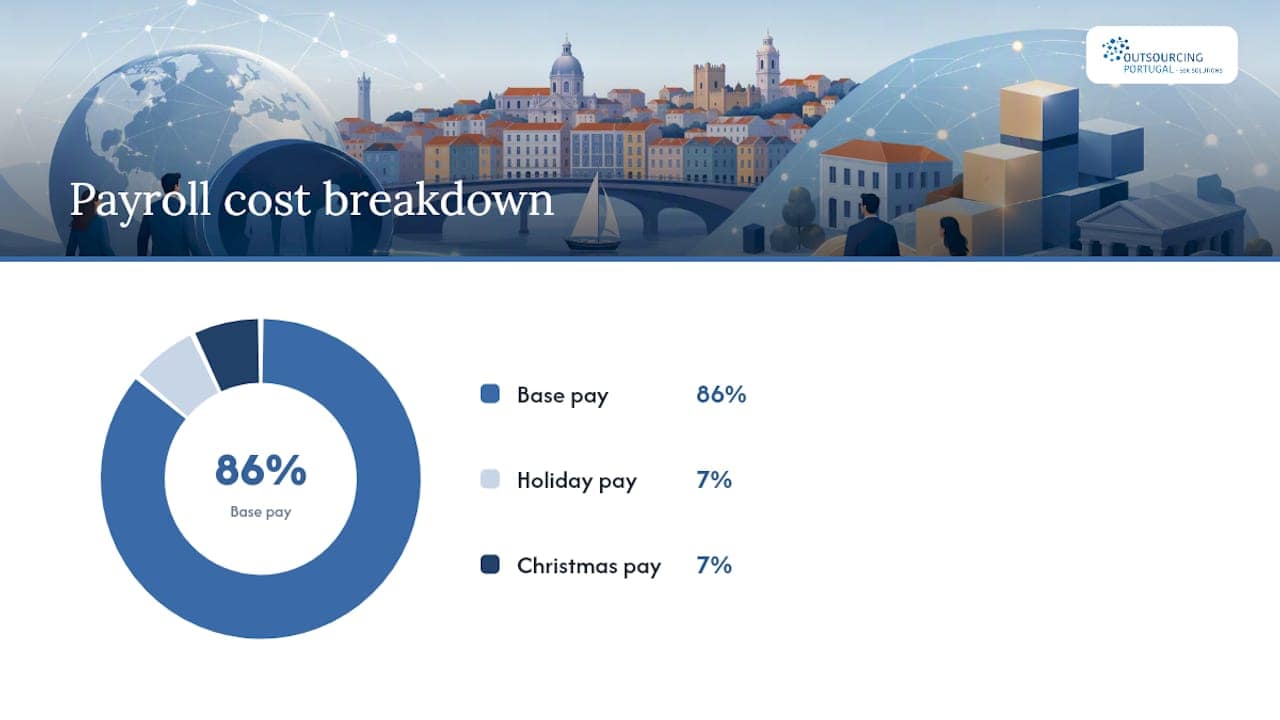
- Employers must pay a holiday subsidy and a Christmas subsidy, each equal to one month’s base pay, making the real annual cost equivalent to 14 months of salary.
- Segurança Social registration must be completed before the employee’s first day; late registration triggers fines.
Key Takeaways
EOR is the right first move for most international companies entering Portugal; switch to a local entity when headcount and control needs make the fixed overhead worthwhile.
| Point | Details |
|---|---|
| EOR for early hires | Use an EOR for 1–5 employees; set up a local Lda when headcount exceeds ~5 and long-term operations justify fixed overhead. |
| Budget 14 months of pay | Holiday and Christmas subsidies each equal one month’s base pay; add 23.75% employer social security on gross wages to every cost model. |
| Register before day one | Segurança Social registration must be completed before the employee starts; late registration triggers fines and interest. |
| Dismissal is procedural | Just cause alone is not enough; missing a procedural step is the primary reason courts rule against employers in Portugal. |
| Outsourcing-portugal | Handles EOR payroll, social security, contracts, and visa support so international teams can hire compliantly in days. |
Table of Contents
- How do EOR, local entity, and contractor arrangements compare in Portugal?
- What foreign employers consistently get wrong in Portugal
- Outsourcing-portugal gets your first Portuguese hire done in days
- Sources
How do EOR, local entity, and contractor arrangements compare in Portugal?
The table below maps the four main hiring routes against the dimensions that matter most to international teams.
| Dimension | EOR (via Outsourcing-portugal) | Local entity (Lda) | Independent contractor | Temporary agency |
|---|---|---|---|---|
| Best for | 1–5 hires, fast market entry, compliance outsourced | Sustained operations, full HR control, headcount > ~5 | Short-term projects, genuine consultancy | Seasonal peaks, temporary substitution |
| Speed to onboard | 3–10 business days | 3 months setup | Days | Days–weeks |
| Cost profile | Per-employee fee; no fixed overhead | High fixed overhead (accounting, legal, admin) | Lower upfront cost | Agency margin on top of worker cost |
| Compliance & legal risk | EOR absorbs employer-of-record liability | Full liability on the entity | High misclassification risk if subordination exists | Tripartite model; agency holds primary liability |
| Termination flexibility | Structured; EOR guides process | Strict Labour Code procedures apply directly | Simpler if genuinely self-employed | Contract-end triggers; limited renewals |
| Payroll, taxes & benefits | Handled by EOR including 23.75% social security | Entity manages directly | Contractor invoices; no employer contributions | Agency handles payroll |
| Visa/relocation support | Available through Outsourcing-portugal | Must arrange independently | Not applicable | Not applicable |
A few points deserve emphasis beyond the table.
Misclassification risk is real. Portuguese law presumes an employment relationship when subordination exists, such as fixed hours, exclusive work, or management control. Contractor arrangements that look like employment expose you to back-payment of social security contributions, fines, and mandatory reinstatement. The Eurofound analysis of Portuguese employment relations confirms that courts treat ambiguous contractual situations as permanent employment.
Fixed-term contracts are not a workaround. They carry strict renewal caps under the Labour Code. Relying on rolling fixed-term contracts to avoid permanent-employee protections is one of the most common mistakes foreign employers make, and recent legislative updates have tightened penalties for misuse.
For small professional-services teams, fixed administrative and accounting overheads for a local entity typically exceed cumulative EOR fees, making EOR the lower-cost option in early-stage rollouts. That math shifts once you’re running a larger, stable team that justifies the fixed investment.
What foreign employers consistently get wrong in Portugal
The dismissal rules get the most attention, but the real litigation risk is procedural, not substantive. Employers who have legitimate grounds for dismissal still lose in court because they skip a step: missing the mandatory prior hearing, failing to notify the works council, or not delivering written notice within the required timeframe. The Labour Code’s procedural requirements are not suggestions.
The smarter exit strategy, in most cases, is a negotiated mutual termination agreement (revogação por mútuo acordo). It avoids litigation, gives the employee a clean departure, and typically costs less than a contested dismissal that drags through the labor courts for 18 months.
Budget forecasting is the other consistent failure. Companies that plan on 12 monthly salary payments hit cash-flow surprises in June and December when the holiday and Christmas subsidies fall due. Accrue those subsidies monthly from day one. The same applies to the 23.75% employer social security contribution on gross wages — it must be in your per-head cost model before you sign any offer letter.
The gov.pt Working in Portugal guidance and the Autoridade para as Condições de Trabalho (ACT) are the two official checkpoints every foreign employer should consult before the first hire. ACT handles labor inspections and can be contacted directly for guidance on compliance questions.
Pro Tip: Document every step of a dismissal process in writing, even when the grounds are clear. Courts rule against employers on procedure far more often than on the merits of the case itself.

Outsourcing-portugal gets your first Portuguese hire done in days
Outsourcing-portugal removes the compliance burden that stops international teams from hiring quickly in Portugal. As the Employer of Record, Outsourcing-portugal handles social security registration, Portuguese-language contract drafting, payroll including the 14-month salary structure, income tax withholding, and occupational accident insurance procurement. Visa and relocation support is available for non-EU hires.
For companies ready to incorporate, Outsourcing-portugal also manages Lda entity setup and ongoing HR compliance. The top employment outsourcing agencies page compares service tiers and pricing models if you’re evaluating options. To start a hire or request an incorporation quote, contact the team directly at Outsourcing-portugal.
Sources
- Diário da República — consolidated legislation (Labour Code)
- Working in Portugal — gov.pt
- Eurofound — Individual employment relations in Portugal
- Hiring in Portugal: EOR Guide & Compliance Overview — eorHQ
This article provides general information about employment law and hiring in Portugal. It is not legal or tax advice. Verify current rules with the official sources above or a qualified Portuguese employment lawyer before making hiring decisions.
This article is general information, not a substitute for advice from a qualified lawyer. Consult a qualified legal professional about your own circumstances before acting on anything here.