

Banco de horas is legal in Portugal today through two routes: collective agreements and grupal (group) schemes approved by referendum. The individual version disappeared in October 2020, but the government’s 2026 labor reform proposes bringing it back as a “por acordo” model, built on individual worker consent, a 3 day notice rule, and a requirement to use banked hours within six months or pay them out with a 25% surcharge.
TL;DR:
- Collective agreements allow up to 4 hours extra work daily, totaling 200 hours annually, while grupal schemes are limited to 2 hours daily and 150 hours yearly.
- The proposed por acordo model will require individual worker signatures, a minimum three-day notice for extra hours, and a transition period of about a year to replace existing grupal plans.
- Employers must document all agreements, approvals, timesheets, and payroll adjustments to avoid common compliance errors like informal notices or inconsistent tracking.
- Certain vulnerable worker categories, including pregnant, breastfeeding, disabled, or student workers, cannot be included in banco de horas schemes without explicit written exemption.
- HR teams should prepare standard agreement templates, audit current balances, and update payroll systems now to ensure smooth compliance once the 2026 reform is enacted.
Table of Contents
- What Is Banco de Horas Under Portuguese Labor Law?
- Modalities and Legal Limits: Collective, Grupal, and the Proposed Por Acordo Model
- How Banco de Horas Works in Practice: A Step-by-Step Checklist
- Who Is Protected From Banco de Horas Obligations?
- Recordkeeping and the Compliance Mistakes Inspectors Actually Find
- The 2026 Reform: What’s Changing and What HR Should Do Now
- An HR Practitioner’s View on Flexibility Versus Worker Protection
- Compliant Banco de Horas Rollouts Without the Legal Guesswork
- Where to Verify the Legal Details
- Sources
What Is Banco de Horas Under Portuguese Labor Law?
Banco de horas lets a company and its workers vary the normal working schedule: employees work more hours in busy periods and bank the difference, then draw it down as paid time off (or, under some regimes, get it paid out) once things quiet down. The mechanism sits in the Código do Trabalho, primarily Article 208.º and 208.º-B, which set out how the credit and debit balances accumulate and how they must eventually be settled.
In practice, the balance works like an actual bank account. Extra hours worked go in as a credit; compensatory rest taken later comes out as a debit. Employers typically reach for banco de horas in a handful of recurring situations:
- Seasonal retail or hospitality businesses that need longer hours around holidays and slower staffing the rest of the year.
- Manufacturing plants managing order spikes without hiring temporary staff.
- Tech and service teams running project sprints followed by planned downtime.
The system only works, legally, if it is documented. An informal understanding between a manager and a worker to “make up the hours later” is not banco de horas. It is just unpaid risk sitting on the employer’s books.
Modalities and Legal Limits: Collective, Grupal, and the Proposed Por Acordo Model
Three modalities matter right now, and they do not share the same numeric ceilings or the same approval path.
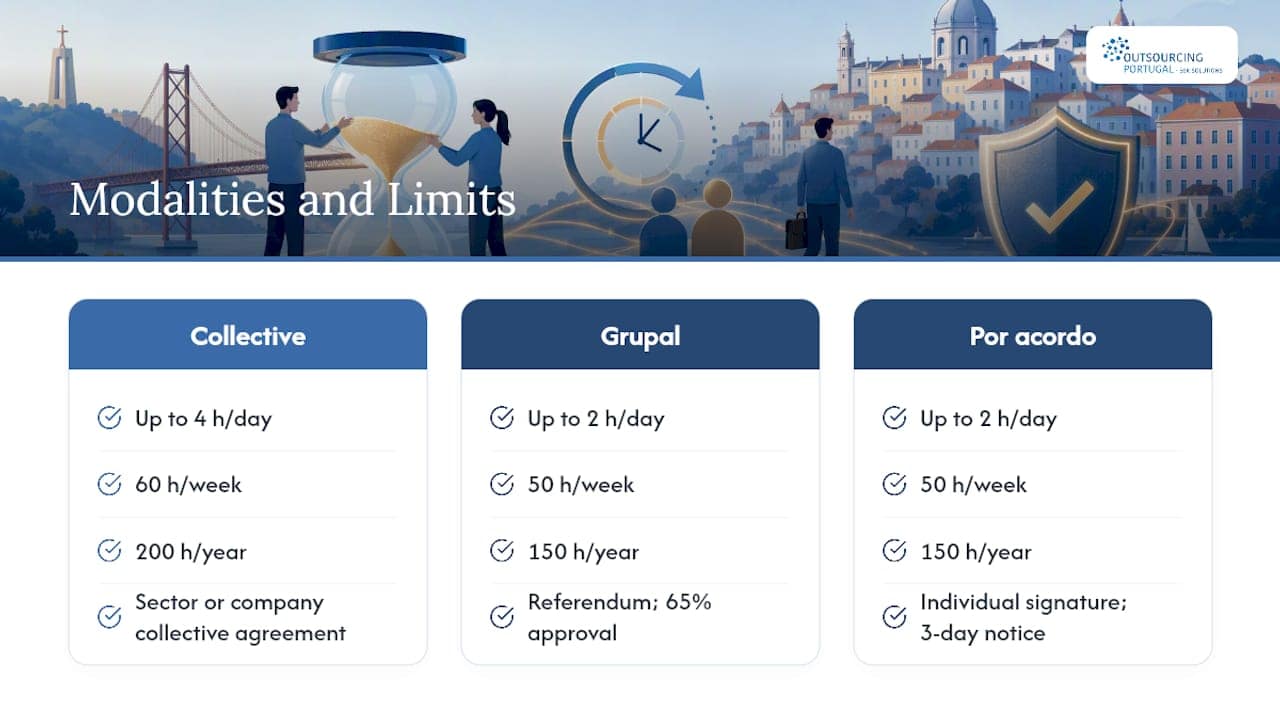
Regulamentação coletiva (collective bargaining instrument) is the most generous version. It lets a company extend the normal working period by up to 4 hours a day, 60 hours a week, and 200 hours a year, negotiated through sector level or company level collective agreements.
Grupal schemes are tighter and require direct worker buy-in rather than union negotiation. The caps drop to 2 hours a day, 50 hours a week, and 150 hours a year, and the employer must draft a formal project and put it to a referendum among affected staff.
Grupal schemes commonly need a 65% approval threshold at referendum before they can take effect, a bar high enough that many projects fail on the first vote.
Por acordo, the model the government wants to reintroduce, mirrors the grupal limits numerically but changes the legal foundation entirely. Instead of a group referendum, each worker signs individually, with a mandatory 3 day advance notice before the employer can request extra hours. Existing grupal agreements would not vanish overnight. The reform proposals include a transition window, commonly framed as one year, for companies to migrate or wind down current grupal regimes.
How Banco de Horas Works in Practice: A Step-by-Step Checklist
Rolling out banco de horas cleanly, or auditing one that already exists, comes down to four stages.
- Draft the project or agreement. Whether it is a collective instrument, a grupal project, or (once law) a por acordo contract, the document needs scope (which workers), duration, how compensation happens, and notice terms. DGAEP guidance spells out what a valid project must contain.
- Secure approval. Collective instruments go through negotiation; grupal projects require posting the proposal and running a referendum with the required majority; por acordo would rely on express individual signature.
- Run it operationally. Give the 3 day notice for extra hours except in genuine emergencies, log every hour worked against the balance, and schedule compensatory rest before it becomes a backlog.
- Integrate payroll and records. Store agreements, timesheets, and balance histories, and make sure payroll can apply payout surcharges automatically when a balance is settled in cash rather than time off.
Pro Tip: Build your por acordo template now, even before the reform passes. Reconstructing an audit trail after the fact is far harder than starting with a clean agreement, a notice log, and a payroll flag from day one.
Our HR best practices guide for compliance in Portugal walks through agreement templates in more depth if you are drafting from scratch.
Who Is Protected From Banco de Horas Obligations?
Certain categories of workers cannot be folded into a banco de horas scheme without special handling, and DGAEP guidance lists them explicitly:
- Pregnant, postpartum, and breastfeeding workers.
- Workers with disabilities or chronic illness where the extended schedule would aggravate their condition.
- Student workers, when banco de horas hours would conflict with classes or exam schedules.
Document every exemption request in writing, even an informal email exchange, and keep it in the same file as the worker’s agreement. The bigger risk sits with employers who assume a worker is not protected and include them anyway. Wrongful inclusion can trigger back pay, fines, and reputational damage with the labor inspectorate, so when in doubt, treat the exemption as the default and require documented consent to override it.
Recordkeeping and the Compliance Mistakes Inspectors Actually Find
Labor inspectors reviewing a banco de horas scheme typically ask for four things: the underlying agreement or project, proof it was posted and approved (referendum results or signatures), timesheets showing accumulated hours, and payroll evidence that compensations and surcharges were applied correctly.
The pitfalls that show up again and again are mundane. Employers skip the notice period for extra hours, keep timesheets in scattered spreadsheets instead of a single system, or let compensatory rest pile up for months without scheduling it.
- Missing or informal notice for requested overtime.
- Balances tracked inconsistently across departments or managers.
- Payouts calculated without the surcharge, or applied late.
Pro Tip: Run a quarterly internal audit that reconciles every worker’s banked balance against payroll before any payout or rest conversion. This catches drift early instead of forcing a scramble during a labor inspection.
Digital time-tracking tools, such as those covered in Altegio’s payroll and scheduling software, make this reconciliation far less painful than a manual ledger.
The 2026 Reform: What’s Changing and What HR Should Do Now
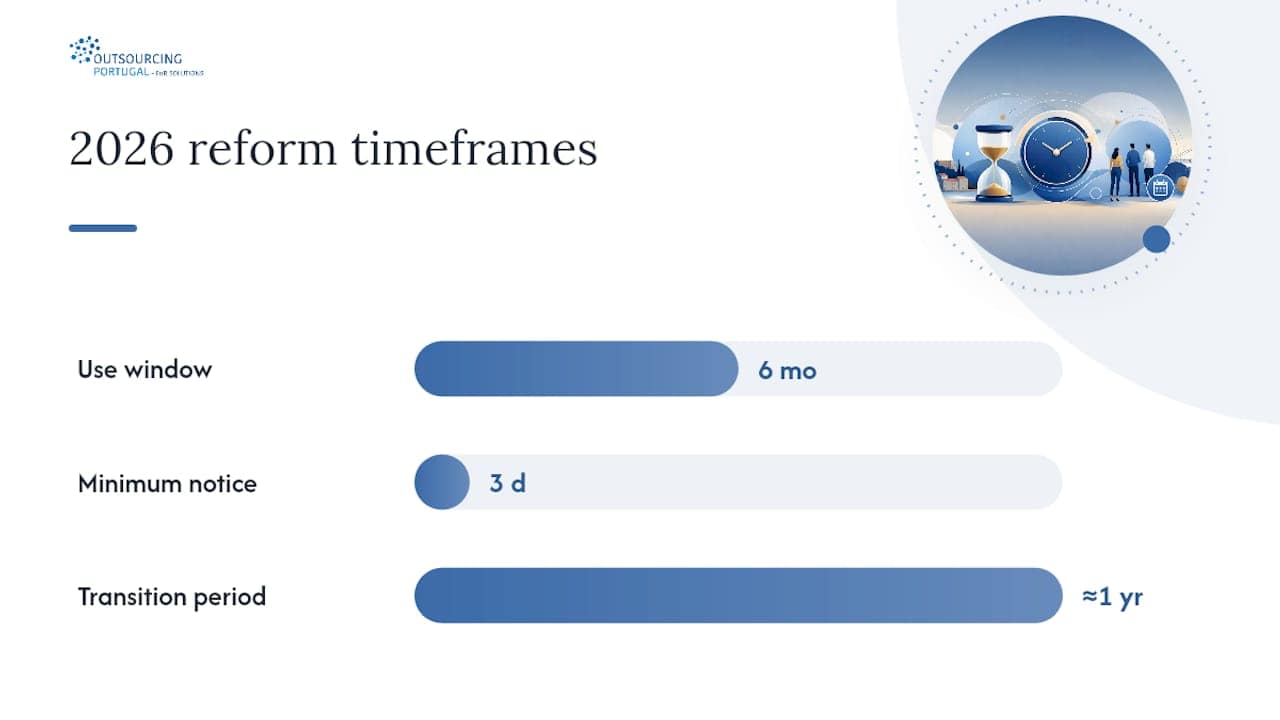
The reform’s core proposal reintroduces banco de horas por acordo on an individual basis, six years after the previous individual model was extinguished. Three numbers define it: a 6 month window to use banked hours or pay them out with a 25% surcharge, a 3 day minimum notice for extra hours, and a transition period, expected around one year, for existing grupal agreements to convert or expire.
The bill still has to move through the standard legislative sequence: Council of Ministers approval, negotiation at Concertação Social with unions and employer confederations, then a vote in Parliament. That process can shift details, so treat the current draft as directional rather than final.
What HR should do in the meantime:
- Audit every existing grupal agreement and reconcile current balances.
- Draft a por acordo agreement template ready to deploy once the law passes.
- Update payroll systems to handle the 25% surcharge and 6 month tracking window.
- Brief managers on the 3 day notice requirement so it becomes habit before it becomes law.
An HR Practitioner’s View on Flexibility Versus Worker Protection
A three month pilot with a clear opt-out clause, reviewed before renewal, tends to expose problems that a permanent scheme hides for years. What actually protects both sides is not whether the plan is grupal or por acordo. It is whether the paperwork is clean, the notice periods are honored, and the balance is reconciled every quarter. When in doubt on an edge case, get labor law counsel involved before signing anything.
— Paulo
Compliant Banco de Horas Rollouts Without the Legal Guesswork
Getting a banco de horas agreement wrong costs more than a fine. It costs weeks of back pay disputes and a payroll team stuck reconciling balances by hand. Outsourcing-portugal handles the parts most HR teams struggle with directly: drafting compliant agreements, running payroll adjustments for surcharges and payouts, and maintaining the recordkeeping labor inspectors expect to see.
Whether you are transitioning an existing grupal scheme or preparing for the por acordo model once it becomes law, our payroll services in Portugal can absorb the surcharge calculations and balance tracking so your internal team is not building spreadsheets from scratch. Companies without a Portuguese legal entity get the same protection through our Employer of Record services, which keep hiring, scheduling, and compensation compliant from day one. Reach out to scope a payroll and compliance setup that fits your current headcount before the 2026 reform takes effect.
Where to Verify the Legal Details
The Código do Trabalho remains the binding legal text on banco de horas; everything else, including this article, is guidance. Cross check details against the DGAEP info page, the Diário da República lexicon entry, and ECO’s explainer on the reform’s mechanics before finalizing any agreement.
Sources
- Reforma laboral reforça flexibilidade com o banco de horas – XXV Governo Constitucional
- Vem aí novo banco de horas individual? Saiba como poderá vir a funcionar – ECO
- Banco de horas por regulamentação coletiva | Diário da República