

A contrato sem termo is Portugal’s open-ended employment contract, the default and legally preferred hiring format under Article 147.º of the Código do Trabalho. For employers, it means no automatic end date, stricter dismissal rules, and a different cost structure than a fixed-term contract. Get the terms wrong and a fixed-term deal can convert into one automatically, so most companies hiring in Portugal lean on Article 112.º trial-period rules and partners like Outsourcing-portugal to stay compliant from day one.
TL;DR:
- Most fixed-term contracts in Portugal are automatically converted into open-ended contracts if they exceed maximum duration or renewal limits or if the employer doesn’t act within 15 days after the contract’s end date.
- Employers should document the justification for each fixed-term contract, including the reason, duration, and proper renewal tracking, to avoid unintended conversion.
- The standard trial period varies from 90 days for general workers up to 240 days for senior management, with prior work history potentially reducing these durations.
- Registering new hires with Social Security on their first day and maintaining signed, detailed contracts is essential to ensure legal compliance and avoid penalties.
- Using an Employer of Record service can simplify compliant hiring in Portugal without establishing a local legal entity, ensuring proper contract drafting, registration, and payroll processing.
Table of Contents
- What the Law Says About Contrato Sem Termo
- When Does a Fixed-Term Contract Become Permanent?
- Período Experimental: Trial Periods Under Article 112.º
- Employer Obligations, Compliance Steps, and Common Risks
- Weighing the Costs and Benefits of a Contrato Sem Termo
- How to Hire Compliantly on a Contrato Sem Termo
- Best Practices for Contrato Sem Termo Hiring
- Hiring on a Contrato Sem Termo Without the Local Guesswork
- Sources
What the Law Says About Contrato Sem Termo
Portuguese labor law treats the open-ended contract as the norm, not the exception. Under Article 147.º, any employment relationship is presumed sem termo unless the employer proves a specific, documented reason for setting a term. That means a contrato a termo needs justification, and a weak or missing justification exposes the employer to reclassification.
The statute also lists formal defects that push a fixed-term agreement into open-ended territory: missing the justifying motive, an unlawfully long duration, or a term used for work that isn’t genuinely temporary in nature. Even without a written contract, the employment relationship exists and carries obligations. A written or verbal hire without documentation defaults toward sem termo status by legal presumption, per the same reasoning outlined in practical employer guidance on Article 147.º.
Every contract, written or not, should spell out important details about types of employment contracts to ensure clarity on terms and rights.
- The employee’s identity and job title
- Start date and, where applicable, contract duration
- Duties, work location, and normal working hours
- Base pay, benefits, and payment schedule
Skipping these details doesn’t void the hire. It just shifts the legal default toward permanent status and leaves the employer without a defense if a dispute ever reaches a labor court.
When Does a Fixed-Term Contract Become Permanent?
A contrato a termo doesn’t stay temporary forever. Portuguese law converts it into a contrato sem termo under a handful of well-documented triggers, and HR teams that miss these dates usually find out the hard way.
- Renewal violations. Exceeding the maximum number of renewals or the maximum total duration allowed for that contract category automatically converts it, as detailed in CGTP’s guide on fixed-term contracts.
- Silent continuation. If the worker keeps showing up after the agreed end date and the employer says nothing for 15 days, the law treats that silence as acceptance of permanent status.
- Uncertain-term drift. Contracts tied to an uncertain event (termo incerto) that runs past its expected conclusion without a clear cutoff face the same conversion risk.
The fix is administrative, not legal wizardry: track every contract’s end date in a shared calendar, document the justified motive for each term contract in writing, and flag renewals 30 days before they trigger automatic conversion.
Período Experimental: Trial Periods Under Article 112.º
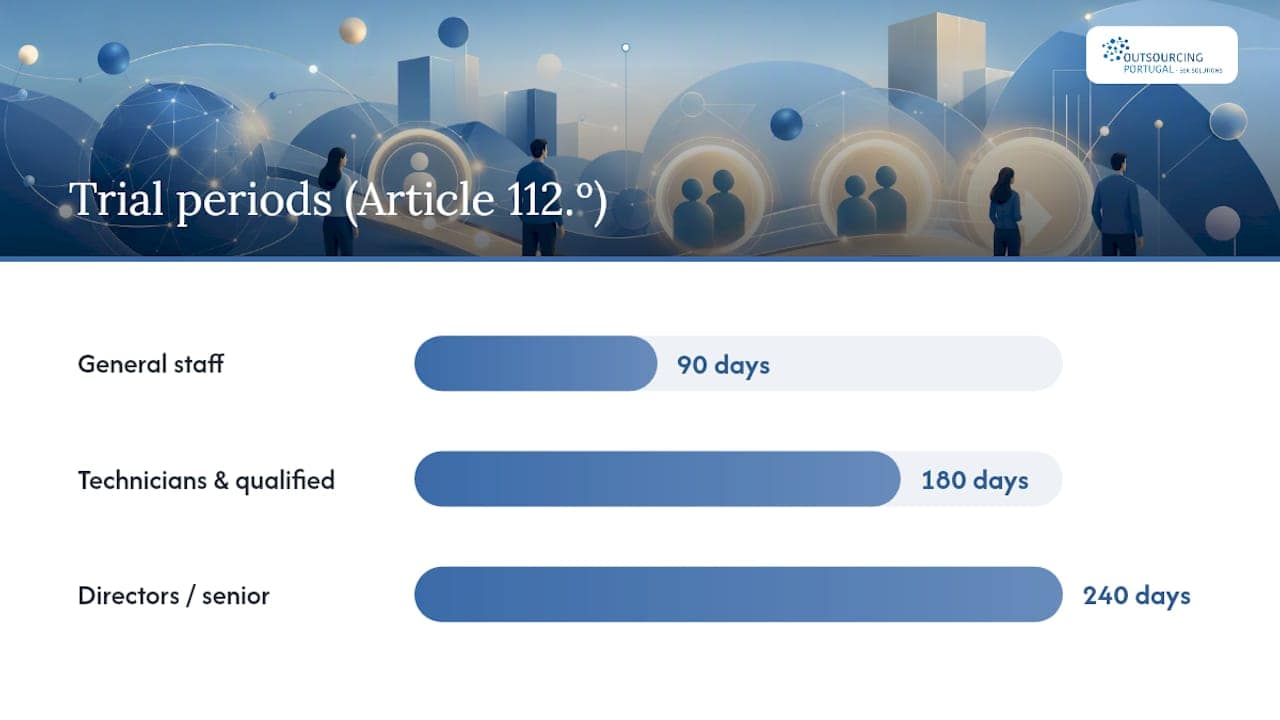
The trial period is where a lot of HR teams get tripped up, mostly because they assume one duration fits every hire. Article 112.º actually sets three separate windows depending on the role:
- 90 days for the general workforce on a contrato sem termo
- 180 days for technicians and other qualified, complex-function roles
- 240 days for company directors and quadros superiores (senior management)
- Shorter, proportional periods apply to fixed-term contracts, scaled to contract length
Pro Tip: Check the candidate’s prior work history before assuming a full trial period applies. Previous service in the same role, a completed internship, or earlier fixed-term work at your company can shrink or eliminate the trial period entirely, and HR teams routinely overlook prior service accumulated across different employers, per CGTP’s guidance on período experimental.
Written agreements or collective bargaining terms can also adjust these defaults. One practical landmine worth flagging: a constitutional ruling limited how far employers can stretch a “first job” subclause to extend trial periods, so don’t assume you can default to the longest window just because a hire is new to the workforce.
Employer Obligations, Compliance Steps, and Common Risks
Compliance starts before the employee’s first day. Register every new hire with Social Security by their actual start date. There’s no grace period, and backdating registration invites scrutiny.
Written contracts are legally mandatory for fixed-term arrangements, part-time work, and a handful of other specific categories. For a contrato sem termo, a written document isn’t always required by law, but skipping it removes your ability to prove agreed terms if a dispute arises.
At minimum, put in writing:
- Identification of both parties and the workplace
- Job title, duties, and reporting structure
- Salary, payment method, and schedule
- Start date and any trial period terms
Pro Tip: Keep a signed copy of every contract and registration confirmation in a centralized file. If the Autoridade para as Condições do Trabalho (ACT) audits your business, missing paperwork is treated the same as noncompliance, even when the underlying pay and hours were correct.
Noncompliance carries real teeth: fines from the ACT, exposure to conversion claims, and liability for back pay or indemnities if a court finds the employment relationship was mischaracterized.
Weighing the Costs and Benefits of a Contrato Sem Termo
Hiring on a contrato sem termo trades flexibility for stability, and that trade shows up on both sides of the balance sheet.
On the upside, permanent contracts tend to lower turnover, which matters when you’re building institutional knowledge in a specialized role. Some hiring incentives and Social Security contribution reductions are tied specifically to open-ended hires, and you avoid the administrative churn of renewing fixed-term agreements every few months.
The costs are real too. Dismissing an employee on a contrato sem termo without just cause triggers notice periods and severance calculated on tenure and base salary, a materially different exposure than ending a fixed-term contract at its natural expiry, as outlined in e-konomista’s overview of employer obligations.
A quick way to decide:
- Choose sem termo for core, ongoing functions where you expect a multi-year relationship
- Choose a termo for genuinely temporary needs: seasonal spikes, project work, or covering a leave of absence
- Consider an EOR structure when you’re testing the Portuguese market and don’t yet want the long-term liability of a direct permanent hire
How to Hire Compliantly on a Contrato Sem Termo
Getting from offer letter to first payroll run without a misstep takes a defined sequence, not improvisation.
- Draft the offer letter and confirm role classification (which duration category applies for trial-period purposes).
- Prepare the written contract terms covering identity, pay, duties, and start date, even when a written contract isn’t strictly mandatory.
- Register the employee with Social Security no later than their first working day.
- Complete onboarding documentation and confirm any prior-service history that affects the trial period.
- Run the first payroll cycle and verify tax withholding and contribution rates are set up correctly.
- Store signed records centrally for audit readiness.
Companies without a legal entity in Portugal, or those unsure how local practice actually works day to day, often skip this entire sequence by using an Employer of Record. An EOR like Outsourcing-portugal becomes the legal employer on paper, handling contract drafting, Social Security registration, and payroll while you manage the working relationship directly.
Pro Tip: If you’re scaling fast in Portugal but haven’t decided whether to open a local entity, an EOR arrangement buys you time. You get compliant hiring now and can transition to direct employment later without disrupting the employee relationship.
Best Practices for Contrato Sem Termo Hiring
Three habits separate HR teams that avoid disputes from those that end up in labor court. First, treat the trial period as a genuine evaluation tool, not a formality, and document performance during it. Second, always check a candidate’s prior service history before setting trial-period length. Third, register every hire with Social Security the same day they start, no exceptions. For international employers navigating this without local infrastructure, a compliance-first partner such as Outsourcing-portugal removes most of the guesswork.
— Paulo
Hiring on a Contrato Sem Termo Without the Local Guesswork
Outsourcing-portugal gets you compliant open-ended hires in Portugal without the months it takes to register a local entity first. Instead of researching Article 147.º triggers and Social Security deadlines yourself, you hand the contract drafting, registration, and payroll to a team that already runs this process daily.
That’s the practical difference: a traditional route means incorporating a Portuguese entity, hiring local counsel, and building payroll infrastructure before you sign a single employee. Outsourcing-portugal’s Employer of Record services let you skip that setup entirely. Contracts get drafted to match the role’s correct trial-period category, Social Security registration happens on schedule, and payroll runs through a system built specifically for Portuguese compliance requirements.
If you’re ready to hire your first employee in Portugal or convert an existing arrangement into a properly structured contrato sem termo, start with Outsourcing-portugal’s main services page to see which setup fits your timeline.
Sources
- Artigo 147.º – Contrato de trabalho sem termo
- Artigo 112.º – Duração do período experimental
- Contrato sem termo: tudo o que deve saber