
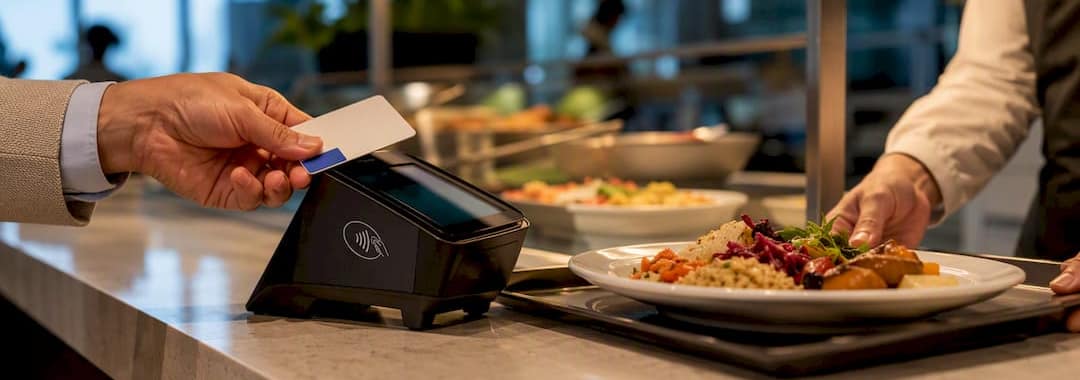
The subsídio de alimentação is Portugal’s meal allowance, paid on top of salary to cover a worker’s cost of eating on workdays. It is mandatory only when a contract or collective agreement requires it, and not by default under the Código do Trabalho. For 2026, the public-sector daily rate is €6.15 in cash, while the meal-card exemption ceiling runs higher, and most private employers pay it through a card rather than cash.
TL;DR:
- The 2026 public-sector meal allowance rate is €6.15 per day, with private employers referencing the higher exemption ceiling of roughly €10.455 for tax benefits.
- The meal allowance is only mandatory if specified in the employment contract or collective agreement, with public-sector employees having a statutory entitlement.
- Payments made via meal cards provide a higher tax-exempt ceiling than cash, making them more cost-effective for employers intending to offer the subsidy.
- Exceeding the daily exemption ceiling triggers taxation as regular income, requiring payroll split between exempt and taxable amounts.
- Employers should regularly review their contracts and exemption thresholds each January to ensure compliance, and consider outsourcing payroll to manage updates efficiently.
Table of Contents
- What Is the Subsídio de Alimentação Portugal Benefit, Legally?
- Is the Meal Allowance Mandatory in Portugal?
- 2026 Daily Values: Cash vs. Card Limits Explained
- IRS and TSU: How the Meal Subsidy Is Taxed
- Who Qualifies for the Meal Allowance and Under What Conditions?
- Calculating Monthly Subsidy Amounts and Handling Absences
- Cash, Card, or Company Meals: Comparing Payment Methods
- Employer Obligations: Contracts, Records, and Compliance
- Special Cases: Garnishment, Sick Leave, and Maternity
- What Changed for Subsídio de Alimentação in 2026
- Does the Meal Allowance Actually Improve Retention?
- How Portugal’s Meal Subsidy Compares to the Rest of the EU
- The Compliance Checklist Employers Should Run Now
- Let Outsourcing Portugal Handle Your Meal Subsidy Compliance
- Sources
- FAQ
What Is the Subsídio de Alimentação Portugal Benefit, Legally?
The subsídio de alimentação is defined in Portuguese labor practice as an extrassalarial benefit: money paid to compensate a worker’s daily meal cost, separate from base salary. The Diário da República lexicon entry on subsídio de refeição frames it exactly this way, distinguishing it from remuneration proper.
That distinction has real consequences. Because the allowance sits outside remuneration, it is generally excluded from the calculation base for seniority-linked pay, overtime, and other salary-indexed benefits, unless a contract or collective bargaining instrument (IRCT) says otherwise.
The public sector’s daily value is set annually by government portaria, not by the labor code itself. For 2026, that instrument is Portaria n.º 51-B/2026/1, published in the Diário da República, which revokes the prior year’s portaria and fixes the new rate. Private-sector employers are not bound to match this figure, but it functions as the reference point the tax code uses to calculate exemption ceilings for everyone else. Anyone verifying a specific clause should read the primary text rather than relying on a summary, since portarias are amended and republished more often than most HR calendars track.
Is the Meal Allowance Mandatory in Portugal?
No blanket law forces private employers to pay it. The obligation exists only when it appears in an individual employment contract or in the applicable collective agreement covering that sector. Many sectors have negotiated it into their IRCTs over the decades, so it is common but not legally automatic.
Civil servants are the exception. For public administration employees, the daily value fixed by Portaria n.º 51-B/2026/1 is a statutory entitlement, paid at €6.15 per day worked as of January 1, 2026.
In the private sector, once an employer commits to paying the subsidy, either explicitly or through consistent practice, withdrawing it unilaterally can trigger a breach-of-contract claim. Courts have treated a long-standing, unchallenged practice as effectively part of the employment terms, even without a written clause. Employers who want flexibility should document the benefit’s terms precisely rather than let it become an unwritten habit that hardens into an obligation.
2026 Daily Values: Cash vs. Card Limits Explained
The public-sector cash rate is €6.15 per day for 2026, set by Portaria n.º 51-B/2026/1. That figure matters beyond the public sector because it anchors the tax-exemption ceilings private employers rely on when structuring pay.
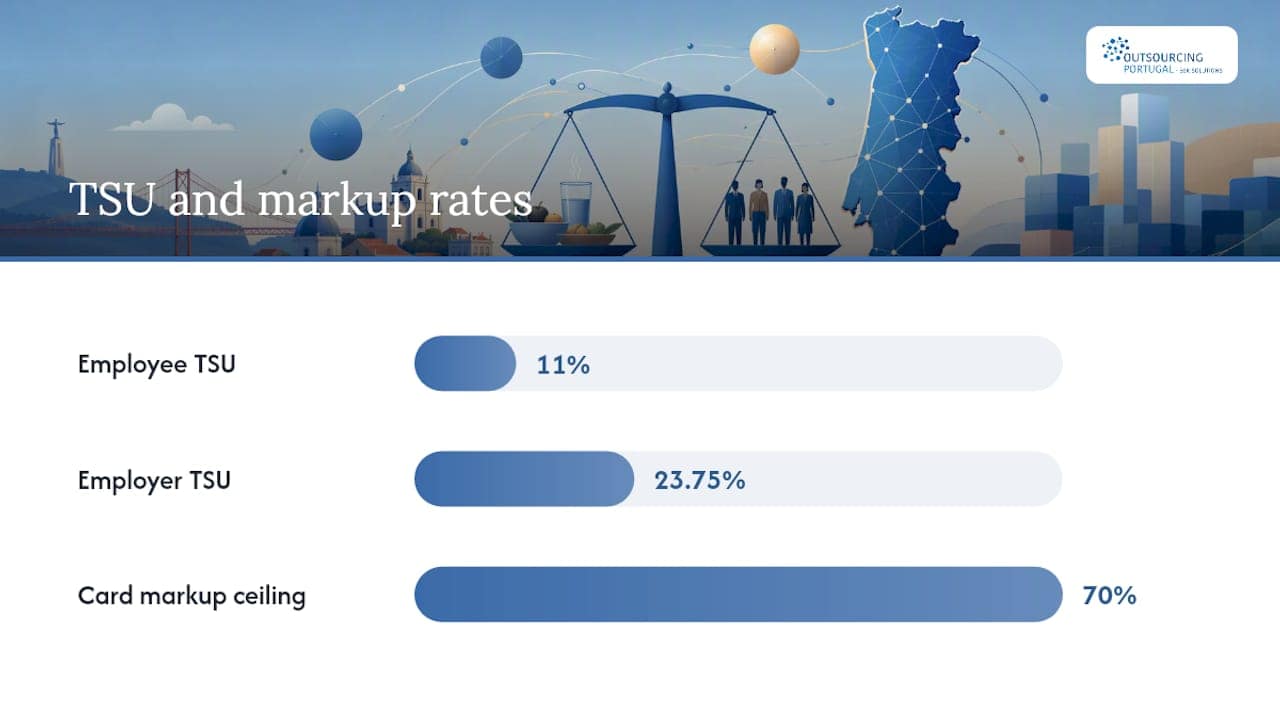
Here is the mechanism most guides skip: the IRS exemption for meal cards is not the same number as the cash exemption. Tax rules allow the card ceiling to sit 70% above the public-sector cash reference, which is why reporting on the 2026 figures puts the card exemption at roughly €10.455 per day. Pay the same benefit in cash instead of on a card, and the tax-free portion shrinks substantially, with the difference taxed as income above the lower ceiling.
That gap explains why most Portuguese employers moved to cards years ago, even before the 2026 update widened it further.
- Cash payment: exempt up to €6.15/day for reference purposes; anything paid above the applicable cash ceiling counts as taxable income.
- Meal card: exempt up to roughly €10.455/day, using the 70% markup rule.
- Monthly impact: at 22 working days, a card paid at the exemption ceiling delivers roughly €230 tax-free monthly, versus about €135 for the equivalent cash payment at its lower ceiling.
For an employer choosing between formats, that monthly gap is the number worth putting in front of a finance director before any decision gets made.
IRS and TSU: How the Meal Subsidy Is Taxed
Both exemption ceilings work the same way from the worker’s side: any amount paid up to the applicable daily limit is exempt from IRS, meaning it does not count toward the employee’s taxable income for the year. It is also excluded from the Taxa Social Única (TSU) base, so the employer avoids social security contributions on that portion too.
Cross that limit, though, and the excess behaves like ordinary salary. It gets added to taxable income for IRS withholding purposes, and the employer must apply TSU contributions on the overage as if it were regular pay. Payroll software needs to split each payment into an exempt slice and a taxable slice whenever the daily rate exceeds the ceiling, rather than treating the whole subsidy as one lump.
- Exempt portion: no IRS withholding, no TSU on the employee or employer side.
- Excess above the ceiling: added to gross taxable pay, subject to IRS tables and full TSU (roughly 11% employee, 23.75% employer).
- Card payments benefit from the higher 70% markup ceiling before any of this taxable treatment kicks in.
- Cash payments hit the taxable zone sooner, since the ceiling is lower.
Accounting entries should record the subsidy on a separate payroll line from base salary, both because it is extrassalarial and because Portuguese tax authorities expect that split during audits.
Pro Tip: Run a quarterly check comparing your actual daily subsidy rate against the current exemption ceiling. Portarias change annually, and a rate that was fully exempt last year can slip into partially taxable territory the moment the government updates the reference value.
Who Qualifies for the Meal Allowance and Under What Conditions?
Entitlement rules are more nuanced than a flat “everyone gets it” assumption, and they change based on hours worked and where the work happens.
- Full-time employees working a standard schedule generally receive the full daily value for everyday actually worked, assuming the benefit is contractually owed.
- Part-time employees are usually entitled on a pro rata basis, and the common threshold applied in practice is that a worker must complete more than five hours in a given day to trigger that day’s allowance. Shorter shifts often fall outside the entitlement window, though the exact cutoff depends on the governing contract or IRCT.
- Telework employees are entitled to the same subsidy as their office-based peers doing equivalent work, under the principle of equal treatment that Portuguese labor law applies to remote arrangements.
- Night-shift and rotating-shift workers sometimes see adjusted values under sector-specific collective agreements, particularly in industries like hospitality and manufacturing where shift patterns disrupt normal meal timing.
The common thread across all four categories: whatever the contract or IRCT specifies controls the outcome, not a one-size-fits-all national rule.
Calculating Monthly Subsidy Amounts and Handling Absences
The core formula is simple: daily value multiplied by days actually worked in the month. The complications show up around the edges, in absences and calendar quirks.
- Count working days for the month. A typical Portuguese month has either 21 or 22 working days, depending on how weekends and holidays fall.
- Multiply by the daily rate. At €6.15/day cash, 22 working days produces €135.30 for the month; at the roughly €10.455/day card ceiling, the same 22 days yields about €230.01.
- Subtract non-working days. Vacation days, public holidays, and unpaid absences are generally not paid unless the employment contract or IRCT explicitly extends the subsidy to those days, a point confirmed in guidance on meal-card usage rules.
- Reconcile card loads against actual attendance. Card providers typically load funds on a schedule set at the start of the month, so payroll teams need a correction process for late absences reported after the load date, to avoid overpaying.
Sick leave follows the same default rule as vacation: no subsidy unless the contract says so, since the days are not worked.
Cash, Card, or Company Meals: Comparing Payment Methods
Portugal offers employers three practical routes for delivering this benefit, and each comes with different administrative and fiscal trade-offs.
Cash payment is the simplest to administer, added directly to the payslip, but it carries the lower exemption ceiling and heavier tax exposure once payments exceed €6.15/day.
Meal cards dominate the private sector for good reason. The Pluxee guide to meal cards in Portugal confirms the fiscal logic: cards carry a materially higher exemption ceiling than cash, which is why so many companies migrated to them well before the 2026 rate increase widened the gap further.
Employer-provided meals, such as an on-site canteen or meal vouchers redeemable at a cafeteria, remain rare outside large industrial employers, mostly because of the operational overhead of running food service.
- Cash requires no third-party provider but taxes more of the benefit once above the ceiling.
- Cards need a provider relationship (like Pluxee or similar issuers) and carry merchant restrictions.
- Cards cannot be converted to cash and can only be spent at authorized food and grocery merchants, a rule the e-konomista guide to meal cards spells out clearly.
- Employer-run meal service shifts the administrative burden onto facilities rather than payroll.
Pro Tip: Before switching an existing cash-paid workforce to cards, check whether your current contracts specify “cash” by name. If they do, HR guidance on the topic notes that changing payment mode without renegotiation can trigger disputes, even when the switch objectively benefits the employee through a higher exemption ceiling.
Employer Obligations: Contracts, Records, and Compliance
Getting the meal allowance right starts with paperwork most employers underestimate. If the benefit is owed under an IRCT, the contract should reference that instrument rather than restate a figure that might change annually. If it is a company policy rather than a sector obligation, spell out the daily value, payment mode, and any exclusions for absences directly in the employment contract.
Changing an established payment mode, cash to card or vice versa, is legally possible but risky without proper process. HR analysis on the topic stresses that switching modes unilaterally invites disputes, so document the change, give reasonable notice, and get written acknowledgment where the contract allows it.
Recordkeeping matters most around days worked. Payroll needs accurate attendance data to avoid over-loading meal cards for absent employees or underpaying staff who worked extra days. Sector guidance on vale refeição costs and administration points to a common failure mode: manual tracking across multiple providers creates reconciliation errors that surface months later during an audit.
For foreign companies without a Portuguese HR team, this is exactly where payroll outsourcing or an Employer of Record arrangement removes the guesswork, since local specialists already track the annual portaria updates and adjust templates without being asked.
Special Cases: Garnishment, Sick Leave, and Maternity
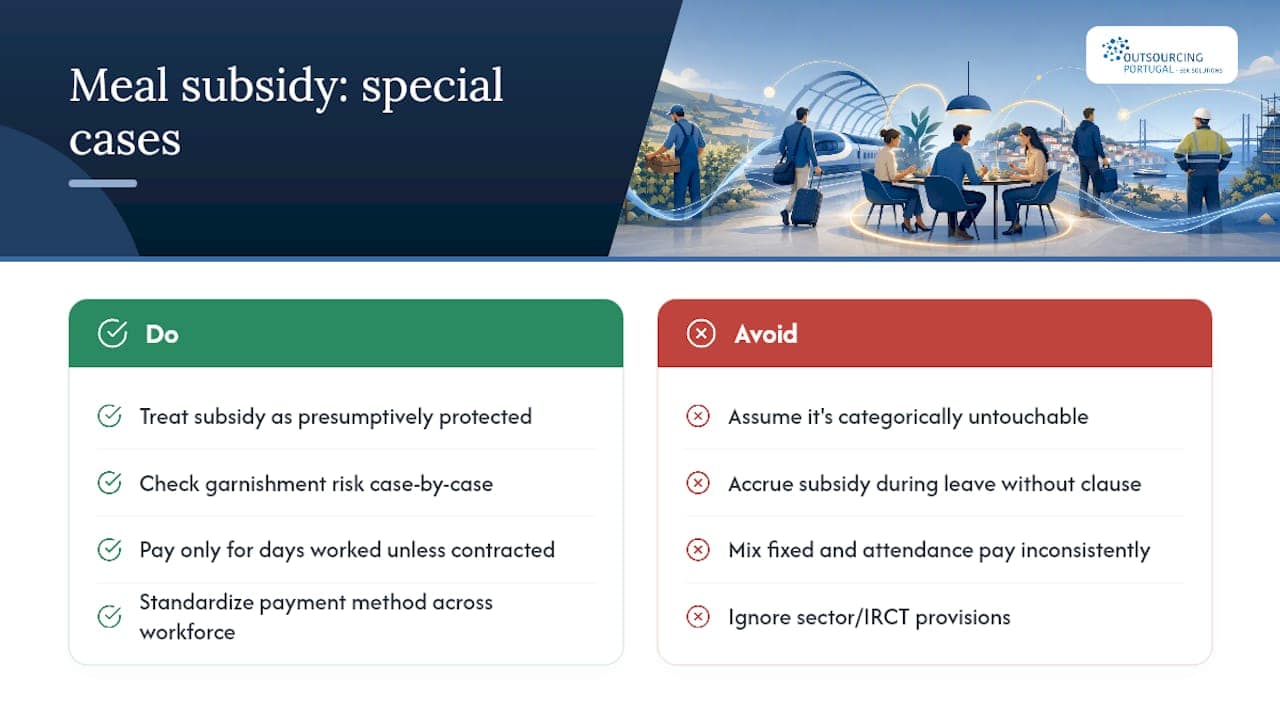
Garnishment (penhora) is one of the most misunderstood areas of this benefit. Meal-card balances are generally treated as non-penhorable while they retain their character as a meal subsidy rather than ordinary salary, according to guidance in the e-konomista meal-card explainer. That protection is not absolute. Courts and enforcement authorities weigh garnishment requests against the debtor’s subsistence needs and total income, so a creditor pursuing wage garnishment can still reach funds if the overall financial picture justifies it. Treat the subsidy as presumptively protected, not categorically untouchable.
Sick leave follows the general absence rule: no subsidy accrues for days not worked, since Social Security, not the employer, covers income during most sick leave periods, and the meal allowance is tied to actual attendance.
Maternity and parental leave work similarly. Because the employee is not physically working those days, the default position is no subsidy accrual, unless a specific contract clause or IRCT extends the benefit through leave periods, which some more generous sector agreements do.
Contractual variations show up constantly in practice. Some companies pay a fixed monthly amount regardless of exact attendance, smoothing out the daily calculation, while others tie every euro to logged hours. Neither approach is wrong, but mixing them inconsistently across a workforce is a common source of internal pay-equity complaints, particularly once employees start comparing payslips.
What Changed for Subsídio de Alimentação in 2026
The headline update for 2026 is the new public-sector daily rate. Portaria n.º 51-B/2026/1 raised the reference value to €6.15 per day effective January 1, 2026, revoking the previous portaria that had governed the prior rate.
When the government adjusts the reference rate, as coverage of the 2026 update explains, the card exemption ceiling rises in lockstep, pushing it to roughly €10.455/day this year.
For employers, this means payroll templates set up in prior years using the old ceiling are now out of date. Any company still running exemption calculations off last year’s figures risks either under-reporting taxable income (a compliance exposure) or over-restricting the tax-free portion of payments (an unnecessary cost to the business, since more of the subsidy could legally be exempt).
Government budget pages tracking the Orçamento do Estado also reference these annual portaria updates as part of the broader public-sector pay framework, though the specific meal-subsidy figure lives in the standalone portaria rather than the budget law itself. Employers should treat each January as a mandatory review point for this one line item, since the rate has moved nearly every year in recent memory.
Does the Meal Allowance Actually Improve Retention?
Employees in Portugal routinely cite the meal subsidy as one of the most tangible, immediately felt benefits in a compensation package, more so than benefits that pay out annually or require paperwork to claim. It lands every payday, it is visible on the payslip or card balance, and it directly offsets a real daily cost.
That immediacy carries weight in a labor market where salary negotiations move slowly but competition for skilled workers, especially in tech and multilingual service roles, remains intense. A generous meal-card program costs an employer far less than an equivalent salary increase, thanks to the TSU and IRS exemptions covered earlier, while still registering as a meaningful perk to the employee receiving it.
Companies hiring internationally into Portugal sometimes skip this benefit entirely, assuming it is a minor line item not worth the administrative setup. That is a mistake in a market where local candidates expect it as baseline practice. Omitting it, or paying it inconsistently compared to Portuguese-market peers, can make an otherwise competitive offer look thin to a candidate comparing multiple opportunities.
How Portugal’s Meal Subsidy Compares to the Rest of the EU
Portugal’s approach, a daily allowance paid through cash, card, or employer meals, sits within a broader European tradition of subsidizing worker meals, though the mechanics differ sharply by country. France runs a similar titre-restaurant voucher system with its own exemption ceilings and merchant restrictions. Belgium and Luxembourg both operate meal-voucher schemes with tax advantages comparable in spirit to Portugal’s card exemption, though the specific daily caps and eligibility rules are set independently under each country’s own tax code.
Few EU markets tie the two so mechanically, which means Portugal’s private-sector tax treatment shifts every time the government revises a single reference number for civil servants. For an international employer benchmarking benefits packages across several EU hiring markets, that volatility is worth flagging to finance teams who might otherwise assume the exemption ceiling is a fixed constant like it is in some neighboring systems.
The Compliance Checklist Employers Should Run Now
Getting this benefit right in 2026 comes down to four checks, and most employers skip at least one of them. Pull every employment contract and applicable IRCT and confirm exactly what they promise on the meal subsidy, because assumptions based on “what we’ve always done” are how disputes start.
Recalculate your exemption ceilings against the 2026 figures. If your payroll template still references last year’s card ceiling, you are either overtaxing employees or under-reporting to the tax authority.
Decide deliberately between cash and card rather than defaulting to whatever a previous HR manager set up. The card route wins on tax efficiency for nearly every company, but that decision should be documented, not inherited. And if your organization is hiring in Portugal without a local entity, weigh whether managing card providers, exemption math, and annual portaria updates internally is worth the risk compared to handing it to a specialist who already tracks this every January.
— Paulo
Let Outsourcing Portugal Handle Your Meal Subsidy Compliance
Outsourcing-portugal exists for exactly the gap this article just walked through: foreign companies that want their Portuguese employees paid correctly, taxed correctly, and compliant with the latest portaria, without hiring an internal HR team to track annual rate changes.
Our payroll outsourcing service calculates the meal subsidy alongside base salary every cycle, applying the correct 2026 exemption ceilings automatically and coordinating directly with card providers so balances match actual attendance. For companies that don’t want a Portuguese legal entity at all, our Employer of Record service puts the entire employment relationship, meal subsidy included, under a compliant local structure while you keep day-to-day management of the employee. Support is provided in English, and onboarding typically enables a new hire to be operational within days rather than weeks. If you’re planning to hire in Portugal this year, contact Outsourcing Portugal for a free consultation on how the 2026 meal-subsidy rules apply to your specific hiring plan.
This article is general information, not a substitute for advice from a qualified financial advisor. Consult a qualified financial professional about your own circumstances before acting on anything here.
Sources
- Afinal, quanto se ganha de subsídio de refeição este ano? É obrigatório? – Notícias ao Minuto
- Subsídio de refeição (ou alimentação) | DR
- Cartão refeição guide (e-konomista)
- Não quer receber o subsídio de refeição em cartão? Saiba se pode exigir essa mudança – HRPortugal
FAQ
How many hours must I work to receive the meal allowance?
Full-time employees typically qualify for each full day worked, while part-time workers generally need to complete more than five hours in a day to trigger that day’s entitlement. The exact threshold depends on your contract or the applicable collective agreement.
What is the minimum meal subsidy value in 2026?
There is no universal legal minimum for private-sector employers, since payment depends on contract terms. The public-sector reference value is €6.15 per day for 2026, and it functions as the anchor for private-sector tax exemption ceilings even where the employer is not required to match it.
How is the meal allowance calculated each month?
Multiply the applicable daily rate by the number of days actually worked that month, which is usually 21 or 22 days. Days not worked, such as vacation, public holidays, or unpaid absence, are excluded unless your contract or IRCT specifically extends the subsidy to those days, per guidance from the e-konomista meal-card explainer.
When can I lose the right to the meal allowance?
You lose entitlement for any day you don’t actually work, including vacation, most sick leave, and unpaid absences, unless your contract states otherwise. Switching employers mid-month, working fewer than the contractual daily-hour threshold on a part-time schedule, or having no contractual or collective-agreement basis for the benefit in the first place can also mean no entitlement exists at all.
Does Outsourcing Portugal handle meal-card setup for foreign employers?
Yes. Outsourcing Portugal’s payroll services include calculating and administering the meal subsidy, coordinating with card providers, and applying current exemption ceilings so foreign employers stay compliant without a local HR team.