

If your company has a taxable relationship with Portugal and you live outside the EU or EEA, you must appoint a fiscal representative or enroll in electronic notifications within 15 days of the triggering event. Skip both, and the Tax Authority can fine you between €75 and €7,500. Check Gov or the Portal das Finanças to confirm which route applies to your situation.
TL;DR:
- Foreign companies with a taxable relationship in Portugal must appoint a VAT-registered fiscal representative or enroll in electronic notifications within 15 days to avoid fines between €75 and €7,500, especially if engaged in activities like owning property, registering vehicles, signing employment contracts, or providing services subject to VAT.
- A valid fiscal representative must have genuine tax residence or a registered office in Portugal; informal contacts or friends without VAT registration cannot fulfill legal requirements, particularly for VAT-related activities.
- The appointment is made through the Portuguese tax portal by submitting a signed declaration of acceptance, and it remains valid as long as the taxable relationship persists, requiring annual checks to avoid unknowing lapses or non-compliance.
- Enrolling in electronic notifications through NCEPF or ViaCTT offers a costless alternative for property owners, but it does not replace the need for a registered VAT-liable representative for VAT filings.
- For companies with broader operations or cross-border complexities, consolidating fiscal representation, legal, and payroll compliance under an employer-of-record service can streamline Portugal’s tax obligations and reduce risks.
Table of Contents
- Who Needs a Fiscal Representative in Portugal?
- Who Can Act as Your Fiscal Representative?
- How Do You Appoint a Fiscal Representative in Portugal?
- What Are the Electronic-Notification Alternatives?
- How Do You Choose the Right Fiscal Representative?
- How Long Does a Fiscal Representative Appointment Last?
- What Does a Fiscal Representative Actually Do?
- How Do You Revoke or Change Your Fiscal Representative?
- Does EU or Non-EU Status Change Your Obligations?
- How Does This Affect VAT Filing and Payments?
- A Practitioner’s View on Getting This Right
- Solving Fiscal Representation Alongside Your Broader Portugal Setup
- Sources
- FAQ
Who Needs a Fiscal Representative in Portugal?
The duty kicks in the moment you create a taxable relationship with Portugal while living outside the country. That relationship can take several forms, and most foreign companies trip into one without realizing it.
You’ve established a taxable relationship if you:
- Own Portuguese real estate, whether commercial or residential
- Register a vehicle in Portugal under a company or personal name
- Sign an employment contract with a Portuguese entity or employee
- Start any activity subject to VAT, including invoicing Portuguese clients
Here’s where it gets specific: residents of the EU or EEA are generally exempt from mandatory representation. Residents of third countries, meaning anywhere outside the EU/EEA, don’t get that pass. Decreto-Lei n.º 44/2022 reshaped this rule by letting many non-residents avoid representation entirely through electronic notifications, but the exemption has a hard limit. If your business runs a self-employed activity subject to VAT, you still need a VAT-registered representative in Portugal, full stop. No amount of digital enrollment gets you out of that one.
Who Can Act as Your Fiscal Representative?
Portugal doesn’t let just anyone take on this role. The representative needs a genuine tax residence or registered office inside the country. A foreign national or foreign company can technically serve as your representative, but only if that person or entity is already resident or registered in Portugal, not simply willing to sign a form from abroad.
The VAT scenario adds another layer. If your business carries out self-employed activity subject to VAT, the representative must be a VAT-taxable person resident in Portugal, and in certain VAT situations, that representative can carry joint liability for tax obligations. That’s a meaningfully bigger commitment than passively receiving mail on your behalf.
In practice, three categories of people take on this role:
- Individual residents, often a trusted local contact, workable for simple property ownership cases but risky for anything involving VAT or ongoing filings
- Certified accountants, a solid fit for companies that need regular tax return support alongside representation
- Lawyers and specialized tax firms, better suited to companies facing disputes, complex cross-border structures, or joint VAT liability exposure
Pro Tip: Never appoint a friend or informal contact as your fiscal representative if your company has any VAT-subject activity. If they aren’t a VAT-taxable person registered in Portugal, the appointment doesn’t satisfy the legal requirement, and you’re still exposed to the fine.
How Do You Appoint a Fiscal Representative in Portugal?
Most companies handle this online, though an in-person route exists for anyone who prefers it or hits a technical snag.
- Log into Portal das Finanças using your NIF (Portuguese tax number) and password.
- Navigate to “Todos os Serviços” and select “Dados Cadastrais,” then choose “Representante.”
- Select “Entregar Nomeação” and pick the correct scope, either IRS alone or the combined IVA & IRS scope if VAT is involved.
- Submit the representative’s details along with a signed declaration of acceptance or power of attorney confirming they agree to the role.
- Wait for the representative to formally accept the nomination through their own Portal das Finanças account. An appointment without express acceptance is not valid.
- Alternatively, visit a Serviço de Finanças office or a Loja do Cidadão in person, where staff can process the nomination and confirm acceptance on the spot.
Keep proof of the representative’s consent on file. If a dispute ever arises over whether representation was properly in place, that documentation is what protects you from a fine you didn’t actually deserve.
What Are the Electronic-Notification Alternatives?
Instead of naming a person, you can opt into electronic notifications through two channels: NCEPF on the Portal das Finanças and ViaCTT, Portugal’s digital mail service tied to the postal operator. Enrollment happens directly on the portal under your tax profile settings, and once active, official notices land in your digital mailbox instead of a paper letter sent to a representative.
This route has become popular with non-resident property owners for a simple reason: it costs nothing and delivers notices faster than relying on a third party to forward them. No representative fees, no coordination lag.
But the limitation matters. Electronic notifications do not substitute for representation when you’re conducting a VAT-subject self-employed activity. If that describes your situation, you need the VAT-registered representative regardless of whether you’ve also enrolled in NCEPF or ViaCTT. The two systems solve different problems, and conflating them is one of the more common mistakes foreign business owners make.
How Do You Choose the Right Fiscal Representative?
Run through this checklist before signing anything:
- Confirm the candidate has genuine Portuguese tax residence or a registered office, not just a mailing address
- Verify VAT registration if your activity requires a VAT-taxable representative
- Get written acceptance of the appointment, not a verbal agreement
- Clarify the scope of services: is this pure representation, or does it include ongoing filings?
- Ask about fees upfront, including any per-filing or annual retainer costs
- Check language capability, since misunderstandings over tax correspondence create real risk
- Ask about professional indemnity insurance, particularly for joint-liability VAT situations
Provider type should match your complexity. Certified accountants work well for companies that need routine filings alongside representation. Lawyers make more sense when you’re facing disputes or a tangled cross-border structure. Specialized tax firms, including those detailed in guidance from PH Advogados, tend to suit companies that want full-service compliance handled under one roof rather than juggling separate vendors. Accountants weighing their own client outreach might also look at SEO support built for accounting practices as a way to grow that side of their business.
Pro Tip: Insist on a written acceptance letter that spells out the representative’s exact responsibilities and fee structure before you submit the nomination. A vague verbal promise to “handle it” is the single biggest red flag in this entire process.
How Long Does a Fiscal Representative Appointment Last?
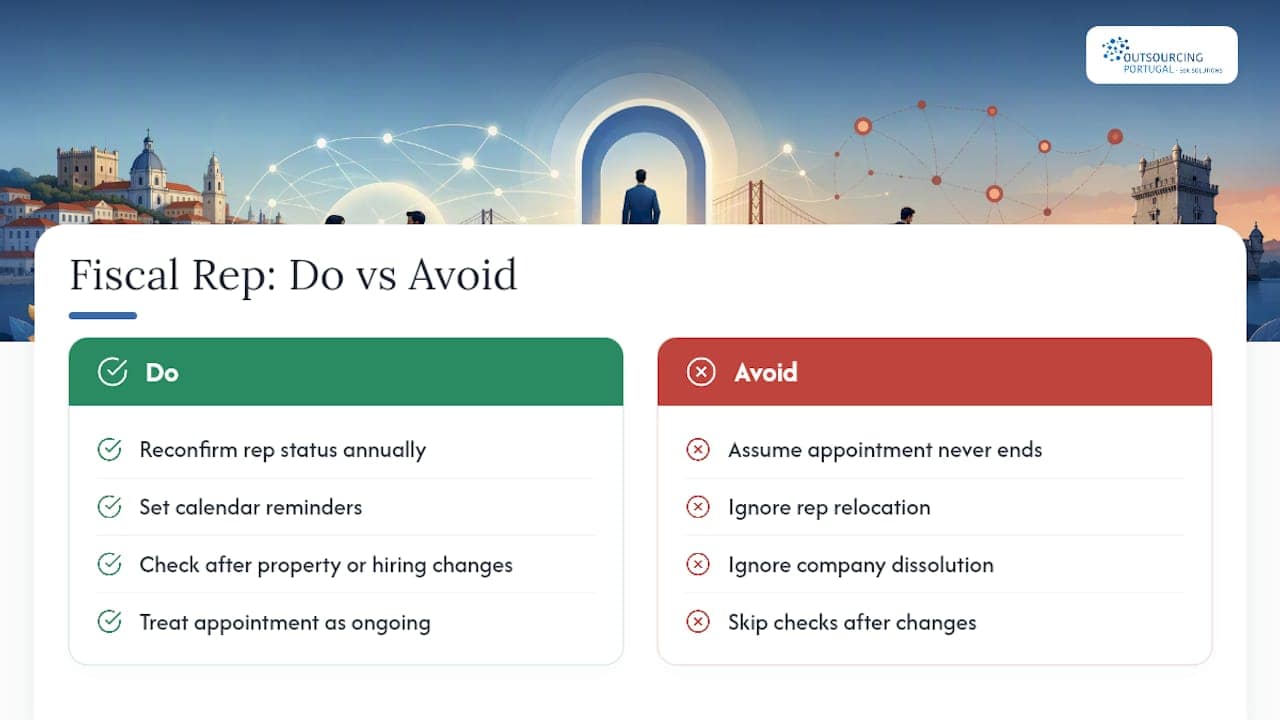
There’s no fixed expiration date stamped on the appointment itself. Representation stays valid as long as the taxable relationship that triggered it continues to exist. Own a Portuguese property for ten years, and your representative arrangement should, in theory, run the same course, provided nothing changes on either side.
That said, the appointment isn’t indestructible. It ends automatically if the underlying trigger disappears, say you sell the property, terminate the employment contract, or wind down the VAT-subject activity that required a VAT-registered representative in the first place. It also ends if you become an EU/EEA resident, since that shifts your status out of the mandatory-representation category entirely.
Representatives can resign, companies can dissolve, individuals can move away from Portugal themselves. None of those events trigger an automatic notification to you. This is why periodic check-ins matter more than most foreign companies assume. A representative who quietly stopped being eligible, because they relocated abroad or lost their VAT registration, leaves you unknowingly out of compliance until a notice goes unanswered and the fine shows up.
Build a calendar reminder to reconfirm your representative’s status at least once a year, especially if your company’s Portuguese footprint has shifted (new property, new hires, a wound-down VAT activity). Treat the appointment as a living arrangement tied to your actual tax situation, not a one-time box you checked and forgot about.
What Does a Fiscal Representative Actually Do?
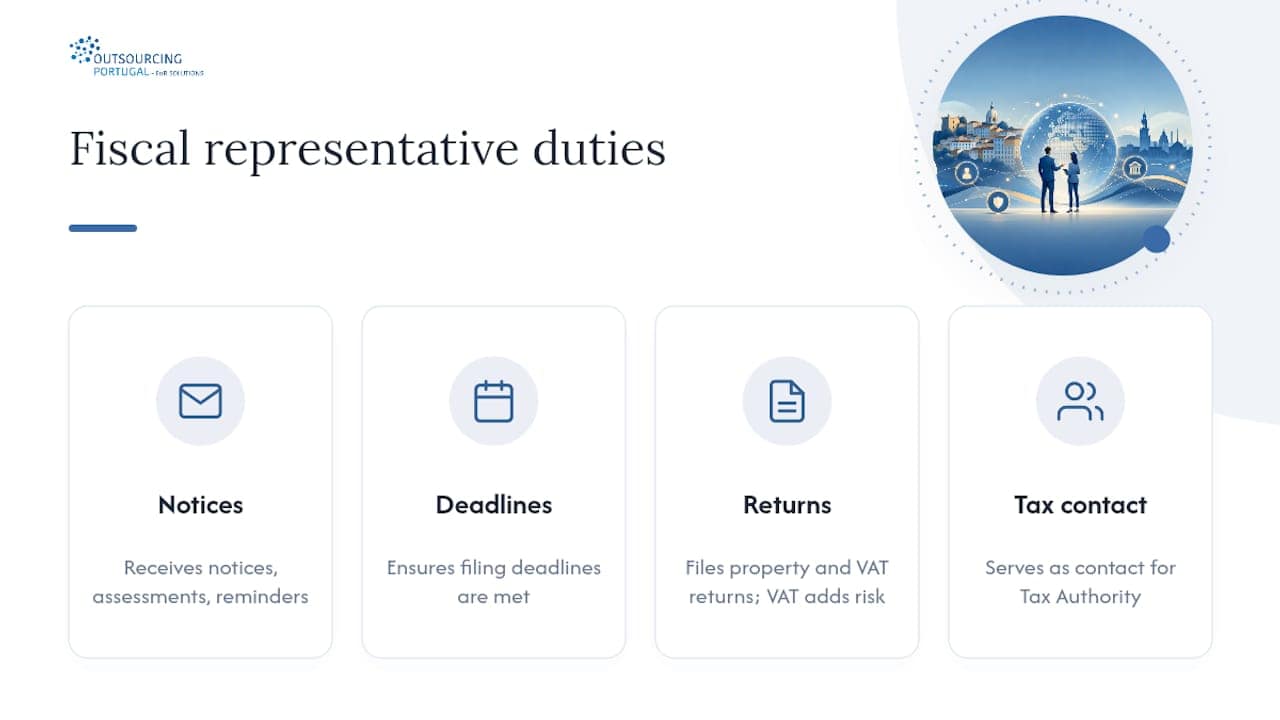
The role goes beyond forwarding mail, though that’s the part most people picture. A fiscal representative acts as the official point of contact between your company and the Portuguese Tax Authority for every notice, deadline, and administrative communication tied to your taxable relationship.
Practically, that means the representative:
Receives and forwards tax notices, assessments, and deadline reminders on your behalf, ensuring you actually see communications that would otherwise go to an address you don’t check. It ensures your company meets filing deadlines tied to whatever triggered the representation, whether that’s an annual property-related return or recurring VAT filings. In VAT-subject cases, the representative may hold joint liability for certain tax obligations, meaning their exposure isn’t purely administrative; they carry real financial risk alongside you. It serves as your point of contact for any Tax Authority correspondence, including audits, information requests, or clarification demands.
That joint-liability piece deserves emphasis. A representative handling straightforward property ownership faces limited exposure. One handling active VAT filings for your business takes on genuine financial risk if returns are wrong or late, which is exactly why VAT representatives tend to charge more and screen clients more carefully before accepting the role.
Without a properly appointed representative or an active electronic-notification enrollment, you also lose the ability to exercise your rights before the Tax Authority, including filing complaints or appeals, a consequence that catches many companies off guard only after they’ve already missed something.
How Do You Revoke or Change Your Fiscal Representative?
Switching representatives follows roughly the same path as the original appointment: log back into Portal das Finanças, navigate to the same “Representante” section under “Dados Cadastrais,” and submit a new nomination naming the replacement.
The new appointment doesn’t take effect until the new representative formally accepts it through their own account, mirroring the acceptance requirement from the initial nomination. Until that acceptance registers, your prior representative technically remains on record, so don’t assume a submission alone completes the switch.
If you’re revoking representation entirely, perhaps because you sold the property or wound down the VAT activity that triggered the requirement, you’ll want to confirm with the Tax Authority that the underlying obligation has genuinely ended before assuming you’re free of the requirement. Simply removing a representative’s name without addressing the taxable relationship that created the duty can leave you non-compliant, even if no one is actively representing you anymore.
Companies switching from an informal individual representative to a professional firm should plan for a short overlap window. Have the outgoing representative confirm in writing that all pending filings and notices are up to date, then hand that documentation to the incoming representative before finalizing the changeover. Gaps in this handoff are where notices get missed and fines start accumulating, often without either party immediately realizing it.
Does EU or Non-EU Status Change Your Obligations?
Your company’s home jurisdiction determines almost everything about whether this requirement applies to you at all. Residents of the EU or EEA generally don’t face the mandatory fiscal representative rule, a distinction rooted in the mutual assistance and information-exchange frameworks that member states share with each other.
Companies based outside the EU/EEA, think the United States, United Kingdom, Brazil, or most of Asia, fall squarely into the category that requires either a Portugal-based representative or enrollment in electronic notifications. That’s the core distinction driving this entire compliance area, and it’s worth restating because so many foreign business owners assume the rule is universal when it specifically targets third-country residents.
The VAT exception cuts across both categories, though. Whether you’re an EU company or a third-country company, if you’re conducting self-employed activity subject to VAT in Portugal, you need a VAT-registered representative resident in the country. EU status doesn’t exempt you from that particular requirement; it only exempts you from the broader representation mandate tied to property ownership, vehicle registration, or employment relationships.
This is where companies often misjudge their exposure. An EU-based business assumes it’s off the hook entirely because it read about the general exemption, then gets caught operating VAT-subject activity without the representative that specific activity requires.
How Does This Affect VAT Filing and Payments?
For companies running VAT-subject activity, the fiscal representative isn’t a passive mailbox; they’re operationally embedded in your filing cycle. Portuguese VAT returns follow monthly or quarterly schedules depending on your turnover, and the representative typically handles submission of those returns alongside payment coordination.
Because the VAT representative can carry joint liability in specific cases, late or incorrect filings expose both your company and your representative financially. That shared risk tends to shape how thoroughly a VAT representative reviews your figures before submission, often more rigorously than a representative handling pure property-related notices would.
Payment timing matters just as much as filing accuracy. Portuguese VAT payments are due alongside the return itself, and a representative who’s slow to process documentation from your side can create a scramble against the deadline. Companies running active sales into Portugal should build a documentation pipeline that gets invoices and records to their representative well ahead of filing dates, not the week the return is due.
If your Portuguese operations extend beyond simple VAT compliance into full payroll and employment tax obligations, that’s a related but distinct set of requirements worth understanding on its own, covered in detail in this guide to employment tax returns for Portugal hires.
A Practitioner’s View on Getting This Right
The mistake Paulo sees most often isn’t ignorance of the rule, it’s timing. Companies find out about the 15-day window after it’s already closed, usually when a fine notice arrives instead of a routine reminder. The second most common issue: informal “representatives,” a friend, a former colleague, someone’s cousin who lives in Lisbon, who don’t hold VAT status and can’t legally satisfy the requirement once a business activity crosses into VAT territory.
A professional solution closes both gaps. It builds the 15-day clock into onboarding instead of treating it as an afterthought, and it puts someone with actual VAT standing in the role when the business needs it.
Some companies work with providers that assist international businesses in navigating compliance alongside broader employment and payroll setup in Portugal, because representation rarely exists in isolation from the rest of a company’s tax footprint here.
— Paulo
Solving Fiscal Representation Alongside Your Broader Portugal Setup
If your company is past the point of needing a single fiscal representative and is actually hiring, paying, or building a team in Portugal, representation becomes one piece of a much larger compliance puzzle. That’s where a coordinated approach pays off: instead of managing a standalone representative, payroll provider, and legal filings separately, Employer of Record services from Outsourcing-portugal fold tax registration, local filings, and payroll compliance into a single managed relationship.
This matters most for companies that started with a simple representative arrangement, maybe to own property or hire one contractor, and have since scaled into something bigger. An EOR structure removes the patchwork of separate vendors and puts one accountable party behind your entire Portuguese compliance picture, from onboarding through ongoing tax obligations.
Sources
FAQ
Who Can Be My Fiscal Representative in Portugal?
Anyone with genuine tax residence or a registered office in Portugal can serve as your representative, including individuals, certified accountants, lawyers, or specialized tax firms. If your business runs VAT-subject self-employed activity, the representative must specifically be a VAT-taxable person resident in Portugal, not just any resident willing to take the role.
How Do I Get a Power of Attorney for a Fiscal Representative in Portugal?
You’ll typically draft a signed declaration of acceptance or power of attorney naming the representative and confirming their agreement to the role, then submit it alongside your nomination on Portal das Finanças. A lawyer or notary can help formalize this document if your company wants added legal certainty around the arrangement.
What Do I Need to Get a Fiscal Representative Set Up?
You need the representative’s identifying details, a signed acceptance declaration or power of attorney, and access to Portal das Finanças to submit the nomination under “Dados Cadastrais.” The appointment must be completed within 15 days of the triggering event, or you risk an administrative fine ranging from €75 to €7,500.
How Do I Avoid Double Taxation Between Brazil and Portugal?
Double taxation between Brazil and Portugal is governed by their bilateral tax treaty, which allocates taxing rights and offers credit mechanisms depending on income type and residency status. Because treaty application depends heavily on your specific facts, income source, and residency history, consult a qualified cross-border tax professional rather than relying on general guidance for this particular question.
What Happens if I Don’t Appoint a Representative or Enroll in Electronic Notifications?
You risk an administrative fine between €75 and €7,500, and you lose the ability to exercise certain rights before the Tax Authority, including filing complaints or appeals. Notices are still considered validly served even if you never see them, which can compound the problem well beyond the initial fine.