

An international employment contract is an agreement between an employer and a worker in different countries, or for work done outside the employer’s home country. The core point is that the contract is judged by the rules of the place where the person works, not by those of your head office. If you want to hire in Portugal without opening a local company, the simplest route is an Employer of Record (EOR), which becomes the legal employer in Portugal. Outsourcing Portugal is a Lisbon-based EOR, so the Portuguese contract, payroll and compliance sit with a specialist in that one country.
This guide is for HR managers, founders and CFOs in the UK, EU and US. It explains who the employer is, which law governs the contract, what an EOR arrangement looks like on paper and what to check for Portugal.
TL;DR
- The employment contract follows the worker’s location. A UK, US or EU template rarely survives unchanged in another country.
- You can usually choose the governing law, but you cannot strip the employee of protections that local law gives them.
- With an EOR there are two separate documents: the employment contract with the worker and a services agreement with you.
- Portugal has no specific EOR framework, so the substance of the relationship matters as much as the paperwork.
- Once a candidate is selected and the offer agreed, we can hire within 2 days.
Table of Contents
- What an international employment contract is
- Which law governs the contract
- Terms that must follow local law
- How an EOR contract structure works
- Portugal: what to check
- A worked example
- Common mistakes
- Why a Portugal-only specialist
- Our perspective
- Start your Portugal hire
- FAQ
- Sources
What an international employment contract is
An employment relationship exists when a person performs work or services under certain conditions in return for pay. That is how the International Labour Organization describes it, and it is the test most legal systems apply in substance. A contract title such as “consultant” does not change it if the person works like an employee.
The international part adds three questions:
- Who is the legal employer?
- Which country’s law governs the contract?
- Which local rules apply whatever the contract says?
The first has a practical answer. If you have no company in the country, you either set up a subsidiary or branch, or use an EOR. An EOR is a third-party entity that acts as the legal employer of your staff in a foreign jurisdiction, as law firm Ashurst Perkins Coie defines it. You direct the day-to-day work. The EOR holds the contract, runs payroll and answers to local authorities as employer.
Which law governs the contract
For contracts with a European link, the reference point is the Rome I Regulation, which still forms part of UK law as retained and amended legislation. Under Article 8, the parties may choose the governing law of an individual employment contract. That choice cannot deprive the employee of the protections that the law otherwise applicable would give them and that cannot be waived by agreement.
Without a choice, the default is generally the law of the country where, or from which, the employee habitually works. Temporary work abroad does not change that link by itself. Article 9 on overriding mandatory rules may also be relevant.
In practice this means:
- A UK-law clause in a contract for someone based wholly in Portugal gives you less certainty than it seems to. Portuguese mandatory protections still apply.
- Your template can set the commercial terms, but local statutory minimums on notice, leave, pay and dismissal come first.
- A US company cannot rely on at-will wording. Termination in Portugal follows local rules.
The rules differ by country and by the reader’s own jurisdiction, so check how your home law treats employees sent or hired abroad.
Terms that must follow local law
Contracts must meet the legal requirements of the worker’s location, not those of the company’s headquarters. A cross-border hiring guide from the law firm Spencer West gives examples: Germany requires precise notice periods and mandatory sick-pay terms, and France requires contracts in French and compliance with industry-level collective agreements. Local courts may also strike out unenforceable clauses, such as overly broad post-termination non-competes.
A useful review list before you sign anything:
- Form and language: does local law require writing, a specific language or specific content?
- Pay: is the salary structure, including allowances, held in line with local minimums and payment calendars?
- Working time and leave: are hours, rest and holiday entitlements at least the statutory level?
- Probation and fixed terms: are the permitted lengths and renewals respected?
- Termination: are notice periods and the grounds for dismissal those the local law allows?
- Restrictive covenants: are non-compete, confidentiality and IP clauses drafted to be enforceable locally?
- Collective agreements: does a sector agreement add terms to the contract?
A template that skips these checks tends to fail at the worst moment, when you try to end the relationship or when a dispute reaches a local court.
How an EOR contract structure works
With an EOR you do not sign a contract of employment with the worker. The structure has two layers:
| Document | Parties | What it covers |
|---|---|---|
| Employment contract | EOR and employee | Role, pay, hours, leave, probation, notice, confidentiality, local statutory terms |
| Services agreement | You and the EOR | Scope of services, fees, responsibilities, liability, how the commercial relationship ends |
The employment contract creates the employment relationship and sets the conditions of work. The services agreement is commercial. Keep the two aligned: if your services agreement lets you end the engagement at short notice, that does not shorten the employee’s statutory notice or dismissal protections.
Things to settle in the services agreement:
- Who pays for what, and when, including salary, employer social security and benefits.
- What happens if you want to end a role, and what dismissal costs are.
- Who owns work product and how IP is assigned to you.
- What happens to the employee if you later open your own entity and want to transfer them.
Our services run on one competitive monthly fee. For the offer itself, see our Employer of Record service.
Portugal: what to check
Portugal is a good test case because the model is widely used but not specifically regulated.
No dedicated EOR rules
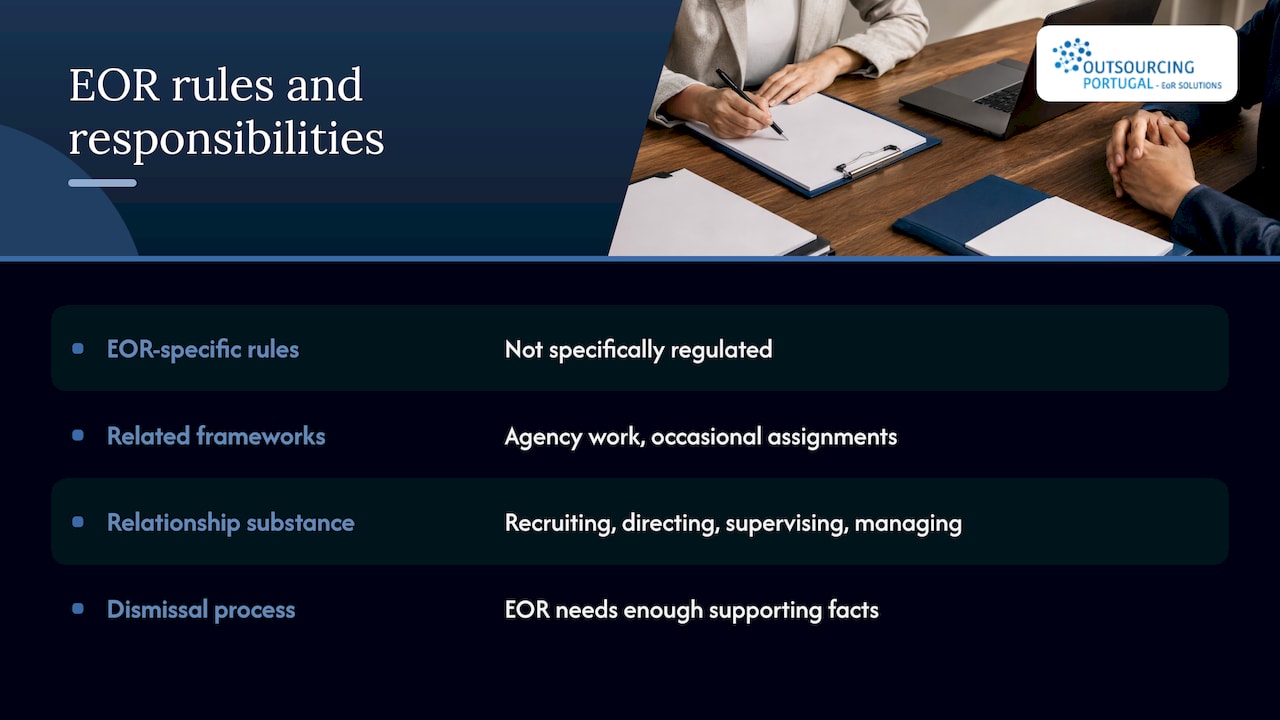
The 2026 Chambers employment guide for Portugal says Portuguese law does not specifically regulate the EOR model. It does regulate temporary agency work and occasional assignments, but those frameworks were built for different situations. The same guide stresses that the substance of the relationship matters: who recruits, directs, supervises and manages the employee. It adds that an EOR needs enough facts of its own to support a lawful dismissal process.
For you, this means the EOR should be a real employer in Portugal, with real HR and payroll operations, and your management of the worker should be consistent with that structure.
Written contracts
The 2025 employment guide by GFDL Advogados says certain Portuguese contracts must be in writing, including those involving non-EU workers, remote work, part-time work, fixed terms and multiple employers. The same guide notes that the Labour Code is supplemented by constitutional labour rights and that the Authority for Working Conditions enforces compliance.
If you hire remote staff, telework needs its own care. The 2026 guide from Macedo Vitorino says a telework arrangement must be agreed in writing, either in the initial contract or in a separate document. It should state:
- the parties;
- the ordinary place of work;
- normal daily and weekly hours and the schedule;
- remuneration;
- who owns and maintains work equipment;
- arrangements for in-person contact.
Social security and the cost of the contract
Employer social security in Portugal is 23.75% of gross pay, and the employee’s share is 11%. Build the first figure into your budget on top of salary. We design tailored salary packages with tax optimisation, so the structure of pay and benefits is planned around Portuguese rules rather than copied from your home market. Our payroll services cover the monthly run.
Contract or entity: the longer view
An EOR suits a first hire, a market test or a small team. If your headcount grows and you want your own company, our guide to EOR versus entity setup sets out the decision. Our softlanding service also covers setting up your own legal entity and visa and immigration support.
A worked example
A UK software company wants a senior backend developer in Porto, working remotely from home, reporting to the UK CTO.
- Employer: the company has no Portuguese entity, so an EOR becomes the legal employer.
- Governing law: because the developer habitually works in Portugal, Portuguese law is the natural governing law, and mandatory protections would apply anyway.
- Employment contract: written, between the EOR and the developer, with the telework terms above, probation, notice and a confidentiality and IP clause drafted for Portugal.
- Services agreement: between the UK company and the EOR, covering fee, responsibilities, liability and exit.
- Day to day: the CTO assigns work. Payroll, social security and statutory filings run through the EOR.
The weak points in this example are the ones teams overlook: a contract in English only where a Portuguese version is needed locally, a home-country non-compete copied across, and no written telework terms.
Common mistakes
- Reusing a UK or US template and adding “governed by English law”.
- Treating a contractor agreement as safe for someone who works like an employee.
- Leaving the EOR contract and the services agreement out of step.
- Forgetting that a change of role, location or hours may need a written amendment.
- Assuming a short ending notice in the commercial deal shortens the employee’s rights.
Why a Portugal-only specialist
Global platforms cover many countries with one template set. We do one country. Outsourcing Portugal is part of HRB Solutions Group, which has been in the market for 20 years, and we have hired 500+ people. Because we focus on Portugal alone, contracts, payroll and compliance are handled by people who work with Portuguese rules every day, and you get personal and human support instead of a ticket queue.
Our perspective
Most contract problems we hear about start before the contract is written. A company decides a role is “just a remote hire”, picks a template from its home market and finds out later that the local rules did not care.
Our view is simple. Hire under the law of the place where the person works, put the employment relationship in one clear document and keep the commercial deal with us in another. Then manage the person in a way that matches that structure.
As a Lisbon-based EOR and a Portugal-only specialist, we think about one set of rules, one payroll calendar and one labour authority. That focus is why we can say that, once a candidate is selected and the offer is agreed, we can hire within 2 days. Behind that speed is the same careful contract work, with a person you can call.
We also think pay should be designed, not just copied. Tailored salary packages with tax optimisation, one competitive monthly fee and no surprises are the way we want clients to experience hiring in Portugal.
Outsourcing Portugal Team
Start your Portugal hire
If you have a candidate, or a role you want to fill, our EOR service makes us the legal employer in Portugal while you manage the work. We handle onboarding, payroll and compliance under one monthly fee. Read how it works on our Employer of Record page, or contact us to discuss your role.
For a step-by-step view of the process, see our EOR setup guide.
FAQ
Can I use my home-country contract for an employee in Portugal?
Not as it stands. Parties can often choose the governing law, but the choice cannot remove the protections the worker would have under the law that otherwise applies. For someone who works habitually in Portugal, that is generally Portuguese law, so the contract should be built around it.
Who signs the employment contract with an EOR?
The employee signs with the EOR, which is their legal employer. You sign a separate services agreement with the EOR covering fees, responsibilities and the end of the commercial relationship.
Does Portugal have specific rules for EORs?
No. The 2026 Chambers guide says Portuguese law does not specifically regulate the EOR model, so the real working relationship and the EOR’s own role as employer matter. Choosing an EOR that operates as a genuine local employer is the practical answer.
Does a remote employee in Portugal need a written contract?
Yes. Portuguese guidance says telework must be agreed in writing, either in the initial contract or in a separate document, and should set out place of work, hours, pay and equipment responsibility.
Sources
- International Labour Organization: employment relationship
- Ashurst Perkins Coie: Transcending borders, employee mobility
- Regulation (EC) No 593/2008 (Rome I), legislation.gov.uk
- Spencer West: Hiring Across Borders
- Chambers: Employment 2026, Portugal
- GFDL Advogados: Employment Law Guide 2025
- Macedo Vitorino: WhyPortugal 2026, labour law
Recommended
- Employment contract types in Portugal: Key examples for 2026
- Avoid Accidental Permanent Hires: Portugal 2 Year Contract Cap
- International Labor Laws: A 2026 Guide for U.S. Employers
- Hiring Contractors: A 2026 Guide for International Teams
Disclaimer: This article is for general information only and does not constitute legal, tax, or employment advice. Laws and regulations change often. Please consult a qualified professional before making decisions. For Employer of Record services in Portugal, contact Outsourcing Portugal.