

A nearshore development team is a group of engineers based in a nearby country, working hours that overlap with yours, who build and maintain your product as part of your delivery process. For UK and EU companies, Portugal is a natural base: it is in the EU, Lisbon runs on London time, and you can employ the team without opening a Portuguese company. The simplest route is a local Employer of Record (EOR), a firm that legally employs your people in Portugal while you direct their daily work. That is what we do at Outsourcing Portugal: we are a Lisbon-based, Portugal-only EOR, and once you have chosen a candidate and agreed the offer, we can hire within 2 days.
This guide covers what a nearshore team is, when it beats the alternatives, how to structure it, what employing it in Portugal involves, and how to get from a first hire to a working team.
TL;DR
- A nearshore team works your hours, so stand-ups, code reviews and incident response happen live rather than by handoff.
- In Portugal you can hire developers directly as employees through an EOR, with no local entity, and keep full control of their work and your IP.
- Budget the real employment cost: employer social security is 23.75% and employee social security is 11% of gross salary, before benefits and extra payments.
- Start with a small core (a senior lead first), prove the working rhythm, then scale.
- Our one monthly fee covers hiring, payroll, compliance and HR support, with personal, human contact throughout.
Table of Contents
- What a nearshore development team is
- Nearshore or offshore: the real difference is overlap
- When a nearshore team makes sense
- Why Portugal for nearshore engineering
- How to build a nearshore development team: step by step
- Employing a team in Portugal: the cost and compliance basics
- Protecting your IP
- What an EOR does for a nearshore team
- Choosing the right partner
- Where our nearshore services fit
- Start your Portuguese team with us
- Our perspective
- FAQ
- Sources
What a nearshore development team is
Nearshoring means working with engineers who are close to you in geography and, above all, in time. The usual definition allows a gap of up to about three hours. The point is shared working time: a question asked at 10am gets an answer at 10am, and a broken build is fixed by the person who wrote it the same day.
A nearshore engineering team is not a product category, it is a way of staffing. The same label covers very different arrangements:
- A dedicated team. A stable group of engineers, QA and designers who sit inside your sprints and roadmap.
- Team extension. Named individuals added to your existing squads to fill a gap, such as cloud, mobile or a specific framework.
- Managed delivery. A supplier takes responsibility for an outcome, with milestones and service levels.
The model you choose decides who employs the engineers, who manages them and who owns the output. For most product companies, the first two are the right fit, because your own product and engineering leaders stay in charge of priorities and the code. A typical well-rounded squad includes software engineers, QA engineers, a UI/UX designer, a scrum master and a product owner or proxy.
Nearshore or offshore: the real difference is overlap
Offshore teams sit six or more hours away, usually for lower hourly rates and deeper talent pools. Nearshore teams cost more per hour than most offshore options, but they cut the hidden costs: review delays, clarification loops, missed incidents and managers working at awkward hours.
For a UK company the comparison is simple. Portugal shares your working day. For a company on the US East Coast, Portugal is five hours ahead, so the overlap is the morning in New York, which is enough for daily stand-ups and reviews if you plan for it. A team in India or the Philippines gives you, at best, a thin slice of overlap at either end of the day.
A useful rule of thumb:
| Work type | Better fit |
|---|---|
| Product work that changes weekly, with daily reviews | Nearshore |
| Core platform and architecture decisions | Nearshore or in-house |
| Well-specified, repeatable maintenance or ticket work | Offshore can work |
| Follow-the-sun support | Offshore or a mix |
If your backlog is still vague, location will not fix it. Define the first modules, the roles and the success measures before you hire.
When a nearshore team makes sense
Companies usually turn to nearshore for one of four reasons:
- Capacity. You need to scale faster than local hiring allows.
- Skills. You need a stack or specialism your team lacks.
- Cost. You want to lower the cost of engineering without moving to a time zone that slows you down.
- Parallel work. You want a second stream of delivery without interrupting the first.
It works best for work that needs real-time interaction: front-end development, data pipelines, and close collaboration between ML engineers and data scientists. It is a weaker fit for work you cannot yet describe, and it needs one thing from you: a named person on your side who owns priorities.
If you are weighing the options, our guide to in-house versus outsourcing development sets out the trade-offs in more detail.
Why Portugal for nearshore engineering
For European and US companies, the case for Portugal rests on a few practical points:
- Time zone. Mainland Portugal follows the same clock as the UK, and is one hour behind most of Western Europe.
- EU membership. Employment law, data protection and IP rules sit within the EU framework, which simplifies contracts and GDPR compliance for EU-based clients.
- A multilingual, educated workforce. English is widely used in tech teams, and the market is strong in web and cloud-native stacks such as TypeScript and React, Node, Java, .NET and Python, plus mobile.
- Competitive labour cost. Salaries are lower than in London, Amsterdam or Munich, though not the lowest in Europe, which is why seniority and retention matter more than headline rates.
There is also a people point that is easy to miss. Lawyers who advise on Portuguese employment report that the companies that were most successful at setting up an engineering team in Portugal sent a landing team from their home country, because company culture cannot be imported through a handbook or video calls. Immigration formalities add lead time, so choosing and preparing that team early matters. We cover this in our pages on why Portugal works for nearshore outsourcing and on the benefits of nearshore Portugal.
How to build a nearshore development team: step by step
1. Define the work and the roles
Write down what the team will own: a product, a module, a platform. Map the roadmap to roles. Decide how much of it is core IP, because that affects how closely you want the team tied to your company. Where it goes wrong: hiring first and defining scope later, which leaves engineers waiting for direction.
2. Hire a senior lead first
Start with a tech lead or engineering manager, then senior developers, then specialists and juniors. Filling a team with juniors to save money pushes technical management back onto your own leaders and slows everything down. The first hire sets the standards, code review habits and hiring bar for everyone who follows.
This is where local recruitment helps. We recruit in Portugal and can run the search with you, so your team is built from candidates who suit the Portuguese market, with salary expectations and notice periods already understood.
3. Choose the employment model
You have three realistic ways to employ engineers in Portugal:
- Set up your own Portuguese company. Full control, but it takes time, needs local directors and accounting, and makes sense once you have a settled team.
- Use an Employer of Record. The EOR is the legal employer: it issues the contract, runs payroll and handles compliance. You manage the work day to day.
- Use a managed delivery supplier. The supplier employs the engineers and is accountable for outcomes, but you give up direct control of the people and process.
For a company testing the market, or building a team of two to thirty, the EOR route is the fastest to start and the easiest to reverse. If you later want your own entity, we can set that up too, and the team moves across with continuity.
4. Build compliant contracts and pay
This is the step where overseas companies most often go wrong, so it gets its own section below.
5. Onboard with a 30 to 90 day plan
A workable pattern for the first three months:
- Days 0 to 30: contracts, data-protection and security terms signed, least-privilege access set up, laptops and tools delivered, a shared risk register started.
- Days 30 to 60: stabilise cycle time and lead time, add simple quality measures such as defects escaping to production.
- Days 60 to 90: run knowledge-transfer checkpoints, then decide whether to scale, change scope or replace someone.
For a first engagement on a defined module, an 8 to 12 week pilot is a sensible way to test the working rhythm before committing to a bigger team.
6. Manage and measure
Daily check-ins, clear milestones and visible work do most of the job. Communication problems are the most common reason outsourced engineering fails, and they are far easier to avoid when the team is awake at the same time as you. Treat the Portuguese team like your own: same ceremonies, same tools, same standards. Once the team is running, structured goals and performance review software make it easier to apply the same review cycle to your Portuguese engineers as to everyone else.
Employing a team in Portugal: the cost and compliance basics
Headline salary is only part of the cost. When you compare Portugal with your home market, build the whole employer cost:
- Employer social security: 23.75% of gross salary.
- Employee social security: 11% of gross salary, withheld from the employee’s pay and paid over with the employer share.
- Additional salary payments: Portuguese employees customarily receive holiday and Christmas payments on top of monthly pay, so annual cost is not simply twelve months of salary.
- Benefits and insurance: meal allowance is standard practice, and workplace accident insurance is mandatory.
- Withholding tax: income tax is withheld monthly through progressive brackets, and employers file returns. Our guide to employment tax returns for Portugal hires explains the cycle.
Portuguese labour law is protective of employees. The Decent Work Agenda, which Parliament approved to change labour legislation, touched work contracts, telework and parental leave, among other areas. Rules on termination, probation periods, remote work and leave are specific, and a contract copied from the UK or US will not hold up. Check current rules with a Portuguese employment specialist before you issue any contract. Our EOR in Portugal compliance guide and our payroll compliance overview cover the practical side.
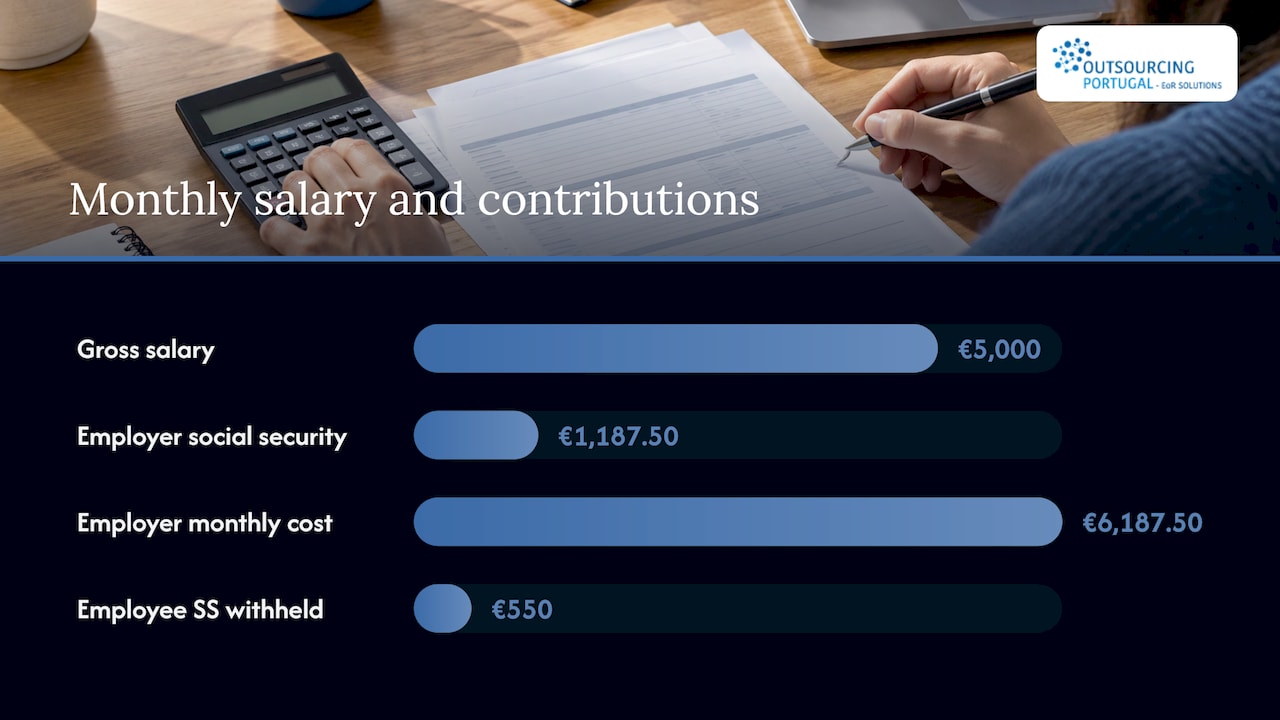
Here is a worked example of how the employer cost layers up. For an engineer on a gross monthly salary of €5,000, employer social security at 23.75% adds €1,187.50 a month, and the employee’s 11% (€550) is withheld from their pay, not added to your bill. Before benefits, insurance and the extra salary payments, the employer’s monthly cost is already €6,187.50. The example is illustrative arithmetic, not a quote or a typical salary.
Protecting your IP
Whoever employs your engineers, your code should belong to your company. In an employment-based model, the contract can assign work product and inventions, and confidentiality and security terms apply from day one. This is much simpler to draft and enforce inside the EU than across borders. Our guide to intellectual property in outsourcing in Portugal explains who owns what in each model.
What an EOR does for a nearshore team
An EOR removes the legal and administrative load of employing in a country where you have no entity. In practice, for a development team, that covers:
- compliant employment contracts and onboarding
- monthly payroll, social security and tax filings
- benefits administration
- HR support for leave, changes and exits
- visa and relocation help where an engineer is moving to Portugal
We handle each of these. Our compensation work includes tailored salary packages with tax optimisation, so engineers see competitive take-home pay within the rules, and you pay one competitive monthly fee rather than a collection of separate invoices. Our EOR page sets out the service, and our guide on hiring remote software developers through an EOR walks through the hiring flow.
Choosing the right partner
Whether you use an EOR, a recruiter or a delivery partner, judge them on what they can show you:
- Local employment-law depth. Do they specialise in Portugal, or treat it as one country on a long list?
- Speed. How quickly can they employ someone once you have picked them?
- Transparent fees. Is there one clear monthly fee, or add-ons you discover later?
- People. Will you have a named, human contact who knows your team?
- Track record. How many people have they actually hired, and for how long have they been in the market?
On those points, our answers are specific. We are Portugal-only. We are part of HRB Solutions Group, which has been in the market for 20 years. We have hired 500+ people. We offer personal and human support, and an English-speaking team in Lisbon.
Where our nearshore services fit
If you want a complete setup rather than only employment, we also provide nearshore engineering capability across custom software development, cloud architecture and DevOps, UX/UI design and front-end development, and mobile app development. Teams can be operational within days. Our nearshore Portugal services page lists what is available, and our guide to building a compliant tech team in Portugal pairs well with this article.
If you are also planning to send people or to settle a founder in Portugal, our soft landing service covers visa and immigration support, local recruitment and setting up your own legal entity.
Start your Portuguese team with us
If you are ready to hire your first engineers in Portugal, we can employ them for you, run payroll and compliance, and support them and your managers throughout. You keep control of the work. We take on the employment.
Tell us the roles, the start dates and the rough size of the team, and we will set out the route. Contact our team to begin.
Our perspective
Most nearshore projects that struggle do not fail on talent. They fail on the practical layer underneath: contracts that do not fit local law, slow hiring, unclear ownership of the code and no one to call when something goes wrong.
We believe Portugal is one of the strongest places in Europe to build an engineering team, and that the best way to start is small, with a senior lead, a clear scope and a legally sound employment set-up from day one.
That is why we work only in Portugal. Twenty years inside HRB Solutions Group and more than 500 people hired have taught us that local knowledge, a single monthly fee and a human contact who answers the phone matter more than a long feature list. Employing through us means your engineers are your team in every way that counts, while we carry the Portuguese legal and payroll work.
Begin with the roles you need. We will handle the rest.
Outsourcing Portugal Team
FAQ
What is the difference between nearshore and offshore development teams?
Nearshore teams are in a nearby country with several shared working hours, while offshore teams are usually six or more hours away. Offshore often has lower hourly rates, but nearshore gives live collaboration, faster reviews and easier travel. For UK companies, Portugal offers the same working day as London.
Do I need a Portuguese company to hire developers there?
No. An Employer of Record can legally employ your developers in Portugal on your behalf. You direct their work, and the EOR handles contracts, payroll, social security and compliance. If you later want your own entity, it can be set up and the team transferred.
How quickly can a nearshore team start in Portugal?
With us, once you have selected a candidate and agreed the offer, we can hire within 2 days. The full timeline depends on recruitment and, for people relocating from outside the EU, visa processing, so plan the search and any immigration steps early.
How much does it cost to employ someone in Portugal?
Employer social security is 23.75% of gross salary, and employees contribute 11%. On top of salary you should budget for benefits, insurance and additional salary payments. With us, you pay one competitive monthly fee for the service.
How big should the first nearshore team be?
Start small: a senior lead and one or two engineers on a defined module, with an 8 to 12 week pilot. Scale once the working rhythm, code quality and communication are proven.
Sources
Recommended
- How to build nearshore teams in Portugal for global success
- Nearshore Team Setup Workflow: Portugal 2026 Guide
- Nearshore Development in Portugal: What It Costs in 2026
- Build a Tech Team in Portugal: Hire Fast, File Before Contracts
Disclaimer: This article is for general information only and does not constitute legal, tax, or employment advice. Laws and regulations change often. Please consult a qualified professional before making decisions. For Employer of Record services in Portugal, contact Outsourcing Portugal.